


- Bottom Line Up Front
- Best Conversation Intelligence Software: At a Glance
- What Is Conversation Intelligence and What Should It Do?
- Aircall: Phone-Native Conversation Intelligence
- Gong: A Standalone Category Leader
- Chorus (ZoomInfo): CI for the ZoomInfo Ecosystem
- Salesloft: CI as Part of a Sales Engagement Platform
- Your Decision Framework: Standalone CI or Phone-Native CI?
- The Best Conversation Intelligence Software for Sales Teams: How to Choose
Last Updated on July 31, 2026 by Ewen Finser
Conversation intelligence is fast becoming one of the most hotly-contested categories in the sales tech stack. If you run a quick search on Google, you’ll find that many platforms claim to be the last word in helping managers to coach better, surfacing deal risks faster, and making call data actionable.
However, the harder question for Sales Ops Managers and RevOps leads at SMB and mid-market companies is whether you need a dedicated CI platform that sits separately in your stack, or whether the conversation intelligence built into your phone system is already doing the job.
The best way to answer this is to focus on platform features that matter most to sales teams: call transcription, sentiment analysis, key topic flagging, AI call scoring, and coaching workflows.
Bottom Line Up Front
If you’re managing an SMB or mid-market sales team running a cloud-based phone system, then built-in conversation intelligence is most likely the optimal solution.
It removes at least one layer of integration work, keeps all call insights and CRM data in one connected workflow, and frequently costs much less than standalone CI platforms.
This said, there are certain cases where these standalone platforms may make more sense: for instance, Gong is a strong option for larger teams that need very detailed revenue intelligence and can afford the relatively high fees.
But for teams of 10 to 100 reps that want practical coaching tools without a five-figure annual contract, phone-native CI is worth serious consideration before adding another platform to the stack for the sake of it.
Best Conversation Intelligence Software: At a Glance
Call transcription | Included with Professional plan (AI Assist) | Included | Included | Included (Advanced tier) |
Sentiment analysis | Included | Included | Included | Included |
Key topic flagging | Included | Included | Included | Included |
AI call scoring | Included | Included | Included | Included |
Live coaching prompts | AI Assist Pro add-on | Available | Available | Available |
Separate tool required | No | Yes | Yes | Yes (also a sales engagement platform) |
What Is Conversation Intelligence and What Should It Do?

In a sales context, conversation intelligence software can record, analyze, and transcribe calls to surface insights that managers can act on.
At its most basic, it can operate using transcription and keyword searches. More advanced setups also include:
- Sentiment analysis that can identify calls that are worth reviewing,
- Key topic flagging that tracks whether reps are covering the right ground.
- AI-generated call scoring that can replace hours of manual QA.
- Live coaching prompts that can help reps to handle objections in real time rather than being told about them the next morning when calls are reviewed.
Naturally, the key question for RevOps leads who are evaluating conversation intelligence isn’t just what features are available, but where those insights land.
For example, a CI tool that routinely generates call summaries in its own interface, separate from your CRM and your dialer, will likely create a workflow where managers have to jump between systems to keep track of what’s happening.
However, if the CI tool is built into your phone system, then aspects like the transcript, sentiment score, key topics, and action items can all appear in the contact record in your CRM the moment the call ends. This can add some serious advantages to workflows for both reps and managers.
Aircall: Phone-Native Conversation Intelligence
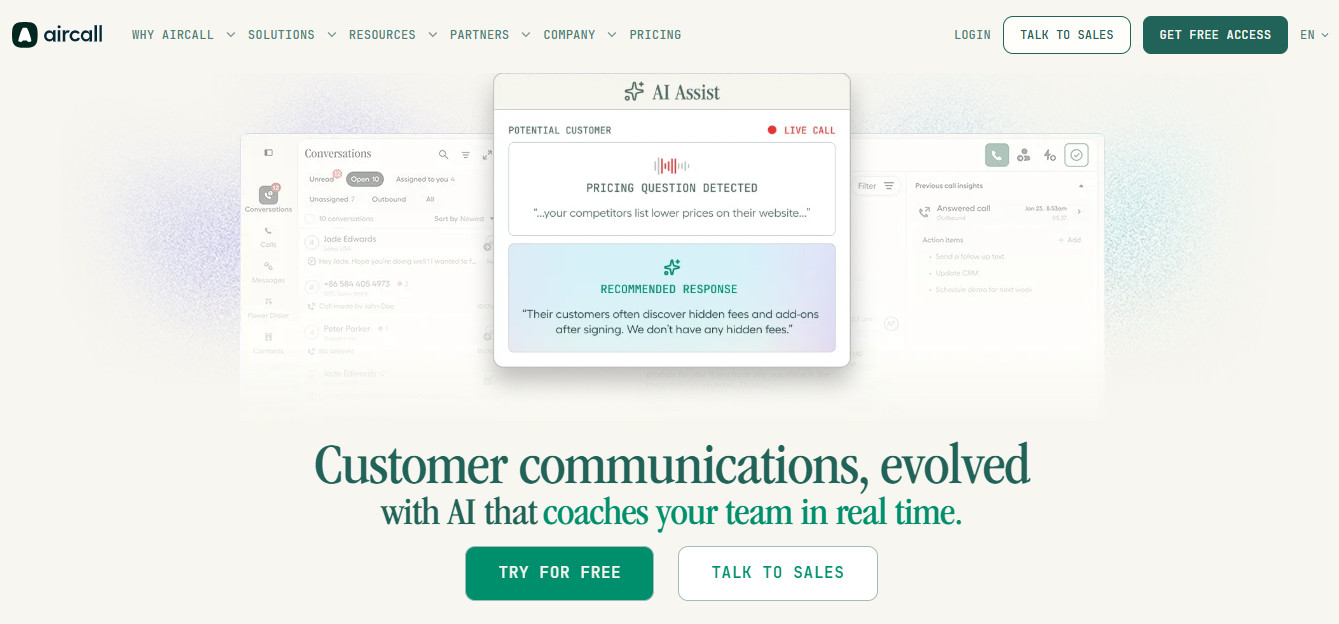
While Aircall’s “AI Assist” has traditionally been available as an add-on, as of early 2026 it’s now included with the platform’s “Professional” plan at $50 per user, per month (billed annually), with no separate purchase required.
This means that “Professional” subscribers benefit from features like automatically generated summaries, key topic tags, sentiment analysis, talk-to-listen ratio, and action items. Depending on your specific setup and configuration, these can all be logged directly to CRMs.
The ‘Conversation Center’ serves as the manager’s CI dashboard. From here, they can view a searchable, filterable library of every recorded call with AI insights attached.
Managers can also filter by sentiment, for instance to find calls when the customer’s mood seems to be negative. They can search transcripts for keywords, and even pull call scoring data across the whole team.
‘Trending Topics’ can also display aggregated keyword frequency across calls.
The “AI Assist Pro” add-on is available for an extra $49 per user, per month, and adds live transcription during the call, real-time coaching prompts triggered by conversation keywords, and embedded sales playbooks built around BANT, MEDDIC, SPICED, or custom frameworks.
You can also configure automated call scoring using custom scorecards, pre-call Contact Insights surfacing the last twelve customer interactions, and automated CRM updates at the end of each call.
The overall structural advantage in choosing Aircall comes down to integration: there’s no recording connector that needs to be configured, nor are there any webhooks to maintain. There’s also virtually no delay between the end of a call and the CRM being updated.
Looking for more details? This comprehensive Aircall review covers everything, check it out!
Gong: A Standalone Category Leader
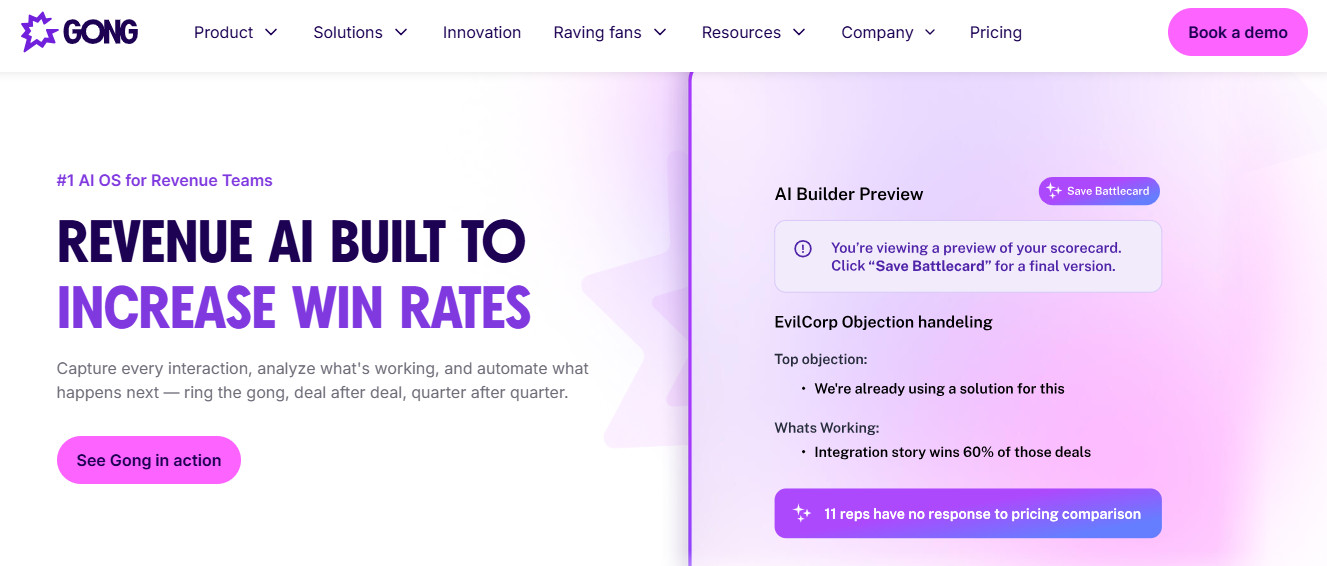
In terms of standalone products, Gong is one of the best-known standalone conversation intelligence platforms.
Gong is particularly strong in transcription, call analysis, deal intelligence, and revenue forecasting. Its deal intelligence layer can also track call data across the full pipeline rather than individual calls. The platform also has revenue forecasting tools that offer revenue intelligence, not just basic recording.
Having given Gong its due, the trade-off users face for such an undoubtedly useful feature set is cost and complexity. For instance, Gong’s pricing page doesn’t list specific fees, beyond saying that licenses are priced per user, and that there’s a platform fee based on the number of users supported.
Independent pricing reports estimate the per-user cost at $1600 per user, per year, with a minimum platform fee of $5,000 per year, depending on team size.
The pricing page doesn’t specifically mention a seat minimum, but based on our research, Gong generally requires a minimum of 15 seats. Multi-year contracts are standard.
All of the above means that if you’ve, say, a 10-person mid-market sales team, Gong’s cost structure is going to be very difficult to justify unless you truly need the depth of the platform’s revenue intelligence features, such as deal risk tracking, multi-stakeholder engagement analysis, and AI forecasting.
These can help to drive decisions much more effectively than simpler CI tools. However, that kind of premium is much more useful to enterprise sales organizations with 50 or more reps and complex, multi-stage deals.
Chorus (ZoomInfo): CI for the ZoomInfo Ecosystem
Chorus, which is now a part of ZoomInfo SalesOS, is a capable CI solution. However, its value will largely be determined by whether you’re already a ZoomInfo customer.
The platform’s structural differentiator is data enrichment. It can automatically append firmographic, technographic, and intent data from the ZoomInfo data graph to every call record. This can give managers relatively deeper context on who they’re talking to and how account intent is morphing along conversation trends when compared to more rudimentary CI tools.
Assuming that you’re a ZoomInfo SalesOS customer running a 25-plus rep sales motion, for instance, this kind of integration can be a real advantage, plus pricing tends to run lower than competitors like Gong.
For teams that buy Chorus without the ZoomInfo data layer, though, the picture changes quite dramatically. Although ZoomInfo doesn’t list specific charges on the main site, independent reviews state this reflects enterprise-level pricing of approximately $8,000 per year base for three seats, then around $1,200 per seat per year. There are volume discounts for 20+ seats and multi-year pricing.
However, without ZoomInfo’s data graph integration, users are left with a conversation intelligence platform that doesn’t obviously outperform Gong on feature depth. The standard contract is two years, and there can be early termination fees.
Naturally, if your organization is already standardized on ZoomInfo as its primary data and intent provider, then Chorus easily earns its place on your shortlist. But if you haven’t set up a ZoomInfo shop, the case for Chorus over Gong or phone-native CI is much harder to make.
Salesloft: CI as Part of a Sales Engagement Platform
Salesloft is primarily a sales engagement platform, so is slightly different from the other tools discussed in this guide. It specializes in combining cadence automation, workflow management, and forecasting.
Nevertheless, subscribers to the platform’s “Advanced” tier benefit from conversation intelligence. This is powered by Salesloft’s “Drift integration”.
The CI feature set is respectable and includes:
- Call recording across Zoom, Teams, and phone.
- AI transcription.
- Key moment flagging for objections and competitor mentions.
- Talk ratio analysis.
- AI scorecards that auto-populate manager review workflows.
As with Gong and Chorus, Salesloft’s pricing page doesn’t list exact per-user fees, but contracts are annual. Third-party reviews place pricing at $125 – $165/user/month at list price, reduced to $100 – $130 per user per month after negotiation for mid-market teams.
This pricing point for mid-market teams also reflects the fact that the platform makes most sense for teams of this size that want cadence automation and conversation intelligence in one platform to save the trouble of having to operate (and pay for) separate tools.
For example, if you’re already using a dedicated dialer like Aircall and a separate sequencing tool, adding Salesloft to get CI means you’d effectively be tripling up on functionality that you already have.
That means you need to think carefully about whether Salesloft can replace both your engagement platform and your CI tool in one purchase. You also need to calculate whether this integrated approach will actually cost less than what you’re currently paying for separate solutions.
Your Decision Framework: Standalone CI or Phone-Native CI?
In the context of conversation intelligence software for sales teams, there’s no one-size-fits-all solution.
Instead, the optimal choice for your team will come down to three main factors: your current stack, your team size, and where your call data actually needs to land.
Phone-native solutions like Aircall are the best solution when your team is already using Aircall or is evaluating a phone system alongside CI.
Adding a separate recording tool to a cloud phone system will create integration overhead, not to mention a second platform for managers to log into.
If the conversation intelligence you need involves call summaries, sentiment analysis, topic tracking, and call scoring connected to your CRM, Aircall’s AI Assist layer on the Professional plan delivers that without additional cost or complexity.
For SMB and mid-market teams of, say, 10 to 100 seats, this is the most operationally efficient path to practical CI.
Standalone CI like Gong is the better solution when your team is running a complex, multi-stage enterprise sales process. In this scenario, deal risk intelligence, multi-stakeholder engagement tracking, and AI forecasting are daily-driver tools rather than just occasional reporting features.
Once a team goes over 50 reps with a high average contract value and a long sales cycle, Gong’s revenue intelligence depth begins to justify the cost.
The platform’s also a good solution if your team uses a legacy or on-premise phone system that cannot generate its own CI. In that case, you’re going to need a recording layer that works across dialers, video conferencing, and web meetings simultaneously.
Chorus is a better choice for teams that are already ZoomInfo customers and want a data enrichment layer attached to every call record. In that context, the somewhat bundled economics make sense. However, as a standalone tool, the pricing model’s hard to justify for smaller teams of, say, less than 25 seats.
Salesloft is likely to be the strongest option if you need sales engagement automation and CI in one platform and would otherwise be running two separate tools in a more costly and/or less efficient way. Those teams where cadence and dialer workflows are central to the outbound motion will find consolidating on Salesloft at the Advanced tier may reduce the total stack cost. Of course, you’ll need to work closely with Salesloft’s sales team to calculate whether switching truly represents better value for money versus your current setup.
The Best Conversation Intelligence Software for Sales Teams: How to Choose
If you’ve already worked through the decision framework above and are busy compiling a shortlist of platforms to trial, bear in mind two key questions:
- Do you already have a cloud phone system that already generates its own conversation intelligence?
- What is the all-in cost including platform fees, additional seats, implementation, and contract length?
If the answer to the first question is ‘yes’, then take the time to find out exactly what data your system logs to your CRM and whether this covers the coaching workflow your managers use. If so, there’s no need to pay for a separate tool. If not, then you’ll need to answer the second question by carefully researching alternative solutions like Gong, Salesloft, and Chorus.
However, for most SMB and mid-market sales teams, the combination of an Aircall Professional plan with AI Assist features and a CRM you’re already running is the most cost-effective path to practical conversation intelligence.
Naturally, if your sales motion grows to the point where deal-level revenue intelligence and AI forecasting become daily-driver workflows, then upgrading to a standalone tool like Gong is a wise choice. But until that time, keeping your CI layer and your phone system in the same product is simpler, faster, and more affordable.