

- Should you Hire an AI Agency or a Consultant?
- The Difference Between an AI Marketing Agency and an AI Consultant
- AI Agency vs. AI Consultant
- Strategy vs. Execution
- Cost Structures for AI Agencies Versus AI Consultants
- What Happens After the Engagement Ends
- Can you Hire Both an AI Agency and an AI Consultant? Is There an Alternative?
- AI Agency or AI Consultant? Questions to Help you Decide
Last Updated on November 17, 2026 by The Digital Merchant Team
If your marketing team has been tasked with integrating AI into your processes, but without a lot of guidance as to how, you may be left holding two very different proposals: one for an AI marketing agency, and one for an AI consultant. And you may be wondering, what’s the difference, and which one should I pick?
Should you Hire an AI Agency or a Consultant?
- Pick an agency if you know what you want AI to do for your team, you just need someone to help you build it.
- Pick a consultant if… you don’t know what the possibilities are when it comes to using AI and you need someone to help you diagnose what you need and make suggestions.
If you aren’t sure which problem you have, you might use a placement agency that specializes in AI capabilities to help you decide which route is best for you.
The Difference Between an AI Marketing Agency and an AI Consultant
First, it’s important to know that “AI marketing agency” can mean two very different things. On the one hand, it can refer to an agency that uses AI to produce your marketing for you, or an agency that builds AI systems into your marketing processes. For the purposes of this article, I’ll be talking about the second type of agency that builds AI systems for your team.
The title of AI consultant can also cover a wide range of job descriptions and deliverables, from someone who comes in to consult about how to use AI to someone who builds workflows on your behalf. In the most classic definition of a consultant, the person will strategize and advise, but not necessarily create the end result.
It’s important to understand what type of deliverables, cost structure, or support you want and need so you can make the best choice for your situation.
AI Agency vs. AI Consultant
AI Marketing Agency | AI Consultant | |
|---|---|---|
Main output | Workflows and integrations that are built and running | An assessment, a roadmap, and training, sometimes with built workflows |
Who builds it | The agency’s team | Your team, with the provider guiding |
Support during the engagement | Ongoing management, fixes, and adjustments to keep workflows running | Strategy, advice, and regular check-ins, with some built workflows in certain cases |
What it asks of your team | Access and approvals | Hands-on time learning and building |
Shape of the engagement | Ongoing service | A defined project with an end point |
What success looks like | Workflows live and performing; changes must be made by the agency | Your team runs the workflows and can update them without outside help |
Best for | Teams who know what workflows they want, and want someone else to build and manage it | Teams who need to know what to fix and how before committing to a build, or who want to build themselves |
In short, an agency builds and runs your AI workflows, while a consultant helps your team figure out what to build and how to do it yourselves.
Strategy vs. Execution

Your choice will probably come down to whether someone on your team can build the AI workflows, or whether you’d rather hand that off.
Each option has a common blind spot, though. Many consultants stop at the diagnosis and don’t handle implementation. Some agencies rush the diagnosis or skip it, relying on you to know what you need.
That’s why you still need to judge each proposal on its own. An agency might offer assessment and strategy as part of their engagement, and certain consultants might offer implementation.
Cost Structures for AI Agencies Versus AI Consultants
Agencies and consultants tend to price their services differently:
- Agencies typically work on monthly retainers, or less often on project-based or results-based fees. Spend continues as long as the agency is engaged.
- Consultants usually charge for fixed-scope projects, discovery engagements, or by the hour. The investment is mostly up front and ends with the engagement.
It can be challenging to compare apples to apples when the two options work on different pricing models, so it’s important to think about how costs will change over time. While a consultant’s price tag might look high at first, you have to multiply the agency’s monthly retainer over the full length of the project and its maintenance to make a real comparison.
What Happens After the Engagement Ends
Maybe the most important question you should ask is what happens after the engagement ends. Whether you end up hiring an agency or a consultant, each one can end up leaving gaps once the engagement is over if you aren’t careful.
With a consultant, as mentioned above, you might get an assessment and diagnosis, strategy, and a roadmap that tells you what you should produce and why, but you may be left to build the workflows and choose the tools on your own. You’ll also need to create your own documentation and onboarding for the team.
With an agency, they may provide all the prompts, workflows, tools, and configuration as part of the engagement, but when you part ways you may not have anyone on your team who is trained to take over, run the workflows, or understand how to make changes when they inevitably come up. It’s also important to understand who owns the tools and accounts when the engagement ends, so you’re not locked into an agency engagement in perpetuity.
In the simplest of terms, you may be looking at a roadmap that nobody knows how to implement, versus a system that depends on the agency that built it.
Can you Hire Both an AI Agency and an AI Consultant? Is There an Alternative?
If you’re struggling to figure out what you need, or you think you might need both an agency and a consultant, you’re not alone. Most teams don’t know what they don’t know. You may have a few ideas for how AI could help, but wonder what else is possible. Or someone on your team might be comfortable with standard LLMs but not know what specialty tools are out there.
In that case, a good next step might be to bring in someone who can scope out the job before you commit to either option. Hybrid placement agencies are one way to do this. They can recommend a consultant, an agency team, or a mix of both.
One I’d point people to is Right Side Up. Their team of former in-house growth marketers figures out what kind of AI help you need, then finds the right people to provide it.
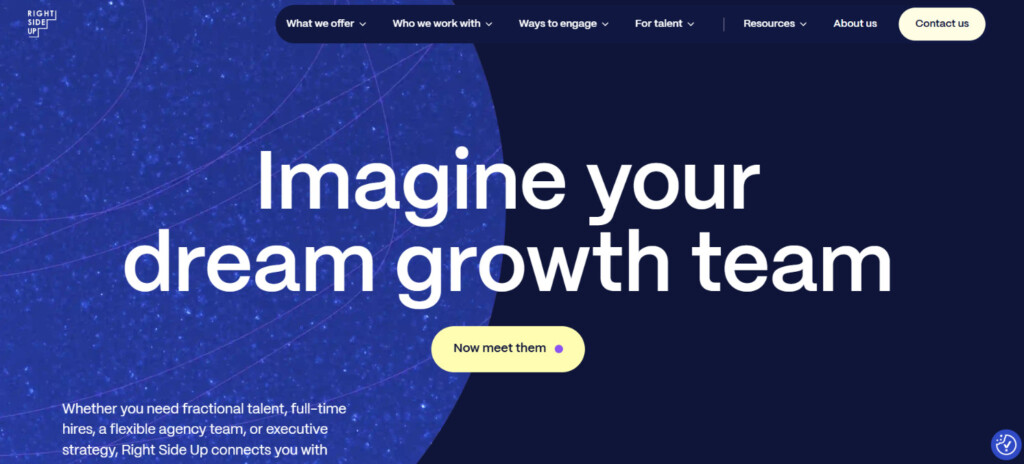
Keep in mind that any placement agency can only recommend from its own network. That network may be broad, but it isn’t endless, and they won’t send you to an outside agency or consultant they don’t work with. Ask what kinds of specialists are in their network, and don’t be afraid to compare their recommendation with a quote or two of your own.
AI Agency or AI Consultant? Questions to Help you Decide
I’ve put together a short list of diagnostic questions you and your team can work through to help you decide whether an agency or a consultant (or both) is a better fit for your needs:
- Who will own the AI processes and workflows a year from now? If there’s someone on your team willing to learn and who will have the time, that points to a consultant. If nobody has the time or interest, that points to an ongoing relationship with an agency.
- When something breaks or you need to make a change, what do you want to have happen? If you want your own team to be able to make changes, a consultant is the better choice. If you don’t want to ever have to look “under the hood” so to speak, an agency is a better choice.
- Does your team have capacity to learn and maintain, or just to approve? Wanting to learn favors a consultant; approval alone favors an agency.
- Can you name two or three things you want AI to do? If you can, either model is an option; if not, you need diagnosis first.
- Have you already tried to implement AI tools but run into problems? If adoption stalled, that suggests the need for training from a consultant. If your team had some skills, but no time, that suggests the need for an agency who can complete the project.
- Is this a long-term, core need? If the answer is yes, an in-house hire may be a better choice, in which case a placement agency like Right Side Up may be a good resource to find a full-time hire.
Once you can answer these questions, you should have the clarity to decide whether you need an AI marketing agency, an AI consultant, both, or neither.