


Last Updated on August 31, 2026 by Ewen Finser
A lot of early-stage founders find the Foundr platform and eagerly dive in, because it looks like a goldmine of information and training packaged in a single place. And it is.
But people also frequently start looking for alternatives to their Foundr subscription for specific reasons. It’s usually not that they outgrew the advice, but rather that the information provided no roadmap and no individual tailoring, the information felt generic and not tailored to DTC brands, or they’re tired of the recurring payments and constant upsells.
All of which are real concerns, but these different problems deserve different answers. That’s why there’s not one clear Foundr alternative, but rather different paths based on your individual experience and needs. Figure out which one is yours, and I’ll suggest where you should head next.
Foundr alternatives at-a-glance

If you’re thinking, “The content was fine, but there was no roadmap — I was just dropped in,” you’re looking for guidance and mentorship.
If the material feels generic, outdated, or not geared toward DTC brands, you’re looking for DTC-native learning opportunities.
If you want actionable resources and tools you can download and use, not just videos to watch, you want operator resources built for your type of business.
And if you were bothered by the recurring prices or constant upsells, you can look for lower-commitment options.
Guidance and mentorship

If you didn’t love Foundr because it felt like you were just dropped into a sea of options with no roadmap, it’s likely you’ll thrive better with a true mentorship or coaching option that includes at least some one-to-one calls and advice. This is for you if the gap for you wasn’t a lack of information, but the desire for someone to advise and walk you through your particular situation. You won’t get that from an online course. You need structure and tailored input.
There are a wide variety of different options out there for individual guidance and mentorship, ranging from individual coaches and mentors (who might charge in the mid-five figures for their services) to mentor matching services and communities.
Start by asking around in your own network to see if anyone you know has worked with a coach or mentor, and how they liked the experience. A referral can often be the best place to start. If you don’t get far down that path, however, these mentor matching services can be useful:
Daily Mentor is a mentorship community aimed at 7-figure high-growth brands that want to scale. It includes weekly 1:1 calls with a mentor, private Slack channels, small group mastermind calls, and a library of downloadable resources.
Growth Mentor is a more budget-friendly option for growth-minded startups that offers access to any of their 750+ members depending on your current challenges. It includes unlimited calls with your subscription. It also includes a Slack channel and networking events.
Mentor Cruise is another option that focuses more on matching you with a long-term 1:1 mentor. It allows you to choose specific experts and get structured guidance through asynchronous coaching and calls.
The tradeoff here is that this kind of tailored guidance and accountability is usually quite a bit more expensive per outcome, and it’s highly dependent on finding a mentor that’s truly a good fit for you. Just a note that Foundr does offer a coaching experience, but it’s on the high end, especially compared to their basic subscription options.
DTC-native learning

You don’t need less education; you need education that’s actually tailored to your circumstances and teaching current best practices. Many DTC operators find a lot of Foundr’s startup content generic even when it’s dressed up as DTC, or it’s advice for mult-million dollar brands that doesn’t apply to a bootstrapped startup. Instead, you should look for content made by people doing DTC now.
Some of your best picks in this category are actually free or very low cost, which is great if you’re bootstrapping, and it doesn’t mean the information is any less valuable. It does mean, however, that you may have to go looking a little harder or create your own “course” materials from what’s available.
Podcasts specific to DTC like Limited Supply, Operators, and eCom Fuel are a great place to start. Most are updated weekly, so you’ll always have fresh content, and many have a huge back catalogue of episodes to peruse, meaning you’re highly likely to find an episode dedicated to your current challenge or question, whatever it may be.
Limited Supply’s Nic Sharma also has a popular newsletter. Operators has an entire portal with their episodes arranged by topic as well as a members-only section with downloads. eCom Fuel has its own membership that might scratch that community or mentorship itch if that also sounds good to you.
Other newsletters to check out include the DTC Newsletter and In the Snow. Many newsletters give you access to back issues once you subscribe, so like with a podcast, there’s a ton of information you can access and search. (How easy it is to search or access that information is going to vary by publication, though.)
Common Thread Collective also has a collection of streaming series all designed to help ecommerce brands grow profitably. These shows are made by DTC operators for DTC operators, so the information is going to be geared directly to your needs.
Because these sources are all updated frequently (sometimes multiple times per week) you can trust that the information is going to be current and relevant. But they aren’t going to hand you a system or a roadmap that will walk you through your particular business or current challenge. It’s going to be on you to navigate the topics and choose what applies to you now. Additionally, beware of information overwhelm, which can be real when you have 17 seasons of podcast episodes to choose from.
Operator resources
If you’re sick of watching endless videos (hello fellow elder millennials and Gen Xers — I see you!) and you just want some deployable assets like templates, playbooks, and systems you can run today, this section is for you.
The benefit of these types of resources is that they’re plug-and-play and generally one-time investments rather than ongoing subscriptions. But they’re also going to assume a level of operational fluency in most cases rather than teaching you the basics.
Commerce Caffeine offers a nice selection of playbooks on different topics created by real ecom brands you’ll recognize. They also offer a series of courses on a variety of ecom topics; not plug-and-play, but might serve a specific need.
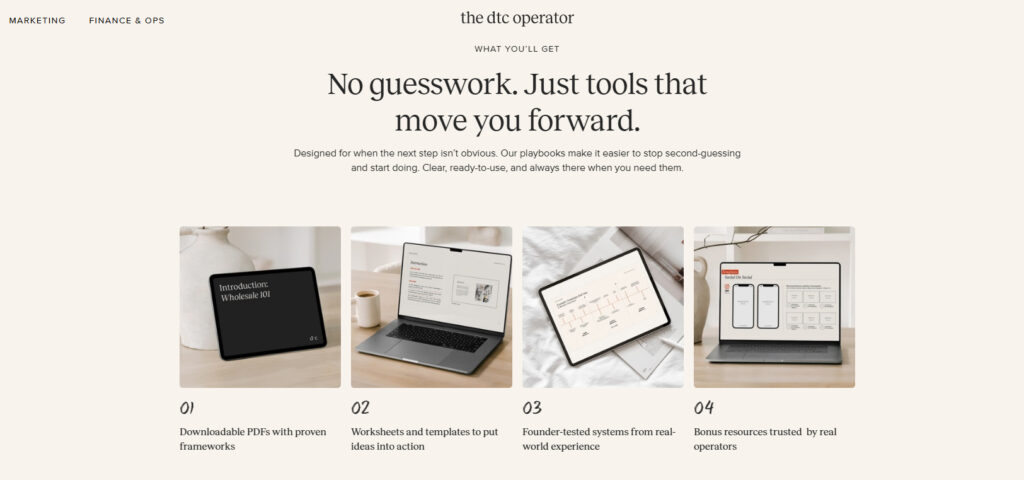
The DTC Operator is a resource platform with a great selection of playbooks, templates, and frameworks you can download and plug into your business with little fuss. They were created by a founder with her hands in lots of recognizable (and profitable) DTC brands.
Common Thread Collective also includes a small selection of digital guides and toolkits (as well as a subscription-based community and a database of benchmarks).
These are generally lower cost tools and templates that you can deploy today, but they also generally assume you can self-diagnose the problem you need to solve so you know exactly which tool to look for.
Lower commitment options
If $99 a month for Foundr felt like a lot, the auto-renew caught you by surprise, or you got sick of the constant upsell emails, you might just be looking for some lower commitment options that provide value without the subscription trap or the five-figure upsell. And you’re in luck! Some of the resources I mentioned above fall into this category.
Obviously podcasts and (most) newsletters are free to subscribe and consume. You can also look for LinkedIn and Reddit communities that frequently offer real, useful insights from people doing the work.
Commerce Caffeine’s playbooks are free, though their courses run a one-time fee up to $3k depending on the topic.
The DTC Operator’s playbooks, frameworks and templates are all competitively priced with many free resources and some as low as $9, going up to $500 for their complete toolkit.
And while these one-time purchases and self-paced materials offer real value, the real tradeoff is that you must self-diagnose and assemble your own path. Nobody is guiding you or structuring it for you. That could be a bug or a feature, depending on your experience level.
Choosing your own path

Your own needs and preferences will guide which path you choose. Mentorship or coaching gives you a direct, personalized experience, but will require the biggest investment of all these options. DTC-native learning options can provide you with truly current, up-to-the-minute topics, but no system to follow. Operator resources like frameworks and playbooks give you the tools, but no roadmap. And the low-commitment options offer freedom, but no structure or accountability.
If you’ve been unsatisfied with Foundr and looking for an alternative, the real question was never “What beats Foundr?” It was “What specific thing was I actually missing, and where can I get that?”
Once you can answer that question, you can choose your own path and get the right support for yourself and your business.