


Last Updated on September 8, 2026 by Ewen Finser
As an affiliate manager, understanding the most important key performance indicators (KPIs) tied to your brand’s affiliate program success can be a constant challenge. Between the inevitable ups and downs of partner churn to market shifts, to tracking…if you don’t have a solid understanding and system in place to manage the information, your bottom line will surely suffer.
That said, with a dozen-plus KPIs you need to keep an eye on, nobody has time to effectively track that level of information by hand in spreadsheets, which is exactly why affiliate software exists. Everflow affiliate software is one such example, turning that manual work into automated reports that can be tailored to inform on KPIs for finance, marketing, leadership, and more. But more on that later.
Let’s break down the KPIs that matter most, so you know which partners to keep and which channels are worth the continued investment.
1. Overall Partner and Traffic Quality KPIs

Managing affiliate KPIs well essentially comes down to two things: focusing on metrics that actually predict health (not just revenue), reviewing the data regularly to catch problems before they hit your bottom line. Keeping a real-time pulse on KPIs is what separates a program that’s just getting by from one that’s built for long-term, sustainable growth.
Partner Concentration
Are all of your eggs in the same basket? Meaning, are only a handful of affiliates driving the majority of your sales? While you may think a sale is a sale, who cares if it’s coming from the same five affiliates, the truth is: you lose even one of those high conversion affiliates and your bottom line could take a hit.
Active vs Total Affiliates
You may have a list of 50 affiliates who have signed on with your brand, but how many are actively using your links to drive traffic? It’s impossible to get an accurate view of your overall partner health if it’s watered down with inactive partners. Make sure you have a way to separate your active affiliates from your dormant ones, before taking a pulse check on your overall partner mix.
Time From Onboarding to First Sale
It’s relatively simple to bring on partners, but how easy is it for your partners to start converting?
The fact is, if a large number of new affiliates are struggling to convert sales, your onboarding strategy is likely the problem, not them. Recruiting quality partners with audiences that are ready to buy is the foundation of every successful affiliate program. Spend the time to find and onboard partners that consistently convert quickly.
Click-Through Rate (CTR)
When your potential customers see an affiliate link, are they clicking it? Do you see more traffic from an email or newsletter link or a banner ad?
This is one of the fastest ways to understand the health of your partner mix. More to the point, if the link placement is not working, or worse, it once worked well but is now barely driving traffic, something is broken and needs your immediate attention to understand what’s changed or if the placement strategy needs a complete overhaul.
Revenue Per Visitor (RPV)
Understanding your RPV will help you quickly understand how much overall revenue each affiliate or partner program is driving. This will help you weed out the low drivers and also show you where to lean into strategy expansion. Bounce rate and time the potential customer is spending on the site are also indicators of how healthy the leads are.

Everflow makes partner management simple, fast, and transparent. Real-time data, clean reporting, and tools built for affiliate managers who want to scale with confidence.
2. Affiliate Conversion KPIs That Measure Traffic Quality

Getting clicks is one thing, but getting profitable clicks is another.
Conversion Rate
In many cases, affiliate managers expect to see huge conversion rates, but the truth is, the majority of healthy partner conversion rates hover in the 1 – 3% range. Of course, depending on the industry, this can fluctuate a little with overall product demand. The bottom line is that conversion rate is a major KPI that should regularly be pulse checked with each partner or program to ensure the cost and time are actually worth the return.
Earnings Per Click (EPC)
While this is a number affiliates live by since it tells them how much the traffic they are driving to you is actually worth to them, this is a two-way street, since this number is one of the fastest ways to spot your top partners. Who are your top earners? How are they managing to drive the traffic, what is their strategy on link placement and how can you learn from it?
Average Order Value (AOV)
Similar to EPC, AOV is another partner pulse check KPI since it lets you know who is actually sending you customers that convert. How are they managing to send customers ready to buy your product? Is it links in standalone reviews, banner ads, social posts?
Refund/reversal Rate
This KPI can easily get overlooked, since many affiliate managers focus on traffic and sales. But what about the sales that get refunded? Are you making sure the commission is not getting paid out on refunds? Is there a stop in place? Is this starting to become a trend with a particular partner or channel?
3. Revenue Driving KPIs
Where are you getting the biggest return on your investment (ROI)? Do you measure ROI as an average of commissions paid, plus platform revenue, plus total retailer sales? Or, simply the difference between payout and earnings? If only it were that simple.
It’s one thing to understand monthly revenue, but what about growth over time, or return customers, or affiliates that are gaming your program? Understanding how each of these relates to your overall ROI is crucial. Volume metrics tell you what happened this month. The following KPIs give you a clearer picture of your overall affiliate program’s health and sustainability.
Customer Lifetime Value (CLV)
A customer who buys once and never returns is worth a lot less than one who sticks around. Affiliates who consistently drive repeat buyers deserve to be rewarded.
New Customer Rate
Is the affiliate or program actually growing your customer base, or just delivering traffic that bounces, or drives bogus bots earning them money, not you?
Year-over-year (YOY) Growth
A lot goes into understanding your YOY growth revenue. It starts with the first item on this list, weeding out the active affiliate numbers and how much was the collective total conversions driven compared to this time last year. Is your affiliate base strong? Is it delivering numbers that show substantial growth or is your program treading water?
4. Easily Managing and Monitoring Your Affiliate Program’s KPIs

I’ve outlined a dozen KPIs that need to be regularly monitored to see the full picture of your affiliate program’s health. All this said, who actually has time to accurately monitor that many KPIs while also managing partners, affiliate channels, onboarding, and reporting?
Traffic & Engagement, Without Manual Pulling
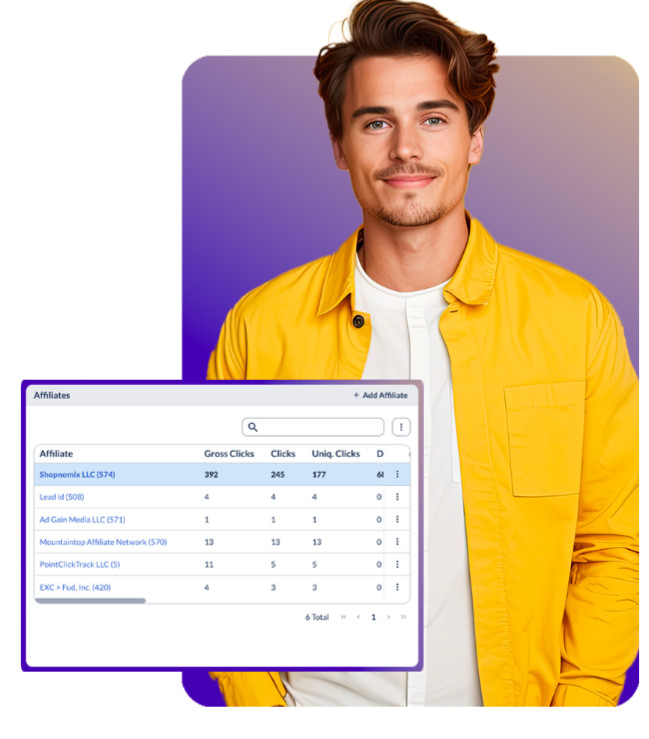
Everflow tracks it all in a real-time dashboard: clicks, conversions, and engagement across every partner traffic channel, including CTR and active-affiliate segmentation. Its server-side postback tracking doesn’t rely on cookies or browser pixels, so your click and conversion counts remain accurate.
Conversion Quality, Broken Down Automatically
Quickly compare performance across partner types and channels and pull dimensional analytics down to click-to-conversion time. Drill down to the core of your conversion rates by affiliate, placement, city, or device in a few quick clicks. One of the biggest advantages of this feature is how quickly you can weed out active from inactive affiliates.
Overall Partner Health
Having an easy onboarding affiliate hub for a full partner mix (influencers, affiliates, media buyers, and resellers) all on one dashboard showing your partner concentration across your whole mix can save you hours of headaches. Your newly onboarded partners also have immediate access to automated tracking links and updates, which shortens time-to-first-conversion.
Revenue Quality and Reversal
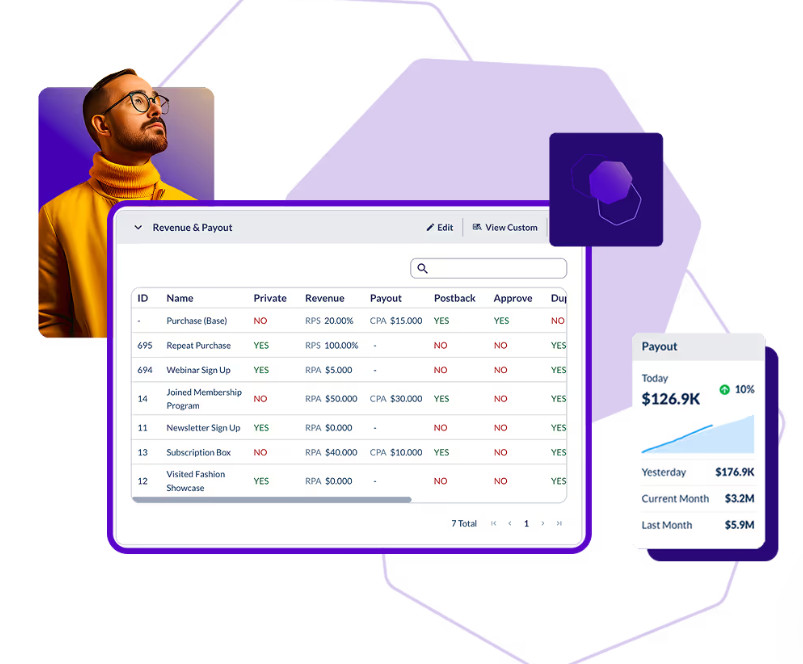
This is where an affiliate platform can pay for itself. In addition to tracking revenue, profit, margin, clicks, and conversions, the system will also flag coupon sites or partners with high rates of refund/reversal sales, and catch low-intent traffic problems before it hits your margin.
Long-term Value, Not Just First-Click Revenue
This is arguably Everflow’s more distinctive piece: it can track ongoing revenue events like repeat purchases, renewals, and upsells, not just the first sale. Unlike some basic affiliate software solutions, Everflow is designed to support deeper tracking and robust reporting across partner activity.
The Bottom Line
Tracking revenue alone tells you almost nothing about affiliate program health; you need to know where that revenue is coming from and whether it’s sustainable, or you risk over-investing in the wrong partners and channels. Understanding your most important KPIs and finding a way to keep your finger on the pulse of those KPIs in real time is essential to healthy, long-term sustainable growth.
That said, manually tracking a dozen-plus KPIs is unrealistic for most affiliate managers. Finding a program that offers real-time dashboards, automated conversion-quality breakdowns, partner health views, reversal/fraud flagging, and long-term tracking of repeat purchases and renewals rather than just first-click revenue, will not only make your job easier, but your overall affiliate program’s health, more manageable by flagging areas that need attention, before it eats away at your bottom line.