


Last Updated on October 8, 2026 by Ewen Finser
Which affiliate marketing agency is right for your brand?
If you’ve been looking at affiliate marketing agencies, you’ve most likely come across JEBCommerce. They provide a well-rounded service and have a great track record, but what you need from an agency depends on your goals.
Let’s take a look at JEBCommerce in more detail, as well as assess a few alternatives to ensure you make the most informed decision when choosing an agency to work with.
What JEBCommerce Does Well
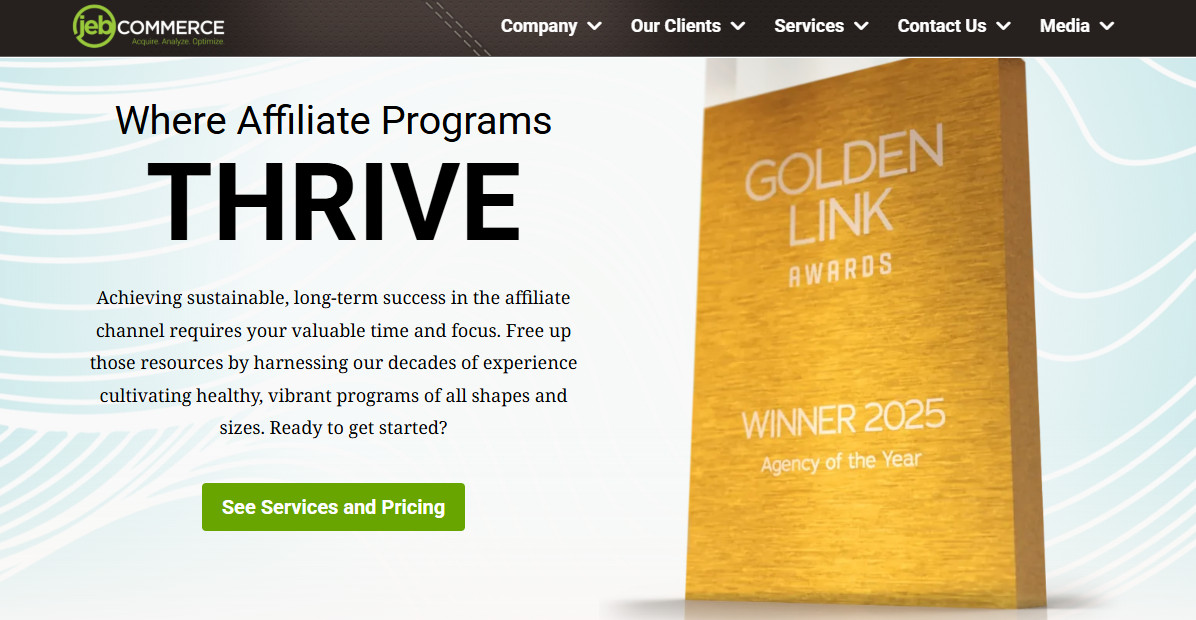
In terms of services, JEBCommerce provides recruitment, optimization, reporting, and paid placement support across various service levels. They are proud of their hands-on approach to program management, and they have a transparent approach to pricing, which is really helpful when making a comparative assessment.
Their pricing and core service are focused on three service levels of affiliate program management:
- Accelerator. The entry-level package that caters to brands that need the fundamentals without the strategy.
- Gold. This includes more strategic planning, targeted recruitment and paid placement management.
- Platinum. This package includes everything you’d expect from an affiliate management agency, such as executive-level strategy, advanced partner negotiations, forecasting, and more sophisticated optimization.
JEBCommerce focuses heavily on recruitment and often uses different team members and resources to recruit new affiliates during the onboarding process.
If they cover all bases, why is it necessary to look at other alternatives? The short answer is… the more specific your program requirements are, the more intentional you should be when choosing an agency to manage it.
I’ve compared four agencies that approach affiliate management from slightly different angles: Acceleration Partners, PartnerCentric, Gen3 Marketing, and Hamster Garage. Here’s a quick overview before we get into each one in more detail:
Agency | Best suited to | Standout capability | Scale/model | Public pricing |
JEBCommerce | Brands wanting hands-on affiliate management with clearly defined service levels | Structured program management and publisher recruitment | Boutique/smaller agency model | Accelerator: $2,000/month + 2% of channel growth; Gold and Platinum custom |
Acceleration Partners | Enterprise and global programs | International program management and regional expertise | Large global partnership agency | Custom |
PartnerCentric | Brands prioritizing attribution, incrementality, deeper partner measurement and integrated services across AEO, Creator and Affiliate | Detailed incrementality measurement and revenue attribution analysis | Specialist affiliate/partnership agency | Custom |
Gen3 Marketing | Brands wanting significant agency scale and broader performance marketing capabilities | Scale, publisher data and cross-channel services | 200+ professionals and global operations | Custom |
Hamster Garage | Growth-stage DTC, ecommerce and challenger brands | Emerging affiliate channels including Amazon, TikTok Shop and AEO | Specialist/operator-led agency | Custom |
Acceleration Partners
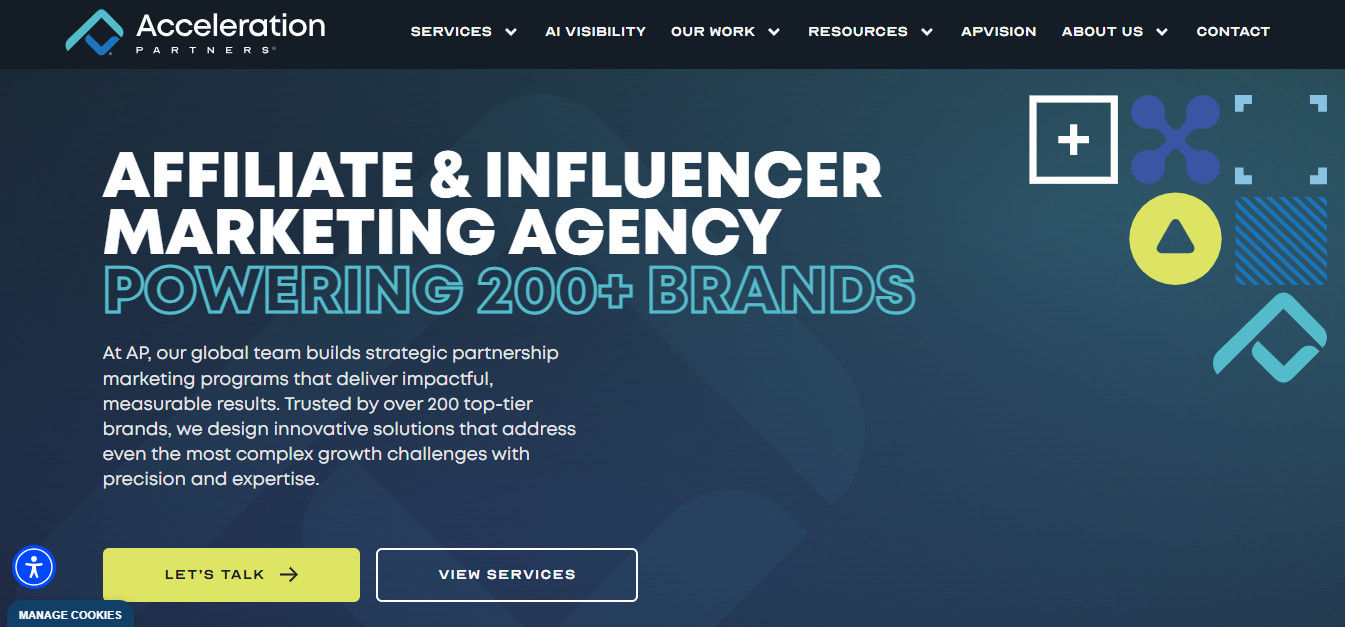
If your goal is to grow internationally, then Acceleration Partners is a good alternative to JEBCommerce. They have an impressive client list spanning over 200 brands and operating in 40 different countries. That scale is also backed by some significant performance figures, as Acceleration Partners reports 36% average year-over-year client program growth.
Acceleration Partners has teams distributed internationally and explicitly positions global partner management as a core part of its offering… great if you’re an enterprise and need to manage an international portfolio. So it works if you’re running affiliate programs across North America, Europe, and APAC, you’re dealing with different publishers, customer behaviors, languages, and commercial realities.
Acceleration Partners also has its own reporting and analytics platform, APVision, which brings together performance data from different networks, markets and partner types. Its bigger differentiator is the infrastructure available to manage complex programs at scale.
Where it may be less suitable is for a smaller brand operating in one market with a relatively straightforward affiliate program. If your main requirement is hands-on recruitment and day-to-day management rather than global coordination, you may not need the level of infrastructure Acceleration Partners is built to provide.
PartnerCentric
PartnerCentric is a specialist affiliate and partnership marketing agency. One of its key differentiators is its ability to measure incremental revenue. Measuring attributed revenue and incremental revenue are quite different. As an example, a coupon publisher can claim a sale as they were the last click before a customer converts, but that doesn’t necessarily mean that the publisher is responsible for influencing the buyer.
PartnerCentric has its own proprietary reporting dashboards called FUSE. FUSE Incrementality has the ability to measure incremental revenue by assessing genuine publisher contribution. FUSE Precision then reconciles affiliate performance against your brand’s own analytics data and can identify attribution discrepancies.
These dashboards sit on top of your existing systems, so you don’t have to change the underlying infrastructure you’re using. PartnerCentric also has technology in place to avoid duplicate card-linked offers and placement measurement. In fact, the agency reports uncovering an average of 30% misattribution in affiliate spend with its FUSE tools. The tools also offer integrated services across affiliate, creator, and AI Discovery optimization, making it a strong multi-discipline choice.
By using FUSE, you can analyze which partners create growth and where you should invest more. JEBCommerce does also measure incremental revenue; however, PartnerCentric is one of the leaders in this space as it’s built its own proprietary technology specifically around attribution and incrementality.
Gen3 Marketing
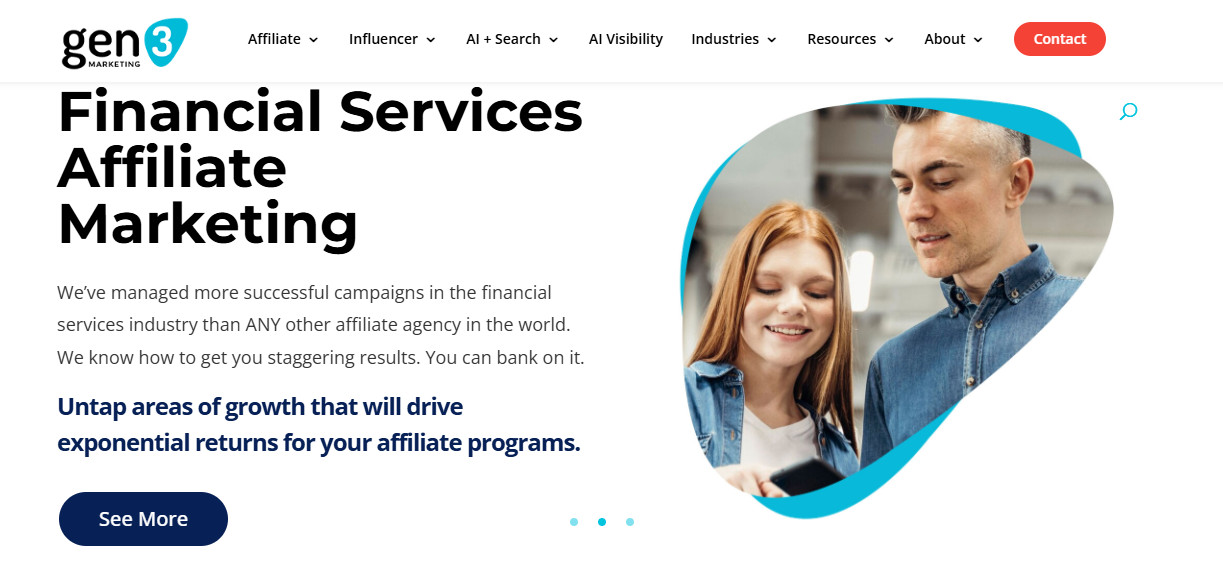
Similar to Acceleration Partners, Gen3 positions itself as a global partner marketing agency with over 500 clients. The agency says its experts drive more than $2 billion in annual client revenue with an average 10:1 ROAS. Their services include influencer marketing, performance PR, Amazon affiliate, paid media, and SEO.
Gen3’s offering is quite different to JEBCommerce and PartnerCentric, where the teams provide a more focused, hands-on approach to management rather than scaling and having multiple touchpoints. For an established brand running several performance marketing activities at once, having those capabilities under one agency makes sense.
Keep your goals in mind. If your focus is on affiliate management, it may not be feasible to use a global agency with multiple service lines and hundreds of specialists. Gen3 doesn’t publish standard pricing, so it’s difficult to make a direct cost comparison with JEBCommerce’s clearly defined packages.
If you’ve outgrown a smaller agency, would benefit from a large agency resource pool, and you operate across various marketing channels, then Gen3 is a good choice. Having said that, if you’re looking for a more focused or boutique relationship, its scale may be more than your program requires.
Hamster Garage
Hamster Garage is a great alternative to JEBCommerce if you’re in a growth phase or want to dabble in different markets; they report an average program ROAS of 7x across its client base. It offers affiliate program management, Amazon affiliates, TikTok Shop affiliates, global partner marketing, and Answer Engine Optimization.
Unlike some of the other agencies on this list, Hamster Garage doesn’t operate like a traditional agency offering broader digital marketing services, but it prioritizes newer affiliate markets. This is useful for ecommerce and DTC brands that want to reach customers beyond traditional affiliate publishers. For example, Amazon Affiliates can drive external traffic directly to product listings, while TikTok Shop connects creator recommendations more closely with the point of purchase.
Its AEO offering takes this a step further by using publisher relationships to help brands improve their visibility across AI-powered search and answer platforms. The benefit here is diversification. Rather than relying on one affiliate channel or customer journey, brands can potentially reach customers across traditional publishers, marketplaces, social commerce and emerging AI-driven discovery.
If emerging channels aren’t relevant to your business, the wider capability isn’t necessarily an advantage. You may be better served by an agency focused on conventional affiliate program management.
What Whould You Compare When Assessing Potential Affiliate Agencies?
Looking at the overview above, you most likely have a couple of agencies shortlisted. I would avoid looking at the lists of brands, clients, or awards that each agency advertises. Instead, I’d focus on what the day-to-day will look like when it comes to managing your accounts. Below are 5 questions you should ask an agency during the discovery process.

1. Who Manages Your Account?
You could ask to meet the team who will be working on your account instead of a sales person or a senior executive who is leading the pitch process. At minimum, you should have a dedicated Account Manager who will be your point of contact. It’s also worth noting how many other clients they manage.
Will your Account Manager be the same person who interprets your performance data and deals with publishers, or are there dedicated experts who handle those conversations? This is an important distinction to make when you’re comparing a boutique agency with a larger one.
2. How Do They Go About Recruitment?
A recruitment strategy goes a long way. Does the agency have a pool of publishers they work with? Most likely! But do they also approach publishers outside their network based on their clients’ requirements?
3. How Is Performance Measured?
Let’s face it, reporting is so much more than just revenue. If revenue is the only, or main, indicator of performance, then you should probably look elsewhere. An agency should be measuring new customer acquisition, incrementality, attribution, partner concentration, profitability, and commission efficiency.
4. What Technology Do They Work with and Recommend?
Agencies have preferred platforms or commercial relationships that influence the technology they use, so it’s worth asking whether their recommendations are based on what suits your program or what fits their own ecosystem.
You want to work with an agency that can work across different networks and platforms and recommend the option that best supports your goals, vertical, and existing setup.
An agency that’s network agnostic, for instance, will be able to work across multiple affiliate networks and platforms rather than requiring clients to use one specific system. This way, you’re more likely to receive technology recommendations around your own business needs and analytics rather than relying on a single proprietary network.
This can become especially important as your program grows. The network or technology that works well for you today may not be the one you need in two or three years, so flexibility gives you more room to adapt without rebuilding your entire affiliate operation.
5. What Happens During the Onboarding Process?
This is one of my favorite questions! The way an agency answers you really sets the tone for your relationship with them. The first 90 days are crucial in setting you up for success, so there should be a plan that covers your existing data, publishers, commissions, technology, tracking, competitors, and immediate opportunities.
A revenue target is a mere goal. You want to know how they’re going to reach it.
Which JEBCommerce Alternative Would I Choose?

Like most of my buying guides, the short answer is, it depends on the problem I’m trying to solve and my goals.
JEBCommerce is a great choice if you want experienced hands-on affiliate management, but the alternatives outlined above create strong cases for a switch when you really look at the stage your brand is in.
For example, if I were managing a complicated program and my goal is to scale globally, then I’d definitely put Acceleration Partners on my shortlist. If I needed to be more aware of the revenue associated with my program, specifically incrementality and attribution, then PartnerCentric would be the first alternative I’d check out.
Don’t just switch an agency and base your decision on the amount of tech, employees, or publisher relationships an agency has. Choose an agency based on their strengths and gaps you currently have… It’s the one that solves the problem your current setup no longer can.
Start by identifying what’s missing, whether that’s stronger measurement, international scale, access to emerging channels, or more strategic support, and compare agencies against that need. If you’re clear on why you’re considering a change and what you want your affiliate program to look like 12 months from now, choosing the right agency becomes a much easier decision.