


- TMS Solutions At a Glance
- Enterprise TMS: When Customization Comes at a Cost
- Point-Solution TMS: Faster to Deploy, Harder to Connect
- Unified TMS: Connecting Operations From Warehouse to Final Mile
- What It Takes to Go Live in Two Weeks
- Selecting the Right TMS: The Financial Cost of Slow Implementation
Last Updated on October 7, 2026 by Ewen Finser
In the logistics industry, we often face serious challenges when it comes to searching for the right software platform. If we don’t select the correct system, we risk losing valuable time, wasting capital, and experiencing a severe drop in overall efficiency.
Therefore, it’s critical to evaluate the current stage of your business to determine which type of TMS is best suited for your operational model. Below, we’ll go through some of the most common operational scenarios and how to position your company for long-term success.
Bottom Line Up Front
- Enterprise TMS platforms: Best for large organizations with dedicated IT teams, complex workflows, and the resources to support longer implementation cycles
- Point-solution TMS platforms: Best for operators that need specialized functionality for a specific part of the transportation process without requiring a fully integrated system
- Unified TMS platforms: Best for growing carriers, 3PLs, and distributors that need warehouse, dispatch, and final-mile operations connected in one system
- Grasshopper Labs: Best for big-and-bulky and final-mile operators that need a unified platform with pre-configured workflows and rapid implementation
TMS Solutions At a Glance
Solution Tier / Category | Representative Platforms | Setup Timeline | Primary Implementation Bottlenecks | Best for |
Enterprise Supply Chain Suites | Manhattan Associates, Descartes | 6 to 12+ months | Custom code, heavy IT involvement, legacy system integration | Global supply chains with dedicated internal IT departments and highly complex custom workflows |
Point Solution TMS | DispatchTrack, FarEye, Extensiv | 2 to 4 months | Third-party integrations needed to bridge warehousing and transport | Regional providers focusing strictly on a single operational segment |
Unified First to Final Mile Platforms | Grasshopper Labs | As little as 2 weeks | Pre-configured workflows for big-and-bulky; minimal custom coding required | Mid market carriers, 3PLs, and heavy goods distributors needing rapid launch across warehouse and final mile teams |
Enterprise TMS: When Customization Comes at a Cost

The Hidden Cost of TMS Customization
When a TMS platform like Manhattan allows extensive customization of views, operational flows, and unique requirements, there is one crucial factor we often overlook: those customizations require software engineers to deeply understand the operation.
Most of the time, these developers have extensive systems experience, but little to no background in logistics or warehouse processes. This means engineering teams spend months building custom features, driving up implementation costs.

Who Enterprise TMS Platforms Are Best For
The options in the market are all valid, and highly customized configurations can work very well for large companies with dedicated IT teams. However, problems arise when a growing operation tries to customize the TMS around every single requirement. You can become increasingly dependent on the software vendor’s IT team, driving up costs on multiple fronts. Your own team spends hours deciding what features should appear on their screens, submitting support tickets, and waiting for external software engineers to understand why a specific operational change is urgent.
Large global enterprises with dedicated internal IT teams can make effective use of TMS platforms such as Manhattan Associates or Descartes. These systems are designed for supply chain organizations, enterprise retailers, and global logistics providers managing international networks with highly complex, customized workflows.
These organizations typically have large software engineering teams and substantial annual technology budgets, allowing them to absorb six-to-twelve-month implementation cycles, significant third-party consulting fees, and the ongoing cost of maintaining custom code.
However, the trade-off is significant: lengthy implementations, high consulting costs, and a long-term dependency on the software vendor for changes, enhancements, and support.
The Cost of Third-Party Consulting and Developer Overhead
When evaluating a TMS proposal, many logistics leaders focus solely on the recurring software license fee. However, legacy platforms and standalone point solutions can carry significant implementation costs beyond the recurring software license.
Enterprise suites require specialized third-party systems integrators to write custom code and map legacy database fields. These consulting fees can become a substantial cost alongside the software license itself, particularly when scope changes or custom development are introduced during the rollout. When scope adjustments occur midway through a rollout, consulting budgets inflate rapidly.
Point-Solution TMS: Faster to Deploy, Harder to Connect

When a Point Solution Works
A point-solution TMS can work well when you only need to solve one specific part of the transportation process. These platforms can manage inventory well or track shipments effectively, but when the goal is to automatically update inventory levels as soon as goods are received, adding that functionality often requires extra charges, custom add ons, or manual workarounds.
The Integration Problem as You Scale
Connecting standalone point solutions across growing operations creates constant technical friction. If a single facility uses a unique process, developers must write custom code to connect it to central dispatch, driving up hidden software maintenance costs over time.
Niche regional providers with focused single process operations can use a point solution like DispatchTrack, FarEye, or Extensiv, which fits local parcel delivery services, dedicated point to point couriers, and standalone warehouse operators. They operate with targeted operational scopes and smaller IT teams, allowing them to benefit from quick, specialized feature setups, provided they do not immediately require integrated warehouse management or complex multi-leg transportation tracking. However connecting these point solutions to warehousing or financial systems later requires building and maintaining costly custom API bridges.
Unified TMS: Connecting Operations From Warehouse to Final Mile
How Native Workflows Reduce Implementation Time
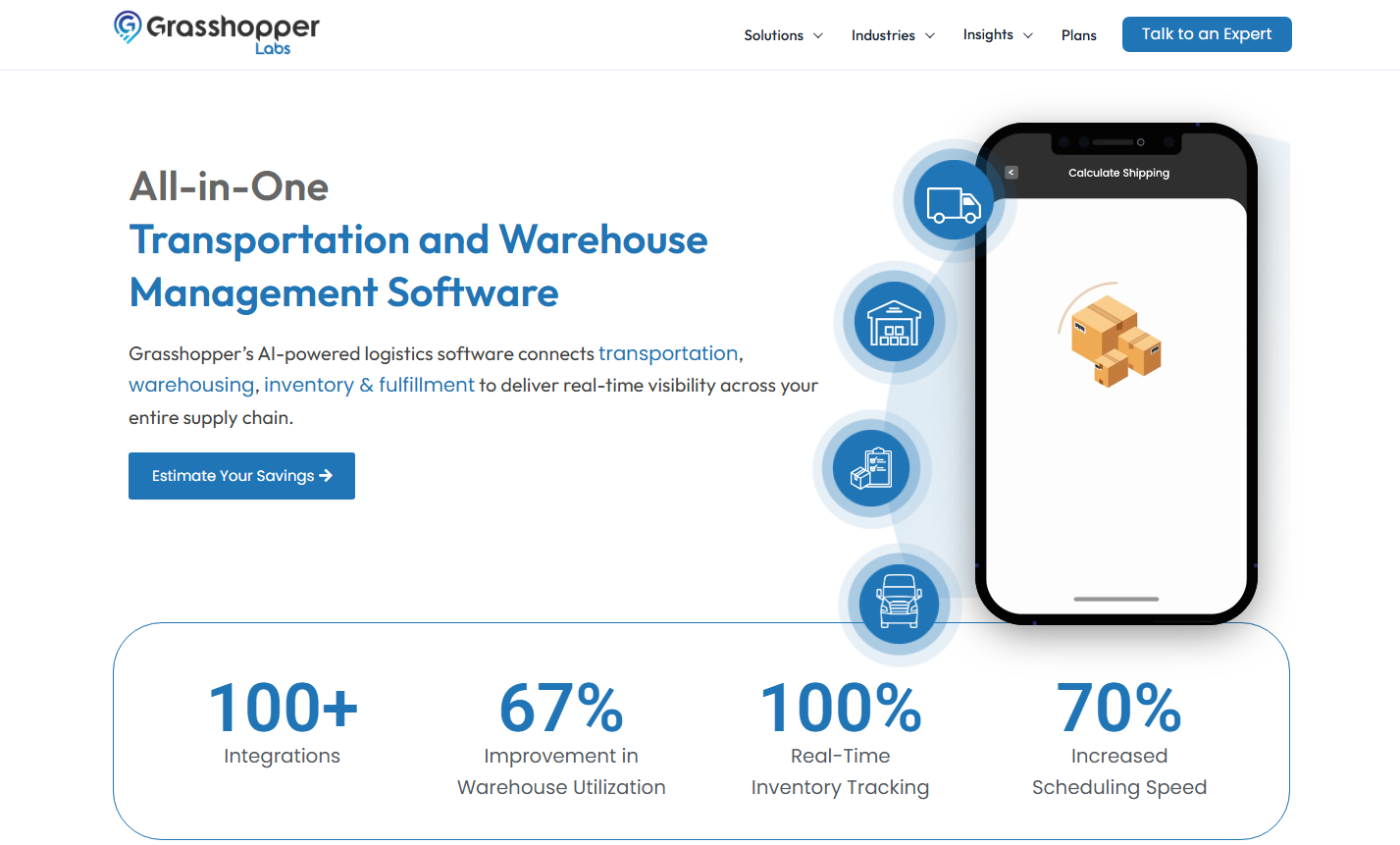
Choosing a unified platform means you do not need to build or maintain API bridges with third parties. It comes with built-in workflows designed around specific operational requirements.
Grasshopper Labs comes pre-configured with operational workflows for big-and-bulky logistics, reducing the amount of custom development required during implementation.
Why Big-and-Bulky Logistics Requires a Different TMS
Many transportation platforms were originally built for small-package delivery or gig economy courier networks. In those operational models, a single driver drops a lightweight box on a porch or at a reception desk. The process takes less than two minutes, requires minimal customer coordination, and carries relatively low operational risk.
When you attempt to force big-and-bulky logistics into a standard parcel TMS, friction can appear almost immediately. Heavy items like furniture, appliances, saunas, and outdoor equipment operate under entirely different constraints. They require two-person delivery crews, precise appointment windows, pre-delivery site inspections, and complex proof-of-condition documentation upon arrival.
Adapting a generic parcel TMS to support heavy goods can force engineering teams to write custom code or purchase separate third-party add-ons. In contrast, specialized platforms come pre-configured for two-person handling and white-glove workflows, reducing the need for months of custom software development and allowing operations to launch faster.
What It Takes to Go Live in Two Weeks

While platform architecture plays a major role in deployment speed, internal operational preparation is what makes a rapid setup possible. Organizations aiming for a fast launch focus on two core operational steps:
- Before configuration begins, operations leaders should consolidate all location and asset data into clean, structured files. This includes street addresses, facility perimeters, dock capacities, and operating hours across all hubs.
- On the fleet side, logistics teams document vehicle dimensions, weight limits, liftgate availability, and crew capabilities. Categorizing delivery teams by two person heavy handling skills allows the system to automate dispatch routing accurately from day one.
Scaling mid-market carriers, 3PLs, and big-and-bulky logistics providers can benefit from a natively unified platform that is built for regional distributors, heavy-goods carriers, and white-glove delivery operators managing complex two-person handling, precise appointment windows, and on-site installation.
For operators without large internal IT teams or the capacity for lengthy deployment cycles, that can make a full operational launch across terminals in as little as two weeks more realistic, while reducing the risk of double licensing costs and minimizing external developer overhead.
Preparing Fleet, Rates, and Settlement Rules
Unified platforms cover dispatch and financial settlements within a single system. To go live in two weeks, operations must consolidate rate cards, fuel surcharge formulas, stop pay structures, and accessory charge rules like stair carry fees or assembly bonuses. Having clean settlement formulas ready enables immediate setup of automated customer invoicing and contractor payouts without requiring custom financial coding.
Selecting the Right TMS: The Financial Cost of Slow Implementation

Evaluating these operational trade-offs makes it clear that software deployment speed is not just a technical metric; it is a financial consideration.
When switching to a new TMS, there is generally a period where the existing system must remain active alongside the new platform. If implementation takes up to 12 months, for example, you could be carrying two software licenses for much of that transition. At the same time, dispatchers, drivers, and warehouse teams may be forced to work across two systems, manually entering the same operational data twice.
Choosing a transportation management system built around native platform unification and pre-configured workflows can avoid months of custom software development and reduce the risk of prolonged dual-system costs. By prioritizing fast onboarding over endless technical customization, growing operations can protect their margins, reduce operational friction across terminal teams, and build a flexible foundation for scalable, sustainable growth.