


Last Updated on October 6, 2026 by The Digital Merchant Team
National Processing was once generally well-regarded in the payments industry. It offered transparent, flat-rate pricing, a variety of hardware options, and 24/7 phone support. It also accepted both low- and high-risk businesses, such as those in pharmaceuticals, gaming, tobacco, vape, and firearms.
But in November 2025, National Processing rebranded as pmtbox. And in April 2026, it raised $15 million to build what it calls an “Enterprise Commerce Platform,” with plans to grow its enterprise sales team and target large, complex merchants. The old National Processing website and rate card are gone, and pmtbox doesn’t even publish pricing or plans.
So for small and mid-sized merchants, that leaves real questions. Will your rate lock be honored? Will your plan still be offered? Will a company focused on enterprise accounts prioritize a small shop? Add longstanding complaints about hard-to-reach support and billing that continued after cancellation, and many merchants have decided not to wait and find out.
If you’re one of them, or if you were planning to sign up with National Processing and found pmtbox instead, here’s what to look for in a replacement and a few processors worth considering.
What to Look For in a National Processing Alternative

- Pricing model: If you are a former National Processing customer, you were accustomed to their flat-rate pricing model, where each transaction faced the same fee. While flat-rate pricing can make it easy for small businesses to calculate their processing costs, it may not be the best option for higher-volume merchants, for whom interchange-plus pricing tends to come out cheaper.
- Contract term length: Some processors will lock you into multi-year terms, and if you want to leave early, you will have to pay an early termination fee. Alternatively, some let you renew your contract month-to-month and don’t charge for early termination.
- Funding speed: Some processors offer fast payouts, such as same-day or instant payouts, to eligible businesses. Others do not, leaving you waiting several business days for funds to arrive and potentially creating cash flow issues.
- Integrations: Your processor should integrate with the existing tools in your stack, such as Shopify or other e-commerce platforms.
- Customer support quality: Not all processors offer phone support, with some providing only chat-based options or email correspondence. In addition, many larger processors are heavily incorporating AI into chat support, making it a challenge to connect with a human.
- High-risk support: Processors all have different risk tolerances. Some work primarily with low-risk businesses, while others are willing to take on those in higher-risk industries. If you used National Processing because of its high-risk support, you will want to make sure that a new processor accepts your industry.
With all that considered, here are some of my top picks for National Processing alternatives.
National Processing Alternatives: At a Glance
Best For | Pricing Model | High-Risk Support | Customer Support | |
Stripe | New e-commerce merchants | Flat-rate | Limited | Live chat, developer Discord server |
Square | In-person processing | Flat-rate | Limited | Chat, email, phone |
Helcim | Volume discounts | IC+ | Limited | Support ticket, phone |
Luqra | Scaling businesses | Custom flat-rate, IC+ | Telehealth, nutra, credit repair, vapes, e-cigs, coaching, courses, travel, digital goods, others | Phone, online form |
Finix | Developers | Subscription with IC+ | CBD, healthcare, nutra, supplements, digital wallets, lending, gaming, others | Email |
Stripe: Best for New E-commerce Merchants
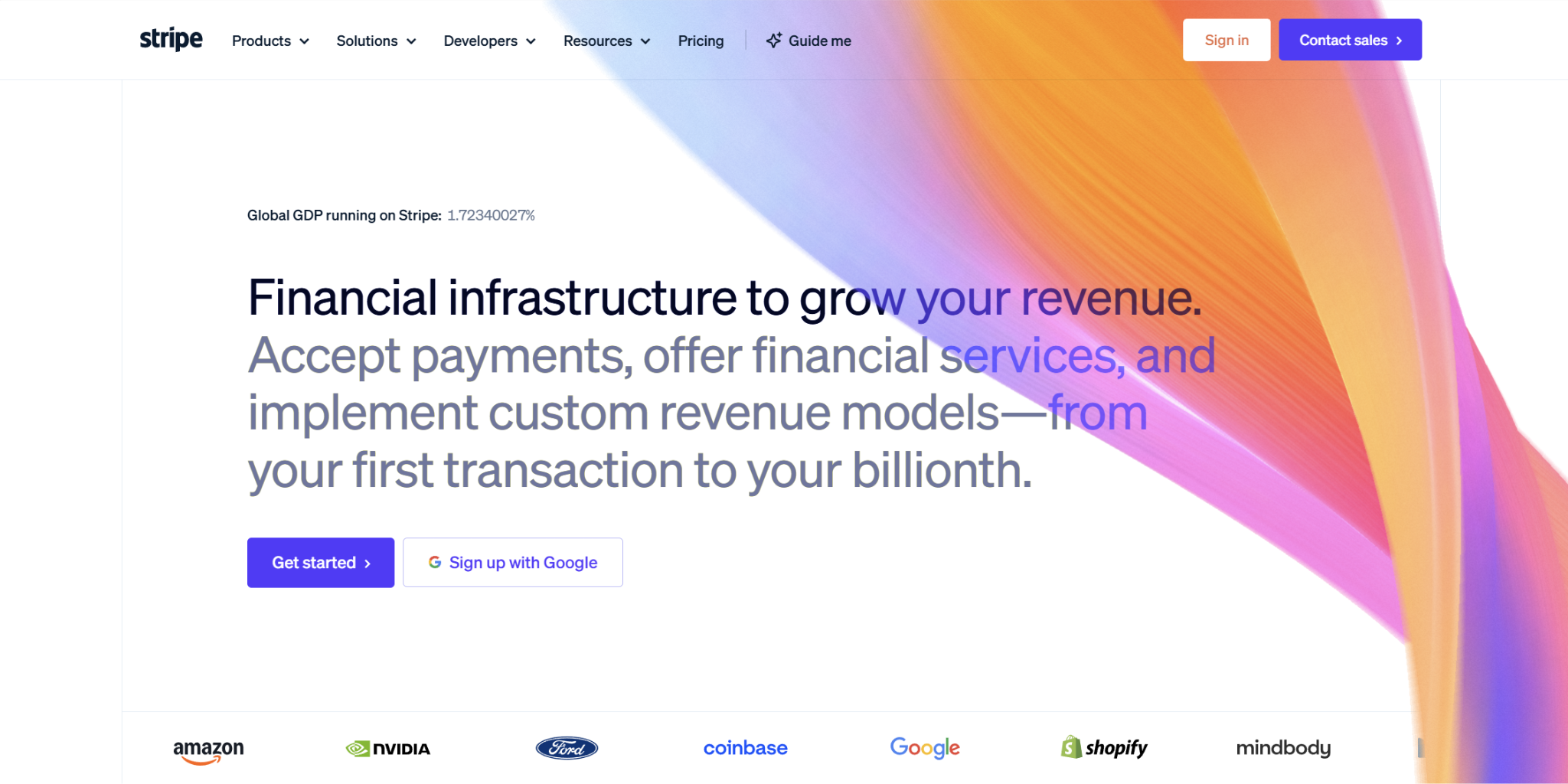
Stripe is one of the most commonly used payment processors. It’s friendly to new sellers, allowing them to start accepting payments quickly, and it uses a simple, flat-rate pricing model. However, it also has plenty of resources for developers, with strong API documentation and prebuilt solutions. Stripe doesn’t impose any contract term lengths or charge early termination fees.
Pricing
Stripe’s standard pricing uses a flat-rate model:
- Online: 2.9% + $0.30
- Additional 1.5% for international cards
- Additional 1% for currency conversion
- In-person: 2.7% + $0.05
- Additional 1.5% for international cards
- Additional $0.10 for Tap to Pay
Certain complex or high-volume businesses can design a custom package using interchange-plus pricing.
High-Risk Support
Stripe is best for low-risk businesses, with many high-risk industries being prohibited or restricted.
Customer Support
Stripe offers 24/7 live support via online chat, but there’s also a developer Discord server for technical questions. Notably, Stripe’s site doesn’t publish a customer support email address or phone number, and some merchants report difficulty getting in touch with a human.
Pros
- No set term lengths or early termination fees
- Thorough developer documentation
- Quick to sign up
Cons
- Flat-rate pricing can be expensive
- Not a high-risk processor
- No dedicated email or phone support
Square: Best for In-Person Processing

Square is another of the more recognizable names in the payments industry. It doesn’t lock you into a long-term contract, and it’s especially popular for in-person payment collection and its hardware, although e-commerce businesses can use it too.
Pricing
Square also uses flat-rate pricing, the fee depending on your plan’s tier:
- Square Free:
- Online: 3.3% + $0.30
- In-person: 2.6% + $0.15
- Square Plus ($49/month/location):
- Online: 2.9% + $0.30
- In-person: 2.5% + $0.15
- Square Premium ($149/month/location):
- Online: 2.9% + $0.30
- In-person: 2.4% + $0.15
High-Risk Support
Square is not a high-risk processor; its Payment Terms explicitly forbid many high-risk industries.
Customer Support
Chat and email support are available to merchants on all plans, although phone support can vary. The Free plan provides phone support Monday through Friday, but only for the first 90 days. Those on the Plus plan can call phone support Monday through Friday, while Premium customers get 24/7 phone support.
Pros
- Strong for in-person processing
- Plenty of payment hardware options
- Offers phone support
Cons
- Flat-rate pricing can be expensive
- Phone support only on paid plans after the first 90 days
- Not a high-risk processor
Helcim: Best for Volume Discounts
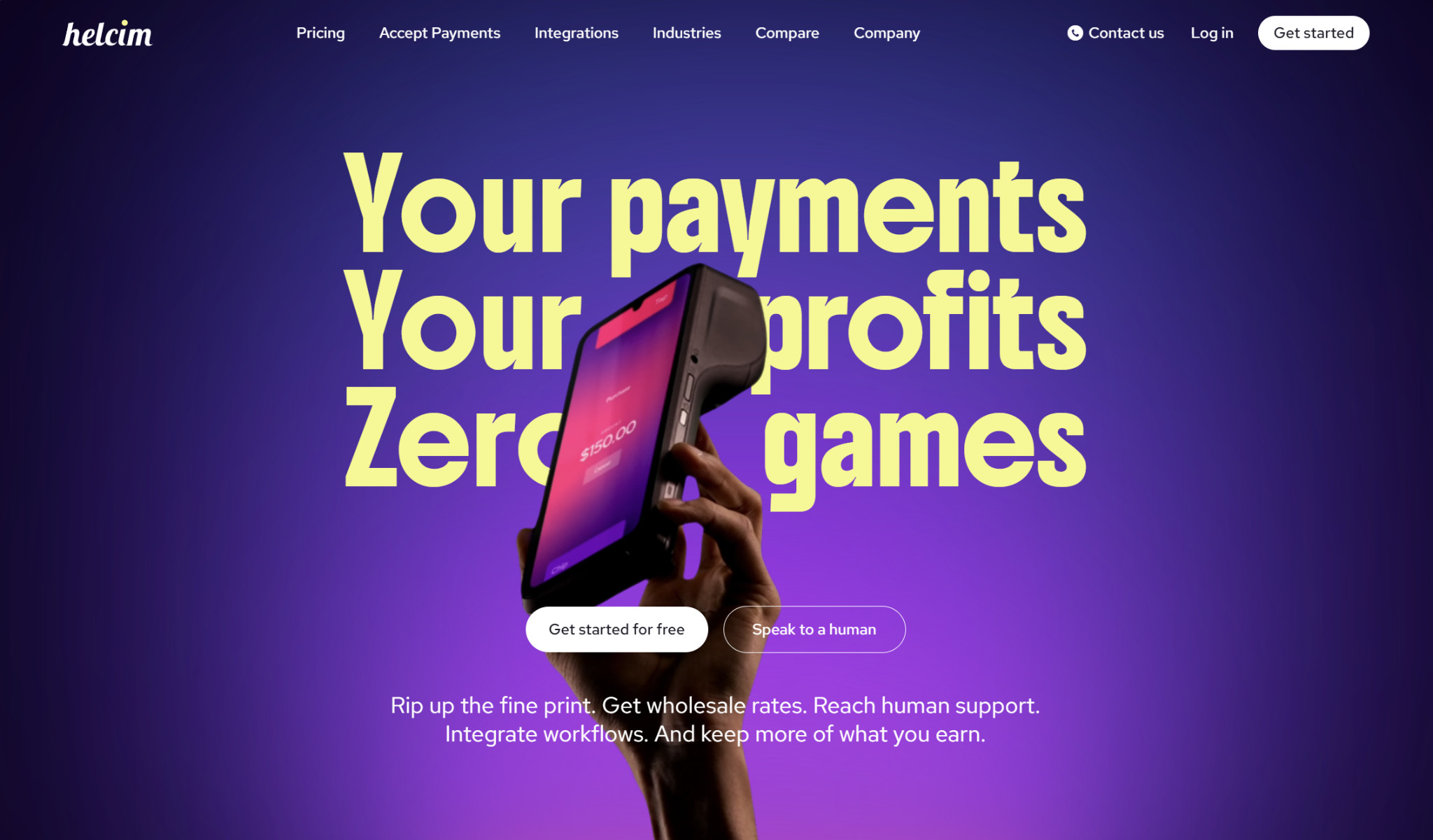
Helcim is gaining momentum as an interchange-plus option for businesses of all sizes. Both online and physical businesses in a range of industries can use it, although it also niches down to industries such as automotive. Helcim has no long-term contracts; in fact, it has a contract buyout program where it will cover up to $500 of your cancellation fees if you switch from another processor.
Pricing
Helcim uses interchange-plus pricing, with discounts available depending on your monthly processing volume.
- Online:
- $0–$50,000: Interchange + 0.50% + $0.25
- $50,000–$100,000: Interchange + 0.45% + $0.20
- $100,000–$500,000: Interchange + 0.35% + $0.20
- $500,000–$1,000,000: Interchange + 0.25% + $0.15
- $1,000,000–$5,000,000: Interchange + 0.15% + $0.15
- $5,000,000+: Custom
- In-person:
- $0–$50,000: Interchange + 0.40% + $0.08
- $50,000–$100,000: Interchange + 0.35% + $0.07
- $100,000–$500,000: Interchange + 0.25% + $0.07
- $500,000–$1,000,000: Interchange + 0.20% + $0.06
- $1,000,000–$5,000,000: Interchange + 0.15% + $0.06
- $5,000,000+: Custom
High-Risk Support
Helcim expressly prohibits many high-risk industries, although it may be willing to work with some businesses in industries it considers restricted.
Customer Support
You can get in touch with Helcim’s support team by filling out a support ticket or via phone, which is available Monday through Saturday.
Pros
- Has its own payment hardware
- Volume discounts available
- Offers phone support
Cons
- IC+ pricing could be expensive for low-volume businesses
- Not a high-risk processor
- Less of a focus on online payments than some competitors
Luqra: Best for Scaling Businesses
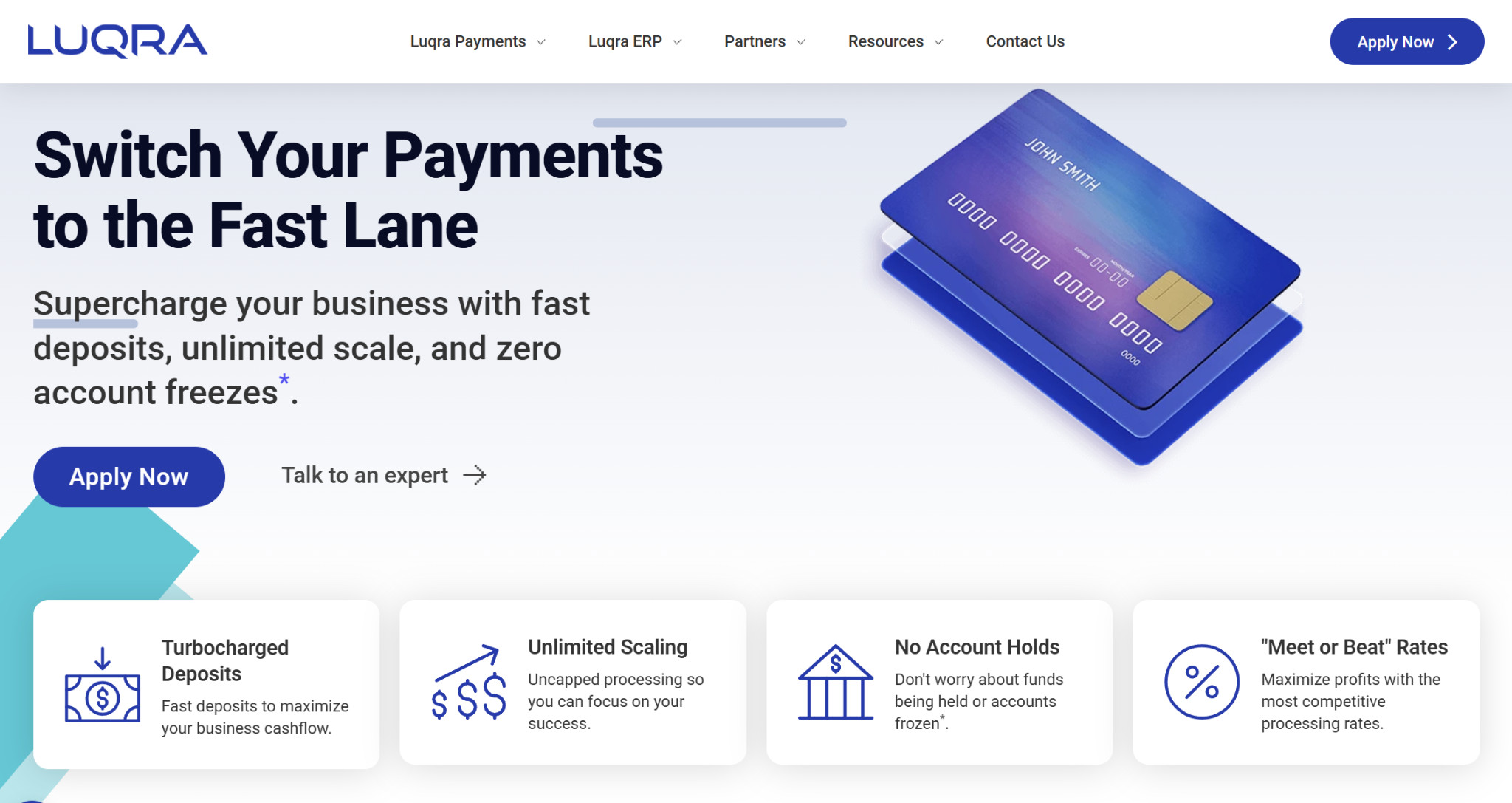
Luqra was built with e-commerce payment processing in mind, although you can also use it to collect in-person payments. Compared to a mainstream processor like Stripe, Luqra commonly works with those that are scaling or in high-risk industries. However, you will have to commit to an initial 36-month contract term, and early termination fees do apply.
Pricing
Luqra offers custom flat-rate and interchange-plus pricing, with transaction fees starting as low as 2.0% + $0.10 per transaction. The company is committed to keeping prices low, stating that they will match or beat your current rates and not increase them.
There’s also a cash discount program, where you can pass on card fees to your customers at a cost of $99/month.
High-Risk Support
Luqra often works with businesses in high-risk industries, including telehealth, nutraceuticals, credit repair, vapes and e-cigs, coaching and courses, travel, and digital goods. It’s also friendly to growth and rapidly scaling businesses, being less likely to freeze your funds due to a sudden spike in volume.
Customer Support
If you need to connect with a member of Luqra’s support team, the main way to do so is via phone, which is U.S.-based and available 24/7/365. You can also contact the company by filling out an online form.
Pros
- Provides both flat-rate and IC+ pricing options
- Works with high-risk businesses
- 24/7/365 U.S.-based phone support
Cons
- Not as well-known as other processors
- Less of a focus on in-person processing than some competitors
- Requires an initial 36-month commitment
Finix: Best for Developers
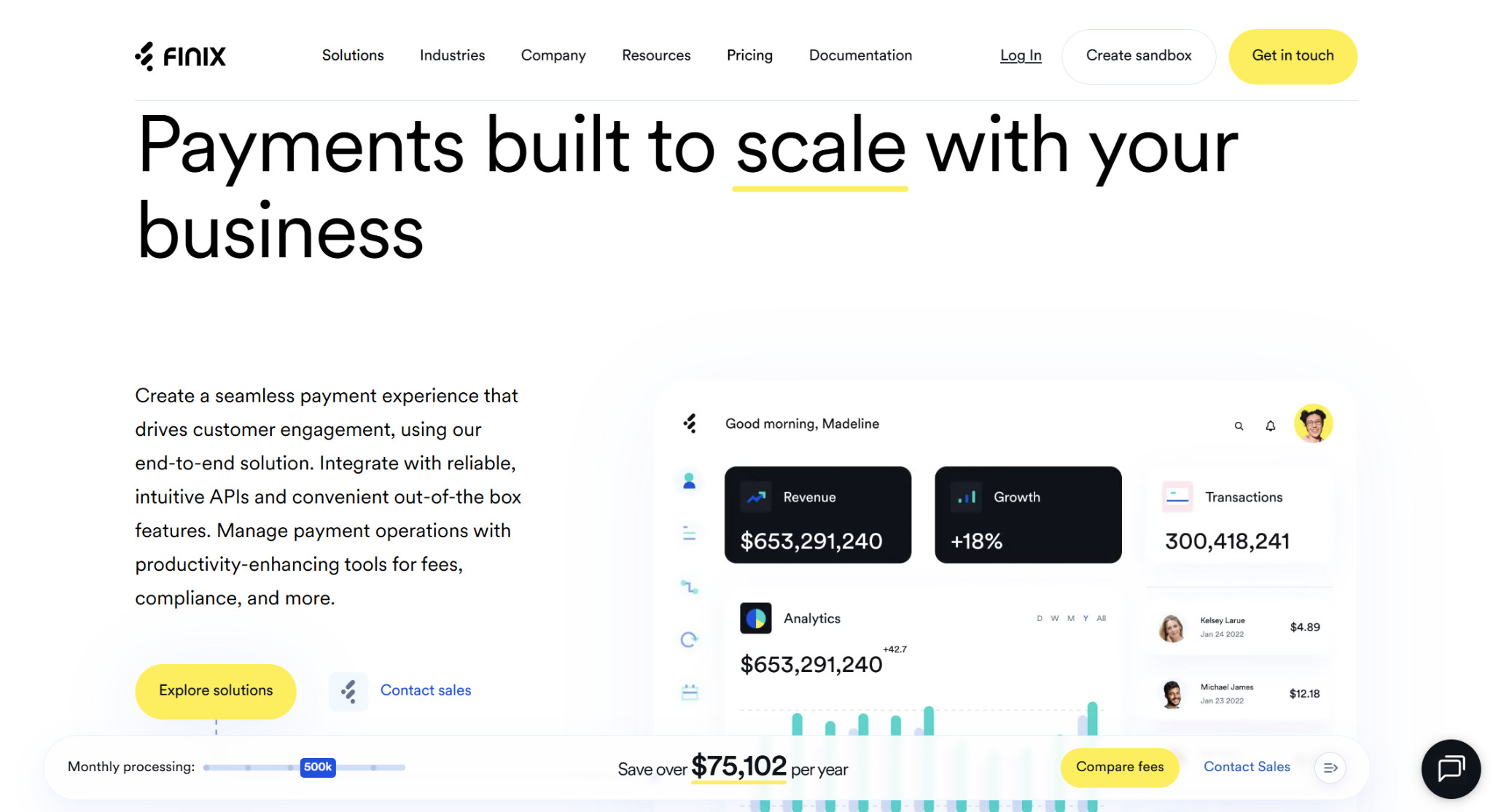
Like Luqra, Finix supports scaling businesses, including those in certain high-risk verticals, while also having robust developer tools more in the vein of Stripe. Notably, Finix doesn’t have long-term contracts or early-termination fees.
Pricing
Finix uses a subscription-based pricing model, charging a $250 subscription fee in exchange for lower transaction fees.
On top of interchange, the card processing fees are:
- Visa, Mastercard, Discover: $0.15
- American Express: 0.3% + $0.15
Custom pricing is available to businesses processing over $1 million annually.
High-Risk Support
Finix is particularly friendly to businesses in certain high-risk industries, such as CBD, healthcare, nutraceuticals, supplements, digital wallets, lending, and gaming.
Customer Support
To connect with a member of the Finix support team, you can do so via email. Finix doesn’t offer phone support, although you can request a call back in your email.
Pros
- No long-term contracts or early termination fees
- Works with high-risk businesses
- Thorough developer documentation
Cons
- Subscription pricing model can be expensive for low-volume businesses
- Less of a focus on in-person processing than some competitors
- No phone support
Which Is the Best National Processing Alternative?

If you’re searching for a National Processing alternative after its rebrand to pmtbox, there are several strong options available to you, including Stripe, Square, Helcim, Luqra, and Finix. However, the best one for you will depend on your processing volume, industry, and other factors.
For example, if you used National Processing due to their high-risk support, you’ll want to seek out another high-risk processor like Luqra and Finix, or else you’d face near-certain rejection. If you deal with frequent in-person payments in a low-risk industry, Helcim or Square may be a strong fit. And, for those in e-commerce desiring predictable, flat-rate pricing, Stripe might make your shortlist.
Whichever you choose, get the new processor’s rates and contract terms in writing. And when you cancel with pmtbox, get written confirmation that the account is closed so that the fees don’t keep coming after you’ve left.