


Last Updated on July 25, 2026 by Ewen Finser
If you’ve built a business around digital products, templates, courses, stock assets, printables, plugins, whatever the catalog looks like, you already know the difference between selling a product and selling the business. Selling a product is a transaction. Selling the business is a transfer of an entire going concern: the storefront, the catalog, the brand, the audience that trusts it, and the processes that keep new products coming.
That distinction matters more than most sellers expect, because it’s exactly where buyers spend their diligence time. A buyer isn’t underwriting your best-selling template pack. They’re underwriting whether the catalog, the traffic, and the audience will still be worth something six months after you hand over the keys.
With years of experience in business brokering, I’ll walk you through the steps to sell your digital product business, clearing up any confusion about the process along the way. Let’s get started!
How Digital Product Businesses Get Valued
Most digital product businesses under $5 million in revenue get valued on Seller’s Discretionary Earnings (SDE), not revenue. SDE takes your net income and adds back your salary, benefits, and any one-time or discretionary expenses, giving a buyer a clean picture of what the business earns for a single owner-operator running it full-time.
One thing I’d like to stress is keep the add-backs clean and real. If not it will most certainly be caught and brought up during due diligence and potentially end the deal. It’s simply not worth it to use any bogus add-backs. I’ve personally seen it way too often!
Current SDE multiples for content and digital product businesses tend to land in a fairly wide band, roughly 2x to 5x, with the low end going to catalogs that lean on a single traffic source or a single hero product, and the high end reserved for businesses with:
- Diversified traffic (organic search, email, paid, social, not just one channel)
- A broad catalog rather than one or two products carrying all the revenue
- Recurring or repeat-purchase behavior from the same customers
- Low owner dependency, meaning the business runs without you personally creating every asset
Above roughly $5 million, buyers typically shift to EBITDA (earnings before interest, taxes, depreciation, and amortization), especially if you’ve built out a team that handles design, content, or customer support without you. That shift usually works in your favor, since EBITDA multiples for established, professionally run businesses tend to run higher than SDE multiples for the same cash flow.
Digital product businesses can also carry a valuation wrinkle that a physical goods brand simply doesn’t: your catalog isn’t inventory sitting in a warehouse, it’s a set of licensing rights with a shelf life. A course or plugin built around last year’s platform version depreciates the same way stale outdated stock does, just faster and less visibly.
Buyers price that in by asking how much of the catalog still sells at full price without a refresh, and how much of it is coasting on work you did years ago. A catalog with a documented update cadence and evergreen-by-design products (frameworks, templates, and systems rather than trend-dependent content) tends to hold its multiple better than one that needs constant rework to stay relevant.
One caution worth noting: don’t anchor your hopes and expectations to headlines about huge multiples from the aggregator boom years. The market has shifted and buyers today are underwriting current cash flow and current channel health, not 2021 comparables.
What Buyers Review in Due Diligence

Buyers in this category run due diligence that looks different from a physical product or service business. A few things do seem to come up in nearly every deal:
Traffic and acquisition sources
Where do buyers actually come from? A catalog that lives or dies on one marketplace’s algorithm (an Etsy shop, a single app store listing, a single affiliate partnership) reads as higher risk than one with organic search, an email list, and paid acquisition all contributing.
Content and product ownership
Buyers will ask who created every asset in the catalog and under what terms. If any templates, designs, or code came from contractors or stock libraries, they’ll want to see the licensing that confirms you can legally transfer or resell it. Gaps here are one of the most common reasons deals stall in due diligence.
Platform dependency
If your products live on a third-party platform (a marketplace, an app store, a plugin repository), buyers will look hard at your standing with that platform: account age, review history, policy compliance, and whether the account itself is transferable under the platform’s terms.
Refund rates and customer support load
Digital products carry their own version of churn: refund requests, chargebacks, and support tickets tied to product quality or licensing confusion. A clean refund history signals a stable catalog. A high one raises questions about product-market fit or overpromising in marketing.
Update and maintenance cadence
Templates go stale, plugins break with platform updates, courses go out of date. Buyers want to know how much ongoing work is required to keep the catalog current, and whether that work is documented well enough for a new owner to pick up.
Revenue concentration
If one product or one customer segment accounts for the majority of revenue, that’s a major red flag. Buyers pay up for a business where no single SKU or client relationship can sink the numbers if it disappears.
Asset and Audience Transfer: The Part Unique to This Model

This is where digital product sales get more complicated than a typical ecommerce deal, because so much of the value lives in things that aren’t physical inventory.
Before you go to market, get clarity on how each of these transfers:
The storefront and domain
Whether that’s a standalone site, a Shopify store, or a listing on a third-party marketplace, confirm the transfer mechanics and any waiting periods the platform imposes. This can save major time in the long run.
The product catalog itself
Files, source assets, and any editable versions (not just the finished downloads customers receive) need to go with the sale. Compile everything!
Email list and subscriber relationships
This is often the single most valuable asset in a digital product business. Buyers will ask about list health (open rates, engagement, how the list was built) and you’ll need a plan for handing over access without violating your email platform’s transfer policies or anti-spam rules. The true value of this is major!
Social accounts and audience
If the brand’s audience lives on Instagram, TikTok, YouTube, or a similar channel, work out in advance whether those accounts transfer, stay with you, or get handled through some hybrid arrangement. Buyers weigh this heavily when the brand and the founder’s personal identity are closely tied together.
Trademarks and brand assets
Confirm what’s actually registered versus just used informally, since that affects both value and how cleanly the brand name transfers.
Customer data and licensing records
Buyers need proof of who owns what license, especially for subscription or membership-style digital products, and you’ll need a data handling plan that satisfies privacy obligations during the handover. Should be traceable and trackable!
Your own involvement post-close
Most deals include some transition period where you’re available for questions, introductions, or light support. Get clear on how long that runs and what it covers before you’re negotiating it under deal pressure. Please keep in mind that it does benefit you and the company to be flexible in this part of the process in order to transfer all of the knowledge to the new owner. Plus I think it shows you believe in the company.
Sorting these questions out before you list saves real time once a buyer is in diligence, and it’s usually the difference between a deal that closes on schedule and one that drags for months over avoidable surprises.
Marketplace or Advisor: Choosing the Right Route
Where you sell matters almost as much as how you prepare, and the right route depends heavily on deal size. I want to stress that this is not an area where you cut corners or risk going on the cheap to save a few dollars. It’s simply way too important of a decision to jeopardize all of your hard work, effort and energy building your business.
If you are under roughly $250,000, self-serve marketplaces like Flippa or Acquire.com make the most sense. Fees run lower, typically 4% to 10% percent depending on the platform, and the deal sizes involved don’t usually justify a full advisory process. You’re trading some hand-holding for speed and lower cost.That way you can move on to your next idea!
In the $250,000 to $5 million range, most sellers get better outcomes working with an advisor or a curated brokerage rather than listing solo. This is the range where digital product businesses sit alongside ecommerce, SaaS, and content sites in brokerages like Quiet Light and Empire Flippers, the two most established names in this size range.
Empire Flippers
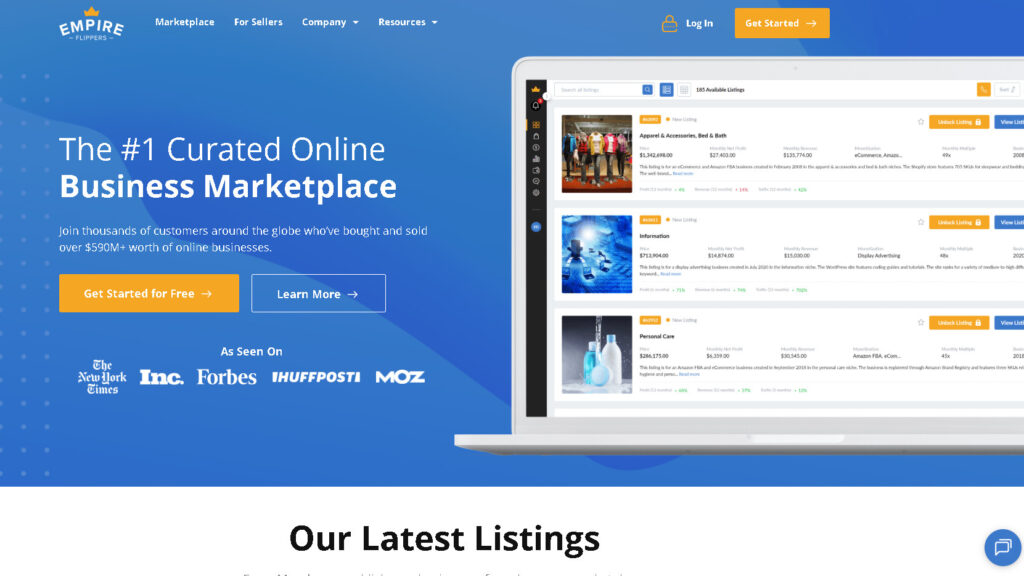
Charges 15% percent up to $700k and then after that it drops to 8% percent. With them you have a designated advisor that works with you on the transaction and they have a strong pool of buyer networks in their database.
Quiet Light

pairs each seller with an advisor who has personally built, bought, or sold an online business, which matters when the thing being valued is an audience and a catalog rather than a shelf of SKUs. An advisor brings a vetted buyer network, helps you position the audience and catalog value in a way a self-serve listing simply can’t, and manages the back-and-forth of diligence, so you’re not learning what buyers ask on the fly. Quiet Light operates on a sliding scale as well, starting at 10% percent and decreasing at higher price points, and the benefit you gain is a much more qualified buyer pool and a process built around getting the deal actually closed and at the highest multiple, not just listed.
If you are above $5 million, or if your business has grown complex enough to need EBITDA based valuation, you’re often better served by an M&A advisor or investment bank with experience in digital and software-adjacent deals, since the buyer pool at that size skews toward private equity and strategic acquirers with their own underwriting processes.
Wherever your business lands on that spectrum, the earlier you start organizing your catalog ownership, your list health, and your platform standing, the more of these decisions you’ll get to make on your own terms instead of a buyer’s demands.
The Bottom Line
Selling a digital product business isn’t the same exercise as selling a single product or a one-off catalog item. Buyers are underwriting an entire system: the traffic, the audience, the catalog, and the processes that keep it all running without you. Get your ownership documentation, your platform standing, and your audience transfer plan in order before you go to market, and you’ll spend less time in diligence and more time negotiating from strength.
If you’re not sure where your business would land on any of this, a straightforward starting point is getting a real valuation and review of your business from a brokerage before you list anywhere. That conversation can bring to the surface the gaps (licensing, platform risk, list health) or other operational deficiencies your business may have while you still have time to fix them, rather than after a buyer finds them for you in due diligence.
With something as important as buying or selling a business it is a priority to get the best information, guidance and representation that you can. The risk is too high to just wing it.