


Last Updated on October 8, 2026 by Ewen Finser
If you’ve ever turned to a staffing agency for marketing help and ended up with weak candidates after a slow process, rigid contracts, and talent that isn’t moving work forward, then this article is for you.
Marketing has a lot of specialization within it, and traditional staffing agencies often aren’t built for that level of granularity. That’s why many marketing leaders look beyond staffing agencies altogether. So, where do you look instead?
Depending on your business’ needs, alternatives to staffing agencies can include:
- Freelance marketplaces like Upwork offer faster hiring and broad access to talent across many marketing disciplines.
- Curated talent platforms like MarketerHire provide better specialization and pre-vetted candidates for faster, higher-quality matches.
- Premium expert networks like Toptal deliver stronger strategic support from senior-level marketers and cross-functional experts.
- Flexible marketing talent partners like Right Side Up offer flexible contracts and scalable support that can adapt as your needs change.
Upwork
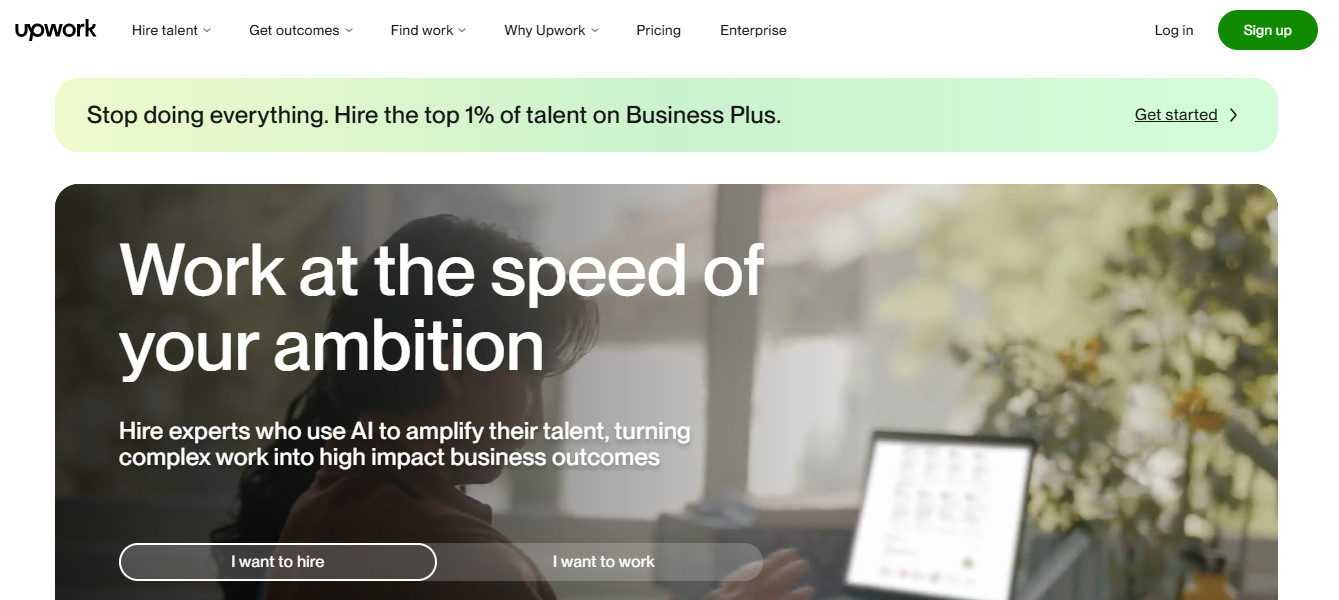
If you need marketing help quickly and want access to a huge pool of freelancers, Upwork is often the first place people look.
It’s a large, famous self-serve marketplace where you can hire freelancers and agencies across almost every marketing function, including paid media, SEO, content, design, copywriting, analytics, and more. The main appeal is simple: you get access to a lot of talent in one place, with full control over who you hire and how you work with them.
Upwork works great when you already know exactly what you need. If your scope is clearly defined, your budget is set, and someone on your team can confidently evaluate candidates, it can be a fast and efficient way to get work done.
The tradeoff is that you’re responsible for most of the hiring process. You still have to screen applicants, verify experience, review portfolios, compare proposals, and manage onboarding. Quality can vary widely, and it often takes time to separate strong operators from people who just know how to present themselves well.
It can also fall short if you need senior-level strategic guidance quickly, since finding that level of expertise usually takes more digging and vetting on your end.
Upwork is best for clearly defined projects, tactical execution work, and teams that already have enough internal marketing experience to evaluate talent effectively.
MarketerHire
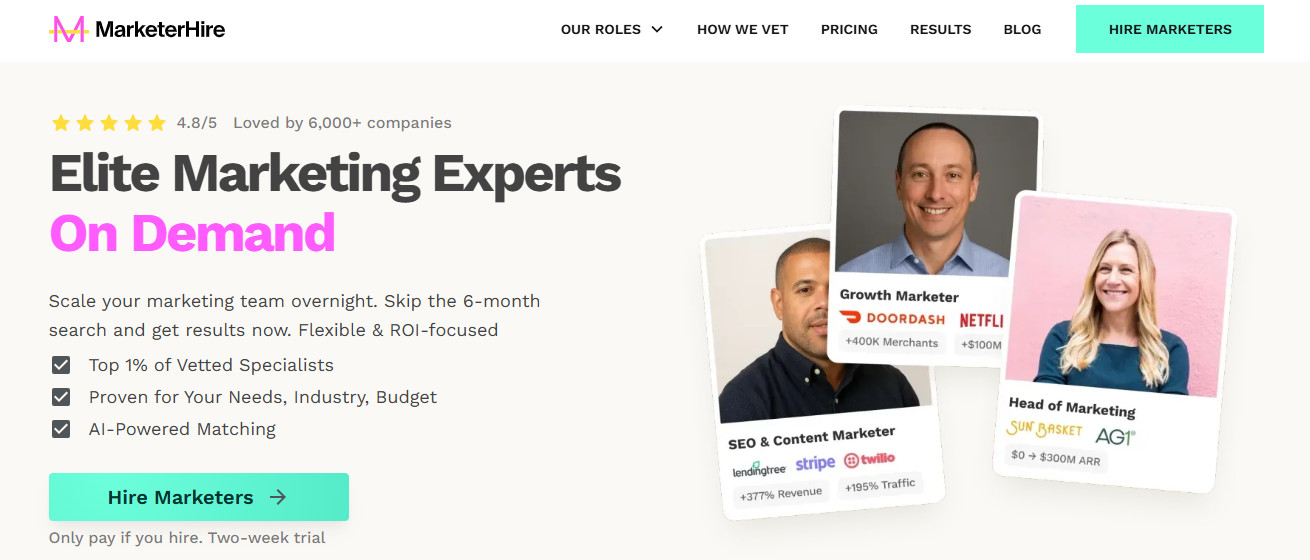
If you need a vetted marketing hire quickly but don’t want to spend weeks sorting through candidates, MarketerHire is often positioned as a middle ground between a freelance marketplace and a staffing agency.
It’s a curated platform focused specifically on marketing talent, matching companies with pre-vetted marketers across growth marketing, paid search, paid social, SEO, lifecycle, content, creative strategy, product marketing, and fractional CMO support.
Compared with Upwork, the experience is more guided. Instead of browsing a large pool and managing outreach yourself, you describe what you need and get matched with candidates who are supposed to fit that scope.
But MarketerHire’s biggest selling point, like Upwork, is speed. It says companies can be matched with expert marketers within 48 hours, with month-to-month engagements and a short trial period.
Because it’s marketing-specific, it also tends to filter out a lot of irrelevant candidates you’d otherwise have to sift through on a general marketplace. It works well when you already know the role you need, like a paid search specialist, lifecycle marketer, content lead, growth marketer, or fractional CMO.
That being said, it’s less useful if your problem isn’t just filling a role, but figuring out what role you actually need. For example, if your growth is stalling but you’re not sure whether the issue is paid media, lifecycle, creative testing, analytics, or channel mix, you may need more strategic diagnosis before you hire. In those cases, matching talent to a predefined request can feel a bit early in the process.
MarketerHire is best for companies that already have a fairly clear scope and want a vetted marketing specialist quickly without doing the sourcing work themselves. It’s a strong alternative to traditional staffing agencies when speed, marketing-specific matching, and flexible month-to-month engagements matter most.
Toptal
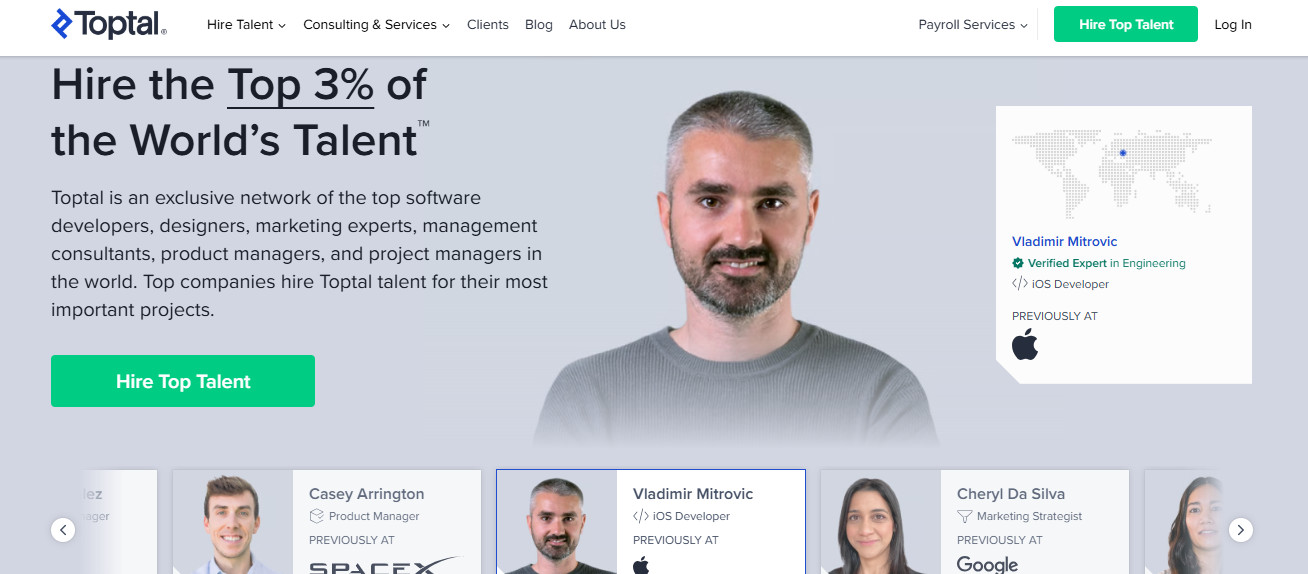
If your hiring needs sit somewhere between marketing, product, analytics, and technical execution, Toptal is often considered a premium talent network worth looking at.
It’s broader than a marketing-specific platform, covering business, design, marketing, and engineering, which makes it more of a general high-end talent marketplace than a focused marketing staffing alternative.
Toptal’s main strength is the level of screening across multiple disciplines. You’re not just getting marketing talent, you’re getting access to highly vetted professionals across areas like analytics, product strategy, UX, and development. That can be useful if your project isn’t purely marketing-led.
For example, if you need marketing support alongside data analysis, product work, or technical implementation, Toptal can help you pull those pieces together under one engagement. Its trial period also gives you a window to assess fit before fully committing.
That being said, it’s not always the best fit if your main challenge is a specific marketing problem like paid acquisition performance, lifecycle growth, affiliate expansion, SEO strategy, or creative optimization.
Because it is not marketing-specialized, you may need to do more work to find someone who deeply understands a particular growth channel or marketing operating model.
Toptal is best for companies that want premium freelance talent across multiple business functions, especially when the work sits at the intersection of marketing, product, analytics, and strategy. It works well when you need strong cross-functional expertise, not just a focused marketing operator.
Right Side Up

If you’re a marketing leader dealing with uneven performance, stretched internal bandwidth, or a hiring gap, Right Side Up is built for exactly that kind of pressure.
It’s a marketing talent and growth services partner that gives you access to senior-level marketers (without locking you into a traditional hire or a rigid agency retainer). Their model blends fractional marketing talent, flexible agency teams, executive strategy, and full-time recruiting, depending on what you actually need right now. They also have AI services if you’re looking to integrate AI-driven processes into your marketing operations.
If you’ve already been burned by staffing agencies that sent over “qualified” candidates who still couldn’t operate at your level, I get it. Luckily, Right Side Up is less about filling seats and more about plugging in experienced operators who can actually get things done. If you need someone who can step into your business, understand your channels quickly, and help you make better decisions while executing, this is the type of model that fits that gap.
That being said, it is not the right fit for every situation. If you are a very small team that mainly needs low-cost execution like quick design updates, basic copywriting, or one-off campaign setup, then this might feel like way too much overhead. A self-serve freelance marketplace will probably be faster and more cost-effective in that case.
Right Side Up also doesn’t publish fixed pricing, so you need to be comfortable having a direct conversation with their team to better understand cost and scope before you commit.
At its best, Right Side Up is for when you need real marketing pros who are senior enough to help define what needs to get done – including diagnosing channel performance issues, rebuilding a growth roadmap, or stabilizing a transition period.
How to Choose the Right Staffing Agency Alternative
The right choice you can make in this situation will always depend on your team, your urgency, your budget, and how clearly you understand the role you are trying to fill.

1. Start With the Gap
Are you missing execution, strategy, leadership, or capacity? If you need pure execution, Upwork or MarketerHire often make sense. If you need a senior marketer who can both define the strategy and execute it, Right Side Up is usually a better fit. And if your work sits across marketing, product, analytics, or broader business problems, Toptal may be worth adding to the mix.
2. Decide How Much Vetting You Want to Own
If you have strong marketing leadership in-house, you may be comfortable sourcing and vetting freelancers yourself. If your team is stretched, or your last bad hire came from weak screening, curated platforms can reduce that burden. That could rule out an open marketplace like Upwork.
3. Compare Flexibility Beyond the First Month
Pay attention to how flexible the engagement really is after you start.
- Can you pause if priorities change?
- Can you scale up or down quickly?
- Can you switch scope without restarting the process?
- Can you move from fractional help into a full-time hire if needed?
This is often where traditional agencies and staffing models fall short, since they tend to lock you into fixed commitments.
4. Ask Who Will Do the Work
Always confirm who you are really getting.
- Is the person you speak with the person doing the work, or is there a layered team behind them?
- How much senior oversight is included?
- What happens if the match is not right?
- How is performance measured and adjusted?
In marketing, the individual matters just as much as the platform.
5. Compare Cost Against Management Time
A lower-cost freelancer who needs constant direction can end up being more expensive in time and rework. Meanwhile, a higher-cost senior marketer may reduce overall workload, improve decision quality, and move faster with less supervision. For most growth-stage teams, that trade-off often favors experience over lowest cost.
6. Test With a Defined First Scope
Even with vetted talent, start small and specific. Run a 30-day paid social audit, a lifecycle revenue diagnostic, a creative testing roadmap, an SEO opportunity review, or a 60-day channel expansion plan. A defined first scope helps both sides evaluate fit before you scale the relationship further.
Which Platform Fits Your Team Now?
No matter what you choose as an alternative to traditional staffing agencies, consider all the facts. Think about your existing team, the role you need filled, and how fast you need to do it (and do it right).
If you want full control and don’t mind doing the vetting, Upwork gives you access to a wide pool of freelancers. If you already know the exact role you need and want it filled quickly, MarketerHire can help you get there faster with less sourcing work.
If your needs sit across marketing, product, analytics, or technical execution, Toptal can be a strong fit for cross-functional, high-end projects.
And if you need senior marketing talent that can flex between strategy and execution as your growth challenges change, Right Side Up is often the closest match to that operating reality.
No matter what, choose the option that gives you the level of seniority, flexibility, and ownership your team actually needs, without pulling you back into the same hiring frustrations you were trying to avoid in the first place.