


Last Updated on May 11, 2026 by Ewen Finser
Peptide and longevity supplement brands often hit affiliate issues earlier than other e-commerce categories. Traffic can scale quickly, there’s risk involved, refunds are demanded, and the difference between a good partner and a bad one is rarely obvious from the conversion numbers alone.
On top of that, FTC guidance makes it clear that health-related advertising claims require detailed documentation, and FDA rules still shape which supplement claims are allowed. This raises the stakes for how brands monitor partner behavior and manage attribution.
The best affiliate software for peptide and longevity supplement brands is usually not the cheapest tool or the simplest plugin. It is the platform that gives you better fraud controls, more accurate attribution, and payouts that still work once the program scales. If your team cannot tell which affiliates drive repeat orders, which traffic sources are gaming the system, or where risk lies, you are going to spend too much and trust the wrong partners.
For peptide brands specifically, the real question is usually not whether affiliate software can track a sale. Most tools can do that. The better question is whether the platform gives your team enough control to manage a high-volume program without bad data, poor tracking, and missing out on massive refunds. That is where the gap opens up between entry-level tools and platforms built for brands that want a more robust operation for their partners.
Before choosing a platform, it helps to understand which features matter most.
What Peptide Brands Should Look For in an Affiliate Platform

Peptide and longevity supplement brands need more than basic affiliate tracking. As programs grow, the most important factors are fraud control, event-level tracking, attribution accuracy, and payout infrastructure.
Controlling fraud is undoubtedly the most important factor. In most verticals, fraud is annoying. In peptides and longevity, it can become a serious drain on margin very quickly because coupon fatigue, aggressive affiliates, and tracking issues can all look productive until you inspect the traffic more closely.
Platforms built for this: Everflow is a platform that has a dedicated helpdesk guide for e-commerce fraud that highlights coupon poaching, proxy masking, and other forms of fraud as common risks, and it also supports third-party fraud integrations such as IPQualityScore and Anura. impact.com leans into Protect & Monitor for invalid traffic, partner quality, and anomaly detection, while Affise and TUNE both market built-in or integrated anti-fraud layers as part of the core platform story.
The second priority is event-level tracking. Peptide and supplement brands often care about more than a single checkout event. They want to know who drove the first purchase, whether the buyer came back, and, in some cases, whether certain events signal higher customer quality. That is one reason heavier partner platforms stand out.
Platforms built for this: Everflow supports server-to-server postbacks, SDK-based methods, pixels, and reporting for conversion postbacks. impact.com explicitly supports tracking across events such as conversions, leads, installs, bookings, and offline conversions. TUNE also provides brands with event tracing and detailed conversion reporting, which is useful when the team needs to debug tracking logic rather than just relying on surface-level dashboards.
The third is attribution accuracy. This category usually has a wider gap between first-order revenue and real customer value than a basic affiliate report suggests. If you credit only the last click and stop there, you can end up overpaying partners who are good at capturing demand and undervaluing partners that actually influence the purchase earlier in the funnel.
Platforms built for this: Platforms with stronger event tracking and partner-level reporting tend to make more sense once the program has real spending behind it. impact.com pushes cross-device tracking, partner dedupes, and customer value reporting. Everflow emphasizes end-to-end tracking, postback reporting, and e-commerce product analysis, all of which can be a boon for overall program health.
The fourth is payout infrastructure. Peptide brands that expand into more affiliates and markets often find that managing partner payments is one of the initial operational challenges they face. As the program grows, teams may need to manage domestic and international payments, tax documentation, commission rules, and partner expectations without creating a ton of manual admin work.
Platforms built for this: Everflow Pay supports domestic ACH, international wire transfers, and built-in tax and compliance tools for partner payments. impact.com supports automated commission structures in more than 70 currencies. Affise markets Affise Pay around multi-currency global payouts. TUNE supports payout rules and processors, though brands should look closely at whether its payout setup matches their international payment needs.

Everflow makes partner management simple, fast, and transparent. Real-time data, clean reporting, and tools built for affiliate managers who want to scale with confidence.
Affiliate Platform Breakdown for Peptide Brands
With those priorities in mind, here are the affiliate platforms that make the most sense for peptide and longevity supplement brands.
Best Overall for High-Volume Peptide Brands: Everflow
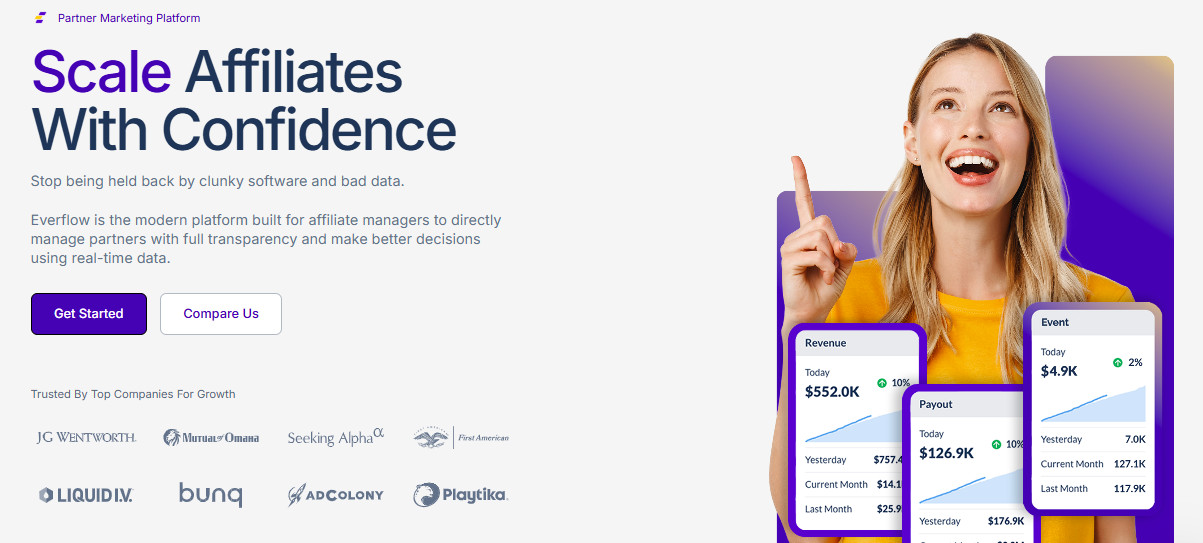
Everflow is the platform I would prioritize for peptide brands already dealing with volume, a growing partner base, or a stronger need for attribution clarity. Its pitch is built around partner marketing operations rather than a simple affiliate dashboard, and that usually fits brands that have outgrown lighter tools.
Everflow combines tracking, reporting, partner management, automation, and payments in one system, which matters a lot when the alternative is piecing together separate tools and waiting for the data to reconcile later.
What makes Everflow especially relevant here is the combination of e-commerce fraud tools and product-level reporting. The fraud guidance for e-commerce brands is practical because it gets into the kinds of abuse patterns that online brands actually run into, including coupon poaching and masked traffic/VPN usage.
The Products Report also goes beyond a generic affiliate summary, providing SKU-level sales and partner performance visibility, while the Refunds Report lets teams track refund patterns by product, partner, and promotional channel. For peptide brands with uneven margins, recurring purchases, or product-specific refund issues, that kind of reporting tends to matter more than a broad performance graph that doesn’t show partner-level detail.
Everflow also aligns well with brands that want direct partner ownership rather than relying heavily on a network environment. That usually becomes more important as a program matures and the brand wants tighter control over data, relationships, and payout operations. The tradeoff is that Everflow is not the lightest option on this list. It makes more sense for teams that already know they need a more robust setup.
Read our full Everflow review here: Everflow Review (2025): The Affiliate & Partner Management Platform That Goes Beyond Tracking
Best for Large Partnership Programs: impact.com

impact.com is the strongest alternative if you want a partnership platform with a large marketplace and a heavier emphasis on tracking and service. Its platform supports unlimited tracking across events, including leads, installs, bookings, and more, and its higher tiers add customer-value reporting, partner contribution reporting, partner deduplication, fraud scoring, and anomaly detection. It also supports automated commission structures in 70-plus currencies and cross-device tracking.
For peptide brands, impact.com usually makes the most sense when your affiliate program is part of a wider partnerships strategy rather than a small, focused affiliate operation. If your team wants access to a larger partner ecosystem and is open to a broader, more enterprise-style system, impact.com is a serious option.
The tradeoff is that it can be more than some brands need. If your main concern is tighter attribution, cleaner e-commerce reporting, and more control within a data-first system, Everflow often feels like the more direct fit. While impact.com is a great option, it may not align perfectly with the daily needs of some direct-to-consumer supplement brands.
Best for Network and Performance Teams that Want Flexibility: Affise

Affise is a strong contender for brands that want a performance-oriented platform with real-time analytics, fraud prevention, and automated payouts, especially if your team has a more network-like operating style or expects to manage a large number of traffic partners. Affise gives teams visibility into clicks, leads, and conversions, with fraud protection and partner tracking built into the platform. Affise also supports multi-currency payout automation through Affise Pay, which is useful if you’re paying partners across multiple regions.
Where Affise tends to make sense is when you want a modern partner platform but care more about performance operations at scale than e-commerce-specific reporting, like product refund analysis. That can work well for peptide brands with a broad partner base and a strong focus on acquisition.
The tradeoff is that Affise is not quite as directly tailored to e-commerce reporting as other platforms like Everflow, which may matter if your team wants deeper visibility into product-level performance, refunds, and partner-level trends.
Best for Teams That Want Control and Customization: TUNE

TUNE still has a strong case for brands that care deeply about owning their program infrastructure, customizing workflows, and maintaining a high degree of control over their relationships with partners. TUNE is built for brands, agencies, and networks that want flexibility and control, and it backs that up with a large API, event tracing, proactive fraud prevention, reporting, and configurable payout rules. It also includes dedicated reporting on partner fraud and conversion history, making it more suitable for serious affiliate teams than lighter e-commerce tools.
For peptide brands, TUNE usually stands out when your in-house team is more technical or more particular about building around your own processes. The limitation is that global payout convenience looks a bit less polished than what you get with Everflow or impact.com. TUNE absolutely supports international payout workflows, but global payments are not its strongest area. Compared with Everflow, impact.com, and Affise, it is the weaker fit if your brand needs to pay partners across multiple countries or currencies.
Best Lighter Option If You Do Not Need a Heavy Platform: Refersion
Refersion is the easiest platform to understand here. It is a simpler affiliate tracking and management platform that automates referrals, commissions, and payouts, and integrates with e-commerce systems to track sales back to affiliates. If your peptide brand is still relatively early, has a manageable partner base, and does not yet need advanced event tracking or deep fraud analysis, Refersion may be enough for now.
That said, Refersion is more likely to serve as a temporary solution rather than a permanent platform for companies seeking to scale partner marketing. Once the team starts asking harder questions around attribution quality, it usually ends up back in the platform bucket.
Final Verdict
The best affiliate software for peptides is usually the platform that helps you trust your data and follow the revenue trail wherever it leads. If you are running a high-volume peptide or longevity supplement program and you want the most balanced mix of e-commerce reporting, attribution depth, fraud controls, automation, and global payout, Everflow is the strongest pick.
impact.com is a strong option for brands with a bigger partnership strategy and a greater emphasis on scale. Affise is a solid fit for performance-driven teams seeking a modern platform with robust fraud and payout coverage. TUNE makes sense for teams that need flexibility and customized systems. Refersion is fine for simpler programs, but it is less compelling once the program becomes data-heavy.
For the specific buyer behind this search, I would frame the decision pretty simply: If your peptide brand is already seeing enough volume that bad attribution, weak fraud checks, or payout problems can make your data fuzzy, you are probably past the point where a basic affiliate tool is enough. That is where a platform like Everflow stands out. It gives your team a better shot at understanding which partners actually drive durable revenue, where the risk is coming from, and how to scale the program without losing control of the data.