


Last Updated on November 4, 2026 by The Digital Merchant Team
Levanta has built the kind of infrastructure serious e-commerce brands need to run affiliate programs at scale, and it shows in the depth of what the platform can do today. But there’s a different flavor of affiliate platform gaining traction with brands, and Wayward is one of the more interesting examples. Instead of handing you a dashboard to run your own program, Wayward tells brands, “Let us handle it.”
Creators get their own branded storefronts stocked with your products, Wayward’s algorithm does the matchmaking, and orders land in your existing store. That’s an appealing pitch to an over-extended brand manager with more revenue potential than bandwidth, and it raises the question that decides this comparison: how much control are you willing to hand over in exchange for how little effort?
Levanta and Wayward sit at opposite ends of that question. Each is built for a different kind of brand, so it pays to be clear-eyed about which approach you want before you choose.
Levanta vs. Wayward At a Glance
Questions | Levanta | Wayward |
Creator scouting | Search a 90K+ creator marketplace or do your own recruiting | Wayward’s algorithm matches you automatically |
Creator management | Direct relationships you build and control | Wayward mediates; creators operate somewhat independently |
Pricing | Monthly fee + % of sales | $0/mo + 5% of affiliate revenue |
Sales channels | Amazon, Shopify, Walmart, Wayfair , TikTok Shop | Amazon, Walmart, Shopify (creator-storefront model) |
Content approval | No general pre-approval process for performance-based content. For paid placements, brands can review and approve content before it goes live. | No, creators control their own content and merchandising |
Recruit your own creators | Yes, find them in the marketplace, or bring / find your own from outside | No, you only work with who Wayward matches you with |
Custom contracts | Yes, use your own or use/modify a Levanta template | No, standard ongoing terms with 72-hour cancellation notice |
Reporting depth | Real-time, cart adds, new-to-brand, halo effect, BSR, ROAS, cross-channel | Weekly performance snapshot alongside payout |
Effort required | Higher — you’re running a program | Lower — Wayward runs it for you |
Wayward
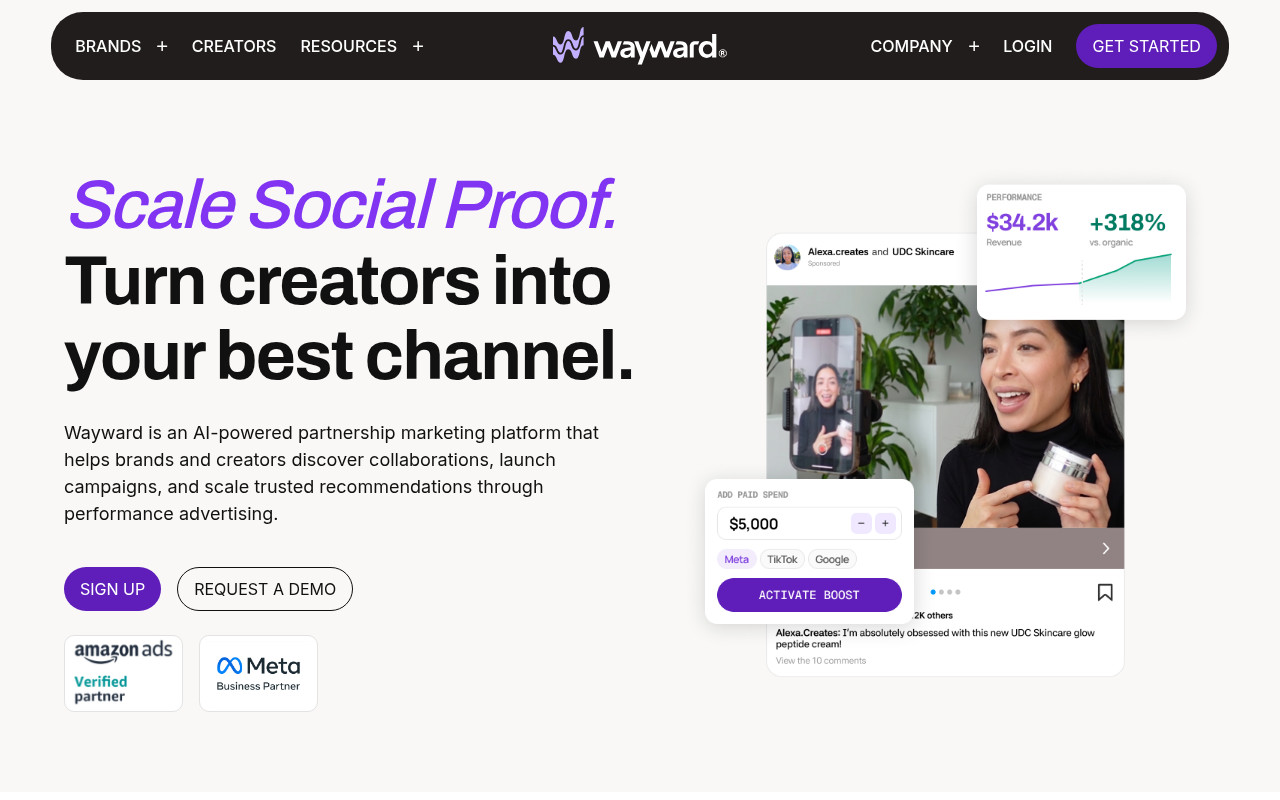
Wayward is built for a brand that wants affiliate revenue without wanting to run an affiliate program – a largely hands-off solution in which you trade time and control for low input growth. If that’s an option that appeals to you, Wayward is a platform to explore. Here’s how it breaks down.
How the model works
You connect your Amazon, Walmart, or Shopify store, and Wayward’s own network of creators and publishers takes it from there. There’s no recruiting step on your side, because Wayward’s algorithm does the matchmaking.
On the Shopify side specifically, Wayward doesn’t use traditional affiliate links. Creators sell your products directly from their own personalized storefronts, Wayward handles the checkout experience and the taxes, and orders show up for you to fulfill the same way any other order would. Wayward calls this “zero extra effort,” a fair description for the service they offer.
Pricing and payments
This is performance-based pricing done right: no monthly fee, just 5% of affiliate revenue, so there’s no limited risk in trying it.
Wayward pays out weekly by ACH and handles creator payments directly, according to the commission structure you set. You can set rates and discounts across the board, by creator, or by product, which is more flexibility than the hands-off pitch suggests.
The creator network
The network includes editorial partners like The Strategist and NBC Select alongside thousands of individual influencers, which is a meaningfully different flavor of reach than a typical affiliate program.
Wayward also says it favors creators with real expertise in a niche over general lifestyle influencers, and describes its approach as selective. The tradeoff is that you’re exclusively working with Wayward’s pool, and there’s no clear path to bringing your own creators onto the platform.
Paid media via Boost
Wayward’s newer Boost product, still in beta as of this writing, takes creator content that’s already converting and turns it into paid media across Meta, TikTok, and Google. It’s a distinct capability to keep your eye on, even if it’s not fully mature yet.
Control over creators and content
According to Wayward’s FAQ, brands don’t get much say in how their products are marketed or presented once a creator relationship is underway. Creators have full control over the content and merchandising around your product, with no approval step on the brand’s side before it goes live. There are also no exclusivity limits, so a creator can feature a competing product in the same storefront.
The tradeoff is that brands have less direct control over how creators present their products. If a partnership isn’t working, Wayward says brands can end it with at least 72 hours’ notice. Changes to the creator roster are handled through a dedicated Customer Success representative rather than directly by the brand.
Reporting and customer data
Reporting comes as a weekly snapshot delivered alongside your payout rather than a live dashboard you can dig into whenever you want. Wayward says on-demand access in your account is coming.
On the Shopify storefront side, there’s a real plus here: brands receive contact information for customers who haven’t opted out of marketing emails, and can email them directly.
Levanta
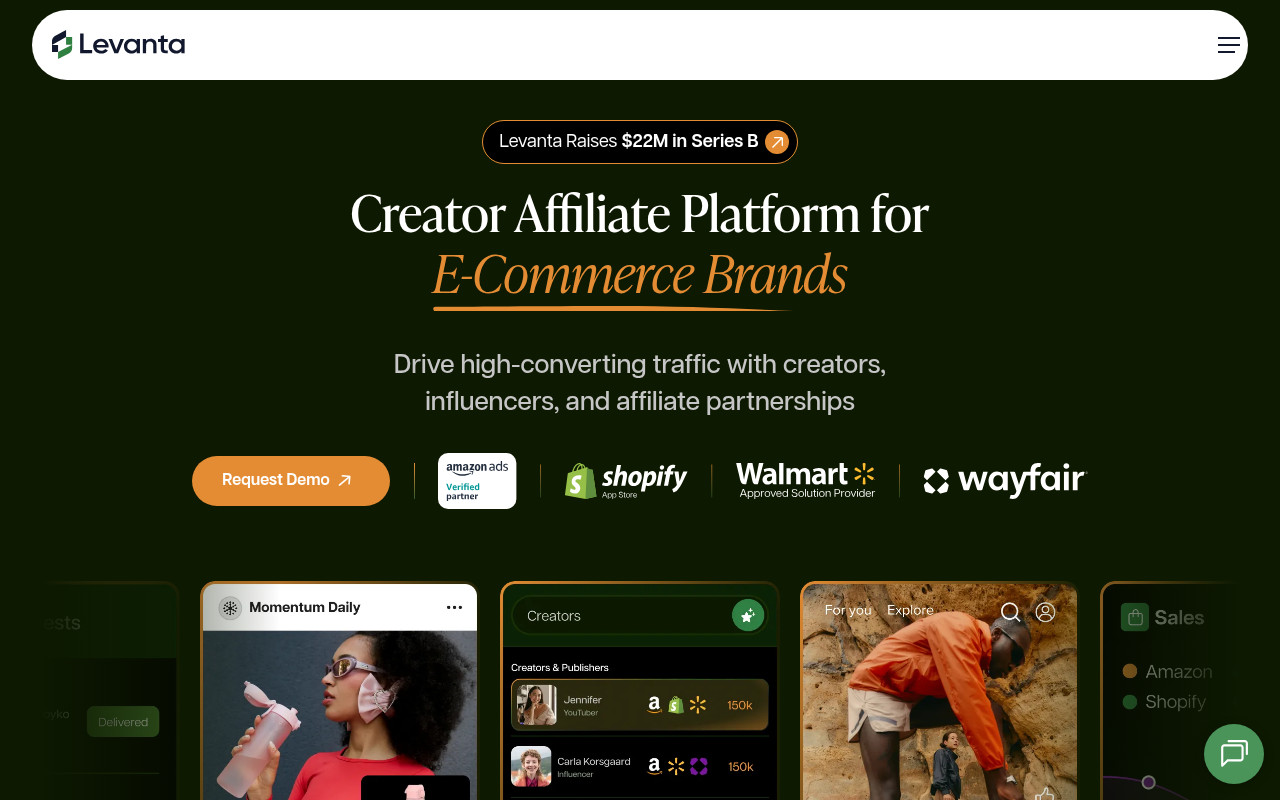
Levanta is built for a brand that wants to choose its partners, control its content, negotiate its own terms, and use the data to get smarter over time. It asks more of you in return: it takes more time to learn and run than a hands-off model, so it suits a brand with the bandwidth to use what it offers.
How the model works
Levanta provides the infrastructure (tracked links, payments, reporting), and you run the program. You choose which creators represent your brand, either by reviewing each applicant or by turning on auto-approval if you’d rather move faster. Links can point to individual product pages or to your storefront, and deep linking is supported.
Pricing and payments
Levanta’s costs are calculated differently than Wayward: they start with a monthly fee plus a percentage of sales, charged to the brand and not deducted from creator earnings.
Qualified brands may be offered a lower introductory price, so it’s worth signing up for a demo and asking about a trial before sticker shock makes the decision for you. Payments to creators are automated, and Levanta handles the paperwork, including filing 1099s.
The creator network
Levanta maintains a marketplace of more than 90,000 vetted creators actively looking for brand partnerships, and unlike Wayward, that’s not the only door in. You can recruit your own creators from outside the platform and bring them in alongside whomever you find in the marketplace.
A customizable branded landing page and a referral program help you invite and grow your own roster. Nobody is blind matching you with partners behind the scenes: you can scout the entire marketplace, and you choose who reps your brand.
Channels and tools
Levanta supports Amazon, Shopify, Wayfair, TikTok Shop and Walmart in one unified dashboard with cross-channel reporting, so you’re not managing three separate relationships to cover three channels. That makes it relevant not only to Amazon-focused brands, but also to Shopify-first businesses building an affiliate program and brands expanding their creator strategy across channels.
Levanta also offers an iOS app for managing creator relationships on the go, along with an MCP server for paid-plan users. The read-only integration connects Levanta to Claude or ChatGPT, allowing brands to ask questions about their performance data and explore insights without changing anything in their account.
Levanta integrates directly with Amazon’s API to help brands connect creator and affiliate activity to sales. Performance tracking at the individual product (ASIN) level helps teams see which partnerships and products are contributing revenue, so they can make more informed decisions about where to invest.
Control over creators and content
This is where the philosophy of self-management shows most. You can set different commission rates for your best-performing creator versus a newer one, by individual creator, by creator type, or by product. You can use your own contract language instead of a standard template, run paid placements under contract, and send free product to creators and track it in your dashboard.
For paid placements, you review and approve content before it goes live, which gives you a say in a way that Wayward’s model doesn’t. Creator content can also be reused in your own ads when that’s covered by a contract.
Reporting
Levanta reports ROAS and shows cart adds that don’t convert, so you can see how many people almost bought and didn’t.
New-to-brand tracking tells you whether you’re reaching new customers or recycling existing ones, and you can see the halo effect across your whole catalog and movement in Best Seller Rank, all in one cross-channel view. That’s the kind of data that lets you understand what’s working for your brand (or not) and steer your strategy accordingly.
Levanta vs Wayward: The Price Comparison
Wayward’s $0 monthly fee and 5% affiliate revenue fee is a structural advantage on paper for brands that want to test creator-driven sales without committing to a monthly subscription. Levanta, by comparison, charges a monthly fee plus a percentage of sales, making it a more substantial investment upfront.
But pricing is only part of the equation; the two platforms offer different approaches to affiliate marketing. Wayward prioritizes convenience by managing creator matching and much of the operational process for you. Levanta gives brands more control over creator selection, partnership terms, and campaign performance, with reporting tools to help them understand what’s driving sales and refine their strategy over time.
For brands that are just beginning to explore creator-driven sales and have limited resources to manage a program, Wayward’s hands-off model makes sense. For brands looking to build and scale an affiliate program around their own goals, relationships, and performance data, Levanta’s greater control and management capabilities may justify the additional investment.
Which Option Is Right For You?
If you want affiliate revenue with minimal day-to-day involvement and are comfortable delegating creator matching and much of the program management, Wayward may be a good fit. It offers a model without a monthly subscription fee, charging instead a percentage of affiliate revenue.
If you want to build a strategic and careful affiliate program, one where you choose your partners, control your content, negotiate your own terms, and have the data you need to get smarter over time, Levanta is built for that job in a way Wayward, by its own design, is not.