


Last Updated on September 20, 2026 by Ewen Finser
Ask three accounting vendors what their AI does to the general ledger, and you will get three answers that sound identical but mean entirely different things. One means a categorization model that guesses the account based on a bank feed line. Another means a chat interface that drafts an invoice when you describe it in a sentence. A third means software that collects, books, reconciles, and reviews continuously and hands the accountant only what it could not resolve. All three get marketed under the same phrase, and as you can tell, they’re all very different.
A tool that suggests coding still requires a human to look at every suggestion, which means the review work stays put and only the typing goes away. A system that posts within a confidence band and escalates the remainder removes the review step for the majority of lines. Same language on the website, but very different staffing math underneath.
The Bottom Line Up Front

AI general ledger automation is really four separate capabilities: transaction coding, reconciliation, accrual scheduling, and quality review. In my opinion, vendors implement them at very different depths. The useful evaluation question is not whose accuracy number is highest. It is whether the system will post without asking, whether it shows its work well enough to undergo an audit, and whether it covers the accrual and schedule work that actually keeps close cycles long. Most platforms answer the first two reasonably well. Far fewer answer the third.
What’s Behind the Marketing

Ledger automation has existed for years in the form of bank rules. If the memo contains “SHELL,” code it to fuel. Rules are deterministic and completely transparent, which is why accountants love them, but they’re brittle in exactly the way you would expect, which is why every firm has a client file with 200 rules and a suspense account full of the transactions none of them caught.
What’s changed with the introduction of AI is the substitution of learned models for handwritten conditions. Instead of matching a string, the system evaluates the vendor, amount, account it hit, history of similar transactions in that file, and coding patterns of comparable businesses, then produces both a proposed account and a confidence score. A rule either fires or does not. A model tells you how sure it is, and that is what lets software decide whether to post silently, flag for review, or stop and ask a human for help.
Sitting even further above that is a newer architectural idea: AI agents that chain several of these judgments into a workflow without a human triggering each step. The ledger does not wait to be asked. It watches transactions arrive and runs the appropriate process against them. That is the real dividing line in the current market. It’s not whether a platform has AI but whether its AI is something you invoke or something that runs in the background.
Real-Time Coding
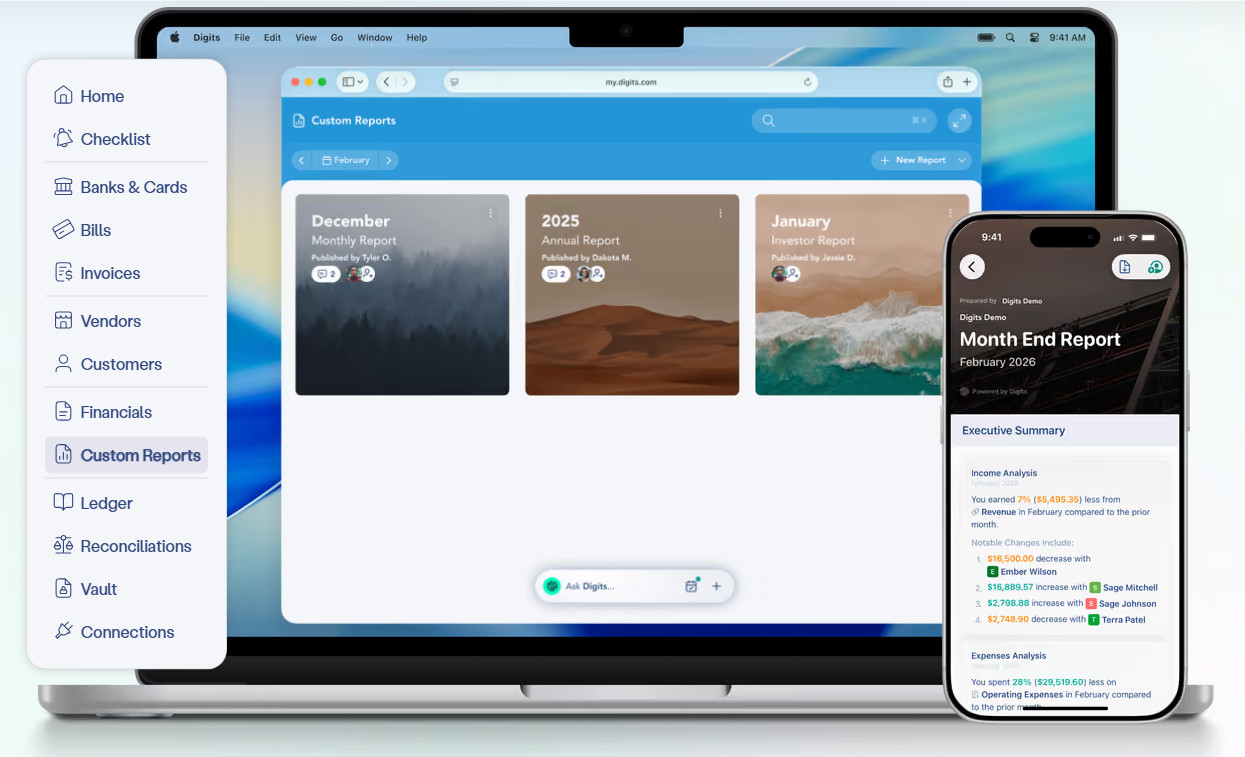
Transaction coding is where automation is most mature and the accuracy claims cluster. The mechanics are straightforward: A transaction enters through a bank or card feed, or through a document the client photographs or emails in, and the model proposes the account, the class or department, and often the vendor record, before anyone opens the file.
The depth of training data is the main differentiator, and it is one worth interrogating. Digits, for instance, which built its Agentic General Ledger (AGL) around this mindset, says its models were trained on roughly 180 million transactions representing about a trillion dollars of real financial activity. However, let’s treat vendor-run benchmarks as directional rather than definitive, because the test design belongs to the party with an interest in the result. However, the underlying point holds. Coding is a pattern-recognition problem, and pattern recognition improves with volume.
QuickBooks Online approaches the same job through its Accounting Agent, one of seven agents Intuit rolled out beginning in mid-2025, which categorizes transactions, assists with reconciliation, and flags anomalies. Access is tiered by subscription level, and Intuit’s own guidance to accounting professionals is to review agent output before posting. Xero’s assistant, JAX, predicts reconciliation matches and drafts invoices from plain language, with autonomy that depends on account configuration rather than applying uniformly. In each case the model does the reading; the question is what happens next.
That next step is the one to test during a demo. Ask what the platform does with a transaction it is 60% confident about versus one it is 99% confident about, and whether you as the accountant can set that threshold. A system that posts everything and lets you clean up afterward is not the same product as one that posts the top band, queues the middle, and routes the bottom to a client question, even though both will be described as automatic coding.
Reconciliation as a Continuous Process

Reconciliation automation is where the workflow framing really pays off, because reconciling is not one task but a sequence: Retrieve the statement, match the feed to the ledger, investigate the differences, document the result.
Most platforms automate the middle of that sequence. NetSuite’s 2026.2 release is a good illustration of the mature enterprise version. For instance, an AI matching assistant recommends a single likely GL transaction when several candidates exist and explains its reasoning. It also presents a space that surfaces up to five alternatives for ambiguous items and narrative summaries that call out unmatched and aging transactions. The matching is automated. The accountant still drives the process.
The more aggressive design automates the beginning and end as well. Digits’s AGL initiates reconciliations on its own, pulls statements directly from supported institutions, matches the feed against ledger data, and surfaces duplicates and anomalies as exceptions rather than as a list to work through. The difference is that reconciliation stops being a scheduled event that someone remembers to start and becomes a background state the ledger maintains, with the accountant’s attention going only to the items that broke.
For firms carrying dozens of client files, the time savings of this cannot be understated. The cost of a monthly close is rarely concentrated in the matching. It is in the coordination of chasing statements, remembering which entities are done, and discovering on the 12th that a feed disconnected on the 3rd. All of this can go away if you have continuous reconciliation in place.
Accrual Schedules: The Most Difficult Part
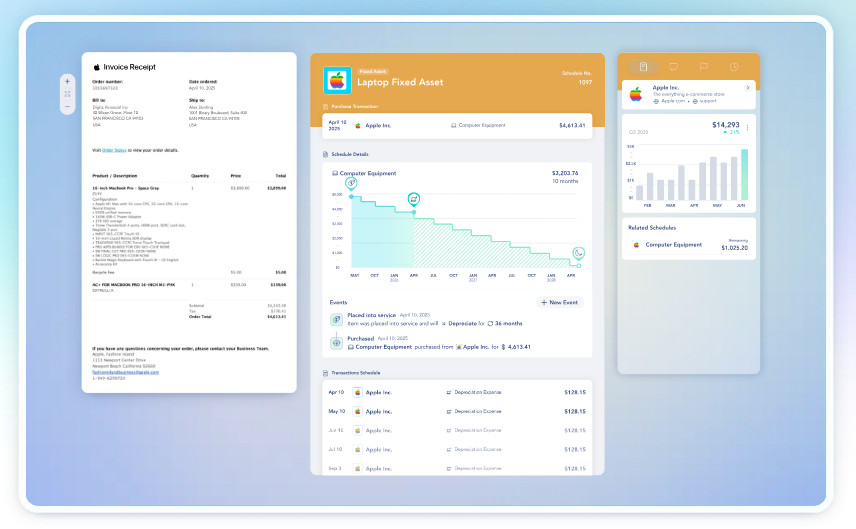
Here is where the category separates, and where buyers should focus their diligence, because this is the work that genuinely extends a close.
Fixed-asset depreciation, prepaid amortization, deferred revenue, and accrued expenses all sound scary, and they can be tough for a business owner to work through. However, fear not. The calculations are deterministic and the entries are predictable, which makes them ideal automation candidates.
Yet in most environments they live outside the ledger entirely, in a workpaper or a spreadsheet that someone recalculates, ties out, and re-enters every period (guilty as charged). AI coding does nothing for that. Neither does reconciliation matching. The schedule is a parallel system, and its maintenance is manual regardless of how smart the transaction feed has become.
A few platforms have started pulling schedules inside. Digits launched exactly this in May 2026. The ledger detects a transaction requiring accrual treatment, drafts the supporting schedule with its assumptions and projected entries, and, once the accountant approves, posts the recurring entries automatically for the life of the schedule. It shipped covering fixed assets and prepaid expenses, with revenue recognition and accrued expenses on the roadmap, so the coverage is out there but not yet complete.
Regardless of who builds it, the structural argument is sound: Keeping the schedule, its source document, and its entries in one place eliminates the reconciliation between the workpaper and the ledger, which is a category of error that consumes real time and appears in review notes constantly. When evaluating any platform’s automation claims, ask specifically about schedules. It is the fastest way to distinguish a categorization tool from a close system.
Review Controls and Defining What “Autonomous” Means

Automation that posts without review only works if something is watching the postings. The current answer is always-on checking. That requires you to do continuous monitoring for balance anomalies, unusually large transactions, spending outside normal patterns, and duplicate entries as transactions arrive rather than as a month-end review step.
“Autonomous” should not mean the software improvises and no one ever checks what’s happening. It should mean the software executes defined work without being prompted, produces an auditable trail for every posting, and escalates anything outside its parameters. Ask any vendor to show you the audit trail on an automatically posted entry. They should be able to show what the system saw, what it concluded, and why it was confident. If that record is thin, the automation is a liability regardless of its accuracy.
So What Can AI in a GL Do for You?

My summary is that AI general ledger automation is further along than skeptics assume and less complete than the marketing implies. Transaction coding works well and is broadly available. Reconciliation matching is solid across the board, though only some platforms run the full cycle unprompted. Accrual scheduling is where the real time savings sit and where coverage is thinnest, so it’s worth weighing heavily in any evaluation.
The firms getting the most out of this are not the ones that bought the highest accuracy score. They are the ones that figured out which specific step of their close was the bottleneck and then asked whether the platform in front of them actually automates that step or just the data entry around it.