


- Bottom Line Up Front
- How I Ranked AI Call Tools for Insurance Agencies (5 Criteria Questions)
- 1. Aircall: Best Overall AI Call Platform for Insurance Agencies
- 2. Insurvoice: Best Insurance-Specific AI Receptionist
- 3. Bland AI: Best for High-Volume Insurance Call Automation
- 4. Dialpad: Best for Larger Insurance Teams That Need More Governance
- 5. Synthflow: Best for Building a Customized Insurance Call Workflow
- The Licensed-Human Handoff Should Be Part of the Buying Decision
- Which AI Call Tool Should an Insurance Agency Choose?
Last Updated on October 9, 2026 by Ewen Finser
Insurance agencies do not need another AI tool that summarizes a PDF or writes a follow-up email; the bigger opportunity is much closer to the phone. A prospect calls after hours, a policyholder wants an ID card, someone needs to report a claim, and another caller has a billing question. The producer is already on a call, and the service team has six people waiting. The best AI for insurance agents should help with that traffic without creating a second layer of problems behind the active work.
For this list, I focused specifically on AI tools that can work around the call itself. I looked at whether they can answer when your staff cannot, collect the information your team needs, connect the conversation to a CRM or agency workflow, hand a caller to a real person when necessary, and avoid bluffing when the question goes beyond what the AI should handle. A good AI phone agent does not need to pretend it is a licensed producer, but it does need to know when it has reached the edge of its job.
Bottom Line Up Front
My picks are:
Tool | Best For |
Aircall | AI call handling connected to the phone system, CRM, and human team |
Insurvoice | Insurance-specific option for independent agencies |
Bland AI | High-volume insurance call automation |
Dialpad | Larger insurance operations that need strong governance and contact-center controls |
Synthflow | Teams that want to build more customized voice workflows |
If the goal is simply to put an AI receptionist in front of the existing agency, Insurvoice has this as a specialized option. But if the goal is to improve the whole call workflow around the humans already handling sales and service, I believe Aircall is the stronger overall fit.
How I Ranked AI Call Tools for Insurance Agencies (5 Criteria Questions)

Does it answer calls around the clock?
- Insurance calls do not conveniently stop at 5:00 PM on Friday. A new prospect may call at 7:30 PM, or a policyholder may have an accident on Saturday. The AI does not necessarily need to solve everything, but somebody or something should answer.
Can it capture the information the agency needs?
- The call itself is rarely the entire workflow in an insurance agency. A caller may need to be identified, asked a few questions, routed to the appropriate person, documented, and followed up with later.
Where does that information go?
- If the AI takes a beautiful set of notes and then somebody has to copy them into the CRM Monday morning, you have automated the conversation and kept the administrative work.
Can a human take over cleanly?
- For me, this is a major dividing line. When a call reaches something the AI should not handle, the transition should feel like a handoff, not a restart.
What happens when the AI does not know?
- The correct answer is not, “It makes something up confidently.” A system needs a defined fallback: transfer the caller, create a follow-up, take a message, or route the conversation to somebody qualified to handle it.
With those criteria in mind, here is where I would start.
1. Aircall: Best Overall AI Call Platform for Insurance Agencies
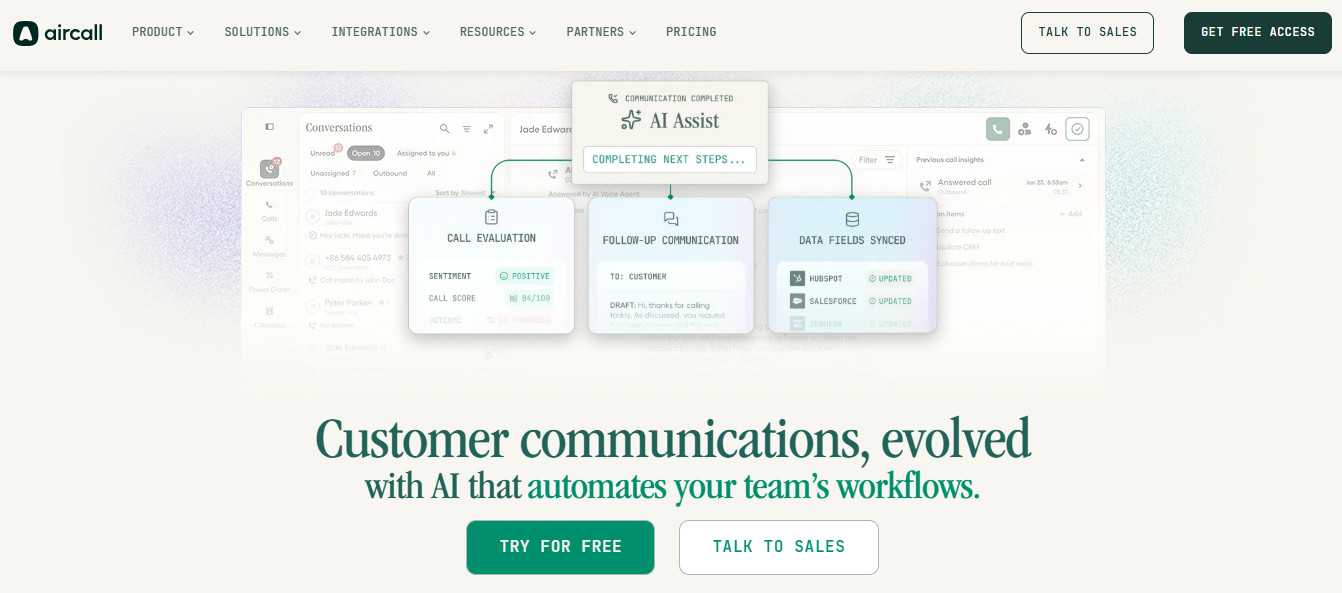
Aircall is my best overall pick because it solves more than the “AI answers the phone” part of the problem. Aircall combines AI Agents, a business phone system, CRM and help desk integrations, call routing, messaging, analytics, and human agent workflows in one platform.
Its current platform connects with more than 250 business tools, including Salesforce, HubSpot, Pipedrive, Zendesk, and monday.com. Aircall’s positioning is specifically built around connecting conversations to the systems the team already works in rather than treating the AI agent as a standalone bot.
For inbound coverage, Aircall’s AI Voice Agents can answer calls immediately, handle routine requests, gather caller information, and escalate conversations to a person with the context already captured. The platform also supports after-hours and peak-volume coverage.
That handoff is the part I care about most for an insurance agency. Say somebody calls wanting proof of insurance. An AI agent may be able to identify the request and collect the necessary information, but that is a much different conversation from somebody asking whether a specific loss is covered under a policy. The system needs to recognize that difference and get the second caller to the right human rather than trying to be clever.
Aircall also goes beyond the autonomous calls, its AI-assisted tools can transcribe conversations, identify topics and sentiment, summarize calls, update CRM records, and automate follow-up work after the conversation ends, which is why I rank it ahead of a standalone voice bot.
Best for: Growing agencies and insurance teams that already rely heavily on phones and want AI to work inside the existing sales and service workflow.
The tradeoff: If all you want is an inexpensive AI receptionist for a three-person office, Aircall may be more platform than you need. It makes more sense when the phone system, integrations, human team, and AI all need to work together. Aircall is built for teams rather than individual agents or freelancers, which is an important distinction in its own positioning.
2. Insurvoice: Best Insurance-Specific AI Receptionist
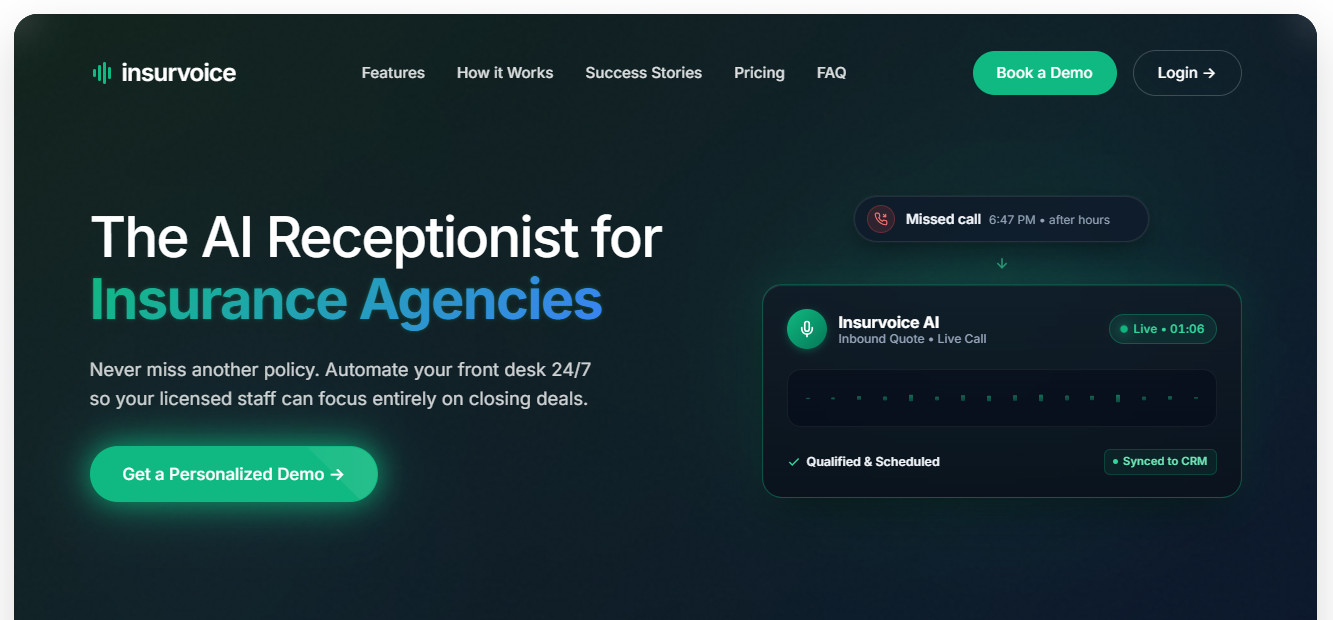
Insurvoice takes almost the opposite approach. Instead of building a broad customer-communications platform and adapting it to insurance, it is designed specifically around independent insurance agencies.
That gives it an advantage if your biggest requirement is connecting AI phone handling directly to insurance workflows. Its current integrations include agency systems such as HawkSoft, EZLynx, AMS360, Applied Epic, and QQCatalyst, alongside Salesforce and HubSpot. It supports use cases including quote intake, first notice of loss, policy renewals, endorsements, lead follow-up, and live transfers; services that are closer to the language an independent agency uses every day.
I would look closely at Insurvoice if the problem is something like this: Your staff is spending too much time answering routine service calls, good leads are arriving after hours, and you want those conversations written back into the AMS without creating another manual process. It also supports warm handoffs and appointment scheduling, which makes it better suited to lead intake than an AI system that simply takes a message.
The biggest advantage and limitation simultaneously is its specialization. While Aircall gives you a broader communications platform for human and AI teams, Insurvoice is much more tightly focused on automating insurance-agency workflows. Which one is better depends on whether you are primarily replacing front-desk work or rebuilding how the agency handles communications more broadly.
It is worth noting that Insurvoice only started in 2025, and while it appears to be positively reviewed so far, there may still be hiccups and growing pains as the company continues to evolve its offering.
Best for: Independent insurance agencies that want an AI receptionist tied directly into common agency-management systems.
The tradeoff: It is a more specialized product, so I would scrutinize how it fits your existing phone infrastructure, reporting requirements, and broader communication stack before assuming industry specialization automatically makes it the best choice.
3. Bland AI: Best for High-Volume Insurance Call Automation
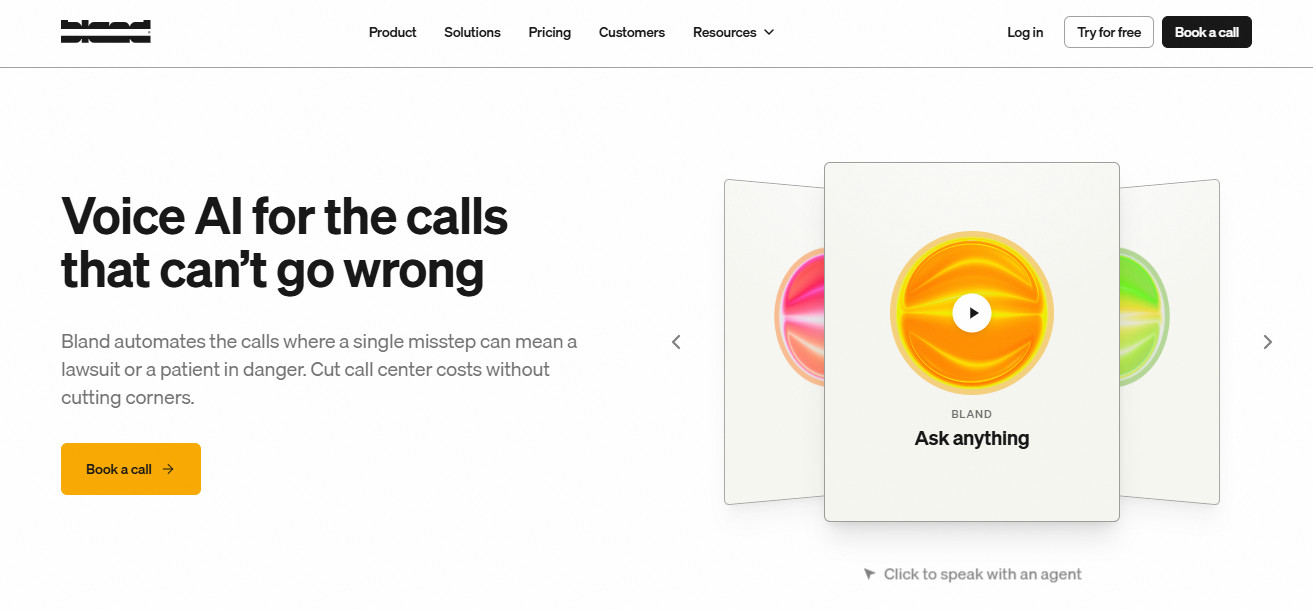
Bland AI belongs on this list because it has unusually concrete insurance use cases. The company is running voice AI for insurance workflows including lead qualification, claims intake, policy servicing, renewals, preliminary quoting, and payment handling. Its insurance materials also specifically describe transferring callers to human agents with context.
There is a particularly relevant example from a Florida health insurance agency using Bland for large-scale outbound lead qualification. The AI confirms the person’s identity, verifies interest, checks location information, and then warm-transfers qualified prospects to licensed agents; the live agent gets context before taking over. That is the right division of labor, let the AI do the repetitive qualification work and the licensed producer handle the conversation where professional judgment and selling skills matter.
Bland is also built for substantial call volume and emphasizes regulated industries, security, call routing, CRM connections, and configurable workflows.
I would put Bland ahead of most general AI voice tools when an insurer, brokerage, or large agency has a very specific process it wants to automate at scale. But there are some complaints about the complexity of its billing and the involved nature of the initial setup.
Best for: High-volume agencies, brokerages, and insurance organizations automating repeatable inbound or outbound call workflows.
The tradeoff: Bland is closer to infrastructure than a simple plug-and-play agency receptionist. If you just need somebody to answer the phone tomorrow, there are simpler choices.
4. Dialpad: Best for Larger Insurance Teams That Need More Governance
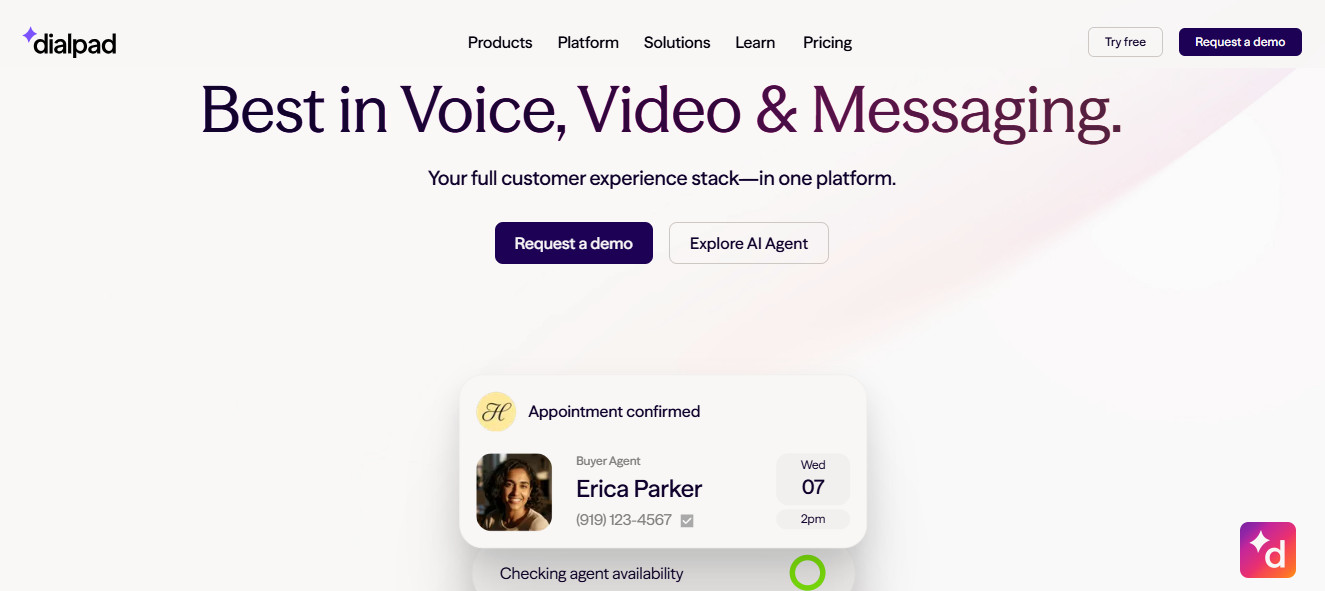
Dialpad’s best-fit use case is probably for a larger insurance contact center. Its insurance-specific AI Agents can handle policy inquiries, claims intake, billing questions, renewals, after-hours support, and call triage. The system can gather information, identify caller intent, trigger configured actions, and hand a conversation to a person with context.
Where Dialpad becomes such a strong choice is in governance. Insurance companies are not just asking whether the bot works. They also need to know what it did, why a call went down a certain path, and whether automated interactions are following the organization’s rules.
Dialpad currently highlights tools for testing AI agents before deployment, controlling access, maintaining audit trails, and monitoring automated activity. That makes more sense for a 100-seat operation than it does for an independent agent with two CSRs. Dialpad also brings transcripts, AI recaps, omnichannel communication, CRM integrations, and live human-agent capabilities into the same broader platform.
Best for: Larger insurance organizations and contact centers where governance, QA, and visibility into automated conversations matter as much as answering the call.
The tradeoff: Smaller agencies may be buying controls and infrastructure they do not need.
5. Synthflow: Best for Building a Customized Insurance Call Workflow
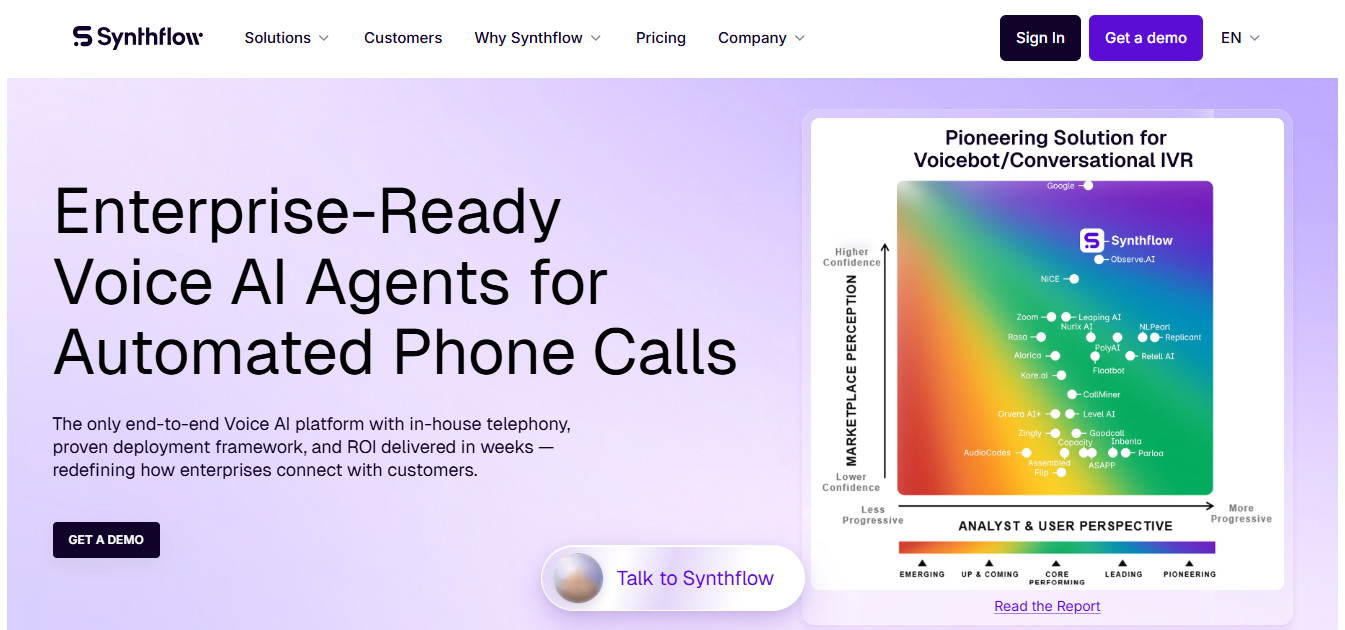
Synthflow is the option I would look at when none of the more packaged products quite matches the process you want. Its financial-services and insurance offering supports always-on voice agents for account requests, claims-related workflows, caller verification, and live transfers. When it transfers a conversation, it can pass along transcripts, caller history, and context rather than making the human agent start over.
The appeal here is flexibility. Maybe you have a very particular intake workflow, multiple business lines, or unusual routing logic. A configurable voice platform gives you more room to build around the agency rather than changing the agency to fit the software.
That flexibility comes with an obvious cost. Somebody has to design the workflow and you need to decide what the AI is allowed to answer, what information it should collect, when it should transfer, what goes into the CRM, and what happens when it reaches an exception.
Best for: Insurance organizations with a clearly defined call process that want more control over how the AI agent behaves.
The tradeoff: More flexibility generally means more setup and more responsibility for getting the workflow right.
The Licensed-Human Handoff Should Be Part of the Buying Decision

This is the part I would spend the most time testing before choosing any of these platforms. Do not just ask the demo AI an easy question. Give it something outside its knowledge, interrupt it, change the subject halfway through, ask for something the system is not configured to provide and then see what happens.
For insurance, the goal should not be an AI that finds a creative answer to every question. The better system is the one that understands what it can handle, collects what the human needs, and gets out of the way at the right time.
The producer should spend less time asking for the caller’s name, digging through notes, updating the CRM, or returning basic after-hours messages. Allowing them to focus on the parts of insurance where people are calling because they need judgment, reassurance, explanation, or a real decision.
Which AI Call Tool Should an Insurance Agency Choose?
I believe Aircall is the best AI for most growing insurance teams because it connects the AI call handling to the rest of the communication workflow. Aircall answers routine calls with AI, connects conversation data to CRM and help desk tools, and escalates callers to human team members with context when needed. Its AI capabilities sit inside the same platform as the phone system, routing, messaging, analytics, and human-agent tools, which means fewer seams to manage.
Insurvoice would move ahead of it for an independent agency that specifically wants deep into AMS-oriented automation and an insurance-trained receptionist. Bland would be high on my list for large, repeatable calling workflows where volume is the main challenge. Dialpad makes the most sense when governance and contact-center operations are major requirements. Synthflow is the one I would prioritize when the workflow itself needs to be heavily customized. But I would not choose any of them based on how human the demo voice sounds.
I would not center my choice on which product offers the most life-like voice, but on what happens when a real policyholder calls at 7:42 PM, asks something the AI cannot answer, and needs somebody licensed to take over. If the system can recognize that moment, preserve the context, route the call correctly, and leave the CRM in better shape than it found it, then the AI is doing something valuable. If it just sounds impressive on the phone, you bought a demo.