


Last Updated on July 25, 2026 by Ewen Finser
Whether you are outfitting 50 corporate volunteers, 300 festival attendees, or a full conference team, the shirt decision follows the same basic logic. You have the date, the headcount, and the budget and now you need a printer that can deliver on all three without leaving you scrambling the week before your event.
This guide is for event organizers who are past the browsing stage and ready to make a decision. Here’s what we’ll cover:
- What “bulk” actually means at different event scales
- How vendor selection should shift as your order size grows
- What to look for in deadline reliability
- How to evaluate design and approval workflows before you’re under the clock
What “Bulk” Actually Means at Different Event Scales
Bulk custom shirts are not just one category. The volume you are ordering changes almost every variable: pricing, vendor selection, turnaround expectations, and how much risk you are carrying if something goes wrong.
Small Batch (6-50 Pieces):
The sweet spot for committees, volunteer crews, staff teams, and small community events. At this scale, most printers can accommodate you easily, and per-shirt pricing is still reasonable.
The bigger risk at this volume is not the cost but instead it is the timeline. Small orders often get deprioritized in production queues unless you choose a vendor with guaranteed turnaround at any quantity.
Mid-Volume (50-300 Pieces):
This is the most common range for community events, corporate gatherings, school fundraisers, and nonprofit walks. It’s where bulk pricing starts to work in your favor, and where vendor capability starts to matter more.
A vendor that handles this range routinely will have a smoother proof and approval process than one who treats it as an unusual order.
High-Volume (300-1,000+ Pieces):
Festival scale, large conferences, regional events. At this level, production capacity and in-house vs. outsourced fulfillment become the central question.
A vendor routing your order through a network of third-party printers introduces variability that smaller orders can absorb but high-volume event orders often can’t. One facility handling your full run means consistent color, consistent sizing, and one point of contact if something needs fixing.
How Vendor Selection Changes as Volume Grows
For small orders, the main variables are price, design tool usability, and standard turnaround. Most vendors can handle this competently. When you begin to cross into the mid-volume orders and above, you should add these questions to your evaluation process:
Can They Guarantee a Delivery Date in Writing, Not Just Estimate One?
This is the single most important question for event-day distribution. A confirmed Saturday event is not flexible. Shirts that arrive on Monday are useless. Ask directly whether the vendor will commit to a specific date. Some will give you some guarantee, others will just give you a window.
Is Production In-House or Outsourced?
Vendors who route orders through partner networks can offer broad product selection, but introduce timing variables that are harder to control at scale. A single facility operation handles your order from start to finish, which means faster problem resolution and more predictable delivery.
What Happens When Something Goes Wrong?
Color accuracy issues, incorrect sizing, and damaged products all happen, even with the most reputable vendors. What matters is how quickly they can fix it. A customer service team that sits in the same building as production can resolve issues in hours. A call center that escalates to a vendor partner cannot.
What Does the Proof and Approval Process Look Like?
For bulk orders, a missed detail in the proof stage then gets multiplied across hundreds of shirts. Ask how design review works, whether they flag issues before printing, and whether you get a digital approval sign off before the run begins.
The Vendors Worth Knowing for Event-Scale Bulk Orders
Your Situation | Best Fit |
Comfortable timeline (2+weeks), broad product needs, want an easy design tool | Custom Ink |
Compressed timeline, last-minute order, speed is top priority | Rush Order Tees |
Fixed event date, mid-high volume, need a guaranteed delivery date | BlueCotton |
All of the above, want lowest possible price on very large runs | Get quotes from all three as pricing varies by garment, quantity, and timeline |
1. Custom Ink
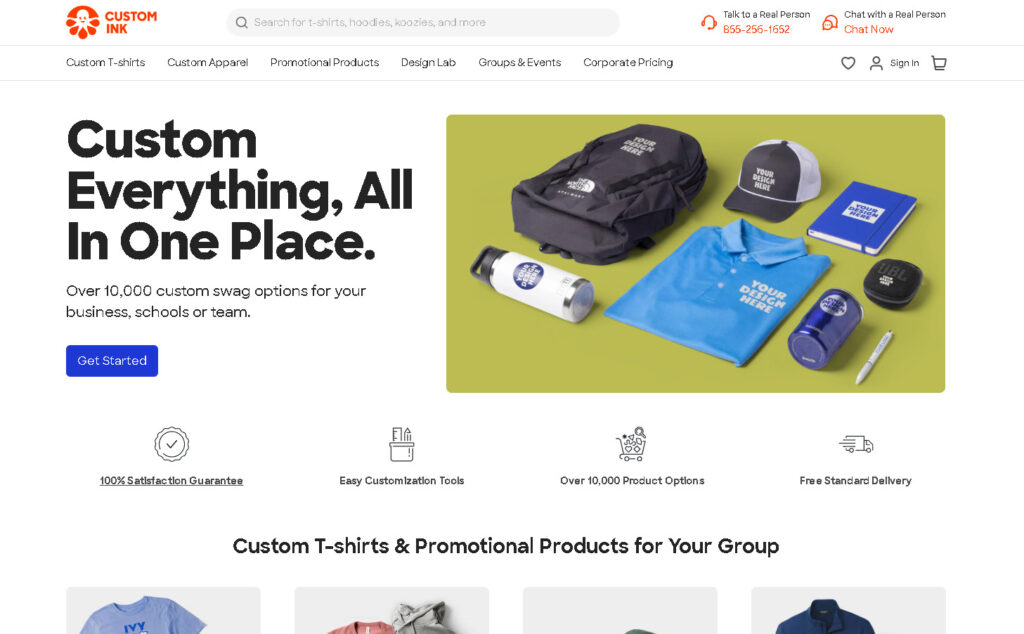
Custom Ink is the most widely recognized name in custom apparel and frequently the first vendor event organizers contact. Their online design tool is user friendly. You can upload a logo, preview placement, and get visual mockups without design experience, which is a real advantage for organizers managing events on top of their other responsibilities.
Pricing is transparent, with per-piece cost decreasing automatically as quantity increases, and there are no hidden fees once your order is configured. Standard delivery runs approximately 2 weeks, with a Rush option at one week for an additional 15% of the order total and Super Rush at three business days for an additional 30%.
The structural thing to understand is that Custom Ink has shifted a significant share of its production to a network of outside digital print fillers, which gives them a broad product catalog but introduces variability in production timing.
For events with comfortable timelines, this is rarely an issue. For fixed event dates with no room to slip, ask specifically whether your delivery tier includes a guaranteed date for your region.
Best for: Organizers who value an easy design experience and transparent pricing, events with at least two weeks of lead time, corporate and Conference orders where product selection breadth matters.
Watch for: Confirm delivery commitment versus estimate before submitting a time-sensitive order.
2. Rush Order Tees
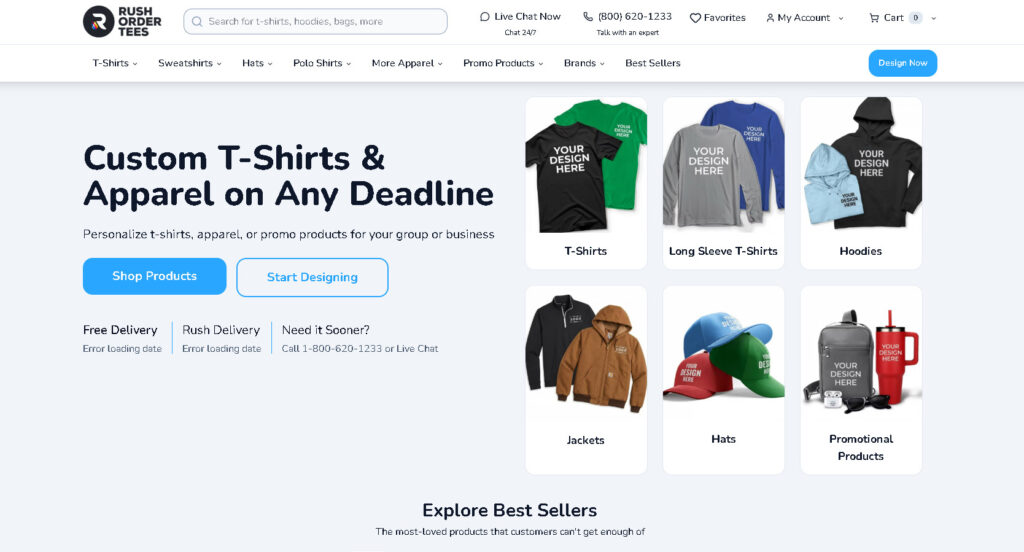
Rush Order Tees is built around speed, which makes them a natural fit for event organizers who are ordering close to their deadline or managing a timeline that keeps shifting.
They offer no minimums on most printed products, with standard free shipping delivering in 9-12 business days and a Rush Delivery option bringing that down to as fast as 2 business days. Every order goes through a design review before printing to flag issues with artwork before the run begins.
The tradeoff on speed is the cost. Super Rush and Rush tiers carry premium pricing and extreme rush shipping fees can substantially increase the total on large orders. For organizers with comfortable timelines, their standard turnaround is competitive and free shipping is included.
For last-minute situations, Rush Order Tees is one of the few vendors with a reliably fast production option, but factor in the added cost into your budget before committing.
Best for: Organizers with compressed timelines, Last-minute orders where speed is top priority events where delivery in 2-9 Business days is required.
Watch for: Rush and Super Rush pricing can significantly increase total order cost for large quantities. Make sure to get a full quote that includes rush fees before committing.
3. BlueCotton
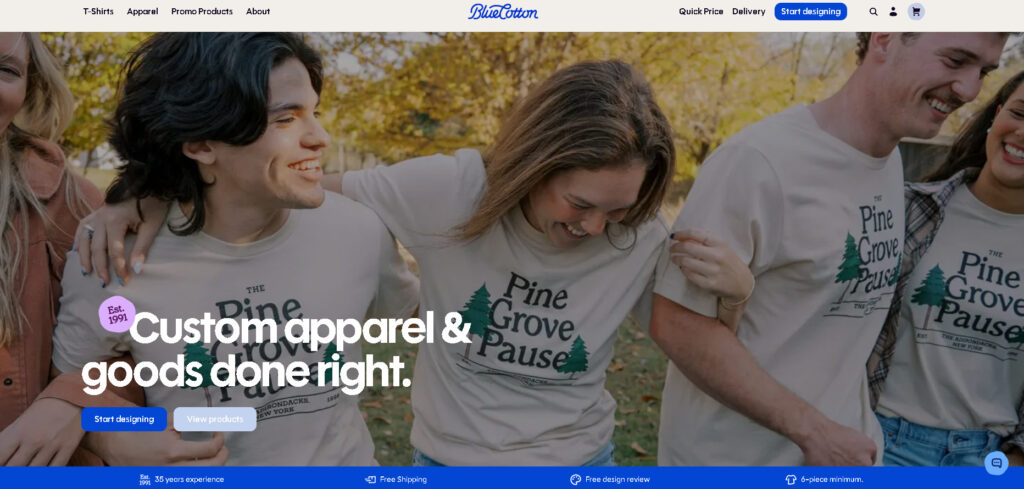
BlueCotton operates differently from both vendors above in one specific way. With BlueCotton, everything happens under one roof. Printing, quality inspection, packing , and shipping all take place at their 50,000 square foot facility in Bowling Green, Kentucky with no outside partners involved.
For event organizers, this matters most in two defining categories. First, delivery dates are guaranteed and not estimated. When you need a shirt by a specific date for event-day distributions, you get a committed date and not a delivery window.
Second, their customer service team is in the same building as production, so if something in your order needs to be resolved, the person you are talking to can physically check on it rather than escalating through a support chain.
Bulk pricing kicks in at 6 pieces and scales favorable as order size grows. The price you see is the price you pay, there are no setup fees or hidden charges at the end. On timing, rush tiers run from 1-day through 5-day options alongside standard productions.
Best for: Event organizers who need guaranteed delivery date in writing , mid-to-high volume orders (50-300+ pieces) with fixed event-day deadlines, organizers who want a direct line to a real person at the production facility.
Watch for: Their catalog focuses on apparel rather than a broad range of branded promotional products. If you need shirts alongside other branded items (bags, drinkware, signage) you may need a second vendor for those.
Deadline Reliability: What to Ask Before You Commit
Regardless of which vendor you choose, you need to ask the following questions before committing:
- Does this delivery tier come with a guaranteed date or an estimate? These are different things. An estimate is just a projection, and a guarantee is a commitment.
- What is the production clock starting point? Order date, design approval, or payment received can all differ by a day or two. When your timeline is tight it can throw off all of your timing.
- What happens if there’s a problem with my order after it ships? Know the reprint and replacement policy before you need it, not after.
- Does the rush option I’m considering apply to my full order quantity? Some vendors have rush limitations at high volumes or restrict service to specific garment styles.
The answers to these questions will tell you more about how a vendor operates than anything on their website.
Final Checklist Before You Order
- Event date confirmed and shirt arrival date calculated backward from it
- Headcount finalized with a 5–10% size buffer on common sizes (M, L, XL)
- Artwork prepared at 300 DPI or higher, vector preferred
- Vendor confirmed to provide a guaranteed delivery date, not just an estimate
- Full quote in hand including rush fees, shipping, and any per-color charges
- Digital proof reviewed and approved before production begins
- Reprint/replacement policy understood before the order is placed
The shirt order is a small part of a larger event, but it is one of the few logistics items where being wrong on the delivery day has no fix. Getting the vendor decision right early is what makes everything else go smoothly.