


- The Model That Makes Quiet Light Different
- Deal Size: Who Quiet Light Is Actually Built For
- Commission Structure: What You Actually Pay
- The Listing Process: What to Expect
- Timeline: How Long Does the Process Take?
- Buyer Network Quality: Who’s Actually on the Other Side
- Who Quiet Light Is Not Right For
- The Bottom Line
Last Updated on May 2, 2026 by Ewen Finser
If you’re a founder thinking about selling your online business, you’ve probably come across Quiet Light. Maybe it showed up in a podcast episode, a forum thread, or a quick online search. The name carries some weight in the online business acquisition arena, but recognition and weight alone doesn’t tell you whether a broker is the right fit for your specific situation.
So I went for a deep dive on this. I read through the exit forums, watched third party breakdowns, talked to founders who have been through the process, and worked through every corner of what Quiet Light actually does and doesn’t do.
Here’s what I found, starting with the part of their model that seems to matter most.
The Model That Makes Quiet Light Different
Most business brokers come from a finance, sales, or a real estate background. They’ve learned how to process deals, manage paperwork, and negotiate closings. That’s not exactly nothing. But when you’re selling a seven-figure SaaS, content site, or e-commerce business, the person across the table from you needs to understand what an MRR churn rate actually means and why it really matters to a buyer.
Quiet Light built its model around a much different premise: every advisor on its team has actually built, bought, or sold an online business. Not as a side hustle, but as their primary career. The advisors aren’t brokers who learned the internet business vocabulary. They’re founders and operators in the space who learned the brokerage side.
That distinction matters more than it sounds. When an advisor with firsthand experience reviews your business, they bring a few specific advantages:
- They ask the questions a serious buyer will ask before you’re ever in front of one.
- They can spot weaknesses in your financials or operations that a traditional broker would likely miss entirely.
- They understand the vocabulary of online businesses natively, intuitively, not as a second language.
It’s a form of deal preparation that a traditional brokerage model isn’t really set up to provide.
Deal Size: Who Quiet Light Is Actually Built For
Quiet Light works in the $250,000 to $25 million range. That’s a wide range, so it helps to know where Quiet Light’s model seems to fit best.
- Below $250K: You’re not the right fit. The economics don’t work for either side. Quiet Light’s process is built for businesses with real complexity, including multiple revenue streams, documented financials, and operational depth. A business doing $60K in annual profit doesn’t need a full CIM, a buyer qualification process, or a six-month deal timeline. Self-serve marketplaces are much more appropriate tools at that stage.
- $250K to $5M: This is where Quiet Light’s model makes the most sense. These deals are complex enough that you need professional guidance, but not so large that you’re naturally gravitating toward investment banks or M&A firms. The buyer pool for businesses in this range is active, competitive, and, if you’re working with the right broker, they are well-qualified.
- $10M to $25M: Quiet Light can still be a good fit, depending on business type and buyer profile. But sellers at that tier should also be evaluating whether a more traditional lower-middle-market M&A firm might access a different class of strategic or institutional buyers. Quiet Light can absolutely still make sense for larger deals. But at that price point, sellers tend to have more options, so it’s worth seeing how they compare against the broader M&A landscape.
Commission Structure: What You Actually Pay
Quiet Light charges a 10% commission on the sale price, with a sliding scale as deals get larger. For a $500K deal, you’re looking at $50,000 in commission. That’s a real number. It’s also a number you should weigh against the alternative: selling without representation, underpricing your business, accepting a buyer who falls apart during due diligence, or spending six months trying to manage a deal process you’ve never navigated before.
What you don’t pay is equally important. Here’s what Quiet Light does not charge for:
- Listing fees
- Retainers or upfront engagement fees
- Creating your Confidential Information Memorandum (CIM)
Quiet Light is compensated on success. That structure aligns their incentives with yours: they make money when you close, and they make more money when you close at a higher number. The sliding scale also means the commission percentage decreases as deal size increases, so you’re not penalized for having a more valuable business.
The Listing Process: What to Expect
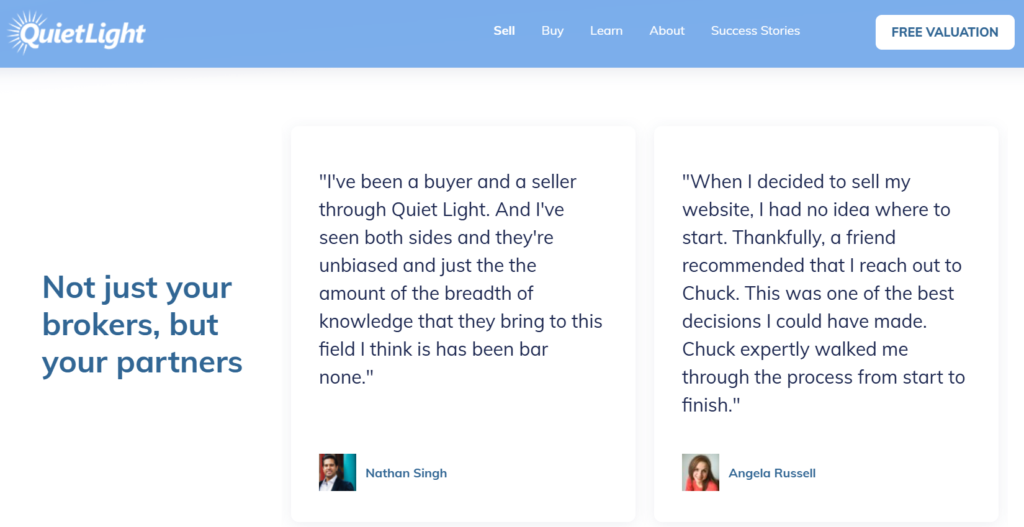
If you reach out to Quiet Light, the first step is an initial call with an advisor to understand your business and determine whether it’s a fit for their process. They’re selective. Not every inquiry becomes a listing, and that selectivity is actually a feature. It means the businesses that do get listed carry some credibility with their buyer pool.
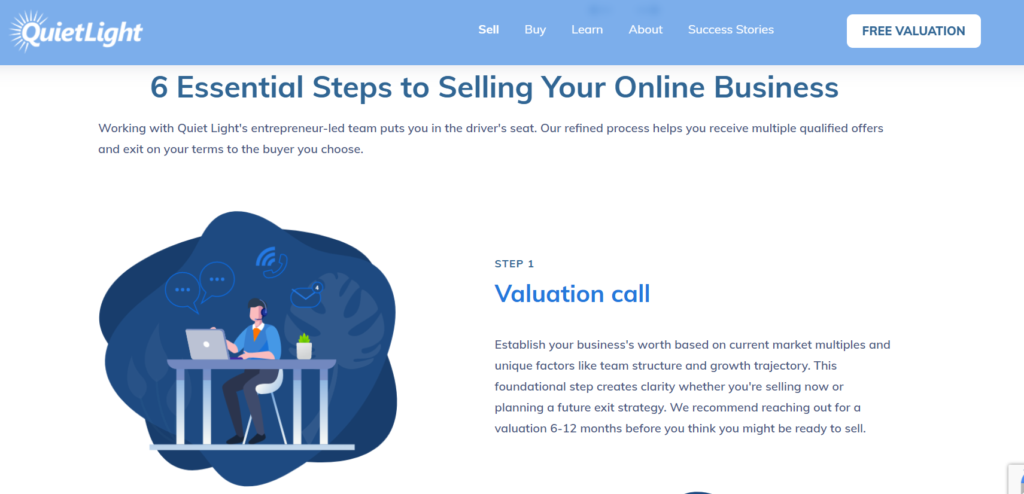
Once you’re engaged, the process moves through several distinct phases:
- Prep and financial normalization. Your advisor helps reconstruct and normalize your financials, identify EBITDA adjustments, document operational processes, and build the CIM. Done well, this stage protects your valuation. Done poorly, or skipped entirely as in a FSBO scenario, it’s where deals fall apart.
- Staged market disclosure. Your business goes to a vetted buyer database. Interested buyers sign an NDA before receiving the full package, and proof of funds is required before any serious financial discussions begin. This teaser-to-NDA-to-data-room sequence is standard at this level and protects you from tire kickers and competitors posing as buyers.
- Offer evaluation and due diligence. Once offers arrive, your advisor helps evaluate LOIs (Letters of Intent), negotiate terms, and manage due diligence. This is where deals die, and having an advisor who has been through this stage multiple times is one of the clearest areas of value in the whole process.
Timeline: How Long Does the Process Take?
There’s no honest answer that fits every situation, but you should plan for three to nine months from the time you engage an advisor to the time you close. Some deals move faster. Some take longer. The variables include your business type, how clean your financials are, buyer demand at the time you list, and how smoothly due diligence goes.
A few timeline realities worth knowing upfront:
- The prep phase, before you’re even listed, can take weeks or even many months depending on how organized your records are and how much normalization your financials require.
- If you’re considering selling in the next six to twelve months, the time to start getting your documentation in order is now, not the week you decide you want to exit.
- If you need a fast exit, say 45 days or fewer, Quiet Light’s process is not aligned with your timeline. And that isn’t a criticism of them. A thorough sale process takes time, and sellers who try to compress it usually leave money on the table or end up in deals that fall through.
Buyer Network Quality: Who’s Actually on the Other Side
This is one of the less discussed aspects of choosing a broker, and it matters a lot. The quality of your deal depends heavily on who sees your listing. A broker with a small or poorly qualified buyer network means fewer competitive offers, more tire kickers wasting your time, and weaker negotiating leverage.
- Quiet Light’s buyer network is made up of:
- Individual entrepreneurs actively looking to acquire profitable online businesses
- Search fund operators with capital committed for strategic deployment
- Family offices with an appetite for cash-flowing digital assets
- Small private equity groups that specialize in online business acquisitions
The point is that these are operators who understand the asset class and have made the financial and operational commitment to pursue acquisitions at this level. The NDA and proof-of-funds requirements filter out casual browsers before they consume your valuable time, and the advisor’s job includes qualifying buyer intent throughout the process, not just at the beginning.
Who Quiet Light Is Not Right For
Being honest about this matters. If the brokerage model doesn’t match your business or timeline, the process can get expensive, stressful, and frustrating fast.
- Very small businesses (under $250K sale price). The commission economics don’t justify the process complexity. You’ll get more traction with a lower-tier marketplace.
- Sellers who want a fast, self-serve listing. Quiet Light’s prep-heavy process is a valuable feature for sellers prioritizing price and deal quality. If you want to list tomorrow and accept the first offer, this model will frustrate you.
- Sellers with messy or unverifiable financials. Quiet Light’s buyer pool is sophisticated. If your numbers don’t hold up to scrutiny, the deal falls apart in due diligence, regardless of who your broker is.
- Sellers who need a passive broker. You will be involved. Quiet Light’s advisors are collaborative, not just transactional. If you’re expecting to hand off the process entirely and wait for a check, that’s not how this works.
The Bottom Line
Quiet Light is a genuinely strong option for online business sellers in the $250K-to-$10M range who want a process-driven, advisor-led exit. The entrepreneur-only advisor model is a real differentiator, not just a marketing angle. The strong established buyer network is legitimate. The staged disclosure process protects you. And the success-only fee structure means you’re not bleeding cash before you close.
The tradeoffs are real too. The process takes time. It requires thorough preparation. And it’s not built for the seller who wants to move fast or list a business that isn’t ready. But if your business is solid and you’re serious about maximizing your exit, Quiet Light belongs near the top of the list.