


- How Beauty Differs from General Small Businesses
- What Salons and Spas Need from an AI Receptionist
- What to Consider Before Switching
- Alternatives at a Glance:
- Podium AI Receptionist Alternatives
- 1. Podium + Your Existing Booking Software
- 2. BookingBee + Your Existing Booking Software
- 3. Clara + Your Existing Booking Software
- 4. Boulevard (Booking and AI Receptionist Built-In)
- 5. Zenoti (Booking with AI Receptionist Built-In)
- In Summary
Last Updated on September 24, 2026 by Ewen Finser
The era of the AI receptionist in a salon is firmly upon us, but choosing the right one is easier said than done. If you’re here, I’m guessing you’re not finding the value in your AI receptionist on one or more levels. It may not be the technology but the fact that you’re not using a platform built specifically for salons and spas.
Salon owners can waste a lot of time trying to work with stand-alone AI receptionists in their booking systems. They have might great capabilities, but integration quality and good support matter too. When looking for an AI receptionist to handle incoming calls, be sure to note that not all of them can manage our unique multi-service and often multi-provider workflows. Let’s take a look at some of the alternatives and what might work better for your salon or medspa.
How Beauty Differs from General Small Businesses
Other small businesses may need to schedule with just one person: one legal assistant or lawyer, one plumber, catering manager, an event center, etc., and can work with a basic Google Calendar to find slots. Callers are looking to set something up quickly to get the ball rolling, and often these types of businesses offer a consultation or something similar that can be set up once, for 30min to an hour, and it’s done. It’s easy for the AI agent to find a slot that works.
Conversely, salon appointments may involve multiple providers working on different time blocks. The system has to understand processing time, especially if a stylist likes to be double-booked while color is processing, along with when to book the follow-up blow-dry or haircut. Plus, you have to confirm cancellation and no-show policies while booking. There are a lot of moving parts for booking salon services, so I’ve created a list you can use to weigh what’s important to your staff when considering a move to another platform.
What Salons and Spas Need from an AI Receptionist
- Believable human touch: owners and clients alike agree that this can ease discomfort with interacting with a “bot” before reaching a human. Clients understand that staff could be busy with in-studio clients; they’re not necessarily offended, but if the AI agent is at all robotic or wasting their time, you’ll lose them.
- Recognize new versus existing clients and adjust the journey accordingly. New clients will need to provide more details; established clients will have more profile and appointment history for the AI agent to access.
- Understand what the client is trying to accomplish, and understand when to send a booking link or to escalate the conversation to your front desk staff. Being able to recognize a client’s tone matters here. Asking frustrated clients to continue with an AI agent makes things worse.
- Understand multi-provider scheduling: departmentalized salons with separate color and cut resources need to configure the processing time before handing off the color client to the stylist. Your system should understand service durations and order of services (don’t wax after a facial, for example).
- Take deposits for some higher-priced, in-demand services. This must be a secure, encrypted transaction.
- Proactive re-engagement using client history to follow up with lapsed clients
That is a lot of information to access, and if your standalone integration isn’t up to the task, you can miss a lot of after-hours calls, spend time handling double-booking nightmares, and risk having clients show up without proper pre-appointment steps completed, like intake forms. Can you be sure your integration is using everything available in your booking platform to reduce any booking errors?
External AI receptionist systems aren’t responsible for the booking systems, or any problems that may arise with them communicating with each other. Who do you reach out to when you need support? Your booking platform support team or your AI receptionist support team? Does your booking platform support person know how each of these AI receptionist platforms integrates?
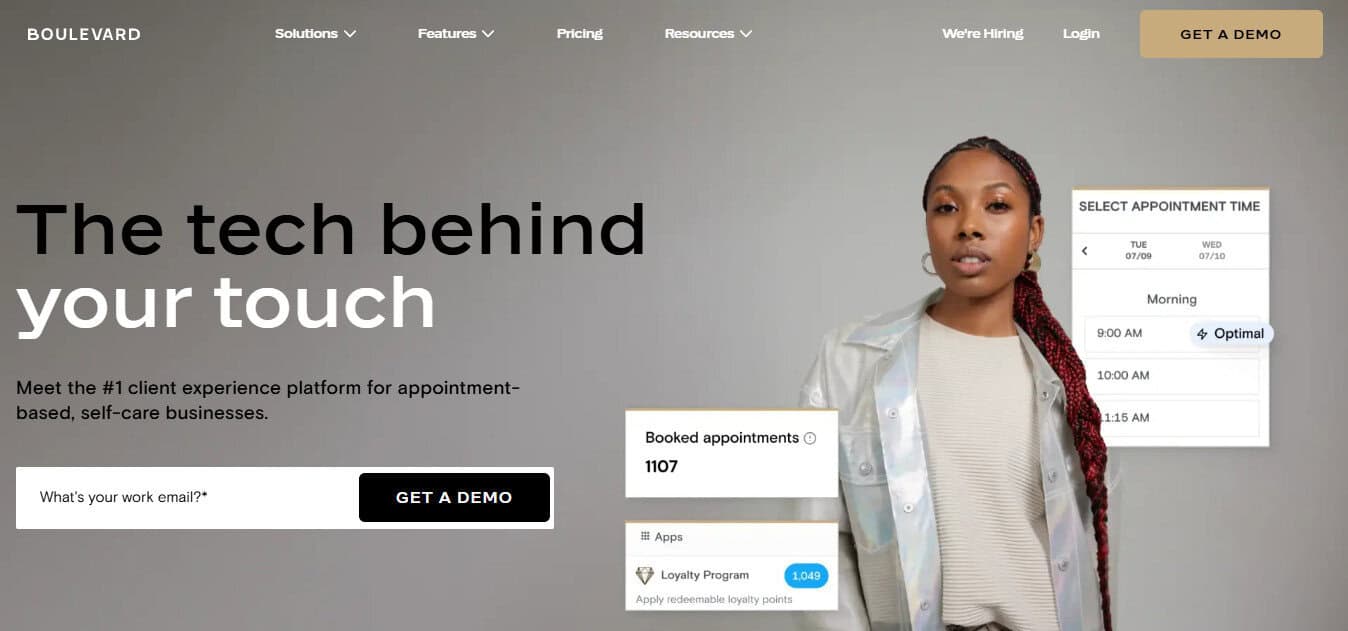
Boulevard was built for real stylists, salon, and spa owners. It handles booking, checkout, and smart scheduling the way busy salons actually work. It even handles marketing, from rebooking reminders to targeted emails and texts, plus it fills open spots with waitlist requests, without the scrambling.
What to Consider Before Switching
When comparing Podium alternatives, consider whether you want an AI receptionist that connects to your existing salon software or one that’s built into the salon management platform itself. There are benefits to both.
Built-In:
- Pros: You’re consolidating tools. Your AI receptionist will work seamlessly from the same system handling clients, services, providers, and appointments. You’ll also have one tech support team for both the booking platform and AI receptionist.
- Cons: Bigger migration effort, more retraining time for staff.
Standalone:
- Pros: Easier to add into your existing platform and workflow
- Cons: Another integration to manage. Support teams may not be fully familiar with your specific booking platform. Their specialty is their AI agent, not your salon software.
Alternatives at a Glance:
Platform | Type | Pricing | Setup Timeline |
Standalone | $399 to $599/ month plus $99 to $399/month for Avery voice agent AI Add-on | 1- 4 weeks | |
Standalone | $99/month to $499/month | Self-serve, about an hour. BookingBee team setup: 3-5 days | |
Standalone | $299/month to $749+/month | 24-48 hours per location | |
Built in | Per location: $125/mo for 200 minutes, then $0.60 per minute over 200 min | 4 weeks | |
Built in | Custom quote required Part of their enterprise AI Plus package | 8+ weeks (per location) |
Podium AI Receptionist Alternatives
1. Podium + Your Existing Booking Software
Podium is text-first, so you’ll need the Avery voice agent add-on to handle your phones. It’s best for established salons and spas that want one platform for client communication, lead conversion, reviews, and AI across multiple channels. Also, Podium is designed as a broader customer communication platform rather than a beauty-specific system, so keep that in mind.
One thing to be aware of with Podium: there are hidden fees to expect: Mandatory 10DLC text compliance fees (~$5/month), phone setup fees (~$500), and extra team seats (~$25–$30/user/month). Keep an eye on these along with your existing software costs for booking and POS.
2. BookingBee + Your Existing Booking Software
With 10 – 20 different voice options (on the 2 higher tiers), this is a voice-first system created specifically for beauty and wellness businesses. It’s designed for salons of all sizes and integrates with any booking platform. It’s particularly useful for independent stylists, including those who manage clients with a basic calendar. A truly stand-alone option for those not using booking software at all. The only extra fee is a setup fee for the Essentials tier (not published).
3. Clara + Your Existing Booking Software
This one boasts a voice-first, luxury concierge experience with expressive, highly advanced, remarkably human-sounding voices. You can choose from American, British, Australian, Irish, and Canadian accents. It’s perfect for luxury spas looking for personalized, white-glove voice support. The downside? Their integration only works with Boulevard, Vagaro, Mindbody,
Jane App, Mangomint, Zenot, and Aesthetic Record.
4. Boulevard (Booking and AI Receptionist Built-In)

Beau, their AI Receptionist, can access the service menu and business details in real time. Any pricing or service offering updates are used on the next call, instantly. You only need to pay for any AI call minutes used, and Boulevard alerts you at 75% and 90% usage. You always know when your minutes are getting low rather than getting cut off from the service. You’ll then have the option to turn off or adjust your settings. This is an all-in-one solution for growing salons/spas that want native AI without moving into an enterprise platform like Zenoti.
5. Zenoti (Booking with AI Receptionist Built-In)
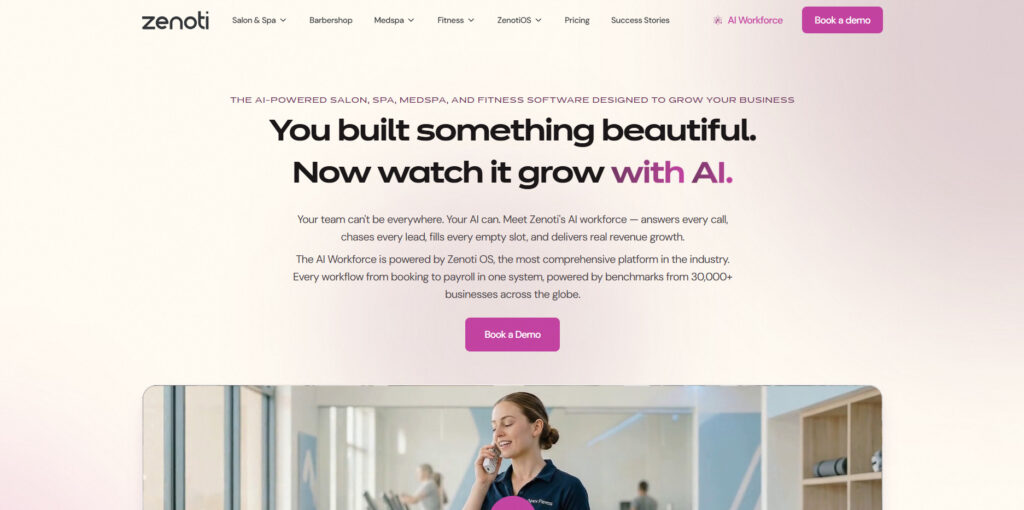
This all-in-one solution offers a very robust AI system, including marketing, loyalty, retention, inventory, scheduler, and even a dispute manager. Zenoti’s AI Receptionist is also programmed to upsell during client interactions. If you’re an existing multi-location salon business, you will appreciate this, but it may be too much for growing salons. It’s best for large or multi-location businesses that want full platform consolidation.
In Summary
BookingBee makes sense if you love your current booking setup and simply want to add AI reception. I like that it can work for solo stylists, who may need the support the most. Clara’s standalone option gives a strong voice experience, plus it can filter in (or out!) leads by asking important qualifying questions before booking, saving your staff from having an appointment booked that they won’t be able to complete.
Boulevard becomes particularly interesting for a growing salon or spa that wants its AI receptionist and booking platform working from the same system. And Zenoti makes more sense for larger salons looking for true consolidation; their AI suite is really impressive, spanning marketing, scheduling, and more, not just phone calls.
Hopefully this helps you move the needle a little more in deciding which AI receptionist would take your salon or spa to the next level. Don’t choose solely on how human the receptionist sounds or even which one is most affordable.
Choose based on how much you want it to know about your business and how much you and your staff are willing to change to give it that access. For me, there’s a real advantage to an AI receptionist built into a platform that already understands how salons and spas work and has access to the same information your front desk uses every day.