


Last Updated on June 26, 2026 by Ewen Finser
For merchants, predictable cash flow is the absolute lifeblood of sustainable growth. Whether you’re stocking inventory for the upcoming holiday rush, managing a growing payroll, or investing in marketing campaigns, waiting two to three business days for your hard-earned revenue to clear can severely bottleneck your operations.
And in an era where commerce moves at lightning speed, your revenue should not be trapped in transit.
If you’re tired of refreshing your bank account and waiting for merchant batches to clear, upgrading your payment processing infrastructure is probably the most effective solution. So let’s showcase the top payment processors that can accelerate your cash flow, detail the hidden mechanics of risk reviews and settlement cutoffs, and offer some practical steps to reduce the chance of holds.
What Causes Payout Delays?

Even with a top-tier payment processor and same-day funding enabled, merchants can still experience sudden disruptions in cash flow. When your expected deposit fails to hit your bank account, it’s usually the result of automated security protocols designed to protect the banking network from fraud.
For instance, high-ticket transactions that fall outside of your normal processing averages are a primary culprit. If your average order value is $50, and you suddenly process a single transaction for $5,000, the processor’s algorithms will flag the batch for manual review. Similarly, sudden spikes in overall daily volume, such as a massively successful Black Friday sale that triples your usual revenue, can trigger automated holds until the processor verifies that you actually have the inventory to fulfill those orders.
Furthermore, spikes in your chargeback ratio can quickly derail fast funding. If a processor notices an influx of customer disputes, they may halt your payouts to ensure there’s enough capital in your account to refund those customers.
Finally, simple administrative errors, such as a mismatched routing number on your bank account or an expired KYC compliance document, can cause the ACH to reject the deposit entirely.
With that in mind, let’s go over some of the biggest processors that offer same-day funding while simultaneously alleviating some of the above concerns.
The Top Payment Processors with Same-Day Funding: At a Glance
Payment Processor | Fastest Available Funding | Standard Funding | Fee for Fast Funding | Risk of Sudden Holds |
Instant (Minutes) | Next-Day | 1.5% per rapid deposit | Low (Traditional bank underwriting) | |
Instant (Minutes) | 2 Business Days | 1.5% per instant transfer | High (Strict algorithmic risk monitoring) | |
Instant (Minutes) | Next-Day | 1.5% per instant transfer | Moderate to High (Aggregator model) | |
Same-Day / Next-Day | Next-Day | Included in pricing | Very Low (Real-time upfront underwriting) |
Clover

Clover is a popular choice for merchants requiring powerful point-of-sale hardware, functioning as a comprehensive physical payment processor. For business owners relying on continuous cash flow, Clover’s Rapid Deposit feature functions exactly as same-day funding to keep operations running, allowing businesses to request an immediate transfer of their daily sales balance to a debit card instead of waiting for batches to clear.
That being said, the upfront capital required to purchase Clover hardware outright can be steep for small businesses, and because the system is sold through a range of vendors, customer support quality and contract terms can vary wildly depending on who you buy from.
Pricing and Processing Fees
For in-person transactions swiped via proprietary hardware, merchants see predictable rates of around 2.6% + 10¢ per transaction, while processing online or keyed-in transactions increases the rate to roughly 3.5% + 10¢ to reflect higher fraud risk. The Rapid Deposit feature for same-day funding requires paying an additional 1.5% fee on the total transfer amount. This is pretty close to the standard immediate deposit fee, and there’s not a real way around it.
Pros
- Hardware is modern, durable, and handles heavy daily foot traffic
- Large App Market allows customization with third-party accounting integrations
Cons
- Hardware upfront costs can be expensive for small businesses
- Support quality and contract terms vary by vendor
Best for: Clover is engineered specifically for brick-and-mortar environments like restaurants and retail storefronts, where high-speed point-of-sale efficiency is paramount. The system shines for business models requiring intricate inventory management and employee hour tracking immediately out of the box.
Stripe
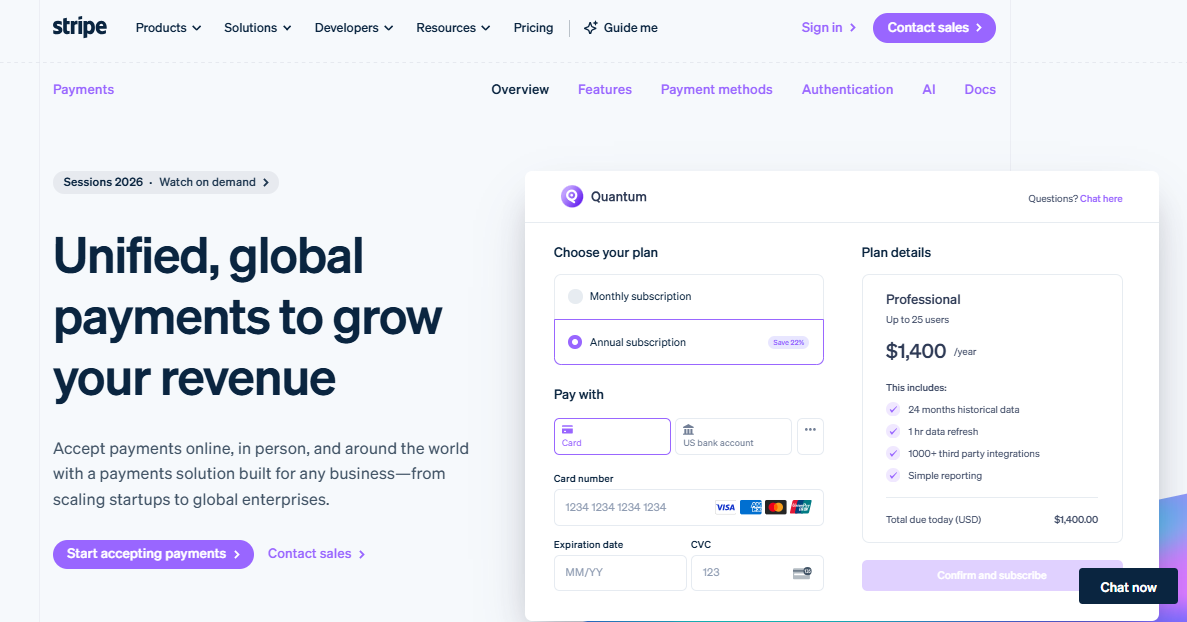
Stripe has built a stellar reputation as the gold standard for online payment processing, powering millions of global digital storefronts. While operating on a standard two-day payout schedule, it provides an Instant Payouts feature to help businesses accelerate cash flow, allowing eligible merchants to instantly route their available balance to a supported debit card or bank account and achieve true same-day funding.
That power comes with some friction, however. The backend interface and initial setup can be highly technical and intimidating for traditional business owners without coding experience, and Stripe strictly enforces its acceptable use policy via algorithms, which can result in sudden account freezes for misunderstood industries that throw a wrench into cash flow forecasting.
Pricing and Processing Fees
Stripe maintains a highly transparent, flat-rate pricing model for standard online transactions, charging a predictable 2.9% + 30¢ per charge, while in-person transactions utilizing Stripe Terminal hardware drop to a competitive 2.7% + 5¢. When merchants opt to use Instant Payouts for rapid liquidity, Stripe assesses a 1.5% fee with a 50¢ minimum.
Pros
- Best-in-industry developer documentation makes integrations easy
- Natively supports many international payment methods and digital wallets
Cons
- Backend setup is intimidating for non-technical users
- Algorithmic enforcement can cause sudden account freezes
Best for: Stripe is unequivocally the best option for agile technology startups and expansive e-commerce platforms requiring customized digital checkout infrastructure, and it is a seamless, natural fit for subscription-based services and international businesses that need to accept local currencies effortlessly.
Square
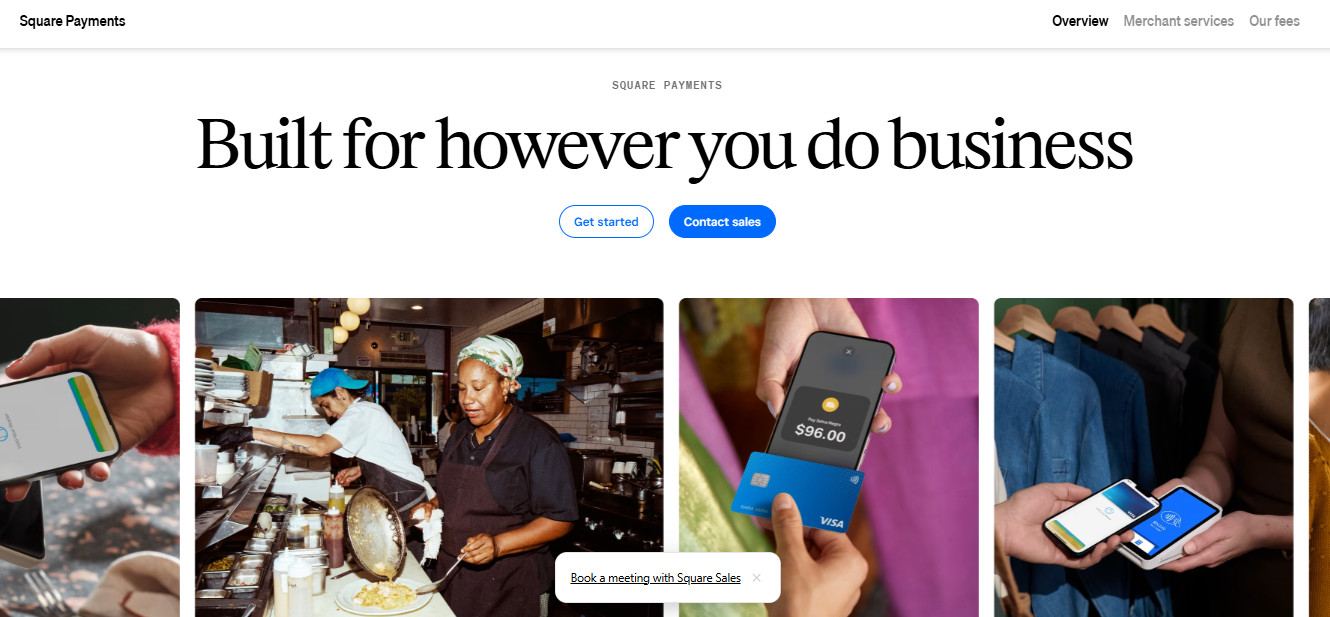
Square revolutionized the payment processing industry by empowering anyone with a smartphone to quickly accept credit cards and maintain flexible cash flow. When a business owner needs capital immediately, they can trigger an Instant Transfer via their dashboard to send balances to a debit card. Those who utilize a Square Checking account benefit even further: processed funds are automatically deposited and available to spend instantly, providing continuous same-day access to revenue.
There is a notable catch to be aware of, though. Because Square rapidly aggregates merchants under a master account, its automated fraud detection algorithms can unexpectedly freeze legitimate accounts, and as your business scales processing volumes, the flat-rate pricing can become significantly more expensive than traditional interchange-plus models.
Pricing and Processing Fees
Square champions accessibility with a standardized pricing structure that entirely eliminates hidden monthly subscription fees and complex, binding legacy contracts, charging a predictable flat 2.6% + 10¢ for card-present transactions swiped or tapped on Square hardware. Manual Instant Transfers to an external bank incur a 1.75% fee, but the internal Square Checking account eliminates this fee entirely.
Pros
- Near-zero barrier to entry with free POS software and card reader
- Self-contained ecosystem with payroll, marketing, and inventory built in
Cons
- Flat-rate pricing gets expensive as volume scales
- Aggregator model can unexpectedly freeze legitimate accounts
Best for: Square is the undisputed champion for hyper-mobile businesses, weekend pop-up shops, and solo entrepreneurs who need absolute simplicity and minimal commitment. It serves as an excellent, risk-free stepping stone for brand-new businesses that need to start accepting payments immediately without undergoing lengthy underwriting.
Luqra
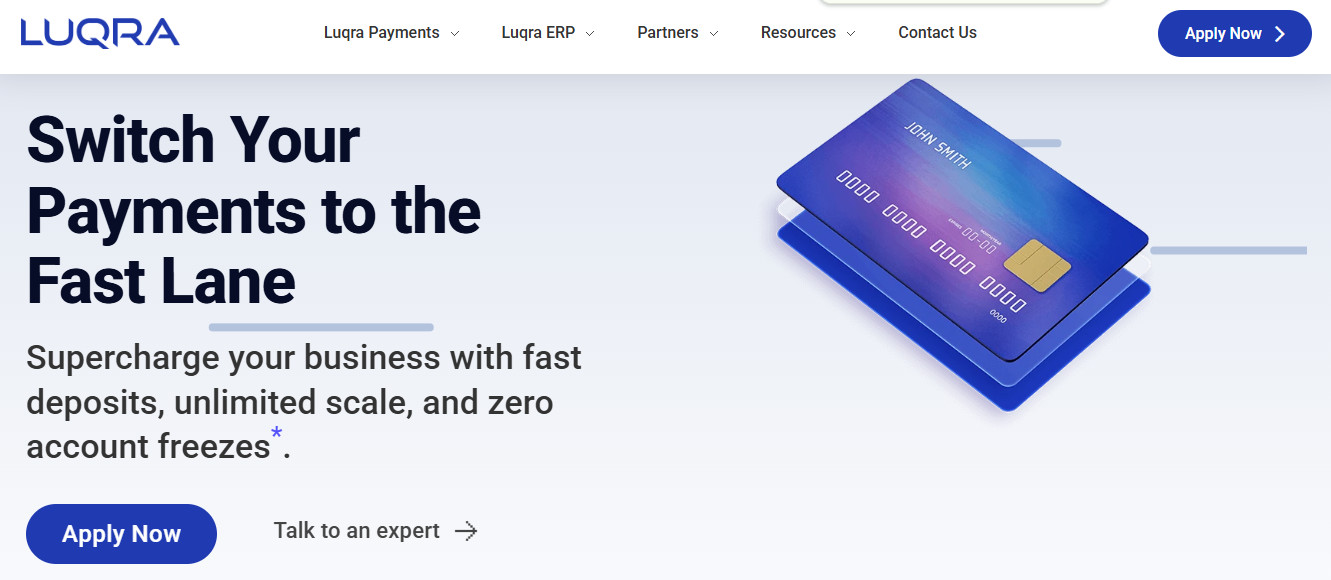
Luqra is an emerging powerhouse in the financial technology sector that specifically positions itself as an all-in-one enterprise resource planning platform. With strong underwriting and banking relationships, it achieves aggressive 12- to 24-hour deposit times to ensure critical business budgets are fueled, payroll is met, and bills are paid on time.
The model isn’t without its tradeoffs. Because Luqra is a relatively newer player in the fintech space, its public ecosystem of direct third-party developer integrations is still growing, and the application process involves thorough traditional underwriting upfront, meaning approval isn’t instantaneous and requires submitting legal documentation.
Pricing and Processing Fees
Luqra aggressively competes on long-term price by offering transparent rates and an explicit guarantee to meet or beat a merchant’s current costs, with baseline advertised rates starting at an incredibly competitive 2.49% + 10¢ for retail and 2.75% + 25¢ online. Notably, there are no premium percentage surcharges required to access quick deposit schedules, as accelerated cash flow is fundamentally built into their services.
Pros
- Dedicated U.S.-based relationship manager and 24/7 support
- ERP layer bundles payments, fraud prevention, and disputes in one interface
Cons
- Newer player with a still-growing third-party integration ecosystem
- Upfront underwriting means approval isn’t instant and requires documentation
Best for: Luqra is built for high-growth e-commerce brands, mid-market retail operations, and ambitious businesses that have outgrown standard entry-level payment aggregators. Because it natively includes built-in chargeback management and active fraud protection, it’s a phenomenal fit for businesses dealing with complex operational needs.
Behind the Scenes: How Fast Funding Actually Works
Because chargebacks and fraud can occur days or weeks after a transaction, advancing money rapidly means the processor is essentially floating you a short-term loan. Here’s how processors manage that risk and how it impacts your operations.

Eligibility Requirements
Not every merchant qualifies for accelerated funding out of the gate. Processors typically evaluate your business history, credit score, processing volume, and industry type. High-risk industries, such as travel, ticketing, or adult entertainment, are rarely eligible for instant or same-day payouts.
Most providers require a clean processing history of at least several months to prove that your chargeback ratios are well within acceptable limits.
Risk Reviews and Reserve Policies
Because processors take on liability when funding you quickly, their underwriting and risk departments constantly monitor your account. If you experience a sudden surge in sales or a spike in disputes, the processor may institute a reserve policy.
A rolling reserve dictates that the processor will hold back a percentage of your daily processing volume for a set number of days to cover potential chargebacks.
Premium Fees
Convenience costs money. Moving funds via standard ACH takes a few days but is incredibly cheap for the processor. Utilizing push-to-card networks or Same-Day ACH incurs higher network costs.
Processors pass these costs onto merchants either through a flat monthly subscription fee for the “fast funding” program, or a transactional fee (often around 1.5% of the transfer amount) for instant payouts.
Instant vs. Same-Day vs. Next-Day Funding
Instant funding delivers revenue to a linked debit card within minutes for an additional percentage fee, providing immediate intra-day liquidity.
Same-day funding utilizes the Same-Day ACH network to deposit funds before the business day ends, offering predictability provided you meet strict afternoon batch cutoffs and are willing to pay a flat fee or slightly higher processing rates.
Finally, next-day funding serves as the cost-free industry standard, depositing your end-of-day batch via an overnight ACH transfer so your hard-earned revenue is ready in your account the following morning.
How to Proactively Reduce the Risk of Holds

The best way to handle a funding hold is to prevent it from happening in the first place. By operating transparently and communicating effectively with your payment partner, you can ensure your revenue flows without interruption.
- Provide comprehensive documentation during the initial underwriting process. Submitting detailed financial statements, processing history, and fulfillment proofs upfront builds immense trust with your processor’s risk department.
- Maintain clear, transparent, and easily accessible refund and return policies. Customers who can easily secure a refund directly from you are far less likely to initiate a chargeback with their credit card company, which keeps your merchant account in good standing.
- Proactively communicate with your processor before launching major promotions or sales. Warning your account manager about an expected surge in volume prevents their security algorithms from interpreting the spike as fraudulent activity.
- Ensure your business descriptors match your actual brand name. If a customer does not recognize the name of your business on their credit card statement, they will likely dispute the charge out of confusion.
- Quickly and thoroughly respond to all retrieval requests and chargeback notices. Ignoring processor communications signals that your business may be abandoned or fraudulent, leading to frozen funds.
Protecting Your Cash Flow for the Long Haul
Moving away from standard three-day holding periods and graduating to same-day or instant funding can radically transform how you manage inventory, pay your employees, and scale your operations.
While aggregator platforms offer the allure of instant onboarding, they often hide the risk of sudden account freezes. For merchants who are serious about protecting their cash flow, taking the time to undergo proper underwriting with a processor like Luqra or Clover is an investment in operational stability.
Assess your specific cash flow needs, review the daily batch cutoffs, and partner with a processor that views your revenue with the same urgency that you do.