


- Why Choose a Prepaid 5G Network Plan?
- Best 5G Networks on Prepaid Compared: At a Glance
- 1. Visible By Verizon: Best Overall
- 2. Cricket Wireless: Best For AT&T Coverage
- 3. Mint Mobile: Best Budget Option
- 4. US Mobile: Best For Multi-Network Flexibility
- Top Mistakes When Choosing a Prepaid 5G Network Plan
- How To Choose The Best 5G Network On Prepaid
Last Updated on August 5, 2026 by The Digital Merchant Team
Prepaid cellular plans haven’t always had the best reputation. You’d often hear them being mentioned in the same breath as “You get what you pay for”. Still, in recent years they’ve come a long way, especially with the rollout of 5G coverage across most of the USA.
In 2026, you can sign up for a plan riding the actual network of major providers, like Verizon, T-Mobile, or AT&T, sometimes for much less than postpaid customers. In many cases, you’re not even sacrificing that much in terms of data speeds or coverage either.
Choosing the right plan means picking one that won’t leave you struggling for coverage, see your data speeds slow to a crawl, or impose unfair download caps when you’re using your phone as a hotspot.
Why Choose a Prepaid 5G Network Plan?

One of the main advantages of going down the prepaid route is that you can skip the usual credit check you need for most postpaid plans. This is a major perk if, for instance, you’ve just arrived in the USA so don’t have much of a credit record yet.
Prepaid plans can also make budgeting easier. True, you still typically pay a fixed amount per month, but at least you know what this is, and pay for it upfront. Prepay contracts also tend to offer more flexibility with month-to-month terms, although there are some exceptions to this (see below).
Traditionally, postpaid contracts have also been a better choice as they offer guaranteed charges, but multiple prepaid plans also now come with pricing guarantees for certain periods.
Best 5G Networks on Prepaid Compared: At a Glance
Carrier | Network | Starting Price | Hotspot | Deprioritization |
Verizon | $25/mo (Visible) | Up to 5-15 Mbps depending on tier | Base plan deprioritized; Visible+ and Visible+ Pro plans are not | |
AT&T | $35/mo (Select), up to $55/mo (Supreme) | Up to 50GB on top tier | Always deprioritized behind AT&T postpaid on Select and Smart plans, but not Supreme | |
T-Mobile | $15/mo (current three-month or annual promo, unlimited) | Up to 20GB depending on plan | Deprioritized after 50GB on Unlimited plan | |
Verizon/T-Mobile/AT&T | $10/mo (Light), $25-44/mo (Unlimited tiers) | Up to 100GB on Premium tier | Premium tier includes true priority data |
The top spot in this comparison goes to Visible by Verizon. Of all the prepaid carriers here, it combines simple, transparent pricing with strong coverage, as well as generous data allowances and speeds.
Of course, the best prepaid 5G network is the one that matches your needs, preferences, and budget. For instance, if you need to rent multiple lines for your family, want to switch between networks for more wide-ranging coverage, or are on a very tight budget, then one of the other carriers discussed in this guide may serve you better.
1. Visible By Verizon: Best Overall

- Strong coverage ℅ Verizon’s network
- Transparent pricing with no hidden fees
- Certain Visible+ plans skip deprioritization entirely
- Multi-line discounts can’t be combined with other promotional credits
- Base Visible plan’s 5 Mbps hotspot cap only really suitable for basic browsing
If you take a look at Visible’s website, you’ll see that its whole MO is centered on simplicity. For example, the pricing page lists prices without any hidden fees. There are also three main price plans: Visible, Visible+, and Visible+ Pro, so it’s easy to compare features.
The entry-level Visible plan ($25/month) gets you unlimited talk, text, and data, but that data may be deprioritized during periods of heavy network congestion. Tethering is supported, but hotspot speeds are limited to 5 Mbps, which is only really good for basic web browsing.
However, if you upgrade to the highest Visible+ Pro tier ($39/month), you’ll benefit from Verizon‘s faster Ultra Wideband 5G, as well as non-deprioritized “premium” data, meaning your speeds will hold as steady as any Verizon postpaid customer, even when the network is slammed, all other factors being equal. This means, for instance, you can stream video of up to 4K UHD quality. Hotspot speeds of up to 15 Mbps are also supported.
2. Cricket Wireless: Best For AT&T Coverage
- Rides on AT&T’s extensive network
- Transparent pricing
- Reasonable discounts for multi-line rental
- Data is deprioritized behind AT&T postpaid customers on some plans
- No hotspot included on entry-level ‘Select’ plan
- Video typically streams at standard definition on all plans.
Cricket‘s main advantage is that it works over AT&T’s network, which means it offers solid coverage – even in some rural areas where other MVNOs have much less reliable signal.
Pricing starts at $35/month for the Select Unlimited plan up to $55/month for Supreme Unlimited. The entry ‘Select’ plan doesn’t include hotspot data, though you can purchase this as an add-on.
The aforementioned highest tier ‘Supreme’ plan gives you 50 GB of hotspot data before speeds are slowed to 125 Kbps, which is fairly generous, plus there’s no deprioritization of your data behind AT&T postpaid customers. However, Cricket may temporarily slow speeds if the network is busy on the ‘Select’ and ‘Smart’ plans.
3. Mint Mobile: Best Budget Option
- Low pricing with annual prepay
- Access to T-Mobile’s national network
- Free mobile hotspot on all plans
- Requires 3, 6, or 12-month upfront payments
- Data can be deprioritized behind T-Mobile postpaid customers
- No multi-line or family discounts
As most people have seen from the fun commercials with Ryan Reynolds, this carrier has a reputation for being the budget champion of T-Mobile-based MVNOs.
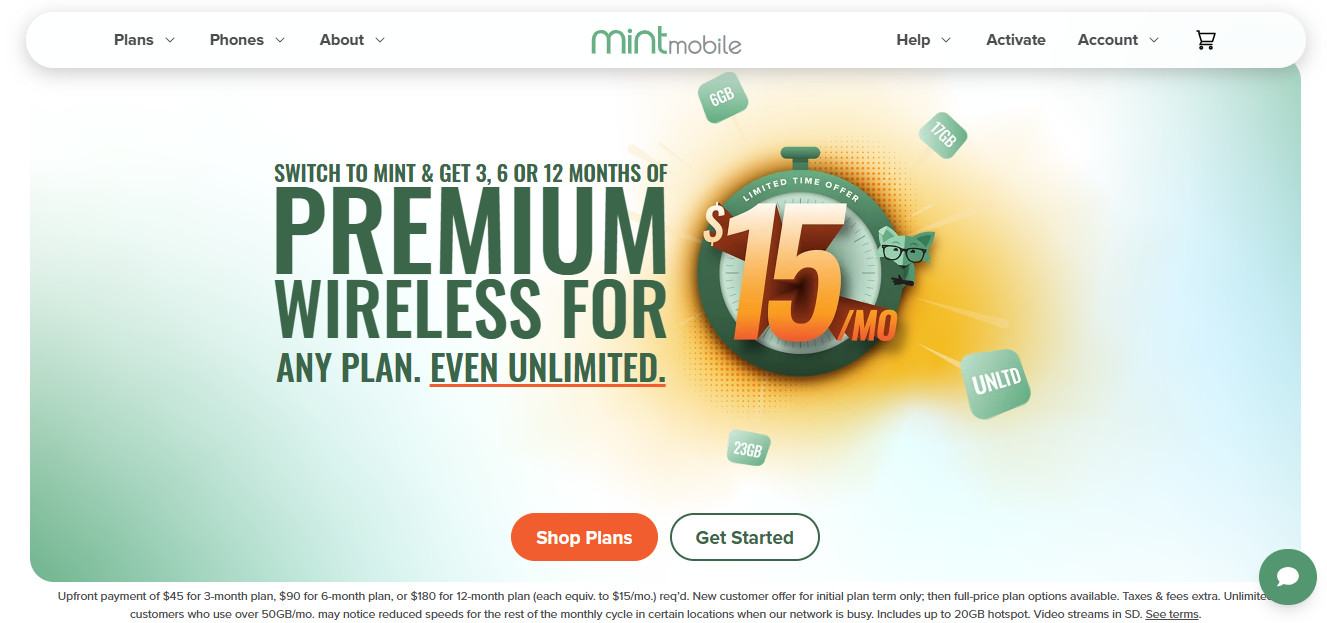
Prices vary depending on your required data allowance and how much you’re willing to pay upfront. For example, the ‘Unlimited’ data plan is currently available for $45 for 3 months, which works out to $15 per month. This, however, is an introductory rate, after which prices can increase.
The fine print also says that the ‘Unlimited’ plan includes 50 GB/month, and speeds may be reduced for users who go over this month. Plans include ‘up to 20 GB’ hotspot. Videos stream in SD over cellular data for all plans.
4. US Mobile: Best For Multi-Network Flexibility
- Choice of network (Verizon, T-Mobile, or AT&T) per line
- Premium tier includes 100GB of priority hotspot data
- Highly customizable plans
- Multi-network switching isn’t always seamless
- Network transfers are capped and cost extra beyond the first two free swaps.
- Plan structure and add-on fees can get confusing
True to its rather generic name, US Mobile focuses on flexibility. It’s one of the very few major MVNOs that offers an easy way to pick your underlying network, via its Multi-Network add-on, which lets you switch between carriers if one is underperforming in your area. This is particularly useful if you travel a lot around the USA, as different regions tend to have different coverage strengths.
There are two principal monthly plans: Unlimited Starter ($25/month) and Unlimited Premium ($39/month). Assuming you choose the highest tier plan, you’ll get priority data, though the pricing page warns that the definition of this can vary by network. This tier also includes 100 GB of data at 8 Mbps, after which speeds are slowed to 600 Kbps.
At this level network transfers are also free, but they’re not always simple or automatic. The pricing and features page is also more complicated to navigate relative to other carriers in this guide, as you have to take into account factors like watch plans, the cost of the multi-network add-on (if applicable), and differing data prioritization levels, such as QCI 8 for the Unlimited Premium plan. Of course, this trouble may be worth it for frequent travelers, remote workers, or people who live across multiple homes. But it’s certainly not always a set-it-and-forget-it solution.
Top Mistakes When Choosing a Prepaid 5G Network Plan

Choosing Based On Pricing Alone
A plan that seems to cost only, say, $15/month can look great on paper, but that figure is rarely going to mean you’ll have a prepaid plan with every feature you need.
For example, carriers might cut corners by reducing hotspot allowances, or even disabling hotspot data altogether on lower-priced tiers. Streaming may be throttled, so at most you’ll experience, say, SD rather than HD video. Some ultra-cheap 5G plans may also have lower deprioritization thresholds (see below).
Before locking into the cheapest option with any carrier, you should always check the features for every pricing tier, to see what paying $10 – $15 per month will get you. You may be pleased you ran this comparison, as paying extra may mean your plan includes essential features.
Ignoring Data Deprioritization
You may be asking, “Why doesn’t everyone just sign up for a prepaid plan?”
Well, people who are on prepaid plans that run over major networks normally find that their data is “deprioritized” (queued) behind postpaid customers when cell towers get congested.
This is how most MVNOs work, with a few exceptions. Some plans will also deprioritize your traffic only after your downloads reach a certain threshold, say 35 GB, or possibly not at all on some higher-paid premium plans.
But you need to be aware of this, as even if a prepaid 5G plan is advertised as being “unlimited” that speaks to the amount of data you can download – not to bandwidth speeds.
If you stay within your ‘premium’ allowance of data, deprioritization may never become a major concern. However, if you’re someone who’s constantly in crowded areas, concerts, stadiums, downtown at rush hour, this is the spec that matters more.
Ignoring Hotspot Issues
This is another important concern if you plan to tether your laptop or other devices to your cellphone’s mobile data connection.
Many base-tier plans only offer a small amount of hotspot data (if at all), and speeds may be capped. This can be as little as 5 Mbps, which might be enough to stream a few SD YouTube videos or check your email, but can struggle with HD videos, gaming, or any other bandwidth-intensive activities.
This means you can’t just assume that because a plan supports “hotspot” that it’ll do everything you need it to. Check for any speed or download caps, fair use policies, and whether certain types of traffic are throttled.
Skipping The Coverage Check
A carrier might operate a network with wide national coverage, but you can’t assume that the signal will necessarily be strong where you live and work.
If you check the coverage maps for most providers, you’ll see that it can vary block by block in certain places, especially in rural or semi-rural areas.
Before switching, pull up the specific carrier’s coverage map for your zip code. You can also run some searches on social media sites like Reddit, or local Facebook pages to ask about people’s real-life experiences with certain prepaid carriers, instead of just reading their marketing materials.
Just make sure these people live close to you, as even if a signal is strong one or two towns over, that doesn’t necessarily speak to your situation.
How To Choose The Best 5G Network On Prepaid

If you’re a single-line user looking for a 5G prepaid network with dependable coverage, fast speeds, and pricing that doesn’t require reading fine print for an hour, Visible+ remains the strongest overall pick. This is down to operating over Verizon’s network, and the option to use premium, non-deprioritized data.
However, there are certain niche cases where the other providers in this list may make more sense
For instance, Cricket suits users in AT&T’s territory who want a simple no-frills plan. Mint is a more economical option overall for annual-prepay budget shoppers. US Mobile is the clear winner if you need multi-network flexibility and a very generous hotspot allowance, so long as you’re willing to navigate the associated complexities that come with pricing and switching providers.
Whichever carrier you choose, make sure to match your usage pattern to the plan, not just the price tag. That way you’ll land on the right prepaid 5G carrier for your specific needs.