


Last Updated on August 14, 2026 by The Digital Merchant Team
Xero is good at capturing a bill; it’s the payment itself that tends to fall out of the system. You code the bill, route it for approval, mark it awaiting payment… and then open a separate browser tab to your bank, cut a check, or hand a list to whoever has signing authority. The payment happens somewhere Xero can’t see, and the ledger catches up a few days later when the bank feed clears.
For a business paying 15 or 20 vendors a month, that gap is a minor inconvenience. For one paying 200, it’s where errors and duplicate payments live.
But paying a vendor from inside your accounting workflow is no longer the hard part — Xero now handles domestic payments natively, and every tool in this comparison can move money. What separates them is everything wrapped around the payment: how approvals are structured, what spend controls sit in front of the money, how a payment gets funded and whether a card can stand in for cash, how far the international coverage reaches, and whether you want one tool that also runs your corporate card program.
The Bottom Line Up Front
For most small businesses already running books in Xero, Melio’s standalone platform is the strongest overall fit, largely because it’s the same payment engine Xero itself now uses (Xero acquired Melio and launched native online bill payments for U.S. customers in March 2026 using Melio’s payment rails) while still offering the deeper feature set of a dedicated product. Xero’s built-in bill payments are the right answer if your needs are simple and domestic, since standard ACH is included in the subscription. BILL earns its higher price when approval structure and audit trail matter more than cost. Ramp makes sense if you want corporate cards and AP under one roof at no software cost.
Melio
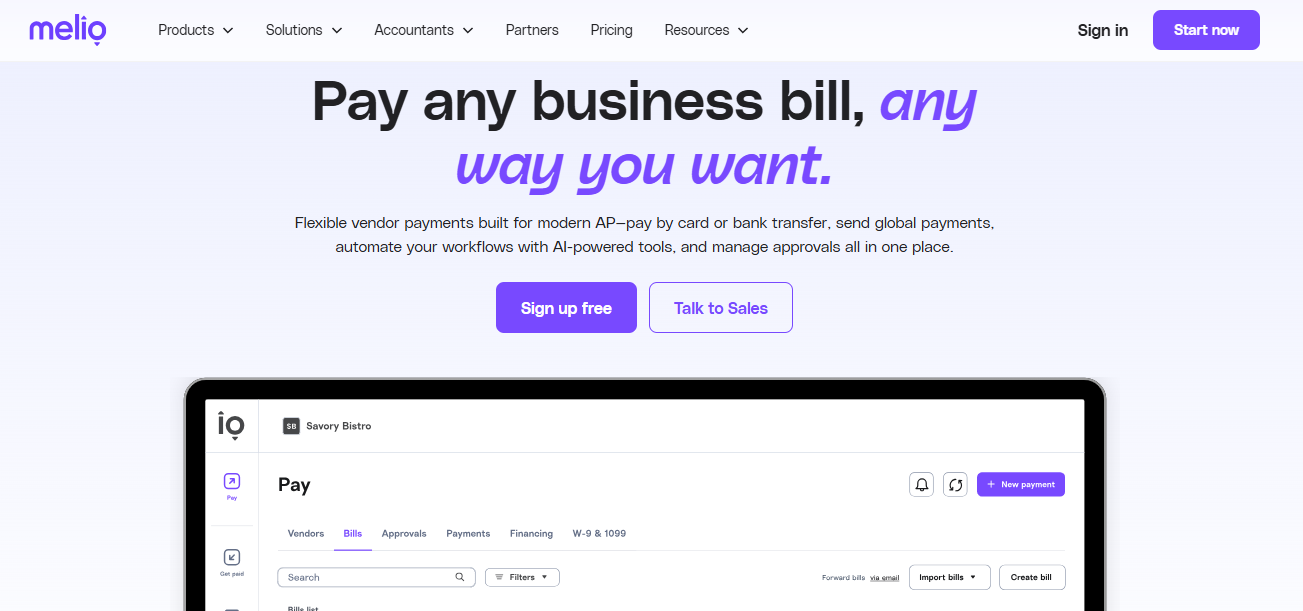
Melio built its reputation on a specific workaround. It allows you to fund a payment with a credit card (even when the vendor does not accept cards), and Melio will deliver the funds as an ACH transfer or a mailed check. That capability, plus a generous free tier, made it the default recommendation for Xero and QuickBooks users who wanted AP automation without a per-seat contract. Xero paid roughly $2.5 billion for the company in 2025 and now runs its native payments on the same rails, so choosing standalone Melio is not a bet on a third party — it’s the first-party engine, sold as a fuller product than the version embedded in Xero.
Pricing includes a free Go plan, Core at $25 per month, Boost at $55, and Unlimited at $80 — with roughly a 20% discount for annual billing. Card funding costs 2.9% regardless of tier, mailed checks run $1.50, and instant transfers carry a 1% fee. The two-way Xero sync covers bills, vendors, payment status, and coding, and it’s unlimited on paid plans.
One practical wrinkle worth knowing: a standalone Melio account and Xero’s embedded payments are separate environments. Historical vendor and payment data does not transfer between them, and you can’t reach your standalone account from inside Xero.

Pros
- The free and low-cost tiers make it realistic for a business paying fewer than fifty bills a month.
- Card funding works with any vendor, which turns a card into a more flexible working capital tool.
- The accountant dashboard is free for firms managing multiple client entities, with each client syncing to its own Xero organization.
Cons
- Integration coverage stops at QuickBooks and Xero, so a business planning a move to NetSuite or Sage Intacct will outgrow it.
- Approval routing is functional but simpler than what BILL offers, and the more advanced controls sit on higher tiers.
- Overnight check delivery is expensive relative to competitors, which matters if you’re frequently rescuing a late payment.
Best fit: A Xero-based business that wants a real AP platform, flexible funding options, and predictable subscription cost without paying per user.
Xero Bill Payments
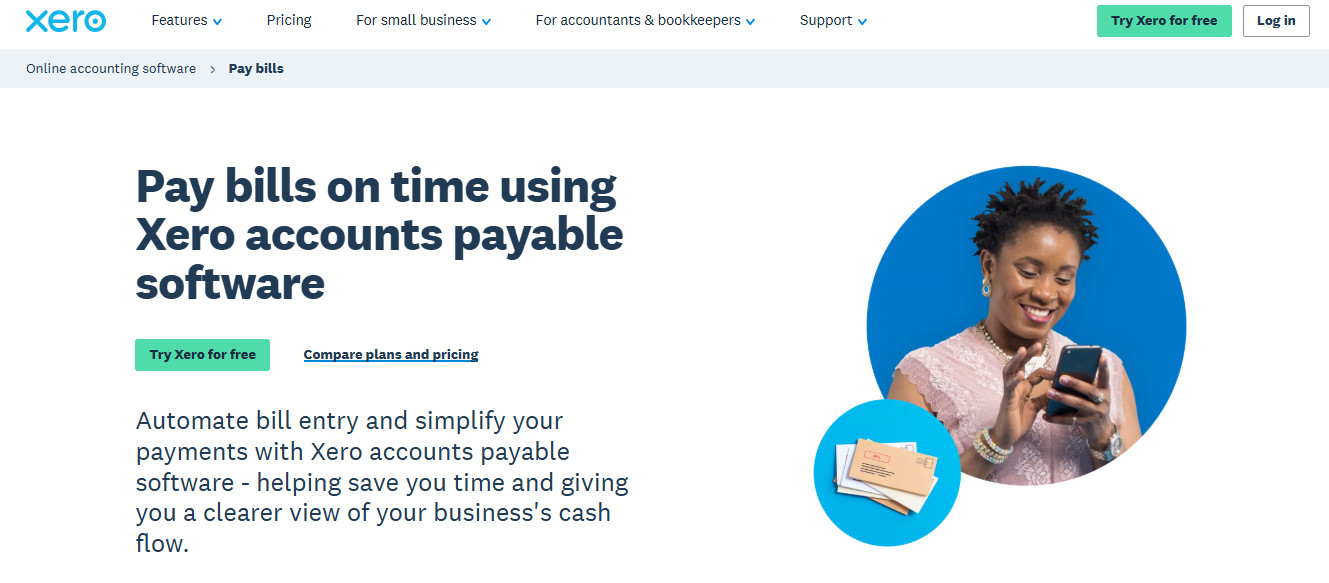
Standalone Melio is the full-featured product with its own account, its own plans, and its own login. But if you already work in Xero and your needs are basic, this is the pared-back version wired directly into the ledger.
The workflow is what you would expect: select bills from the awaiting payment screen, choose a funding source and a delivery method, pick a date, and confirm. The payment posts to account transactions immediately and reconciles against the bank feed when the statement line arrives. Contractor payments run through the same flow and update 1099 reporting at the point of payment.
The economics is the main argument here. Standard ACH is included in the Early, Growing, and Established plans at no additional cost, which, for a business paying domestic vendors by bank transfers, means the marginal cost of AP is zero. Other methods carry fees: mailed checks are $1.50, card funding is 2.9%, same-day ACH and instant transfers are 1% capped at $75, and domestic wires are $10. International payments in foreign currency require the Established plan, since they depend on multi-currency. There is a $1 million ceiling on any single bill payment.
The real appeal, though, is structural. Having one system means nothing to integrate, nothing to reconcile between systems, and no second subscription to manage or cancel. The approval workflow is no slouch either: Xero can route payments based on permissions and credential levels, which covers most informal approval needs without a dedicated controls layer.
Pros
- The free standard ACH removes the most common recurring cost in small business AP.
- Card funding with check or ACH delivery is available natively, which is unusual among accounting platforms.
- One system to run and reconcile, with no second subscription and no cross-system sync to babysit.
Cons
- There’s no vendor portal, purchase order matching, or spend management layer, so it’s payments rather than procurement.
- Nonprofits, NGOs, and trusts are not eligible for international and cross-border payments.
Best fit: A business paying domestic vendors by ACH that values one system over more features and does not yet need structured approval rules.
BILL
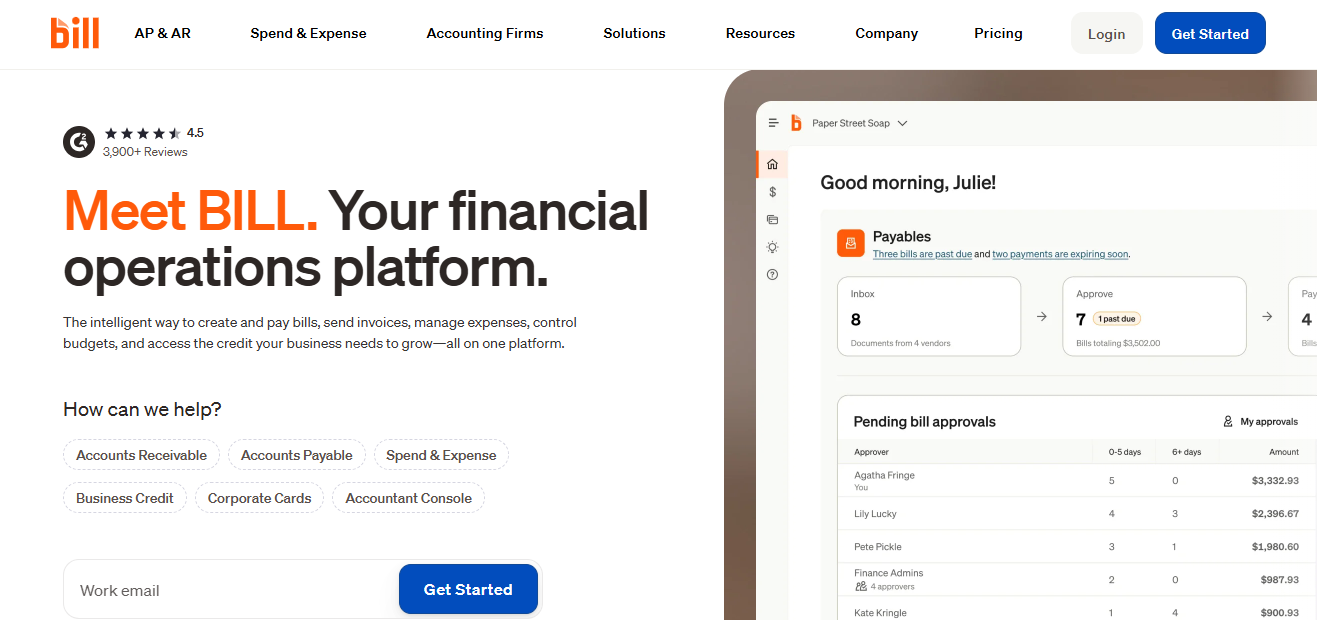
BILL’s strength is process rather than price. Invoices arrive at a dedicated inbox, get captured, route through approval chains you define by amount or department or GL account, and pay out through an established payment network that most vendors already recognize. The audit trail is thorough enough to satisfy a lender or an outside accountant without additional documentation, which is why it stays entrenched in businesses that have outgrown informal approval.
Pricing is per user, which is the deciding factor for most small businesses. Essentials starts around $45/user/month, Team around $55, and Corporate in the high $70s to high $80s. Transaction fees are layered on top: roughly $0.49 per ACH payment, $1.99 per check, 2.9% for virtual cards, and about $9.99 per international wire. Note that automatic two-way Xero sync sits on the Team tier and above, so the entry plan is not the one most Xero users actually want.
Pros
- Approval workflows are among the most configurable at the small business end of the market.
- The payment network is large enough that many vendors are already enrolled, which shortens onboarding.
- Purchase order matching and multi-entity support exist on higher tiers, so the platform grows with a business.
Cons
- Per-user pricing compounds quickly once approvers, bookkeepers, and a controller all need access.
- The two-way Xero sync requires stepping up from the entry plan, which raises the starting price.
- Users consistently describe the interface as heavier than newer alternatives, with a longer ramp for occasional approvers.
Best fit: A business where documented approval and separation of duties are the point, and cost per seat is an acceptable trade.
Ramp
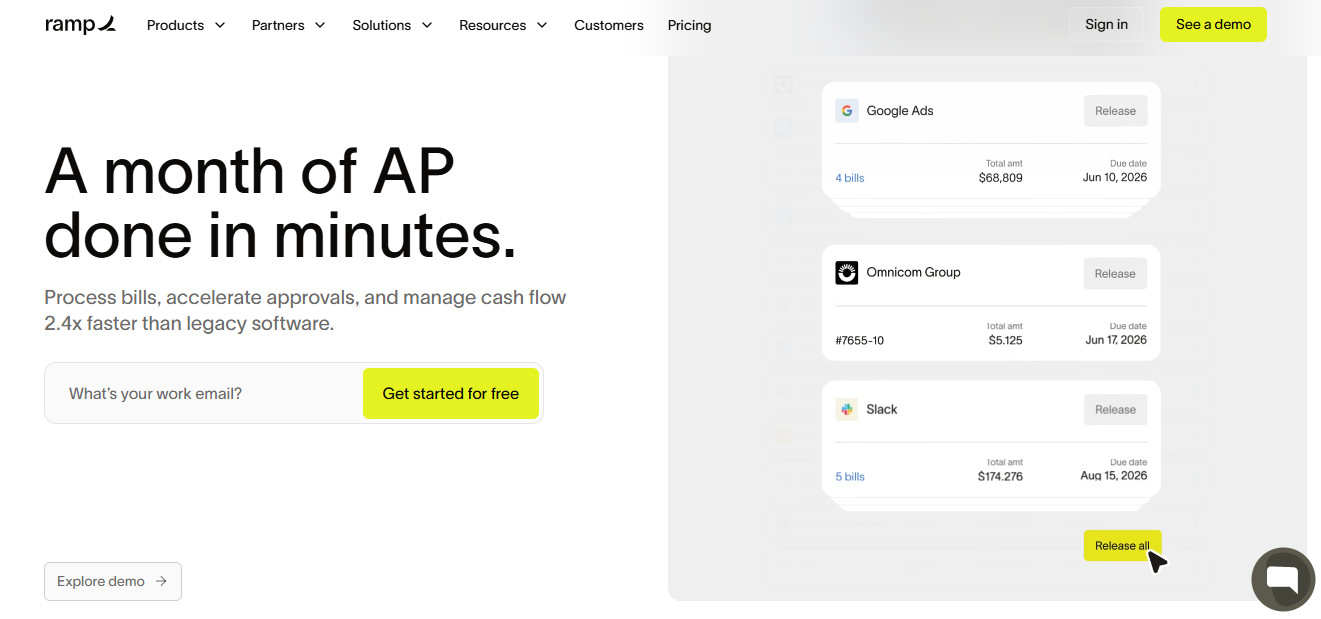
Ramp approaches AP from the spend management side. The company earns revenue on card interchange rather than software subscriptions, which is why the base plan is free and includes corporate cards, expense management, and bill pay all in one place. For a business already thinking about card controls, that bundling is extremely attractive: it’s one vendor, one set of coding rules, one place where spend appears before it becomes a bill.
The free tier includes free wires and same-day ACH, and it covers bill pay with two-way Xero sync for vendors, bills, payments, and credits. The Plus tier adds AI-assisted coding and approval recommendations at $15/user/month, plus a platform fee scaled to team size.
The catch is scope: Ramp issues cards only to U.S.-registered companies, and its deeper ERP connections sit behind the paid tier. Businesses with meaningful international vendor exposure will find the coverage thinner than a dedicated global payables tool.
Pros
- Domestic wires and same-day ACH are included at no charge on the base tier, where most competitors bill both per transaction.
- Cards, expenses, and AP share one coding layer, which removes a reconciliation seam at close.
- Approval routing supports roles, permissions, and separation of duties without a paid upgrade.
Cons
- U.S.-only card issuance rules it out for businesses with foreign entities.
- The economics depend on card spend, so a business that pays almost everything by ACH is not the target customer.
- Advanced integrations and AI coding require Plus, which reintroduces per-user pricing.
Best fit: A U.S. company that wants corporate cards and bill pay in one system and is comfortable with an interchange-funded model.
Picking the Best Bill Pay Option for Xero

For most Xero users, the built-in option deserves a real trial before you shop. Free standard ACH inside the ledger removes the two things that made AP annoying, and if your bills are domestic and your approval process is informal, that may be the end of the analysis. Revisit it once the approval expansion lands later in 2026.
Where the built-in option runs short, the gap is usually specific and solvable: If you need control structure, BILL is worth the per-seat cost. If cards and expenses belong in the same system, Ramp is the consolidation play. And if you want a fuller AP platform than Xero’s native flow while staying inside the same payment infrastructure Xero itself chose, Melio is the natural place to land.
The useful test is not which platform has the longest feature list, but which one removes the step in your close that you dread most.