


Last Updated on June 8, 2026 by Ewen Finser
Picking the right phone system can make a huge difference when it comes to ensuring that your sales or support team operates well day to day.
Get it wrong and you’re left managing the fallout: dropped calls, tedious manual data entry, and disconnected tools. This can result in reps spending more time dealing with admin than with customers.
On the other hand, choosing wisely can mean your phone channel suddenly becomes a performance lever: it will feed accurate, comprehensive data into your CRM, coach reps in real time, and even scale seamlessly as your team grows.
This decision particularly matters for SMBs. A well-integrated telephony platform won’t just reduce rep admin – it will also improve CRM data quality, and give managers better visibility into team performance.
But none of these things will necessarily show up by reading feature checklists in marketing materials. That’s why it’s vital to do your research upfront and make the right choice from your start, rather than trialling a platform and having to switch a year later.
Two platforms that stand out in this space are Aircall and Nextiva: each one takes a different approach towards solving the issues faced by SMB phone systems. Which is the better fit will depend on your specific organization, its needs and its budget.
What Is Aircall?
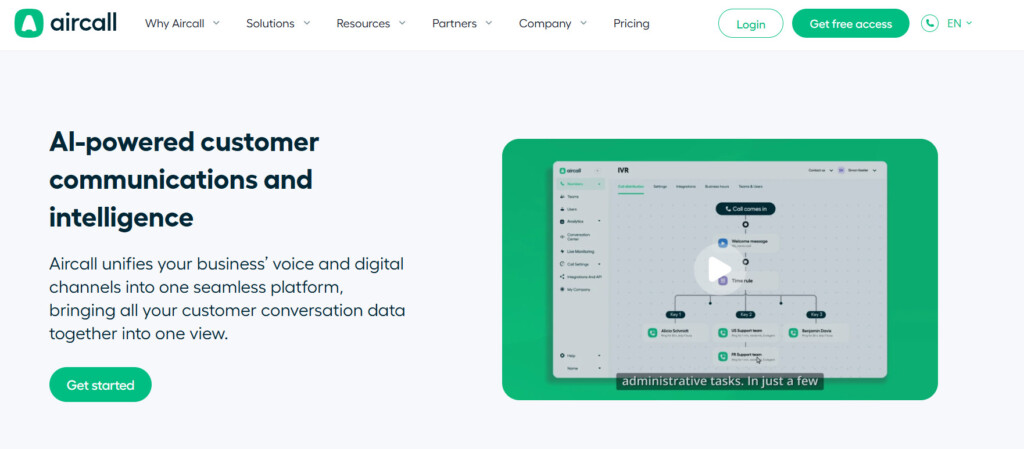
Aircall launched in Paris in 2014, with a stated focus on building a cloud phone system for sales and support teams, not just a generic communications suite.
The platform now has 22,000 customers globally with offices across North America, Europe, and Asia-Pacific.
Aircall’s marketing describes it as an AI-powered customer communication and intelligence platform, with deep CRM and helpdesk integration at the center of its value proposition.
The platform emphasizes fast setup, powerful AI features that are layered well around calls, and workspaces where voice, SMS, and messaging can connect directly to the tools teams already use, depending on their needs.
Aircall’s particularly well-regarded among SDR teams, inside sales organizations, and support desks that live inside HubSpot, Salesforce, or Zendesk, so need their phone channel to feed those systems automatically. This can save the trouble of manually inputting data after each call.
Keep reading: Aircall Review
What Is Nextiva?
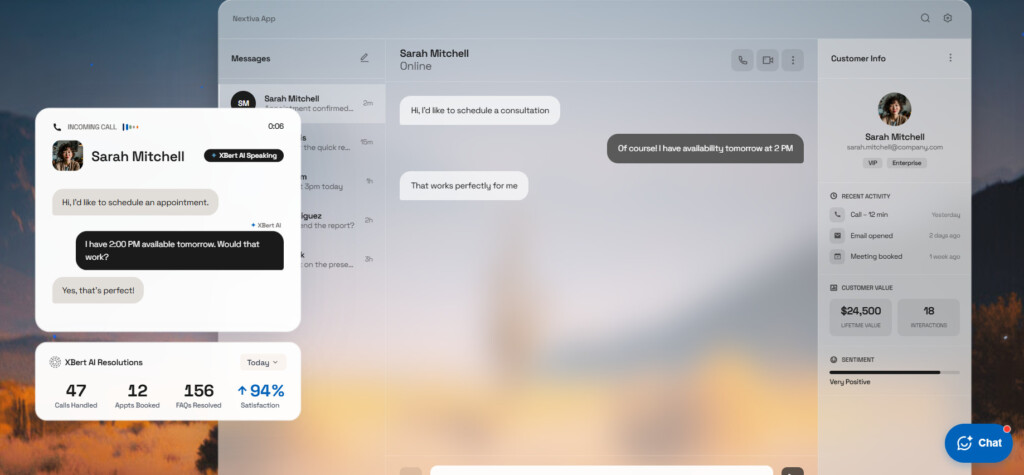
Nextiva was founded in Scottsdale, AZ in 2006, though it treats its birth year as 2008, as that was when it first started offering its services officially to customers. Since then, it’s grown to be one of the most well-known names in business VoIP.
While Aircall focuses mostly on sales and support telephony, Nextiva has a much broader remit: voice, video calls, team messaging, SMS, and customer experience tools in a unified communications platform.
This means that Nextiva has a good reputation among SMBs that want most of their communications stack to be handled by a single vendor, as it can handle use cases from single phone lines to contact center features.
The platform has strong third-party reviews for ease of use, customer support, and reliability. For example, Capterra rates Nextiva 4.6 out of 5 from over 900 reviews.
Like Aircall, Nextiva has been working on improving its AI features, adding AI call transcription, summaries, and a virtual AI receptionist across certain plans.
Aircall: Main Advantages
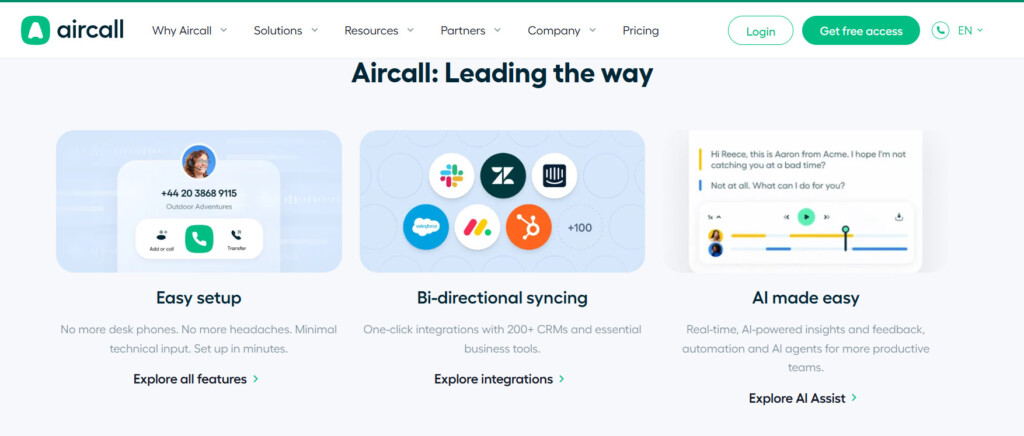
The advantages of using Aircall are going to be most apparent if your team is CRM-first. In other words, its integrations go much deeper than many competitors.
CTI inside Salesforce, HubSpot, and Zendesk means reps never have to leave their core tool to make or log a call.
AI features like post-call summaries, sentiment analysis, call scoring, and key topic extracting can also be built into the same workspace (depending on your plan), so there’s no need for a separate third-party tool.
Setup is very fast: new numbers, IVR routing, and integrations can go live within hours for small teams. Naturally, larger deployments and number porting can take longer.
Aircall doesn’t position itself as some kind of generic communications suite. For instance, it doesn’t support video calls natively. Whether this is an advantage is a matter of perspective. By way of example, as the platform doesn’t seek to compete with the likes of Teams and Zoom it arguably stays cleaner and more focused, so reps may find Aircall easier to adopt.
Nextiva: Main Advantages
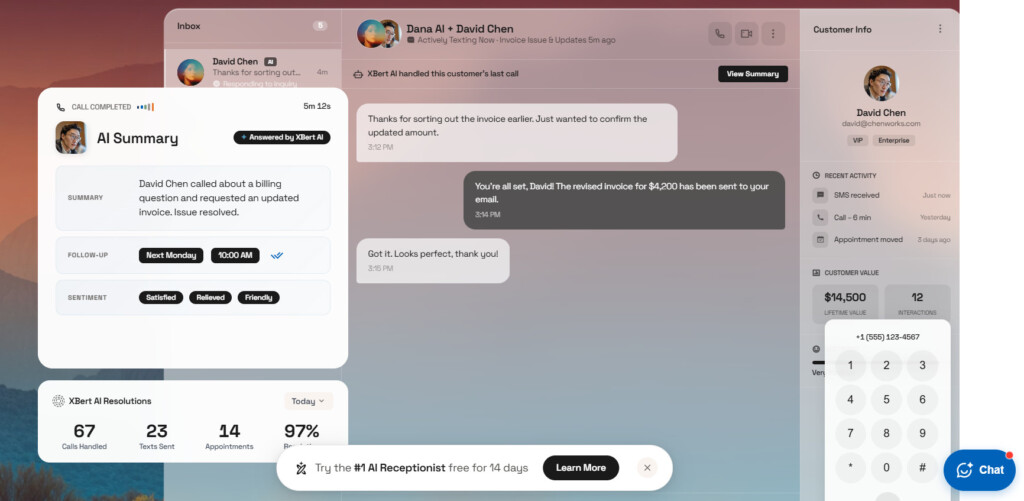
The best word to summarize Nextiva’s main advantage is ‘breadth.’ If a business needs features like voice, video calling, SMS, and basic contact center features from a single, centralized app then Nextiva can deliver these out of the box for a fairly competitive entry price.
The platform has a good reputation for reliability. It claims 99.999% uptime across eight points of presence and carrier-grade data centers. Overall, it has positive third-party reviews for ease of use and customer support.
Nextiva’s broader scope also means it can serve teams beyond just sales and support: HR, ops, and leadership can use the same platform for video meetings and team chat, for instance, without downloading and deploying extra tools. Consolidating in this way can be a real advantage for small businesses that want to keep their tech stack lean.
Aircall vs. Nextiva: SMB Phone Systems
Aircall
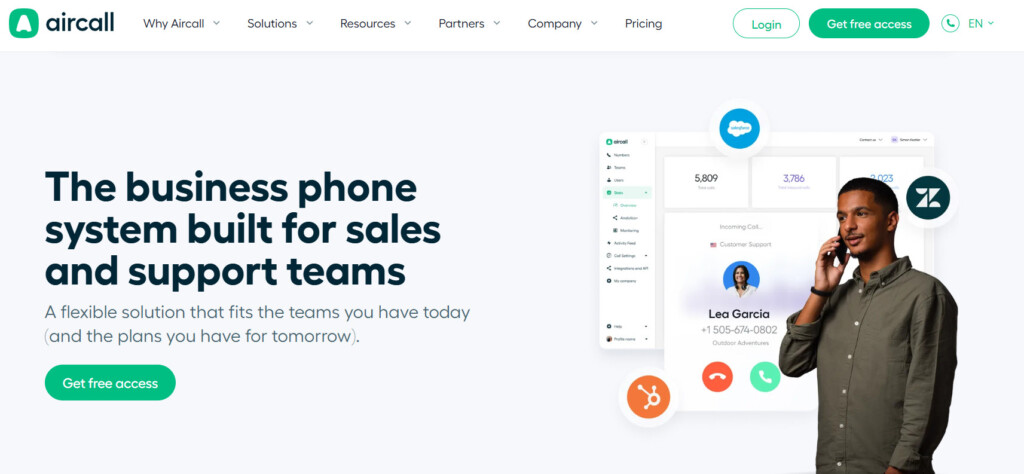
The platform is entirely cloud-based, meaning that no hardware or desk phones are required. Customers also don’t have to configure carriers.
Reps typically work from a desktop app, browser, or mobile app (both iOS and Android are supported). International virtual numbers are available for over 100 countries.
When it comes to Aircall, the core SMB experience comes down to clear call quality, reliable routing, and a workspace that can bring voice, SMS, and WhatsApp messages into place (plan dependent). All of this can be connected to a CRM or helpdesk running in the background.
Aircall’s “Smartflows” tool deserves special mention here, as it can provide admins with an intuitive interface for building call routing logic: IVR menus, schedules, ring groups, and queue management, without hiring a dedicated developer.
In other words, a non-technical team lead can configure the phone system themselves, which is useful for small businesses that may not have their own IT department.
Nextiva
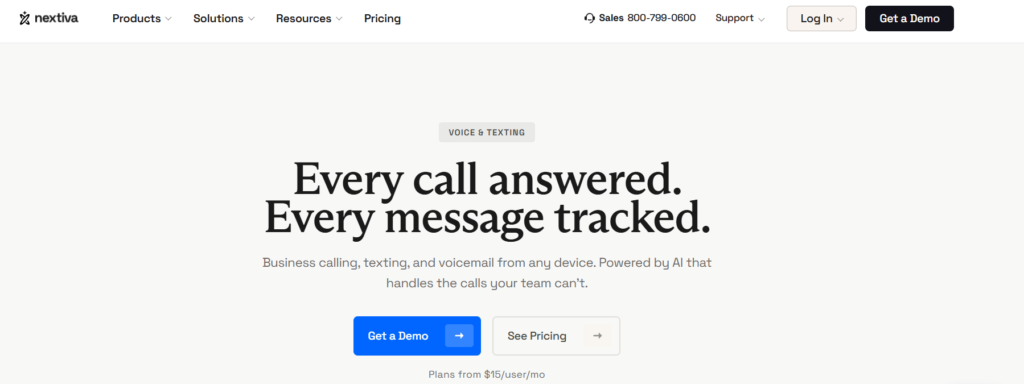
If you go to third-party review sites like Trustpilot, you’ll see that Nextiva is consistently rated as one of the top business phone systems for SMBs.
The platform earned this reputation as its ‘Core’ plan is built specifically for small teams. Even at the lowest pricing tier, users benefit from inbound and outbound voice, business SMS, video meetings, screen sharing, auto-attendant, call routing, team chat, and a mobile app. Unlimited calls within the US and Canada are also offered on all price plans.
For a small business transitioning from a landline, this range of features at a low starting price is a practical and low-risk starting point.
Winner: It’s a Tie
Each platform has its advantages depending on your SMB profile. For instance, Nextiva is a great fit for small businesses that need a single app covering voice, video, and messaging from the outset, with no add-ons.
Aircall is the better choice for SMBs where the phone system is mainly a sales or support channel, and tight CRM integration matters more than having an all-in-one communications suite. In other words, if your team lives in CRM, then Aircall’s phone system can feel like an extension of it, if properly configured. But if your team needs a more general-purpose business phone, then Nextiva will likely deliver more out of the box for less.
Aircall vs. Nextiva: Contact Center Features
Aircall
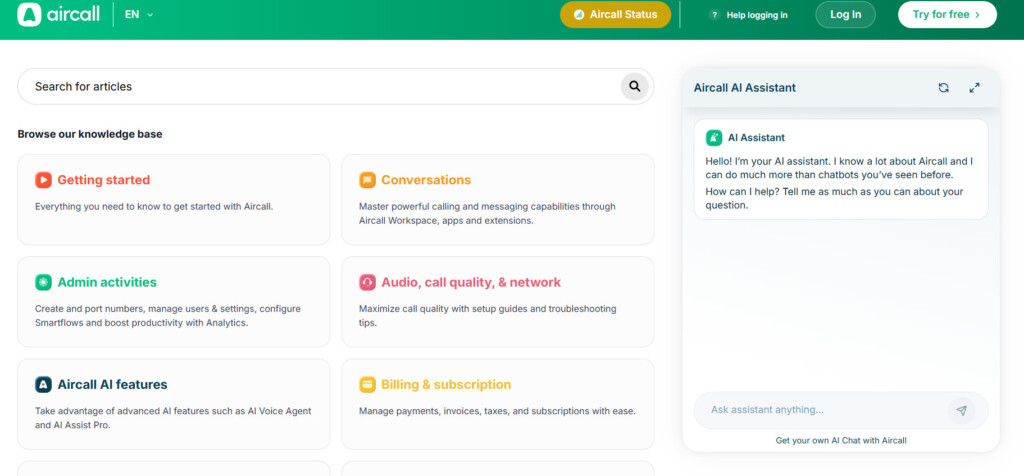
The platform’s contact center feature set is mainly built around voice-first sales and support workflows.
IVR, call queues, ring groups, warm transfer, call recording, Power Dialer, Voicemail Drop, and live monitoring, are all supported, though some features will depend on your plan.
Shared inboxes can bring SMS, WhatsApp, and voicemails into a single queue for team triage, once again, depending on your setup and pricing plan. There’s also an AI Voice Agent, which can provide your SMB with 24/7 coverage. This can be useful for SMBs that want to answer routine calls, capture leads, or even route queries outside business hours.
Besides the agent, Aircall’s AI layer includes sentiment analysis, real-time in-call coaching, and automated call scoring. After the call, it layers in capabilities from Piper AI, a recent acquisition. Where the existing AI layer handles what happens on the call, these added features pick up everything that follows: automatically updating CRM fields, drafting follow-ups, and tracking deal health across video, email, and phone/WhatsApp.
For teams running multi-touch sales cycles across several channels, this means that the intelligence Aircall captures on a call doesn’t just sit in isolation; it connects to the broader picture of how each deal is actually moving.
Nextiva
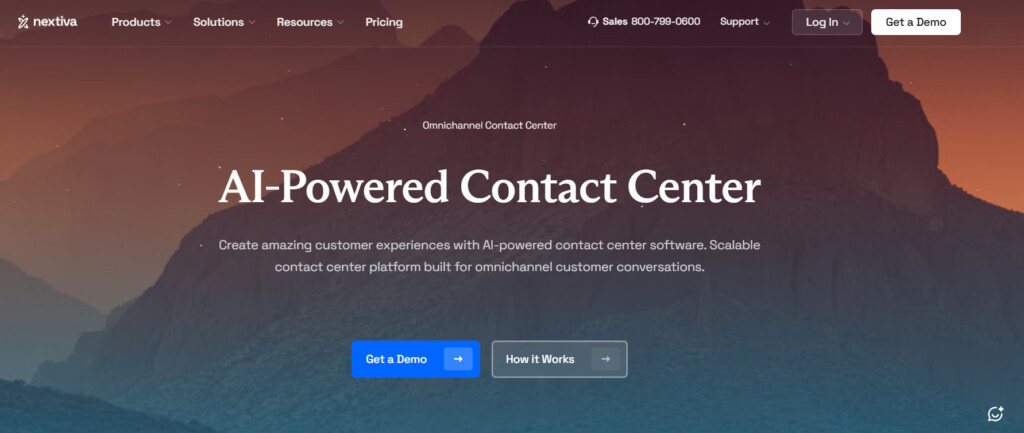
Nextiva’s contact center covers both inbound and blended call center functionality. It also supports skills-based routing, live chat, and chatbots.
Depending on your pricing tier, the platform can also provide AI summaries, and advanced reporting. Its XBert AI Receptionist can also handle routine inbound inquiries.
Video meetings and team messaging are supported natively, giving it a broader channel footprint.
Winner: Aircall
Nextiva’s contact center tools are impressive, especially if you want a broader communications and CX platform. However, Aircall’s integrated AI features, real-time coaching, and CRM-connected call intelligence are more mature and focused for pure sales and support call-center workflows.
Aircall vs Nextiva: Integrations
Aircall
As we’ve learned, integrations are Aircall’s headline feature. The platform can connect with over 250 CRM, helpdesk, and productivity tools with real depth: CTI inside Salesforce, HubSpot, Zendesk, Dynamics, and Freshdesk.
Depending on your subscription type, Aircall also supports bi-directional data syncing and automatic activity logging, with recordings, summaries, AI-generated notes attached to the right contact or ticket. You can deploy custom workflow builds beyond the native marketplace using APIs and webhooks.
One of the key benefits of Aircall is that when a rep closes a call, the platform can automatically attach a summary, sentiment score, and key topics to the relevant deal/ticket in the CRM. This can significantly cut the amount of manual admin a rep has to do after each conversation.
This kind of post-call automation is where integration depth can really translate into measurable time savings, particularly for teams running 40+ calls per rep per day.
Nextiva
The platform can integrate with key CRMS, like Salesforce, HubSpot, Zoho, and Zendesk, plus Microsoft Teams, Google Workspace, and healthcare-specific platforms like Epic and ModMed. You can also extend the integration footprint further via Zapier.
That said, Nextiva’s integration library is narrower than competitors like Aircall. Its depth of CRM connectivity, such as automatic logging, AI summary syncing, and bi-directional data flow also isn’t as comprehensive as Aircall’s.
Winner: Aircall
While Nextiva may have the broader communications platform overall, Aircall supports more native integrations and has deeper CRM and helpdesk connectivity of the kind that matters to sales and support teams.
Aircall vs. Nextiva: Ease of Scaling
Aircall
The platform has a tiered structure, so users, numbers, and features can be added incrementally.
Aircall is typically a practical fit for small and mid-sized sales/support teams, especially once you’re above the microbusiness stage. It handles distributed and remote teams well.
There’s a minimum expectation of three seats: for example, the ‘Essentials’ plan works out at $30/license when paid annually, but you’d need to pay a minimum of $90/month for three licenses to subscribe. This may make Aircall a less attractive choice for one or two-person businesses.
However, for teams that are already in the 50 – 100 seat range, adding new ones can be done in minutes. If you expect that you’re going to go above 100 agents you’ll likely want to look at Aircall’s custom enterprise tiers for more headroom without switching platforms.
Nextiva
Nextiva is designed to scale from very small businesses (core plans start at $15/user/month when paid annually) through to enterprise tiers with dedicated business VoIP, omnichannel capabilities, and contact center support for large organizations.
This means an organization can start on a ‘Small Business’ plan, then once they grow beyond 100 users, they can stay with a single vendor as they scale by switching to an enterprise plan.
Winner: Nextiva
If your business plans to grow beyond the SMB mid-market and/or wants a single communications vendor for the long haul, Nextiva’s range is wider. Aircall’s sweet spot is better defined.
Aircall vs. Nextiva: Overall Winner
Both Aircall and Nextiva are good at what they’re designed to do: they’re simply built for different use cases.
Nextiva is the better option if you want a single communications platform that covers voice calls, text messages, and team chats under one virtual roof. It has a lower entry price point than Aircall but has a broader feature set and a good compliance story for certain regulated-industry buyers.
It also scales further up market, as advanced enterprise tiers are available, and it has strong customer support ratings on third-party platforms.
Aircall, on the other hand, is a better choice if your team’s phone channel is tied directly to sales pipeline or customer support outcomes, and if you need it to work seamlessly inside a CRM or helpdesk.
It has deep integrations, mature AI features at the call level, and its focus on high-volume sales and support workflows gives it a clear edge in that context.
Its recent acquisition of Piper AI extends that edge into post-call execution, further separating it from the pack with capabilities that most general-purpose communications platforms don’t touch.