


- What Is an AI Voice Agent in Healthcare?
- What Can an AI Voice Agent Do for a Healthcare Practice?
- When Should an AI Voice Agent Transfer a Call to a Live Agent?
- That Being Said, are AI Voice Agents HIPAA Compliant?
- How to Choose an AI Voice Agent for Healthcare
- How to Choose the Right AI Voice Agent for Healthcare
Last Updated on September 1, 2026 by Ewen Finser
If you’ve ever sat on a phone for minutes waiting to schedule an appointment with a doctor or hear back about very important test results, you will know the frustrations of waiting. This is a rampant problem for many medical offices and hospitals, but there are solutions.
One major option is to integrate an AI voice agent into your healthcare office.
A traditional phone system will only get you so far. Long wait times, the inability to speak with an agent, and the lack of integration across various CRM (customer relationship management) platforms are signs that it’s time to try something new.
While you don’t have to adopt an AI voice agent, there are ways that it can help streamline communications between your office and patients.
What Is an AI Voice Agent in Healthcare?

An AI voice agent is exactly what it sounds like: having an automated agent built with artificial intelligence to greet and speak with your clients whenever they call. They often act and sound like a real human, but without all of the resources dedicated to having someone answer the phone every single time someone calls.
An AI voice agent is always present and always available, unlike real people. This allows the AI to be a reliable resource that you can count on to make your workload easier and the entire healthcare process a bit less frustrating for customers. All the while, an AI voice agent will cost you much less than it would to hire someone to work for you after-hours and the like.
That said, an AI voice agent doesn’t completely replace a real, live agent, especially in the healthcare field, but rather supplements them. The idea is to automate the areas that you are able to automate safely in the healthcare industry, while freeing up the experts on your team to focus on the actual issues only they can address.
What Can an AI Voice Agent Do for a Healthcare Practice?
AI voice agents can handle many routine calls that would otherwise take up time for receptionists and other staff. They’re especially useful for administrative tasks that don’t require clinical judgment or access to sensitive patient information.
Common healthcare use cases include:
- Scheduling appointments: Patients can call to check availability and schedule appointments without waiting for a receptionist.
- Rescheduling and cancellations: AI agents can help patients move or cancel appointments and find another available time.
- Appointment reminders: The AI can make outbound calls to remind patients about upcoming appointments, reducing the need for staff to make these calls manually.
- Answering common questions: AI agents can provide basic information about office hours, accepted insurance, new-patient availability, locations, and other frequently asked questions.
- After-hours support: When the office is closed, an AI agent can let callers know when staff will be available and provide appropriate next steps or resources.
Better yet, the AI doesn’t have to take time off, so this can be the case 24/7. Even in the middle of the night, the automated agent can provide callers with details about their upcoming appointment and other information.
When Should an AI Voice Agent Transfer a Call to a Live Agent?

While an AI voice agent is an excellent help for your medical office, there are parts you need to keep in mind to keep compliant with HIPAA and everything else.
For one, there are some calls and requests that will always require a live agent. This includes anything that deals with the patient’s direct, personal info beyond basic intake details.
If someone needs to update their insurance or change certain personal information, this is where an AI needs to reroute the call to a real person that can help. The same goes for any type of medical advice or question. An AI might be quite intelligent, but it is not a licensed professional at the end of the day.
In general, medical advice should only come from a real person trained for years for that exact type of situation; not AI. Any questions that a caller has regarding their condition, whether they should come in to be checked or not, or results from a recent appointment should be addressed by a real person.
If the contents of the call go beyond the bare minimum details about intake, hours, FAQs, and the like, that is when you have to have a real person step in to take over.
That Being Said, are AI Voice Agents HIPAA Compliant?
An AI voice agent can be used in a healthcare setting, but whether it is HIPAA compliant depends on how it is built, what patient information it handles, and how that information is stored and protected. Healthcare organizations should evaluate an AI voice provider the same way they would any other technology that may handle protected health information (PHI).
When evaluating an AI voice agent for HIPAA compliance, look for:
- Data encryption: Patient information, call recordings, transcripts, and other data should be protected with appropriate security measures both in transit and at rest.
- PHI handling: Understand what patient information the AI collects, accesses, processes, or stores and whether the system actually needs that information to complete its task.
- Access controls: The system should limit access to patient information to authorized users and use appropriate authentication and permissions.
- Business Associate Agreement (BAA): If the vendor will handle PHI on behalf of a covered entity, determine whether it will enter into a BAA as required under HIPAA.
- Call recording and data retention: Understand whether calls are recorded or transcribed, how long that information is retained, where it is stored, and how it can be deleted or retrieved.
- Audit and monitoring: Healthcare organizations should have appropriate processes for tracking access to and handling of sensitive information.
AI voice agents can be useful for routine administrative tasks such as scheduling, appointment reminders, and basic FAQs, but healthcare organizations should be careful about allowing an AI system to access or disclose sensitive patient information.
Tasks involving medical advice, clinical decisions, or more sensitive patient requests should generally be routed to an appropriately trained staff member.
How to Choose an AI Voice Agent for Healthcare

Once you decide an AI voice agent could be useful for your practice, the next step is finding a system that fits your existing workflow. There are plenty of options, from phone platforms such as RingCentral, Aircall, and Dialpad to more specialized AI voice solutions.
Price is one consideration, but it shouldn’t be the only one. Before choosing a system, look at how well it fits into the technology you already use and what you actually need it to handle.
A few things to consider include:
- Integrations: Check whether the system works with the CRM, scheduling software, EHR, or other tools your practice already relies on.
- Healthcare features: Some AI voice platforms are designed primarily for sales or customer service, so make sure the system can support healthcare-specific workflows.
- Security and compliance: If the system will handle protected health information, understand how it handles that data and whether the vendor offers the appropriate compliance and contractual protections.
- Scalability: A system that works for one provider may not be the right fit if you plan to add more providers, locations, or call volume.
- Human handoffs: Look at how easily the AI can transfer callers to staff when a request requires human assistance.
- Ease of implementation: Consider how much technical work is required to get the system running and whether the vendor provides support during setup.
Aircall as an AI Voice Agent Option
Aircall is one option healthcare organizations may want to consider when comparing business phone and AI voice systems. At its core, Aircall is a cloud-based phone system that lets teams manage calls from desktop and mobile devices. It includes features such as call routing, IVR, call recording, SMS, CRM integrations, and analytics. Aircall also offers an AI Voice Agent that can answer calls, handle common questions, collect information, perform routine tasks such as appointment scheduling, and transfer callers to a human when needed.
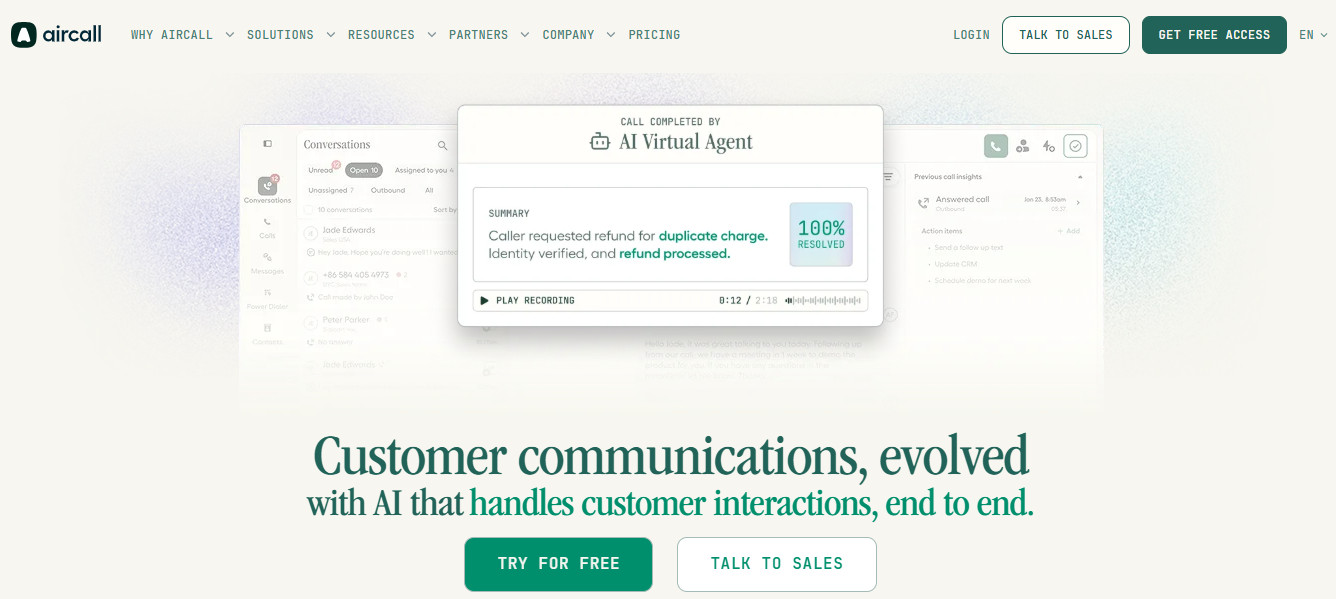
For a healthcare practice, the AI component could take care of some of the repetitive calls that would normally fall to a receptionist or call center. You can configure the agent with information about your practice and define the types of questions and tasks it should handle. If a caller needs help with something the AI isn’t equipped to handle, the call can be transferred to a staff member with context from the conversation.
Some potential uses include:
- Answering common questions about office hours, locations, and services
- Helping patients schedule, reschedule, or cancel appointments
- Collecting basic information before transferring a caller to staff
- Routing calls to the appropriate department or team member
- Handling routine calls outside normal office hours
- Logging calls and interactions in connected business systems
Another reason a practice might consider Aircall is that it doesn’t necessarily require replacing every system you already use. Aircall offers more than 250 integrations, including tools such as HubSpot, Salesforce, and Zendesk, which can make it easier to connect your phone system with the rest of your workflow. For a smaller practice, this could be helpful if you want to add AI capabilities without completely rebuilding your existing phone setup.
How to Choose the Right AI Voice Agent for Healthcare
Legacy phone systems will only get you so far in the healthcare field these days. There are moments when your receptionist and agents are busy, the phones are ringing nonstop, and patients are getting frustrated with the lack of help after-hours. When these moments happen, an AI voice agent is essential to success.
Of course, implementing an AI voice agent can be quite daunting, especially if you don’t have anything similar to it already implemented. For the smoothest and most effective AI voice agent system for healthcare professionals, Aircall is the answer due to its strong features, quick integration with CRMs, and transparent details that keep you HIPAA-complaint.