


- Comparing final mile software for asset based 3PLs
- Enterprise TMS: Tailored performance at a cost
- Point Solution TMS: Focused functionality and the limits of point solutions
- Unified Platforms: Rapid deployment but only with best practices
- Who unified platforms are best suited for
- Final thoughts: Strategic decision framework for 3PLs
Last Updated on October 23, 2026 by The Digital Merchant Team
If you run an asset-based third party logistics operation, your daily reality is completely different from that of an e commerce supplier. You are not arranging small packages to be delivered by the national mail. Instead, you receive, consolidate, prepare, and deliver large, high volume items such as household goods, appliances, and fitness equipment using your own warehouses and your own trucks for the final mile.
As the owner of the operation from the receiving dock to the selected point of delivery, you feel the operational gap between your warehouse management system and your transportation management system every single day. Most managers or coordinators ignore these differences, operating as if they were handling couriers or small packages.
Finding the best 3PL software for the final mile that aligns with your warehouse reporting requires evaluating platforms designed to eliminate that gap between the dock in the warehouse and the truck in the final mile.
My upfront recommendations are:
- Descartes for enterprises with complex global supply chains and the resources to properly capture complex workflows,
- DispatchTrack for regional-level operators focused on a single aspect of the package lifecycle,
- Grasshopper Labs for mid-market carriers and heavy goods firms who want a speedy launch connecting both warehouse and final mile.
Comparing final mile software for asset based 3PLs
Solution Tier / Category | Representative Platforms | Average Setup Timeline | Primary Implementation Bottlenecks | Best for |
Enterprise Supply Chain Suites | Manhattan Associates, Descartes | 6 to 12 months | Custom code, heavy IT involvement, legacy system integration | Global supply chains with dedicated internal IT departments and highly complex custom workflows |
Point Solution TMS | DispatchTrack, FarEye, Extensiv | 2 to 4 months | Third party integrations needed to bridge warehousing and transport | Regional or medium providers focusing strictly on a single operational segment like parcel dispatch or standalone WMS |
Unified First to Final Mile Platforms | Grasshopper Labs, Kibo, One Network | 2 weeks | Internal data readiness. It requires structured facility and rate card data prior to setup | Mid market carriers, 3PLs, and heavy goods distributors needing rapid launch across warehouse and final mile teams |
Enterprise TMS: Tailored performance at a cost

Enterprise solutions can be an ideal choice for massive global 3PLs that have their own dedicated IT teams, technical resources, and the extended timeframe required to carry out a thorough review of their operations prior to implementing software. Large global enterprises and enterprise scale 3PLs with dedicated internal IT teams can use a TMS like Manhattan or Descartes, which fits supply chain organizations, enterprise retailers, and large third party logistics providers managing international networks with highly complex, custom workflows.
These enterprise 3PLs operate with large, dedicated software engineering departments and substantial annual technology budgets that allow them to absorb six to twelve month implementation cycles, heavy third party consulting costs, and ongoing custom code maintenance.
When a large organization has those resources in place, a customized TMS can deliver highly tailored views, specific operational flows and unique functionality suited to complex global networks. However when a growing 3PL attempts to replicate this customization without those massive IT budgets, the exact same process becomes an operational bottleneck. Without dedicated software engineering resources on staff, forcing custom code builds creates endless support delays, inflates third party implementation fees and leaves dispatch teams waiting on external developers just to handle basic operational changes on their daily screens.
Third party consulting and financial overhead
When evaluating a TMS proposal, many logistics managers focus solely on the recurring software license fee. However, these kinds of platforms usually have hidden charges and expensive implementation fees. Enterprise suites require specialized third party systems integrators to write custom code and map legacy database fields. These consulting fees are billed at steep hourly rates, often equaling or exceeding the annual cost of the software license itself. When a company needs an adjustment while the implementation is underway, overall expenses increase rapidly.
Additionally, it is very important to keep in mind that when switching to a new TMS, you have to pay for two software licenses at the same time during the transition. If an implementation takes up to 12 months, you will be paying double license fees for an entire year. In the meantime, dispatchers, drivers, and the warehouse team are forced to work across two different systems, entering the exact same data twice and manually updating both platforms whenever information changes.
Point Solution TMS: Focused functionality and the limits of point solutions

Local, regional, or medium sized 3PLs with operations focused on a single process can leverage point solutions like DispatchTrack, FarEye, Salesforce, or Extensiv. These platforms excel at matching specific logistics workflows such as courier networks, small parcel delivery, point to point transport, or dedicated warehouse storage. Operating with focused scopes and smaller IT teams allows these providers to benefit from rapid, highly specialized software setups without immediately requiring integrated warehouse management or complex multi-leg tracking. However, as operations grow, connecting these standalone tools to external warehousing or financial platforms requires building and maintaining costly custom API bridges.
Choosing a point solution TMS means adopting a software application built to manage a single step in the supply chain rather than the end to end operation. While this model works effectively for single segment coverage, operational friction emerges when attempting to automate workflows across multiple departments. For instance, updating inventory levels automatically upon dock receiving often requires extra charges, custom add ons, or manual workarounds. Over time, managing isolated tools creates ongoing technical debt and administrative friction for expanding 3PL businesses.
This technical friction compounds when separate facilities across a 3PL network run unique processes. When an individual hub uses a distinct workflow or layout, software developers must write customized code to connect that specific facility with the central dispatch system. Relying on custom code bridges between standalone tools constantly inflates software maintenance expenses, leaving growing operators stuck paying continuous developer fees just to keep basic operational databases synchronized.
Integration friction and dock to truck delays
In a typical point solution setup, receiving staff register incoming freight inside a standalone warehouse system. Once items are picked and staged for final mile routing, 3PL dispatchers must export order manifests manually or rely on custom API bridges to see what is ready for the road.
When a piece of furniture arrives damaged at the dock or a unit is missing during staging, someone must update both the warehouse software and the dispatch board. If an API sync lags or a manual update is missed, 3PL dispatchers end up routing incomplete loads, leading to failed home deliveries and added windshield time.
Unified Platforms: Rapid deployment but only with best practices

Choosing a unified platform means 3PLs do not need to build or maintain API bridges with third parties. It comes with integrated workflows designed specifically for standard 3PL operations. Grasshopper Labs, for example, is preconfigured out of the box for big and bulky 3PL logistics, eliminating the need to write custom code from scratch. These platforms eliminate the need for expensive software development by delivering integrated operational workflows that mirror how 3PL companies actually run day to day.
However, adopting a unified architecture requires operational trade offs and strict internal data readiness. Because unified platforms rely on standardized workflows rather than unlimited custom development, 3PLs must adapt their operating procedures to prebuilt best practices rather than building bespoke system workarounds.
Furthermore achieving rapid deployment depends heavily on upfront preparation: operations teams must clean, standardize and structure their facility data, fleet specifications and contractor rate matrices before setup can begin.
When that internal preparation is complete, bringing receiving, staging, route optimization, proof of delivery, and contractor settlements under one roof allows 3PL dispatchers to gain immediate visibility into staged inventory without exporting files or waiting on API synchronization. When an item is scanned and staged on the warehouse floor, the dispatch board updates automatically..
Built for big and bulky 3PL logistics vs small package networks
Many transportation platforms were originally built for small package delivery or gig economy courier networks. In those operational models, a single driver drops a lightweight box on a porch or at a reception desk. The process takes less than two minutes, requires minimal customer coordination, and carries low operational risk.
When an asset based 3PL attempts to force big and bulky logistics into a standard parcel TMS, friction appears immediately. Heavy items like furniture, appliances, saunas, and outdoor equipment operate under entirely different constraints. They require two person delivery crews, precise appointment windows, pre delivery site inspections, and complex proof of condition documentation upon arrival.
Adapting a generic parcel TMS to support heavy goods forces engineering teams to write extensive custom code or buy separate third party add ons. In contrast, specialized platforms often come preconfigured out of the box for 2 person handling and white glove workflows, eliminating months of custom software development.
How 3PL operations prepare for a two week launch
While platform architecture plays a major role in deployment speed, internal operational preparation within the 3PL is what makes a rapid setup possible. 3PL organizations aiming for a fast launch focus on two core operational steps:
Clean Facility and Fleet Data: Before configuration begins, 3PL operations leaders should consolidate all location and asset data into clean, structured files. This includes street addresses, facility perimeters, dock capacities, and operating hours across all 3PL hubs. On the fleet side, logistics teams must document vehicle dimensions, weight limits, liftgate availability, and crew capabilities. Categorizing delivery teams by two person heavy handling skills allows the system to automate dispatch routing accurately from day one.
Standardized Pay Rules and Service Matrices: Unified platforms cover dispatch and financial settlements within a single system. To go live in two weeks, 3PL operations must consolidate rate cards, fuel surcharge formulas, stop pay structures, and accessorial charge rules like stair carry fees or assembly bonuses. Having clean settlement formulas ready enables immediate setup of automated client invoicing and contractor payouts without requiring custom financial coding.
Who unified platforms are best suited for

Scaling mid market carriers, asset based 3PLs, and big and bulky logistics providers can use a natively unified platform like Grasshopper Labs, Kibo or One Network which fit regional 3PL distributors, heavy goods carriers, and white glove delivery operators managing complex two person handling, precise appointment windows, and on site installation.
They operate without large internal IT teams or long deployment windows, making this kind of TMS the optimal choice for a 3PL to achieve full operational launch across terminals in as little as two weeks while avoiding double license fees and external developer overhead.
Final thoughts: Strategic decision framework for 3PLs
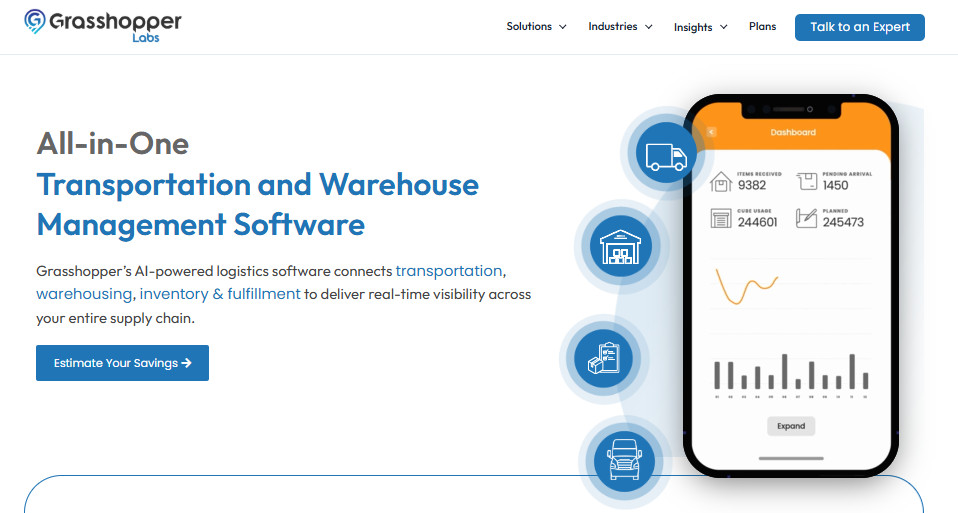
In 3PL logistics, we face multiple operational challenges when searching for the right software platform. If we do not select the correct system, we risk losing valuable time, wasting capital, and experiencing a severe drop in overall efficiency. Therefore, it is critical to evaluate the current stage of your 3PL business to determine which type of TMS is truly accurate for your operational model:
- Large global enterprises with dedicated internal IT teams can use a TMS like Manhattan Associates or Descartes, which fits supply chain organizations, enterprise retailers, and global logistics providers managing international networks with highly complex, custom workflows
- Niche regional 3PLs with focused single process operations can use a point solution like DispatchTrack, FarEye, or Extensiv, which fits local parcel delivery services, dedicated point to point couriers, and standalone warehouse operators.
- Scaling mid market carriers, asset based 3PLs, and big and bulky logistics providers can use a natively unified platform which fits regional distributors, heavy goods carriers, and white glove delivery operators managing complex two person handling, precise appointment windows, and on site installation.
While finding a platform that suits your business needs is logical, the equation also works the other way around: sometimes adapting your processes to a platform, like adopting the best practices of a native unified solution, can enhance the likelihood of a successful migration.