


Last Updated on September 15, 2026 by Ewen Finser
Picking the right business phone system isn’t always easy. The right platform affects your sales pipeline, support SLAs, and every CRM record your team relies on.
Both Aircall and CloudTalk support reliable calling, deep CRM syncing, and AI tools that can do more than just transcribe calls, which is why they often end up on the same shortlist.
If you’re weighing up the two platforms, you need to carefully consider their specific differences, in terms of pricing, AI features, workflows, analytics, and integrations.
Want a visual breakdown? Watch the video below to see how Aircall and CloudTalk compare and where each platform stands out.
What is Aircall?
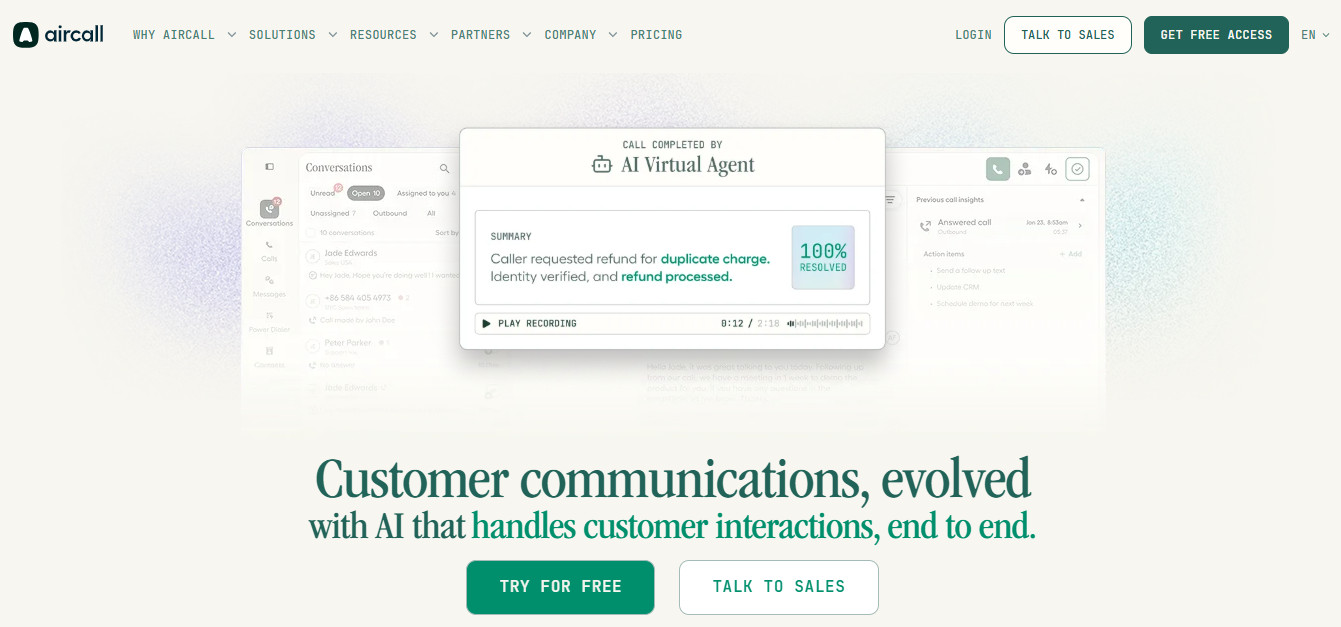
Aircall was founded in Paris in 2014, with major offices in New York and across Europe and Asia-Pacific. Its core focus is cloud calling, routing, recording, CRM and help-desk integrations, and AI-powered conversation tools in one workspace. The platform integrates with more than 250 business tools, including Salesforce, HubSpot, Zendesk, and Pipedrive.
It’s aimed mainly at sales and support teams, particularly ones already spending the majority of their time inside a CRM. Its AI Voice Agent and AI Assist products extend that same workspace model into autonomous and AI-assisted calling.
What is CloudTalk?
CloudTalk was founded in Bratislava in 2016. It began its life as a relatively simple click-to-call widget but has since evolved into a full business phone platform.
CloudTalk targets a similar SMB and mid-market sales and support audience as Aircall, but it places a strong emphasis on outbound-specific tooling. This includes power, parallel, and other automated dialing modes, alongside AI conversation intelligence and its own AI Voice Agent product.
Aircall vs CloudTalk: Pricing
Both platforms charge per seat with tiered plans, but the real cost depends on which features you need and how many licenses you’re buying.
Aircall
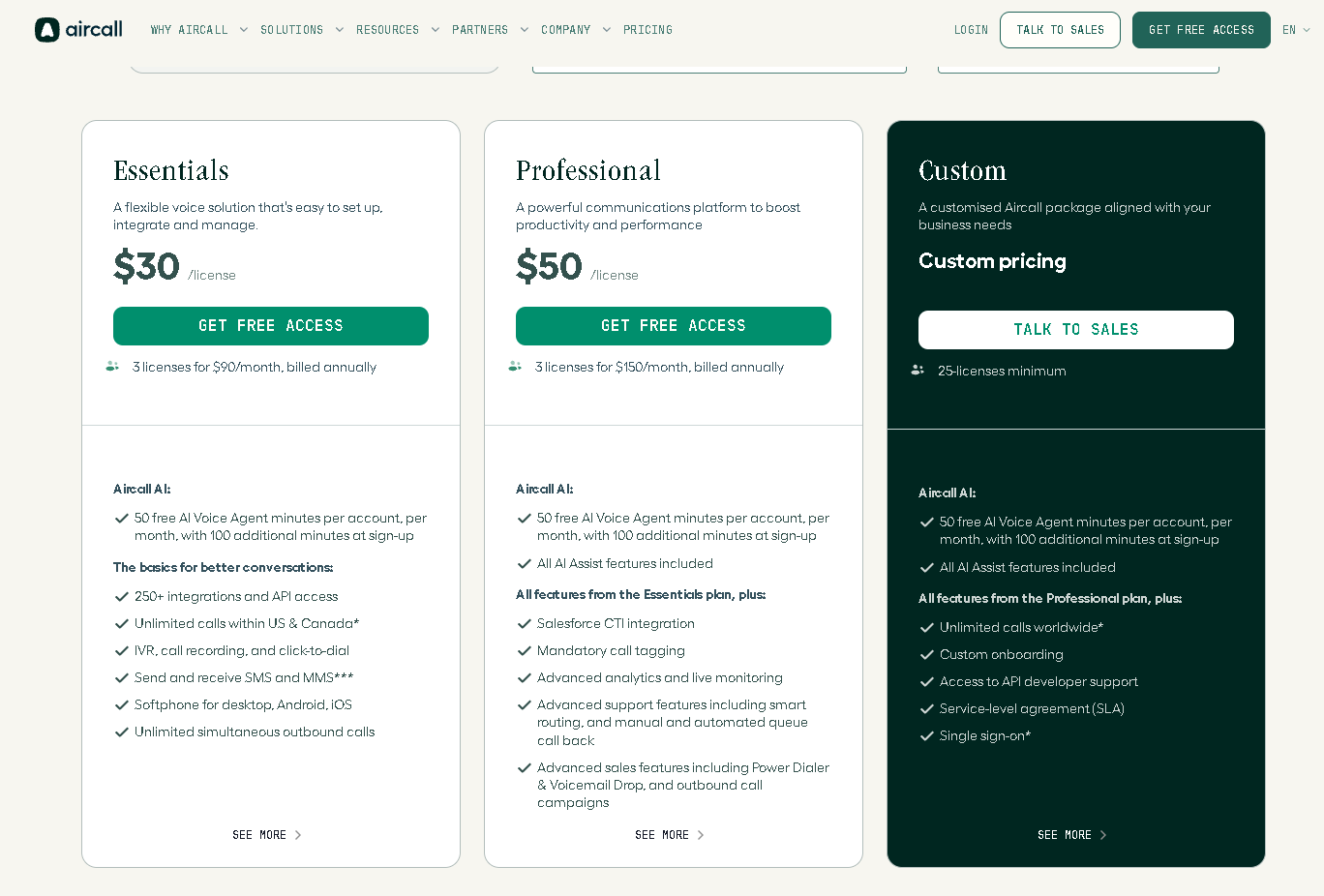
Aircall has two main pricing tiers (Essentials and Professional), as well as a quote-based Custom plan. These are all billed on a per-license basis with a minimum of three licenses for the first two plans. The Custom plan has a 25-license minimum.
The Essentials tier starts at $30 per license/month on annual billing and includes core telephony features such as call recording, click-to-dial, warm transfers, smart routing, and more than 200 integrations.
The Professional tier costs $50 per license/month on annual billing. It adds the Power Dialer, Salesforce integration, Voicemail Drop, advanced analytics, live monitoring, unlimited call recordings, and AI Assist.
If you don’t choose the Professional plan, you can also purchase AI Assist as an add-on to the lower plan for $9/license/month. Other add-ons include AI Assist Pro for $49/license/month, and Analytics+ for $15/license/month.
AI Voice Agent usage is billed separately once you exceed the free allowance, starting at $0.49 per minute and rising by usage tier. Every plan includes 50 free AI Voice Agent minutes per account each month, plus a one-time 100 minutes at sign-up.
CloudTalk
The platform offers three main pricing tiers: Starter, Essential, and Expert.
As with Aircall, pricing is per license, but there’s no minimum seat requirement for the Starter and Essential Plans.
The Expert tier does require a minimum of 3 licenses and costs $49/user/month, when billed annually. For this, you get the same features as on lower tiers, plus the preview and power dialer, which you’d otherwise have to purchase as an add-on for $15/user/month.
CloudTalk’s Voice Agents are billed separately. Prices start at $99 for 200 minutes/month for the ‘AI Receptionist’. You get 50 minutes free for your first month. There’s also an AI Specialist tier starting at €349/month for 1,000 minutes.
Winner: It’s a Tie
CloudTalk’s Starter plan, at $25 per user/month on annual billing, is the cheaper starting point for a solo user or small team, but it doesn’t include important features like CRM or help-desk integrations, APIs and data sync, or the workflow designer.
Aircall’s Essentials plan starts at $30 per license/month but requires at least three licenses, reflecting its focus on growing teams rather than one-person setups.
Aircall ‘Professional’ plan costs $50 per license/month annually, which is only slightly more than CloudTalk’s ‘Expert’ plan ($49/user/month) and has the same three-license minimum.
For teams that need to use Salesforce integration, AI Assist, advanced analytics, live monitoring, Voicemail Drop, and a Power Dialer, Aircall’s one-dollar per user per month difference is unlikely to be the deciding factor.
Neither plan is a clean apples-to-apples comparison. What you pay depends on team size and which features you need, not just the sticker price.
Aircall vs CloudTalk: AI Features
Aircall and CloudTalk both split AI into a voice agent product and a conversation intelligence layer, but they price and bundle those pieces differently.
Aircall
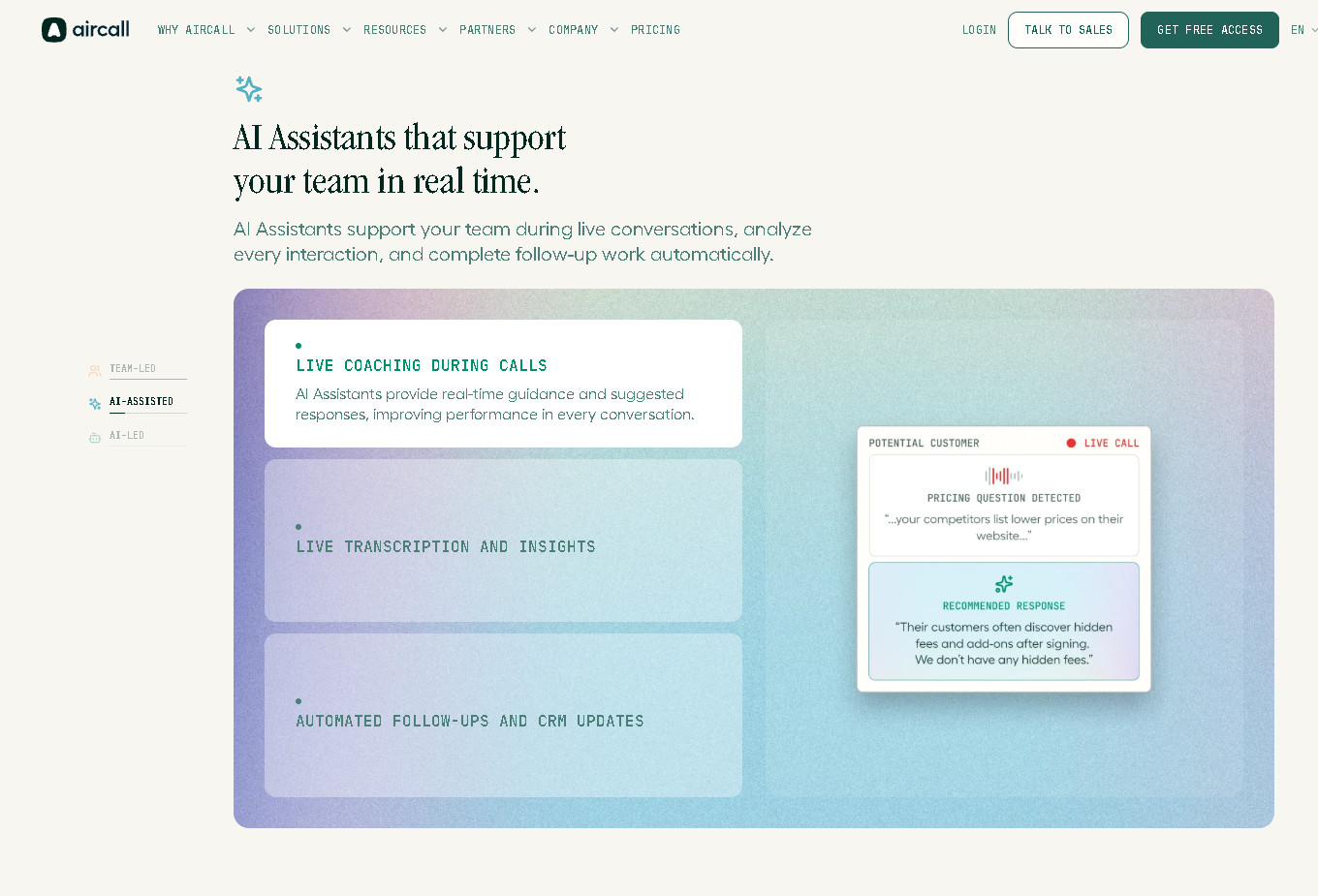
The platform’s AI stack has three main sections: AI Assist, which offers real-time transcription, summaries, and coaching insights, AI Assist Pro, which also incorporates live prompts and next-best-question guidance for reps, and AI Voice Agent.
Aircall’s AI Voice Agent handles routine inbound calls autonomously and it’s recently expanded into outbound use cases, including lead qualification and meeting booking. It can use natural language processing to handle FAQs, qualify leads, capture context, and hand off to a human agent with the full call history attached.
It also supports 23 languages, and can be configured using a no-code Agent Builder that drafts a working agent from a plain-language description. Aircall has also recently added AI Actions that let the agent look up orders or book meetings during and immediately after conversations, alongside AI Messaging Agents for WhatsApp and SMS.
CloudTalk
The platform divides AI into Conversation Intelligence (transcription, sentiment scoring, call summaries, topic extraction) and a separate AI Voice Agent product. Like Aircall, CloudTalk’s Voice Agent can handle both inbound and outbound conversational calls, like appointment booking, lead qualification, payment reminders, FAQ resolution. It can also be configured without programming code to create named personas for different use cases, and can hand off to a human with the transcript and CRM context attached.
Winner: Aircall
Both platforms offer similar AI capabilities, but Aircall’s AI Agents are more closely integrated with its calling, routing, CRM, and help-desk workflows, with 50 free Voice Agent minutes included per account each month.
Recent updates have given Aircall’s wider AI Agent offering a broader set of capabilities, including AI Actions, SMS and WhatsApp messaging agents, and performance reporting for AI agents.
CloudTalk’s Voice Agent is sold as a separate product, with AI Receptionist pricing starting at $99 per month for 200 minutes.
Aircall vs CloudTalk: Integrations
Both platforms connect to the CRM and help-desk tools sales and support teams already use, though the size of the catalog and what’s gated behind pricing tiers differ.
Aircall
Aircall has strong integration depth, which is likely why the platform was named Best for Integrations in Software Advice’s 2026 Call Center Software report.
It has over 250 native connectors, spanning CRM, help desk, e-commerce, and collaboration tools. HubSpot, Zendesk, Pipedrive, and Shopify are all natively supported without users having to deploy third-party middleware.
If you’re on the Professional plan, you also get full Salesforce CTI integration, including screen-pop, click-to-call, and automatic logging, along with the Power Dialer, Voicemail Drop, advanced analytics, and live monitoring.
CloudTalk
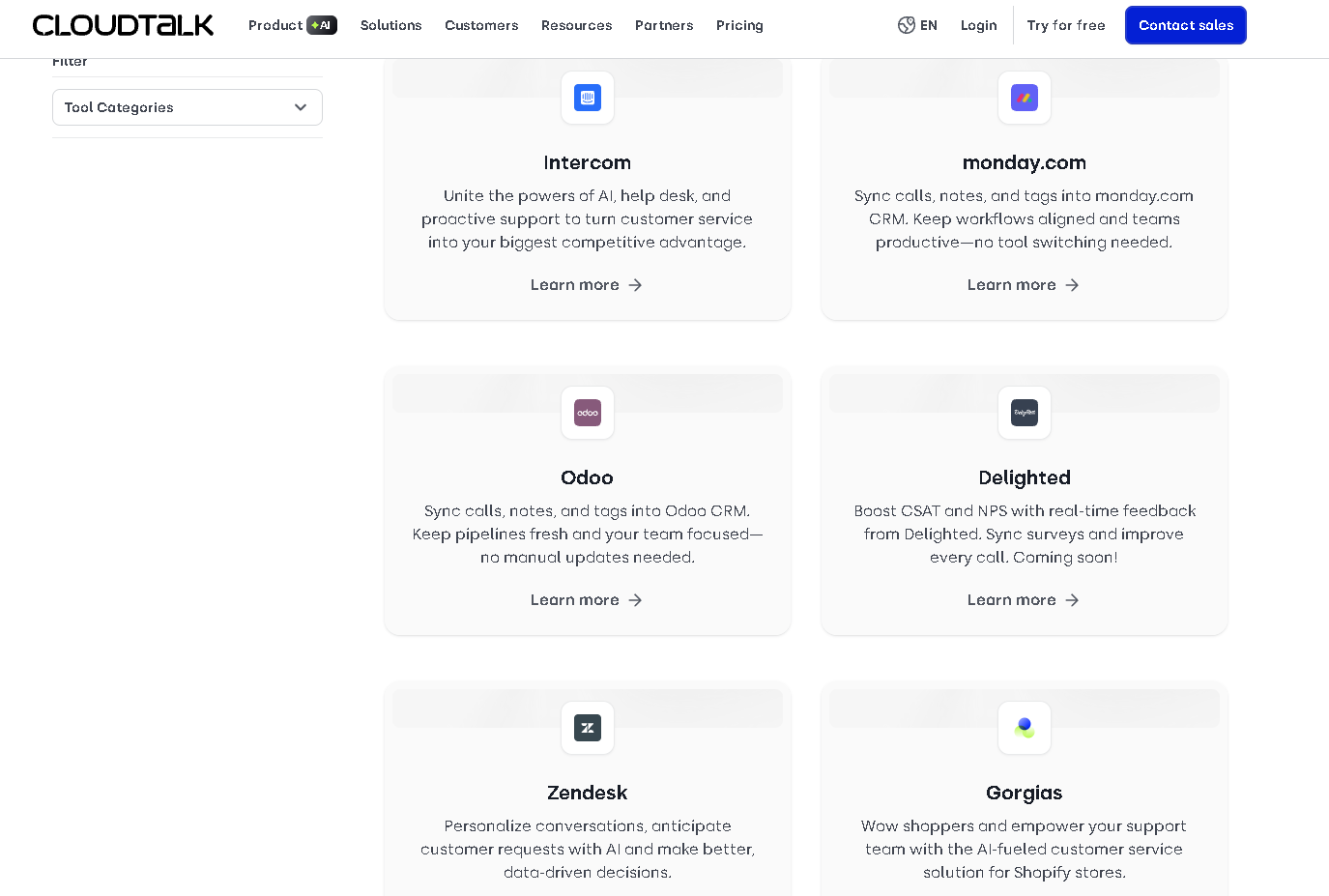
CloudTalk offers over 100 integrations, unlocked starting at the Essential tier, which also includes API access. Salesforce is reserved for the Expert tier, so full CTI depth there, including screen-pop and click-to-call, requires the top plan.
Winner: Aircall
Aircall wins this category because its broader native integration catalog gives teams more ways to connect calling with the CRM, help desk, e-commerce, and collaboration tools already in their stack. The platform also has an excellent reputation for its integration depth.
Aircall vs CloudTalk: Analytics
Call reporting comes standard on both platforms, but the depth you get and what it costs to unlock scale differently.
Aircall
If you subscribe to Aircall’s Essentials plan, it includes core reporting, while the Professional plan adds advanced analytics and live monitoring. The Analytics includes live team monitoring, unique caller breakdowns, and unlimited history. You can also use AI Assist (available either as an add-on or included with the Professional plan) to add sentiment, topic, and coaching-oriented reporting layered on top of standard call metrics.
CloudTalk
All CloudTalk plans support simple monitoring, with unlimited call history and basic dashboards.
AI Conversation Intelligence costs $9/user/month and includes features like call scoring, sentiment analysis, topic extraction, and talk/listen ratios. This can also be exported to a PDF or CRM. Its AI Voice Agent also has its own performance layer tracking containment and resolution rates.
Winner: CloudTalk
While both platforms offer roughly the same level of AI analytics depth, CloudTalk charges around 40% less for this privilege, as well as offering unlimited call history on all plans. Teams that want call scoring and sentiment data without committing to Aircall’s Professional or Custom tiers will likely get there faster with CloudTalk.
Aircall vs CloudTalk: Workflows
Routing, automation, and outbound dialing work differently on each platform, and the gap shows up most in how each handles high-volume calling.
Aircall
The platform’s workflow tooling centers on call routing, such as IVR and business-hours rules, the Power Dialer for structured outbound campaigns, and automatic CRM logging tied-in to its integration layer.
To take full advantage of the Power Dialer and Salesforce CTI, you’ll need an Aircall Professional subscription. Those on the ‘Essentials’ plan can’t access these features, as they can’t be purchased separately as add-ons.
CloudTalk
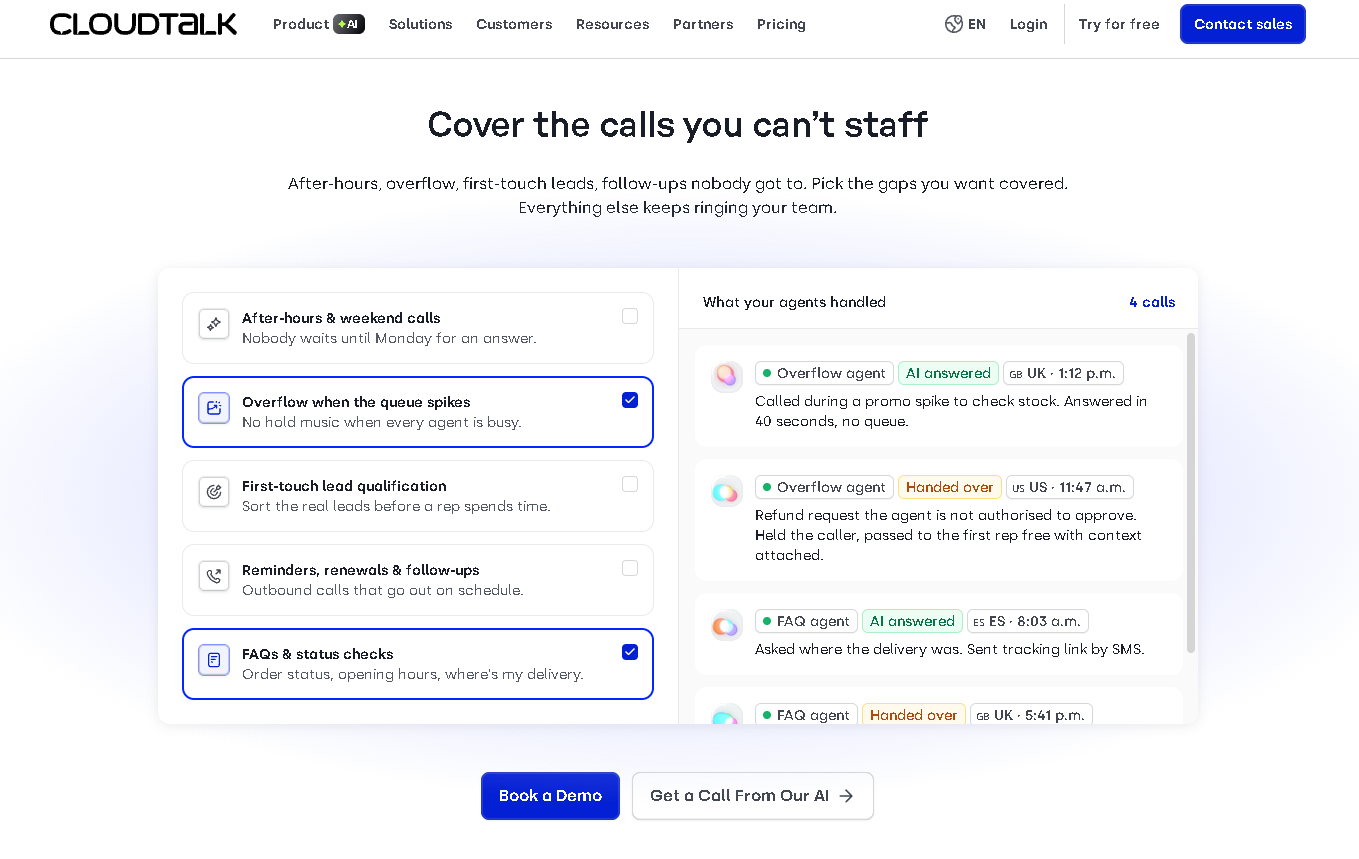
CloudTalk’s workflow engine is mainly built on trigger-based automation: calls, messages, contacts, recordings, and transcriptions can each fire automated actions like CRM updates or Slack alerts.
On the outbound side, it includes Power, Preview, and Parallel dialers (up to 10 simultaneous lines), for subscribers who are able and willing to pay for them. For instance, the ‘Expert’ tier includes the preview and power dialer for $49/user/month, billed annually, while the parallel dialer is available as a separate add-on ($39/user/month, again billed annually).
Subscribers on other plans can also pay for the Power Dialer separately for $15/user/month.
Winner: CloudTalk
CloudTalk has a deeper workflow and outbound toolkit than Aircall. Its Workflow Automations can use triggers, conditions, and actions across calls, messages, contacts, recordings, and transcriptions.
Its dialer lineup also extends beyond a standard Power Dialer, as it includes preview and parallel dialer options. Aircall has no direct equivalent to the parallel dialer, so teams that need high-volume simultaneous outreach have no path to it on Aircall at any price.
That capability isn’t free. Power and Preview dialers are included at Expert, but Parallel is a separate $39/user/month add-on. Aircall’s Power Dialer, by contrast, is already bundled into Professional’s $50/license/month price, and for teams that only need standard one-at-a-time dialing, the two platforms land at almost the same cost.
Add that $39 to Expert’s $49, and CloudTalk runs roughly $40 more per user, per month than Aircall Professional once you want full parallel dialing. But for outbound-heavy teams that need it, CloudTalk is the only one of the two that offers it at all, which makes it the stronger pick for this category.
Aircall vs CloudTalk: Which One Should I Choose?
Across the five categories in this guide, the two platforms split evenly:
- Pricing: Tie
- AI Features: Aircall
- Integrations: Aircall
- Analytics: CloudTalk
- Workflows: CloudTalk
Which one wins for you comes down to what your team needs.
You should choose Aircall if:
- You’re running a sales or support team already built around tools like Salesforce, HubSpot, or Zendesk and want native, bidirectional syncing without middleware.
- You need AI-generated summaries, call scoring, and CRM logging, and you are comfortable adding AI Assist to Essentials or choosing the Professional plan, which includes it.
- You want an AI Voice Agent that works within the same Aircall calling, routing, and CRM-help-desk environment, with 50 free minutes per account per month.
You should consider CloudTalk if:
- You run an outbound-heavy sales operation and can justify CloudTalk’s wider dialing options, particularly if you feel that Preview, Power, or Parallel Dialer functionality will significantly increase your agents’ productivity.
- You need a lower-cost starting point and don’t need CRM or help-desk integrations right away. Those require CloudTalk’s Essential tier.
- You don’t need more than 100 integrations because your stack is simpler.
Either way, the choice comes down to whether your team leans on CRM depth and AI-embedded calling, or values cost-efficient outbound tools and simpler dialing options.