


- Where Agentic AI Helps with Accounting
- Where Human Input Is Still Needed
- Choosing and Implementing Agentic Accounting Software
- Digits: Best for Schedules and Integrations
- Kick: Best for Cash Accounting
- Puzzle: Best for SaaS Revenue Recognition
- Rillet: Best for Agentic ERP
- Getting Started with AI Agents for Accounting
Last Updated on August 21, 2026 by Ewen Finser
AI is increasingly being used to make accounting simpler for firms and businesses. While the tech was initially limited to AI assistants that answer simple questions based on the limited data they’re trained on, newer AI agents go far beyond this, reasoning and making decisions on their own without requiring humans.
But while there’s a lot of hype surrounding agentic accounting, it’s not the right fit for every workflow.
Where Agentic AI Helps with Accounting

Many accounting tasks are fairly repetitive and must conform to certain rules, which make them perfect for handing off to AI agents.
Some of the most common applications include:
- Transaction categorization
- Account reconciliation
- Accounts payable automation
- Invoice processing
- Schedules (depreciation, amortization, AR aging, etc.)
- Month-end close
- Ledger review and transaction flagging
- Real-time reports and dashboards
Where Human Input Is Still Needed

Since AI agents can take over complex accounting workflows with high accuracy and perform at levels far exceeding a traditional LLM, it’s easy to fall into the trap of thinking that AI agents can independently run a business’s entire finance. However, some tasks still call for human judgement.
Some examples include:
- Strategic tax planning
- Ensuring compliance
- Interpreting contracts
- Mergers and acquisitions
- Tax filing
- Financial statement approval
Also, while the tasks in the prior section are great use cases for AI, it’s still not the best idea to be fully hands-off with them. You’ll still want to go in and take a look at things yourself, and many AI agents will automatically surface issues that you’ll need to review anyway.
Choosing and Implementing Agentic Accounting Software
You could technically build your own AI agent from scratch, but the most straightforward way to go about it is to use pre-built agents. Some are standalone agents that are separate from your accounting software, but others are designed to replace your existing solution entirely — they’re basically accounting platforms that come with AI agents built into them.
The latter is the easiest way to hit the ground running, so let’s take a look at some of the leading platforms on the market today.
- Digits: Best for schedules and integrations
- Kick: Best for cash accounting
- Puzzle: Best for SaaS revenue recognition
- Rillet: Best for agentic ERP
Digits: Best for Schedules and Integrations
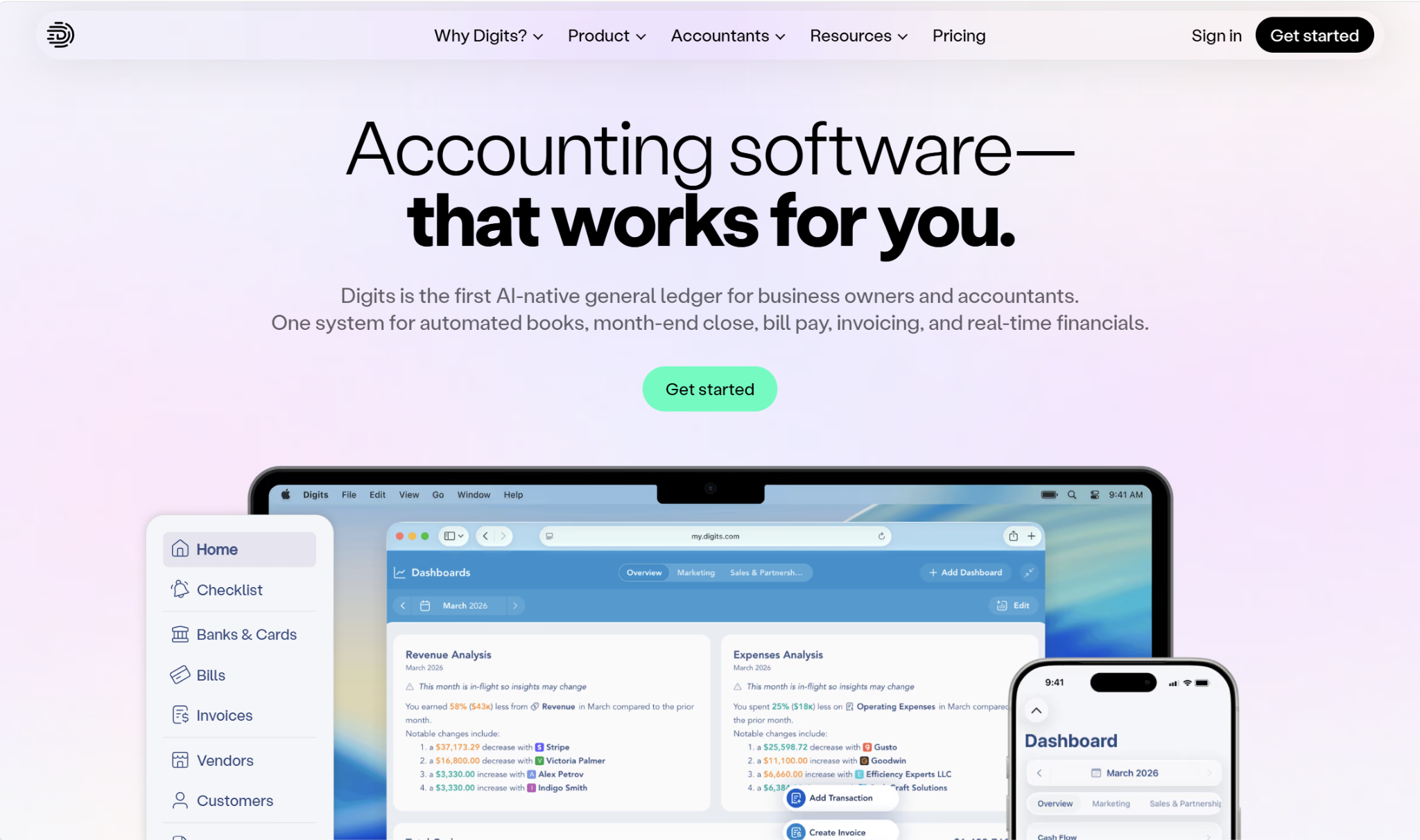
Digits is an AI-native accounting platform, so it was built with AI in mind from the start rather than tacking it on afterward. One of its main selling points is that it uses its own in-house AI models that are fine-tuned to accounting, outperforming common LLMs like ChatGPT, Claude, and Gemini.
Agentic Features
Digits describes itself as an agentic general ledger, which means it uses AI agents within the accounting workflow for month-end close and tasks like variance analysis, detecting recurring transactions, real-time reconciliation, and categorization. It pulls in data from external sources like banks and software, and when it categorizes transactions, it automatically matches them and flags lower-confidence items for manual review.
Fixed asset schedules and prepaid expenses schedules are other areas where Digits leverages agentic AI. These agents can automatically detect when a schedule is needed and pre-populate it, and they can post the necessary journal entries monthly.
Digits also has an “Ask Digits” agent that you can ask analytical questions about your ledger or request that it complete certain tasks.
Pricing
There are different plan options available, depending on whether you’re purchasing a plan for an individual business or for an accounting firm. For individual businesses, you have three choices, starting at $65/month. The next step up is the $100/month tier, which gives you more integrations and customization options. However, if you need agentic close or schedules, you’ll need the Pro plan, which is $250/month. For accounting firms, there are separate options for solo practices, mid-sized firms, and enterprises.
Kick: Best for Cash Accounting
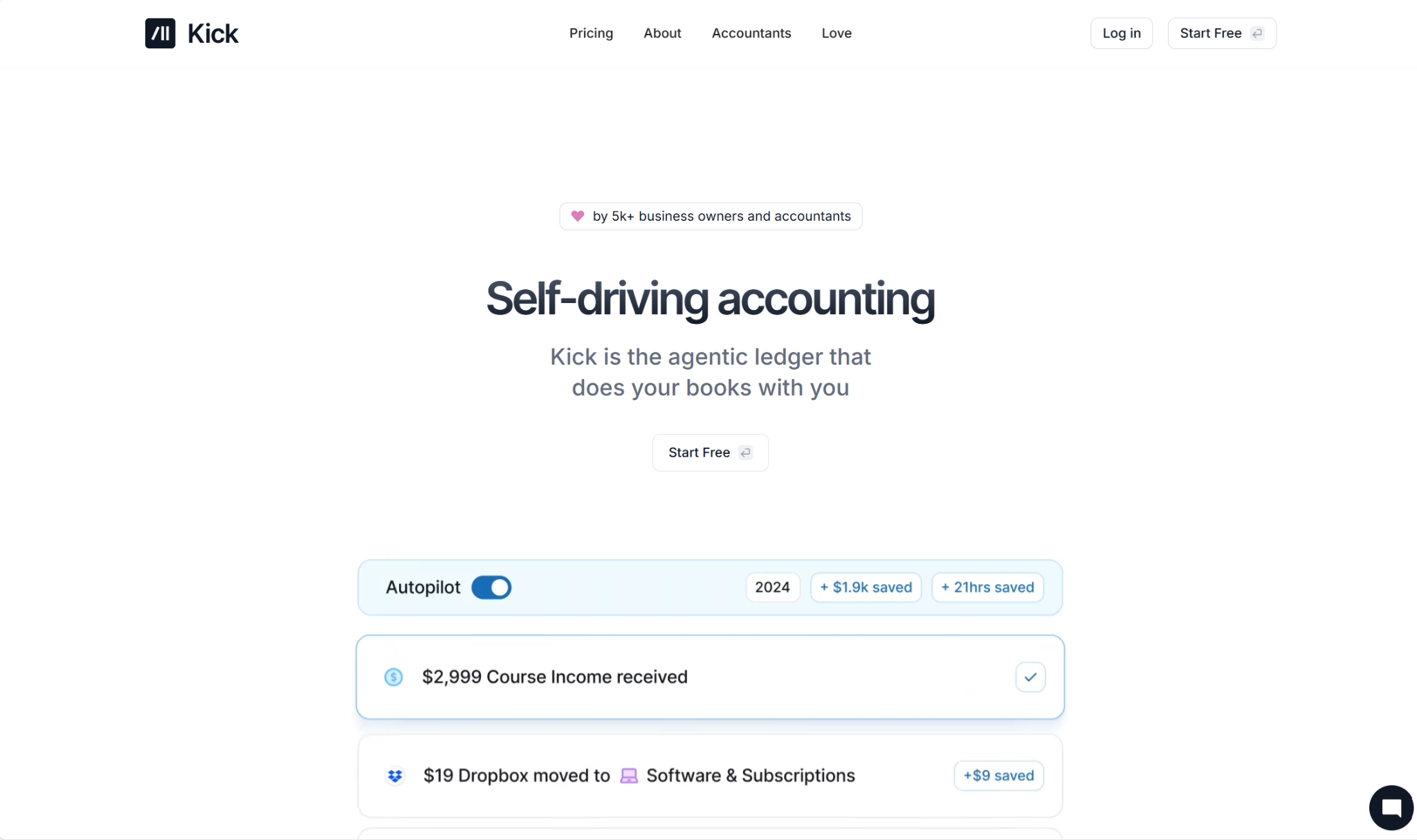
Kick is another AI accounting solution with an agentic ledger. Backed by investors including the OpenAI Startup Fund and General Catalyst, Kick mainly focuses on small businesses using cash accounting, but certain plans support accrual books as well. Accounting and bookkeeping firms can also use the platform to manage their clients’ books.
Agentic Features
Kick’s AI will categorize transactions in real time. If any of them are low-confidence, it will leave them uncategorized and flag them for your review. It’s also effective at reconciling accounts and automatically generating the appropriate journal entries.
Another area where Kick excels is with taxes. If it suspects that you wrongly categorized a business transaction as a personal one, it will prompt you to move it over, and it will help you with deductions for your home office, vehicle, or travel. It can also generate a tax package for you, which includes a cover page with your business information, a balance sheet, a profit and loss statement, a general ledger, and a trial balance.
Pricing
Kick’s free plan is limited to 250 transactions per year. You’ll also only be able to access an accrual ledger once you hit the $100/month tier — below that, it’s cash basis only. Both individual businesses and accountants can use these plans, but accountants can also take advantage of their Kick Accountant AI Program, which is geared toward scaling firms.
Puzzle: Best for SaaS Revenue Recognition
While it has a particular speciality in startups and SaaS companies, SMBs in any industry can benefit from using Puzzle. With options for both businesses and accounting firms. Puzzle heavily markets itself as an alternative to QuickBooks, which is lacking in agentic capabilities and has clunky AI.
Agentic Features
Puzzle uses AI agents in several accounting workflows, including accrual automation and revenue recognition. For accrual automation, Puzzle aims to bridge the gap between cash and accrual books by allowing you to easily toggle between each instead of housing them in separate solutions.
On the revenue recognition side, Puzzle will pull data from other tools in your finance stack and map transactions to deferred revenue accounts. It handles categorization and reconciliation, and it can also create depreciation and amortization schedules.
Specific to accountants, there’s an AI close feature, which automates month-end close using AI agents. To get it up and running, you start by describing your close workflow in plain language, and AI develops steps based on your description. Once you approve the workflow, the agent will complete it and provide a full audit trail.
Pricing
Puzzle uses custom pricing for accounting firms. Otherwise, there are four plans for businesses, starting at $30/month and going up to $360/month. The lower two tiers are more limited when it comes to the number of users, as well as customer support options. Plus, the higher the plan tier, the more advanced AI capabilities you get.
Rillet: Best for Agentic ERP

Rillet is a full-fledged ERP software rather than strictly an accounting solution. However, with finance being a significant part of what it does, it has strong agentic accounting capabilities for businesses at all stages, from startups to enterprises.
Agentic Features
For bank reconciliations, Rillet boasts that it can match thousands of transactions in just seconds with its auto-match engine, posting the appropriate journal entries. Its close management processes are also powerful, helping with schedules, accruals, and other manual close tasks. You can create a customized close checklist, which Rillet will then execute.
In case you need more advanced features, the software can work with complex revenue recognition models, generating deferred revenue schedules and journal entries. It also has strong multi-entity support, performing intercompany eliminations and handling FX currency impacts. Plus, you can ask Rillet’s Aura AI any question about your books, and it can provide an answer based on your GL data or execute full workflows.
Pricing
Rillet uses custom pricing only. You can, however, request a demo, at which point you can speak with the company directly to get an idea of the costs you could be facing.
Getting Started with AI Agents for Accounting
Although these are all strong choices, there are some distinctions between them. One of the major differences is that Rillet is the only ERP. If you’re looking for that, then it’s a smart choice, but it would be overkill if you’re strictly looking for accounting software.
If you need accrual accounting from the start, you may want to avoid Kick, which has a greater focus on cash accounting. It does support accrual ledgers, but this only works when you choose one of the higher-tier plans.
Between Digits and Puzzle, it all comes down to the individual features you need. Puzzle has a strong focus on startups and SaaS companies, particularly those with recurring revenue models, and it has advanced features for revenue recognition. However, Digits integrates with far more third-party tools, and it’s more transparent about plan options for accounting firms.
No matter which platform you end up with, it’s always a good idea to think about the specific tasks you’d like AI agents to do for you before jumping in.