


Last Updated on August 10, 2026 by Ewen Finser
Most savvy founders understand that customer interviews are the key to unlocking everything from branding and marketing to communications and go-to-market strategy. The reality, however, is that most founder interviews either confirm what you already believed about your product or just end up producing nice quotes that never affect a real decision.
Interviews can also be tricky because, frankly, customers lie. It’s not badly intentioned, of course, but all of us make choices about our preferences based on what we want others to think of us, how much we want to fit in with a group (or not), and what we think others are thinking. So, we have to remember that actual behavior trumps stated opinions and preferences.
A customer interview is a decision tool, not just a data-collection ritual, and doing it well comes down to three important things: who you talk to, how you ask, and what you do with the information after you get it.
Start With the Right Mindset

Confirmation bias means that founders often hear exactly what they want to hear in customer interviews, which is great for the old ego, but not very helpful overall.
Rather than looking to confirm your particular thesis, approach customer interviews with a sense of curiosity and openmindedness. Remember: you’re not here to be right, you’re here to learn. (And we’re almost always wrong about something in our businesses.)
Stay curious, not convinced, and you’ll already be ahead of the pack in gleaning actionable insights from your customer interviews.
Who You Talk to Dictates What You Learn
In my experience running a marketing agency for more than a decade, I saw this many times: a founder would make a goal to talk to 50 people about their new product or offer… and then at least the first 20 or so (if not more) would be their friends and colleagues.
I get it. Talking to people you already know is a lot easier than asking strangers to give you their time and opinions. But unless those friends and colleagues are also your ideal customers, their opinions don’t really count for much.
Instead, you want to concentrate on recruiting three main groups of people, and each group unlocks a distinct set of insights:
- Recent buyers: These are important for interviews because their entire purchase-making process is still fresh in their minds and they are actual users of your product.
- Potential customers: This group provides important insight into any pre-purchase friction and objections potential customers might have.
- Switchers: These are folks who already use your competitors’ product and are considering switching. Valuable to identify competitor gaps.
How to Find Interviewees
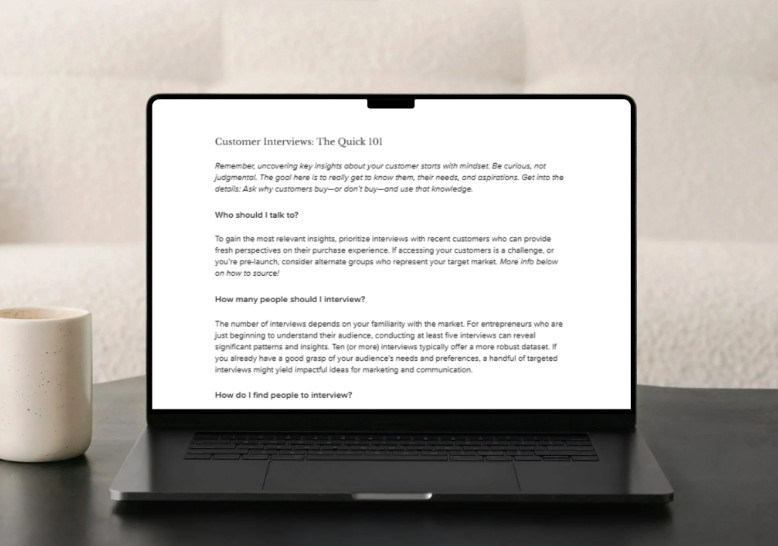
When you’re looking to set up your interviews, start with your existing customers first. These are often your most insightful interviews, and you may be surprised at how willing your customers are to chat.
One resource I’ve found useful is The DTC Operator’s “Gather Customer Insights That Convert” playbook because it offers a lot of great templates to make this process easier, including a ready-made email outreach template and incentive structure to make recruiting the right people much easier.
Next, or if you don’t have customers yet, try recruiting in open forums and communities. Reddit can be a good place for this. There are two ways to approach this kind of recruiting:
- Direct ask: post a plain invitation, something like, “We’re looking to interview people who fit [xyz profile].”
- Organic: pose an open-ended question about your category, look for people with thoughtful answers, and then invite those top responders for an interview by DM.
The organic method can be a more strategic way to go, as their public answer pre-qualifies them.
Finally, you can also try paid recruitment platforms for when you want fast results from specific demographics. This is best for folks who have a budget, but maybe don’t have much time or their own customers to poll yet.
However you decide to recruit interviewees, it’s worth adding a screening step to your interview process, especially if you’re recruiting from open forums. You’ll want to look for their location/timezone, whether they actually fit your target profile, whether they’ve genuinely bought or used the relevant product (instead of just being interested), and any other relevant details you need to confirm you’re talking to the right people.
The Right Questions: Real Insight vs. Surface Answers
Once you’ve recruited some interviewees, the next step is to craft your questions so that you’re getting real insight from the conversations. Simply changing up how you ask your questions can get you better, more usable answers. Let’s start with some core principles of good questions:
- Ask what they did, not what they would do. This helps avoid people telling those little white lies about their preferences and sticks to the facts.
Bad question: “Would you use a feature like this?”
Better question: “Tell me about the last time you ran into this problem and walk me through what you actually did.” - Don’t lead the witness. If you’ve ever watched a courtroom drama, you’ve seen a lawyer yell, “Objection! Leading the witness!” Picture them every time you’re tempted to lead your interview in a particular direction with language that might influence their answer.
Bad question: “What did you love about the onboarding?”
Better question: “Walk me through the first week after you bought it. Where did it go smoothly, where did it snag?” - Retrace the actual buying journey. Try to avoid hypothetical situations and ask them what they actually did: what search terms they used, what stores they visited, who they asked for advice, etc.
Bad question: “Why did you buy it?”
Better question: “Take me back to the moment you decided you needed something new: what was happening right then?” - Listen for what drove them forward rather than what held them back. Purchase decisions are built on momentum, so don’t spend too much time asking what held them back from purchasing.
- The 5 Whys. There’s a problem-solving method that recommends stating a clear problem, and then asking “why?” five times or until you reach the root of the problem. While it might be awkward to just keep repeating “why?” like a toddler in your interviews, this is a great framework to get to the real root of any issue or opinion.
- Silence is golden. A corollary to not leading the witness is to practice giving your interviewee space and silence to think and answer.
If you want more of a fully sequenced interview script, there’s one in The DTC Operator’s playbook as well as a worksheet around understanding drivers vs. barriers.
Turn Conversations Into Decisions
If you only implement one thing you read in this article, let it be this one, because this is what changes customer interviews from a box to tick off to a truly game- and strategy-changing exercise that provides actionable insights for your business.
For every question you ask and every answer you receive, ask yourself: “What decision does this change?”
This framing means that every insight either attaches to a decision (a message, a page, a product tweak, an objection to address) or it’s trivia. It’s a simple way to separate the “nice quotes” from the real insights that will change how you operate moving forward.

There are four moves you can make to help move from raw data to real insights:
1. Organize So That Patterns Can Surface.
Most of these customer interview projects tend to stall when you’ve got a pile of raw transcripts or a folder full of recordings. Raw information isn’t insights.
Start by creating a set of tags that will help you sort through the pile without re-reading a transcript when you want to find something. You might include tags about who the interviewee is (their relationship to your brand or their stage in the customer journey) and where they were recruited (customer vs. Reddit vs. paid platform, etc.). The “Gather Customer Insights That Convert” playbook offers a taxonomy template if you want more examples.
From there, the discipline becomes tagging each conversation right after it happens, while it’s fresh in your mind. The idea here is that you’re building a sort of database that you can query (no matter where you’re saving the actual data) instead of just a pile of information you’ll dread looking at.
2. Map Drivers vs. Blockers
In data analysis, scientists talk about separating the signal from the noise. Signal is about patterns that become apparent when you look at all the data together. Noise is the outliers.
When you start reviewing your interviews, you want to look at them as a complete set of data, not as individual interviews. A single interview tells you a story; the stack gives you a pattern. In other words, a friction point that one person mentions is an anecdote, but one that shows up in six out of ten conversations is a strong signal.
That cross-conversation view is what helps you develop new steps for your onboarding process, new messaging for sales and marketing, new ad angles, etc.
This is a place where AI can actually be quite helpful in the analysis process. Providing an LLM with your transcripts and then asking it to look for patterns is exactly the sort of thing those models are good at.
3. Weigh Behavior Over Opinion
Remember our rule that people lie? This rule doesn’t stop when your interviews are over. As you’re analyzing and sorting quotes from your interviews, you want to put much less weight (if not discount completely) on the enthusiastic, “I’d totally buy that!” statements and more weight on the evidence of what they actually did.
Think about what they already paid for, switched from, or told a friend about. You can also cross-check what people said against what they actually did on your site using session and heatmap tools that show you what people clicked and where they dropped off. That’s actual behavior, not opinion.
4. Steal Their Language
As a copywriter and marketer, I can tell you that the highest-converting copy you’ll ever write is already in these transcripts. When you pull the exact words and phrases your customers use to describe their problem, the win, and any objections, you actually don’t have to write the copy because they’ve already done it for you.
Highlighting select phrases in three different colors, one for problem, one for win, and one for objections, makes them easy to pull. Copy and paste them into a spreadsheet (or have an assistant or AI do it for you) and your copywriters will weep with joy when you hand it to them.
A bank of this kind of customer language is worth its weight in gold for everywhere you need copy: website, ads, emails, onboarding, product packaging, you name it.
What this type of deep synthesis actually produces is:
- A clear buyer persona with specific psychographics as well as demographics.
- A customer journey map
- Sharper positioning
- Pre-determined objection handling for copy or sales
- Messaging and copy
- Content ideas grounded in real language.
Quantitative analysis (how many, how much) tells you what happened; qualitative analysis like this tells you why it happened, and in DTC, the why is where the conversion and the money hides.
The DTC Operator’s “Gather Customer Insights That Convert” playbook includes a couple of extremely useful pieces for the analysis and synthesis stage of your interview process, including a journey map worksheet, some specific prompts for AI, and a prompt to create an AI persona to pressure-test your assumptions.
What to Remember About How to Do Customer Interviews

Customer interviews are about creating a system that you run, not a one-off activity you do to check a box. I recommend that every founder do the first 10 interviews yourself before you hand it off to a sales or marketing team; a report can’t teach you what actually being on the call does.
Stay curious, remember that you’re almost certainly wrong about at least one of your assumptions, and tie each insight to a decision to take customer interviews from an interesting exercise to one of the most valuable tools in your toolbox.