


Last Updated on July 29, 2026 by Ewen Finser
The month-end close has become the proving ground for AI in accounting, and several distinct takes have emerged on it.
For example, Puzzle and Digits sit at opposite ends of the design spectrum. Both promise to compress a 10-day cycle into something closer to a rolling exercise, automating much of the close while still keeping a human accountant in the loop.
What separates them is a difference in philosophy: One hands the ledger the job and asks the accountant to review by exception, while the other treats the accountant as the architect and refuses to post anything without a sign-off.
For firm owners deciding where to point their next automation dollar, that difference is the whole ballgame.
So let’s break down these two approaches and discuss where your time goes, where your risk sits, and which model matches the way your team already works. Keep in mind as you read that both products are young, both launched their firm-facing close systems even more recently, and neither has a long public track record of independent outcome data yet. So treat the comparison below as a map of intent and design, and pilot on one clean entity before you migrate real client work.
The Bottom Line Up Front
Most firms will find that the decision comes down not to speed or feature count (since both compress the same tasks), but whether you want to run a full human review before posting or just check exceptions. That single question will often be the deciding factor.
If you want a ledger that runs continuously in the background, books activity as it arrives, and brings you only the exceptions, Digits is the more fully autonomous system and the more complete swap of your system of record. It prioritizes higher accuracy so that all you’re doing is reviewing exceptions and not every entry.
If you want automation that drafts the work but leaves the accountant approving the entry before it touches the general ledger, Puzzle’s review-and-approve design keeps control closer to the practitioner.
Digits Agentic Close: The Autonomous Ledger
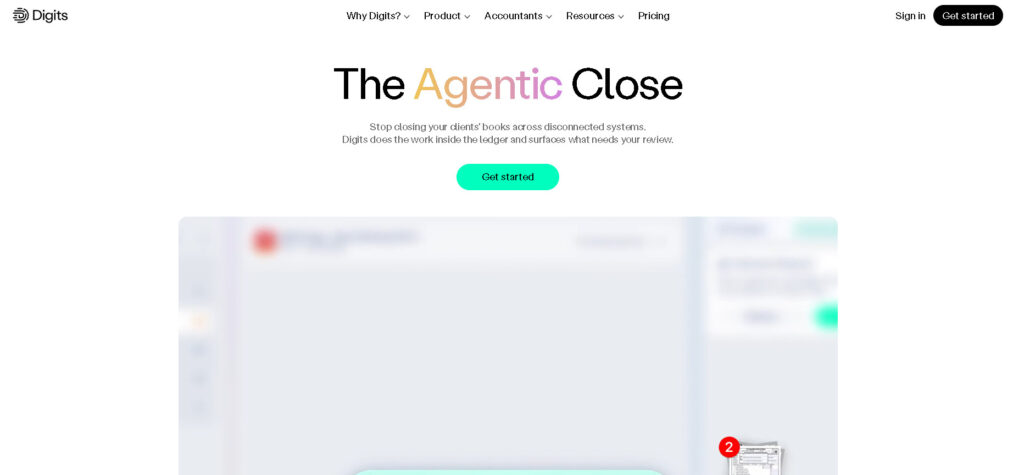
Digits’ core offering is an agentic general ledger, the pitch for which is that intelligence belongs inside the ledger itself rather than bolted on top of a legacy system. This capability was launched for accounting firms in June 2026, bundling its 24/7 bookkeeping, bank reconciliations, automated schedules, quality control, checklist, and firm dashboard into one continuously operating experience.
How Digits Handles the Automated Close
The defining trait here is that Digits’ agentic close doesn’t wait for month-end and doesn’t need a prompt to run. As financial activity enters the platform, the ledger collects it, books it, reconciles it against connected feeds, maintains the supporting schedules, evaluates it against the firm’s standards, and reports on it — all in the background.
The intended effect is that the traditional close sprint largely disappears, because most of the work has already happened by the time you would ordinarily start. What remains are the exceptions.
Where Human Control Sits

Digits books activity as it arrives and then surfaces the exceptions that fall outside firm standards into a checklist for accountant (or business owner) review. The accountant is not building entries from scratch and, in the normal flow, is not approving each routine entry before it posts either. The human review concentrates on what the system flags, shifting oversight from blanket reviews to ad-hoc checks — which is what lets a small team supervise many clients or transactions at once.
Setup and Migration
Because Digits is the ledger, adopting its agentic close means running your books on Digits rather than layering a tool onto QuickBooks or NetSuite. It integrates with more than 12,000 financial institutions, and paper documents like checks, bills, invoices, and statement PDFs can be submitted by photo, drag-and-drop, or email forward for automatic processing. Configuration happens through agent instructions that are written in plain English, so you don’t have to know a bunch of jargon to see what the system is doing.
In short, setup is easy.
However, if you’re currently on another platform like QBO, the migration to get to Digits is much more involved than it probably should be and could be challenging. This is because it’s an entire system-of-record change, not an add-on. So, make sure to prepare for that cost and headache.
Determinism and the Audit Trail
Determinism is the center of the Digits argument. The company stresses that its plain-English instructions become fixed, auditable checks that run the same way every time, continuously and without hallucinating. The theory is that deterministic checks are more trustworthy than an agent that reasons freshly on each run, reducing the need for constant validation. Every check is applied consistently across the ledger, which gives the audit trail a predictable, rules-based backbone.
Pros
- The continuous, always-on model means the close is largely done before month-end arrives, which is valuable for firms drowning in monthly sprints.
- Managing by exception lets a lean team supervise a large book of clients or transactions without rebuilding the same review process for each one every month.
- Owning the full stack, from data collection through reporting, avoids the integration headaches and reconciliation gaps that come with bolt-on tools.
Cons
- Adopting Digits is a system-of-record migration, which is a heavier lift and a bigger commitment than adding a tool to your existing ledger.
- Entries post and are then reviewed by exception, so firms that want a robust human gate before anything hits the books might prefer something less deterministic.
- The product is new, and independent evidence of close accuracy and time savings is still thin.
Who It Fits
Digits suits firms willing to move their clients or business onto a new ledger in exchange for a continuous close, particularly those scaling a high volume of similar clients who benefit most from managing by exception. It rewards firms that trust standardized, deterministic checks and want the platform to carry the routine work end to end.
Puzzle AI Close: The Accountant-Architected Close
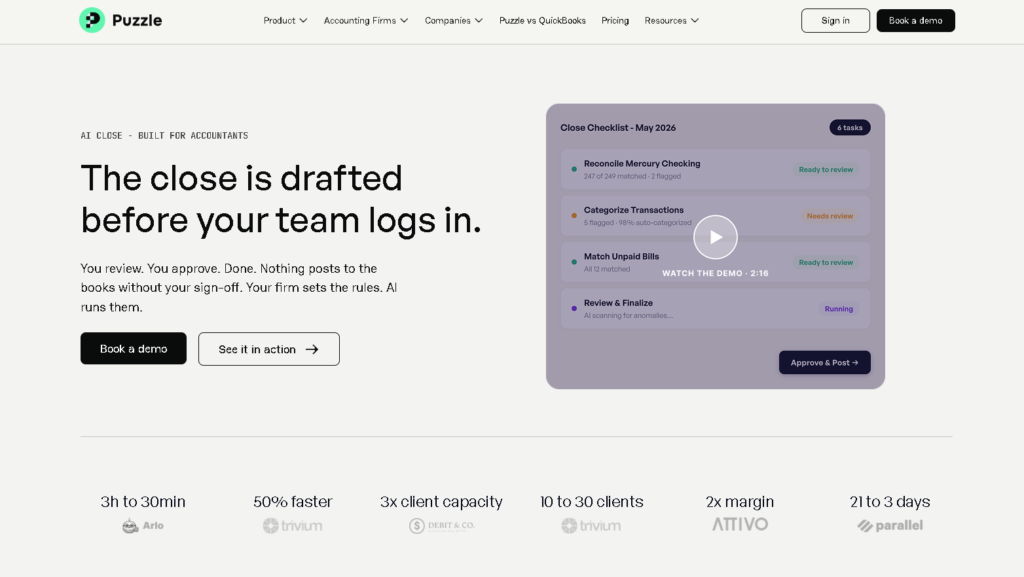
Puzzle is a newer AI-native accounting software that recently added AI close agents that are aimed squarely at accounting firms. The suite lives inside the general ledger rather than in a separate application, and the organizing principle is clear: The accountant is the architect, and the agent is the engine.
Notably, Puzzle runs a partner-only model, which means it does not offer competing bookkeeping services to the firm’s clients. This especially matters to practitioners wary of platforms that also sell to the end customer.
How Puzzle Handles the Automated Close
Puzzle’s agents draft the close in stages, handling categorization, reconciliation, accruals, prepaid amortizations, and recurring entries based on rules that the firm sets once. The company claims categorization automation up to 98%, as well as reconciliations that drop from two hours to five minutes when agents match feeds against the ledger.
A one-off request can be handled through a chat inside the ledger, and any chat task can be promoted into a scheduled agent — a firm builds its playbook once and reuses it across every client. The work is drafted for the accountant rather than committed on the accountant’s behalf.
Where Human Control Sits
Control here sits before the post. The stated rule is that nothing reaches the general ledger without the accountant’s explicit approval, with human sign-off gated at journal entries, accruals, and flagged exceptions. The agents prepare and propose, the practitioner reviews and approves, and only then does anything post.
This is the crux of the platform’s positioning: The approval gate lives ahead of the ledger rather than after it, which keeps the accountant’s judgment upstream of the books rather than downstream of them. This is the key difference between the platforms, and choosing between them will depend on how long of a leash you want to give your AI assistant.
Setup and Migration

Like Digits, Puzzle is a ledger of its own. It’s built around native, streaming integrations with the modern fintech stack, including Stripe, Mercury, Ramp, Brex, Gusto, Deel, and Rippling — which reduces manual journal entries at the source. Setup is very easy, oriented around designing the workflow and the approval checkpoints rather than only connecting feeds, allowing the firm to encode its review standards into the process from the start.
Determinism and Audit Trail
Puzzle’s determinism is that the same inputs produce the same outputs on every run, pairing each one with an explainability layer. Its accuracy reviews attach a reasoning trail to each categorized transaction: showing the data sources and logic behind a decision, flagging where the system is uncertain, and letting the team filter by confidence level, bulk-approve, and retrain from corrections. Every change is logged, timestamped, and auditable, so the trail captures not just what was posted but what the accountant approved and why.
Pros
- Nothing posts without explicit approval, so the accountant’s judgment sits ahead of the ledger.
- The reasoning trail and confidence flags make each entry explainable, turning review into a fast triage rather than a from-scratch rebuild.
- The partner-only model means the platform never competes for the firm’s clients, and the reusable playbook scales a firm’s standards across a growing book.
Cons
- Because the accountant approves before posting, the model asks for more deliberate human touchpoints than a fully background system, which some high-volume firms may see as friction.
- Its native strengths lean toward startup and fintech-stack books, so firms with heavier legacy or industry-specific ledgers should confirm fit.
- Like Digits, it’s a recent entrant, and long-run independent performance data is still accumulating.
Who It Fits
Puzzle suits firms that want automation to do the drafting while the accountant keeps the final say on every entry — particularly practices that serve startups and fintech-native clients. It rewards firms that value explainability and an approve-before-post control gate, and those that would rather scale a documented playbook than hand the ledger the keys.
Choosing Between Puzzle and Digits
Strip away the marketing, and the two products are chasing the same outcome from opposite directions.
Digits makes the ledger responsible for most of the work and asks the accountant to supervise the exceptions; Puzzle makes the accountant responsible for the sign-off and asks the agents to prepare the work. Both compress reconciliation from hours to minutes, both automate the bulk of categorization, both lean on determinism, and both, importantly, still require a human.
The decision, then, is less about capability and more about temperament. A firm that wants to scale a large volume of similar clients, is comfortable migrating its system of record, and is comfortable handling exceptions against a standardized set of continuous checks will feel at home with Digits’ autonomous model.
A firm that wants to keep a human gate in front of the ledger, values a visible reasoning trail behind every entry, and prefers to approve before anything posts will find that Puzzle’s design maps more closely to how it already thinks about control and defensibility. For many practitioners, that approve-before-post gate is the deciding line.
Whichever way you lean, the practical advice is the same. Pilot on one clean entity, write your firm’s standards into the configuration deliberately, and watch how each system behaves for a full cycle before you commit client work.