

Last Updated on July 21, 2026 by Ewen Finser
Most accounting software comparisons are really arguments about time. Old system versus new system, desktop versus cloud, spreadsheet versus platform. This one isn’t.
Digits and Docyt are both AI-native platforms, both launched in the last several years by venture-backed teams, both promising books that stay current instead of getting reconstructed in a panic three weeks after month-end.
One is aimed at the founder and the modern accounting firm serving founders. The other is aimed at the operator running seven properties and the firm that specializes in that operator.
Bottom Line Up Front
What makes the Docyt vs Digits comparison worth having is that the two products answer to different buyers. They use overlapping vocabulary like real-time financials, automated reconciliation, and AI categorization while pointing at businesses that look almost nothing alike.
Digits is generally the default for service and software businesses, startups, and firms building an AI-native client book. It owns its ledger, its pricing is published, and it’s designed around a single entity with a clean fintech stack.
Docyt is the better answer if you run multiple locations with point-of-sale revenue like hotels, restaurants, and franchises and you need consolidated reporting without leaving QuickBooks. It’s an automation layer on someone else’s ledger, priced by conversation rather than by list.
Digits
What It Is
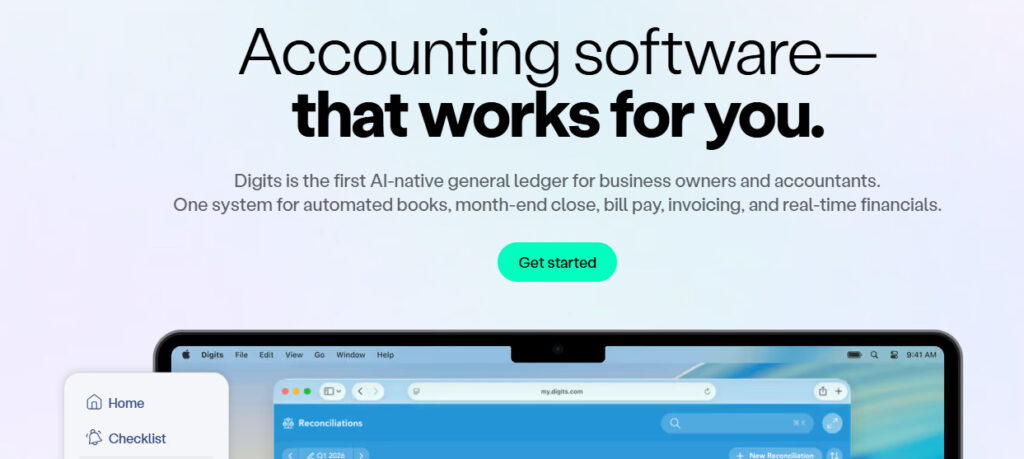
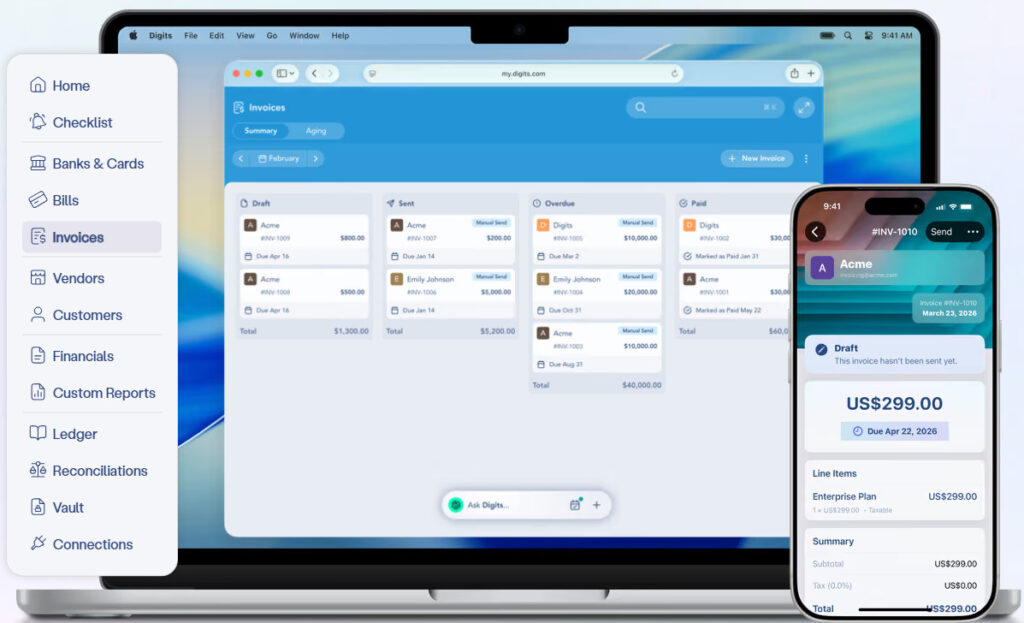
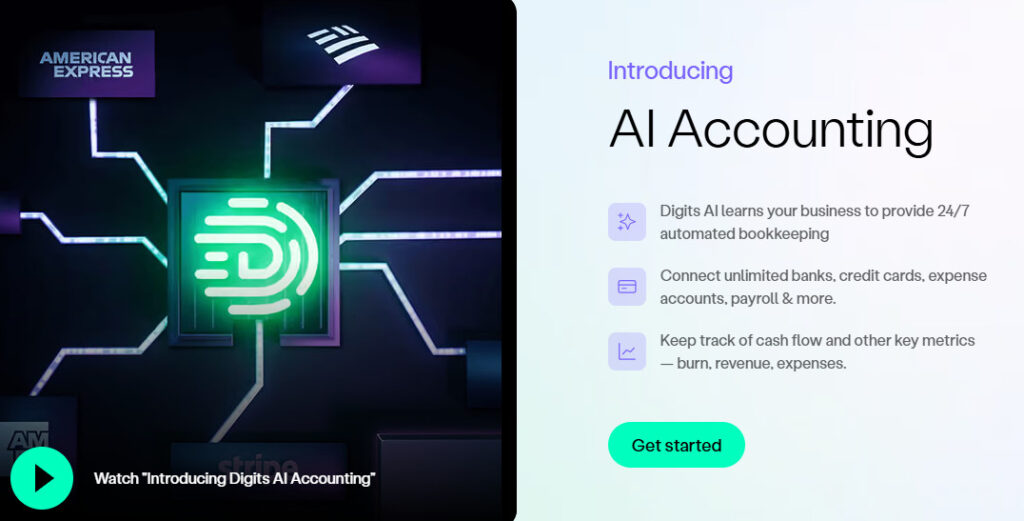
Digits is an accounting platform built around what the company calls an Agentic General Ledger. Digits is its own ledger, running its own AI models, without a QuickBooks or Xero file underneath. Bookkeeping, reconciliation, bill pay, invoicing, dashboards, and financial reporting all live in the same system.
The models are custom-trained on business transaction data rather than fine-tuned general-purpose LLMs, and I think that’s an important distinction. Digits claims its models outperform general LLMs by a meaningful margin on accounting tasks, which is super important when you must be certain the LLM didn’t hallucinate.
Who It’s Actually Built For
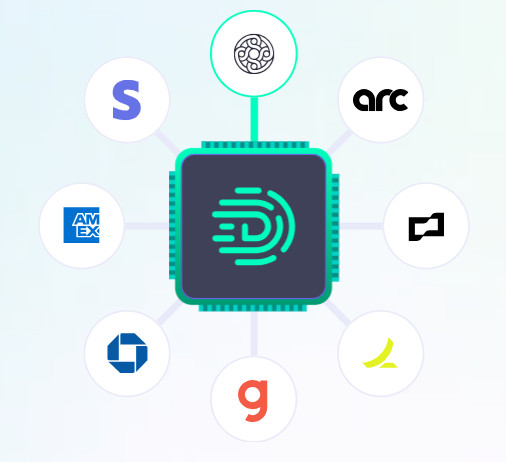
I think that Digits is for US-based service businesses and software companies, generally under a few hundred employees, running a modern financial stack with apps like Ramp, Gusto, BILL, Stripe, and Mercury. Digits was purpose-built for startups and small businesses as well as accounting firms. The firm program is substantial with things like firm-specific model training, white-labeled client logins, dedicated success management, and an academy that teaches how to use the platform.
The exclusions matter as much as the inclusions. Digits is a poor fit for inventory-heavy operations like manufacturers, distributors, and large ecommerce sellers. It’s US-only. And multi-entity businesses need a separate subscription per entity, which is a constraint rather than a footnote.
The Ledger Question
Digits replaces your general ledger. There’s no sync, no mapping layer, no two systems drifting apart between closes. That’s the upside: one audit trail, one chart of accounts, one ledger.
It’s also the cost. Migration is a genuine project for any accounting software. Your tax preparer may not know the system. And you’re betting on a younger fintech company holding your books of record. However, Digits supports exports to Excel, and offers a free API and MCP server meaning you can query your ledger from Claude, ChatGPT, or Cursor. Those exits help reduce the lock-in worry without eliminating it.
Automation and the Close
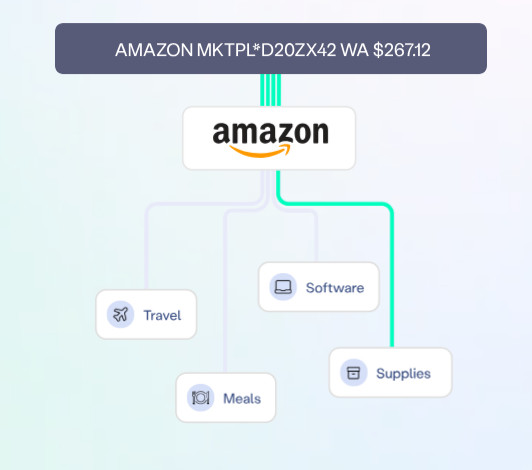
The automation is agent-based and layered: a bookkeeper agent, a researcher agent, a reconciliation agent, and a quality review agent, with a chat assistant on top. Higher tiers add an accrual schedule agent that detects depreciation and amortization patterns from transactions and drafts the entries, and an “Agentic Close” that auto-fetches bank statements, flags anomalies, and runs a customizable checklist. Nothing posts without review.
The claims are aggressive and, notably, somewhat verifiable. Digits published a case in which a top-400 firm serving over 100 CAS clients moved from roughly 75% automated transaction handling to 98% across 2025. The platform tracked whether a human or an AI performed each action, which is what makes that number auditable and able to hold water, at least in my mind.
Pricing
Published, per-entity, no per-seat fees, 30-day trial:
Essentials is $65/mo, Core is $100/mo, and Pro is $250/mo. Core adds Stripe/Ramp/BILL integrations, custom dashboards, and dimensional accounting by department or location. Pro adds automated schedules, Agentic Close, and custom management reporting.
Pros and Cons
Pros
- The published price list means you can budget without a sales call, and the per-seat-free structure keeps costs flat as your team grows. I really appreciate that, especially when compared to platforms like QBO that nickel and dime you.
- Owning the ledger eliminates the sync-drift problem that plagues layered architectures, and the audit trail distinguishes AI work from human work at the transaction level.
- The free API and MCP server let you query your financials from tools you already use, which is rare in this category.
- Outcome-based firm pricing ties vendor revenue to actual automation performance rather than promises.
Cons
- Each entity requires its own subscription, which makes multi-entity structures expensive and consolidation awkward.
- Inventory-heavy businesses are explicitly outside the target profile, and US-only availability rules out anyone with foreign operations.
- Migrating off QuickBooks is a project, and your existing tax preparer likely hasn’t seen the platform.
- The most compelling automation, schedules and Agentic Close, sits at the $250 tier, not the entry price.
Docyt
What It Is
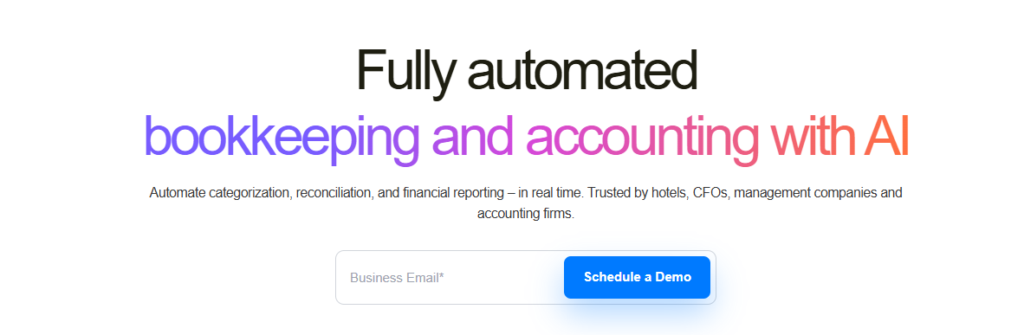
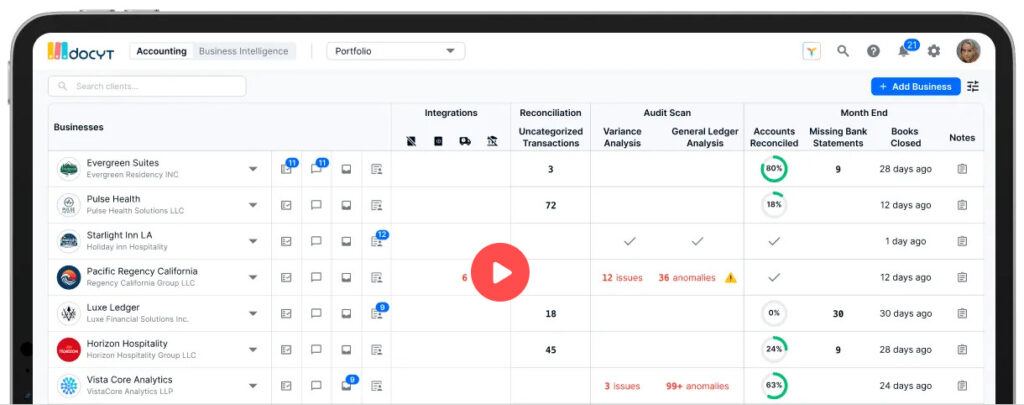
Docyt (pronounced “docket”) is an accounting automation platform that sits on top of QuickBooks Online rather than replacing it. Its engine handles categorization, reconciliation, anomaly detection, and close, with confidence thresholds and human-in-the-loop verification built in. The product is organized into named modules: RevFlow for revenue reconciliation, ExpenseFlow for bill pay and expense workflows, ClosingFlow for month-end, and InsightFlow for reporting.
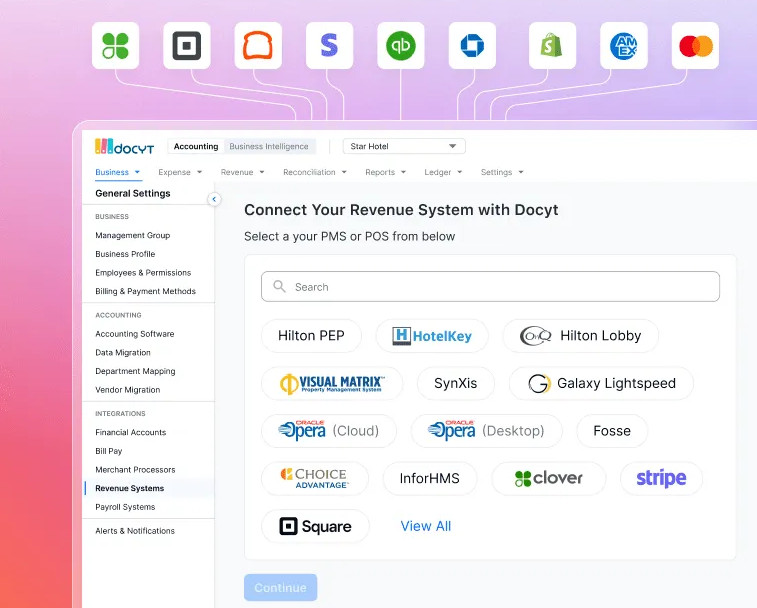
The scale numbers point at where it lives: 30+ POS integrations, 180,000+ vendors in the platform, and connections spanning Toast, Square, Clover, Oracle Opera, Marriott FOSSE, Choice Advantage, and SkyTouch alongside the usual banking and payroll rails. It’s honestly surprisingly robust.
Who It’s Actually Built For
Multi-location, multi-entity operators with point-of-sale revenue, and the accounting firms that serve them. Hospitality is the flagship vertical. The customer roster includes hotel franchisees under Fairfield, Wyndham, and Choice, plus names like Subway, Citgo, and Farmers Insurance. Restaurants, retail, and franchise management also follow.
The firm’s angle is differently shaped than Digits’. Docyt positions itself as the tool that lets a firm standardize a client stack rather than curating six apps per client, and it has historically been distributed through the QuickBooks App Store.
The Ledger Question
This is the fork in the road. Docyt doesn’t ask you to migrate. It automates the workflows around QuickBooks and syncs back to it. Your GL stays where it is, your tax preparer stays fluent, and your historical data stays put. For a firm with 40 clients on QBO, that’s not a minor convenience; it’s the entire reason to look.
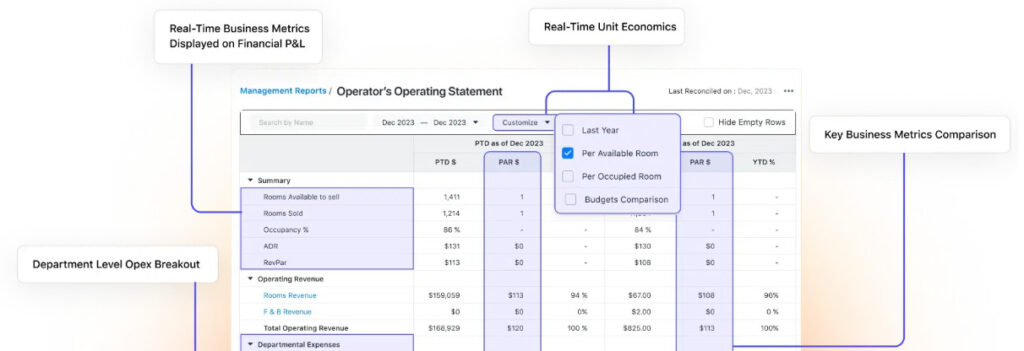
The tradeoff is architectural. You’re running two systems that must agree, and the ledger’s ceiling is still QuickBooks’ ceiling. Docyt’s multi-entity accounting handles automated journal entries, inter-entity settlements, and consolidated reporting on top which is more than QBO does alone but you’re solving multi-entity through a layer rather than natively. Docyt also connects to NetSuite, Sage, Xero, and Zoho, so it isn’t strictly a QuickBooks product, though that’s where its gravity is.
Automation and the Close
Docyt’s automation is workflow-shaped rather than agent-shaped, and the revenue side is where it separates from everything else in this category. RevFlow pulls data from the POS or property management system, reconciles merchant deposits against the bank, tracks chargebacks, and generates daily revenue reports. If you’ve ever tried to tie out a hotel’s night audit to a bank deposit by hand, you understand why that module exists.
ClosingFlow handles bank feed versus statement verification, automated categorization, adjusting entries, balance sheet reconciliation, analysis, and a sign-off report. Docyt’s published claims are more conservative, as they claim automated categorization of 80%+ of transactions, and closing cycles compressed from weeks to hours.
Pricing
Published plans start at $299/mo for hospitality, scaling by transaction volume, number of revenue systems, custom chart of accounts count, and reporting depth. Everything else from accounting firms to other industries to multi-entity beyond the base is a custom quote. Docyt historically offered $50/mo standalone modules and has marketed itself as free for accountants, but the current shape of the business is enterprise-flavored and sales-led.
Pros and Cons
Pros
- Keeping QuickBooks as the ledger removes migration risk entirely and preserves your tax preparer’s and lender’s familiarity with the file.
- The revenue reconciliation module is purpose-built for POS-driven businesses and has no real equivalent among generalist AI accounting tools.
- Multi-entity consolidation, inter-entity settlements, and department-level P&Ls are handled in one place rather than through spreadsheet gymnastics.
- Deep hospitality integrations with suites like Opera, FOSSE, Choice Advantage mean the hard part is already built.
Cons
- The entry price is roughly three to four times Digits’ most popular tier, and real pricing requires a sales conversation.
- Running an automation layer on top of a separate ledger means two systems that must stay in agreement.
- Vertical depth in hospitality comes with vertical shallowness elsewhere; outside its target industries, the product is less differentiated.
Where the Decision Actually Turns
Strip away the marketing and three questions decide this.
Do you want to own the ledger or rent it? Digits replaces your general ledger. Docyt layers automation on top of QuickBooks. That one architectural choice affects migration effort, reporting, and long-term flexibility more than any individual feature.
How many entities, and how much POS revenue? Single-entity service businesses fit Digits naturally. Multi-location hospitality, restaurant, and franchise operators benefit from Docyt’s consolidation and revenue reconciliation tools.
What are you actually paying for? Digits publishes straightforward pricing. Docyt is sold through custom quotes, reflecting its enterprise and implementation-led approach.
The Bottom Line
For most readers landing on this comparison, such as a founder, a small-business owner, or a firm trying to build a modern client book, Digits is the more natural starting point. The pricing is legible, the entry cost is low enough to test rather than commit to, and the ledger and the automation are the same product rather than two products in a relationship.
But defaults are for people without a specific problem, and Docyt’s buyers have one. If your revenue arrives through a POS system, if your books span locations that need to consolidate, if your QuickBooks file is a decade of history you’re not prepared to abandon, Docyt was built for exactly that and Digits was not. Pay the $299 and the onboarding, and you’ll get something the cheaper tool can’t reach.
The useful move here isn’t picking a winner. It’s being honest about which set of problems is yours, and then declining to buy the solution to the other one.