


Last Updated on July 30, 2026 by Ewen Finser
If you’ve been following Aircall for the past few years, you’ll know the platform has been gradually evolving from a business phone system into a full AI‑powered customer conversation platform.
The acquisition of Piper AI, announced in mid‑2026, is the clearest sign of that direction.
While Aircall already handles the conversations themselves, it is now explicitly focused on everything that happens after those conversations: how they feed into pipelines, follow‑ups, and revenue execution.
If you’re still deciding whether this new combined platform earns a place in your go‑to‑market stack, it helps to understand what Piper does and how the Aircall integration works in practice.
Piper AI Review: Bottom Line Up Front
Piper AI is a revenue intelligence and sales execution platform. In other words, it’s designed to capture everything that happens across a deal and automatically convert that activity into structured CRM data, deal scores, AI‑drafted follow‑ups, and real‑time pipeline alerts.
I use the term ‘call’ broadly in this guide, as Piper works well with video meetings, emails, WhatsApp threads, and in-person conversations, not just traditional discussions over the telephone.
That’s why you should care that Piper AI is now part of Aircall’s ecosystem: it can function as an execution layer to handle everything a call unlocks. For, say, a B2B sales team with 25 to 300 commercial reps selling over phone and video, this combination can address a gap that most tools in this space ignore.
What Piper AI Actually Does
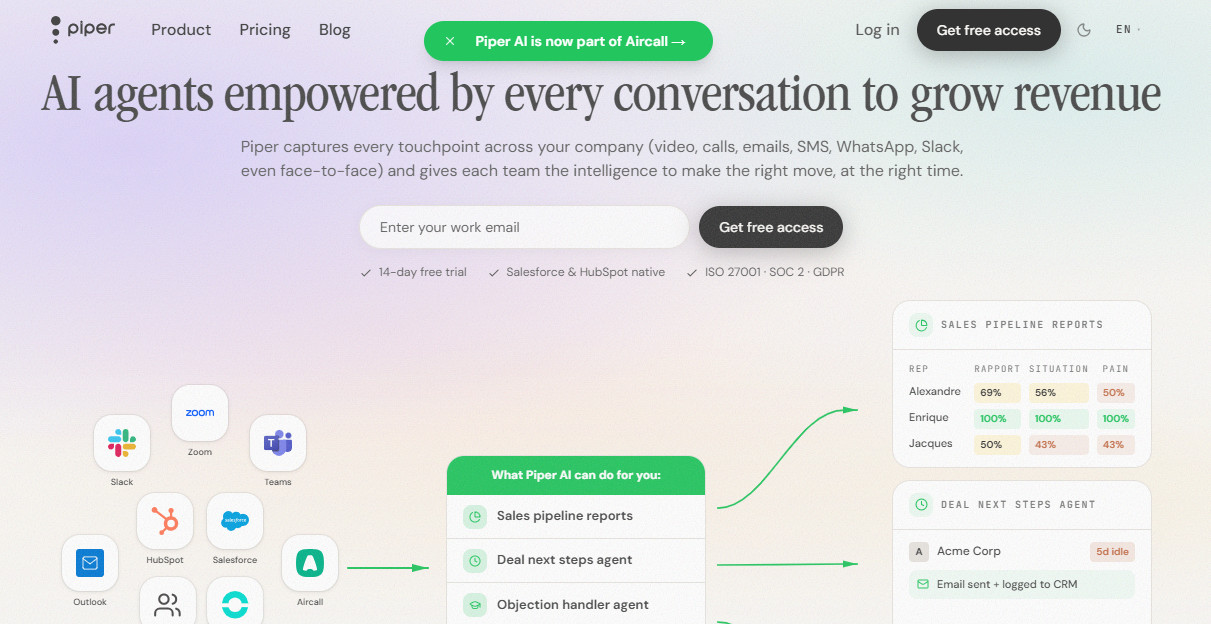
Piper is built to solve a problem that’s common to many revenue teams, even if they don’t have a specific name for it.
The best way to describe this dilemma is: deals can’t always be closed on a single call. They can move over days or weeks, across video demos, follow-up emails, multi-stakeholder threads, and field visits.
This can create a blind spot for many sales intelligence tools, which still center most of their processing on what happens during calls and meetings, not on the full stream of emails, messages, and side conversations around a deal.
Anything else is left undocumented, unless, of course, a rep chooses to enter it manually into the CRM after the call is over. That can be challenging, especially when the rep has a full day’s worth of other activities to log.
In this scenario, pipelines can end up with outdated deal stages, forecasts turn into guesswork, and at-risk deals may only become apparent after it’s too late to do anything.
The average B2B sales rep spends over two hours per day on manual CRM entry, inconsistent follow-ups, and post-call documentation. This is time that could be much better spent in front of customers. Piper addresses this issue by connecting to each channel a deal touches and capturing each interaction automatically.
That includes Zoom, Teams, Google Meet, phone calls, email, WhatsApp, and in-person activity.
From that capture, Piper AI focuses on five main jobs:

1. Omnichannel Conversation Capture
This feature ensures that every sales touchpoint is captured and processed, not just phone calls. It’s also the most substantial difference between Piper and standard call recording tools. The platform supports over 100 languages and can also handle GDPR-compliant recording, with built-in consent management. This is important for European teams trying to navigate disclosure requirements; the consent layer is built into the platform architecture, rather than patched on as a separate step.
2. Automated CRM Intelligence
As we’ve seen, after each interaction, Piper can auto-populate fields in CRMS like Salesforce or Hubspot: deal stages, contact data, and custom fields, without any manual input from reps. Piper reports that customers have cut total CRM data entry time by more than 50% within the first month, although I encourage readers to run their own tests with the platform to verify how much it benefits their setup.
3. Follow-Up and Task Automation
Every interaction can trigger AI-drafted follow-up emails and next-step task creation in the CRM automatically. One Piper customer at the professional network Worky reported saving up to 48 hours per rep per month: double their original intended target of 24 hours.
While individual companies’ requirements will differ, it stands to reason that consistent follow-through when enforced across the entire team will save time that can go back into selling.
4. Call Scoring and Coaching
Every call can be evaluated against the sales team’s methodology: MEDDIC, BANT, or a custom playbook. This can be done automatically without managers reviewing individual recordings.
Naturally, managers can still see dashboards, trends, and key moment highlights for one-to-one meetings with reps. But there’s no need to sit through full recordings. The scoring system also runs across all conversation types: not just phone calls.
5. Deal Visibility and Pipeline Intelligence
Piper monitors opportunity health in real time by combining cross‑channel engagement signals with existing CRM data, so deal risk is based on what actually happened, not just what reps remembered to log.
That means it can flag at‑risk deals early on, generate pre‑meeting briefs, and run agentic workflows continuously on a schedule or when deal conditions change.
While no one can forecast the future with total accuracy, this does allow every stakeholder to gain a live view into their business based on observed deal activity.
Piper AI by the Numbers

While most companies engage in self-promotion with marketing materials and client referrals, Piper backs its pitch with specific customer outcome data rather than generic claims about “time saved.”
The above-mentioned claim by a representative of Worky of saving up to 48 hours per rep, per month is one example. These customer-attributed outcomes tell prospective clients a lot more than internal projections.
For instance, Piper AI reports that Amphora Logistics saw a €300,000 recovery in ARR within weeks of deployment. GoBravo ran an A/B comparison and found a 24% lift in deal conversion among reps using Piper versus those who weren’t, across 35 licenses in Spain, Portugal, and Italy.
Naturally, the platform works best when deals involve multiple touchpoints across a variety of channels. That’s where Piper’s cross-channel capture features will stand out compared to tools that can only process voice calls.
How Does This Integration Work?
Even before the recent acquisition announcement, Aircall and Piper AI had an existing API integration.
This is still visible inside Aircall’s integration hub. Searching for “Piper” in the Integrations & API section of the dashboard displays a listing that describes the trigger‑and‑process loop in straightforward terms:
- When a user ends an interaction, Aircall notifies Piper AI.
- Piper processes the audio and generates notes, insights, and a follow-up email draft as applicable.
- Piper then maps the call to the corresponding CRM contacts and deals and auto-fills any relevant fields.
This three‑step process is the core of what Piper does at the call level, and it has been available as a discrete integration since before the acquisition.
At the time of writing, attempting to install the Piper integration from within the Aircall integrations marketplace returned a 404 page. This may indicate that access is currently restricted to existing Piper customers or that the integration flow is being updated following the acquisition announcement.
Given the timing of the acquisition, it is reasonable to expect changes to how setup and onboarding are handled once the platforms are fully consolidated, but this has not yet been reflected in the publicly accessible installation flow.
I’ve mentioned this here in case you also wish to trial Piper AI’s integration with Aircall right away, as it’s reasonable to expect the onboarding flow to change as Aircall and Piper consolidate their sign‑up experience, so check current documentation rather than assuming the App marketplace will always be the primary route.
In terms of how the integration works, I can do no better than to quote Aircall’s framing:
“Aircall handles the call. Piper handles everything the call unlocks.”
In simplest terms, this means that Aircall will continue to handle the conversation layer: voice, SMS, and so on, within a single workspace, with its AI Assist and AI Assist Pro add-ons providing live transcription, playbook prompts, real-time coaching, and post-call workflow automation for phone interactions.
Piper extends that coverage to the rest of the channels a deal typically touches and adds the revenue execution intelligence that Aircall’s own AI features weren’t originally designed to deliver on their own.
AI Assist Pro also supports real-time AI coaching during phone conversations, but Piper can deliver cross-channel dashboards, rep-level trends, and autonomous AI agents monitoring every deal for pipeline signals between conversations.
While Aircall has traditionally delivered basic call activity to the CRM, Piper can auto-populate complete deal records with custom field data and full qualification framework scoring across touchpoints.
Combined, the platforms support three overall operational modes:
- Teams getting started have access to Aircall’s cloud phone infrastructure, unified inbox, click-to-dial, and shared team visibility, offering a strong foundation even before adding AI layers.
- Teams scaling with an AI layer in AI Assist Pro’s live coaching will benefit from using this alongside Piper’s CRM automation and follow-up drafting.
- Teams pushing toward full automation can add 24/7 AI virtual agents for inbound call handling, smart routing, and Piper’s continuously running deal capture engine.
All of these modes can run without reps manually inputting data at any stage.
Aircall as the Foundation
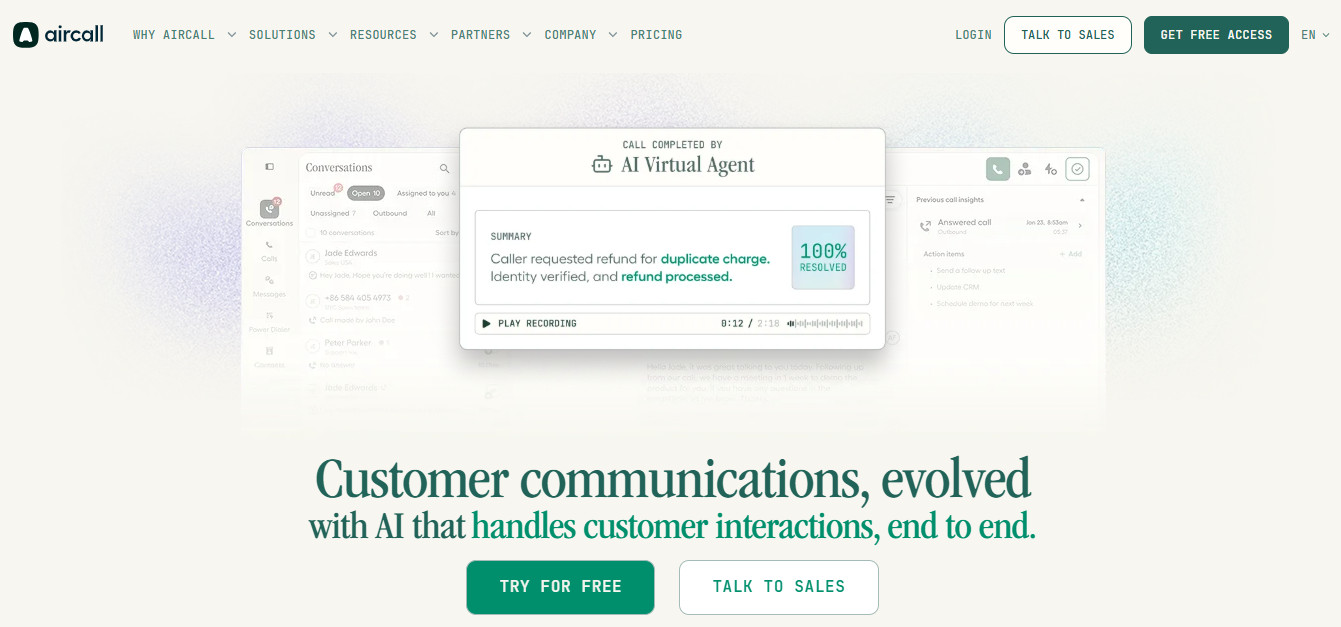
Throughout this guide, I’ve attempted to detail Piper AI’s features in the context of the acquisition. That’s why it’s vital to understand what Aircall itself brings to the picture.
Aircall was founded in Paris in 2014. Today, it operates as a cloud-based customer communications platform serving more than 23,000 businesses across over one hundred countries.
Its main focus is servicing sales and support teams that need a trustworthy business phone system. One of the ways it delivers this is 250+ native integrations (Salesforce, HubSpot, Zendesk, monday.com, Pipedrive). Aircall also offers 99.95% uptime, smart IVR, and skill-based call routing, and unified coverage of voice, SMS, and WhatsApp in a single workspace.
In terms of AI, the stack runs from AI Assist at $9/user/month. This includes post-call summaries, sentiment analysis, key topic recognition, and call scoring. AI Assist Pro at $49/user/month, adds live transcription, real-time prompts, MEDDIC/BANT/SPICED playbooks during calls, and automated CRM updates.
As we’ve established, these are typically paid add-ons, though subscribers to higher-tier plans, such as the ‘Professional’ tier ($50/license/month, paid annually), currently have AI assist included.
In brief, Aircall is a B2B platform for customer-facing teams. There’s a minimum three license requirement, so it’s not best suited for solopreneurs, nor is it a replacement for a residential phone system.
Nevertheless, the company’s acquisition of Piper is in keeping with that foundation: an AI‑powered customer conversation platform built for growing teams that want reliable infrastructure, meaningful integrations, and AI embedded into the workflow.
For a more detailed look at Aircall’s features, pricing, pros, cons, and ideal use cases, check out this comprehensive Aircall review.
How Piper AI Stacks Up Against Competition
Positioning vs. Revenue Intelligence Tools
When evaluated against existing revenue intelligence tools, such as Gong, Modjo, and Jiminny, the structural case for using Aircall with the newly-integrated Piper rests on one crucial fact: Aircall owns the communications channel.
While other conversation intelligence platforms sit on top of whatever calling infrastructure already in use by a team, Aircall effectively is the infrastructure. Piper turns that native position into an end-to-end revenue execution stack, giving Aircall a clear structural advantage that many competing revenue intelligence platforms do not have.
Considerations and Limitations
Despite having a clear edge over competitors in some areas, there are some features Piper AI doesn’t yet include. For instance, live in-call coaching is still a work in progress. However, if you need that right away, Aircall’s AI Assist Pro add-on includes live prompts, live transcription, and playbook surfacing during calls.
Piper mainly comes into its own post-call, with scoring, dashboards, trend analysis, and key moment identification.
A browser-based plugin is currently in development that will offer call recording without a meeting bot, targeting H2 2026, but GDPR disclosure is required for EU users, no matter what recording method you deploy.
CRM field population from email-only interactions also isn’t supported yet. After all, Piper’s automation is conversation-triggered, not email-triggered.
None of these are necessarily major limitations, but they’re worth exploring if you’re considering Aircall with Piper AI as your daily driver.
Pricing
Piper’s pricing reflects its mid‑market focus, with publicly referenced plans positioned at around €40 per user per month, although the pricing model and availability may change once Piper’s acquisition by Aircall is complete. This pricing sits well below enterprise revenue intelligence platforms, although final packaging and availability may evolve following Aircall’s acquisition.
Gong pricing is available on request, and the platform is more of an enterprise-tier tool with lengthy procurement cycles, better suited to organizations at 1,000+ reps with dedicated RevOps functions, than SMBs.
Modjo also does not list standard pricing directly on its website, and while exact costs are not publicly verifiable, it is generally positioned as a premium alternative, particularly for European teams focused on coaching frameworks and GDPR compliance.
Who Piper AI Makes Sense For
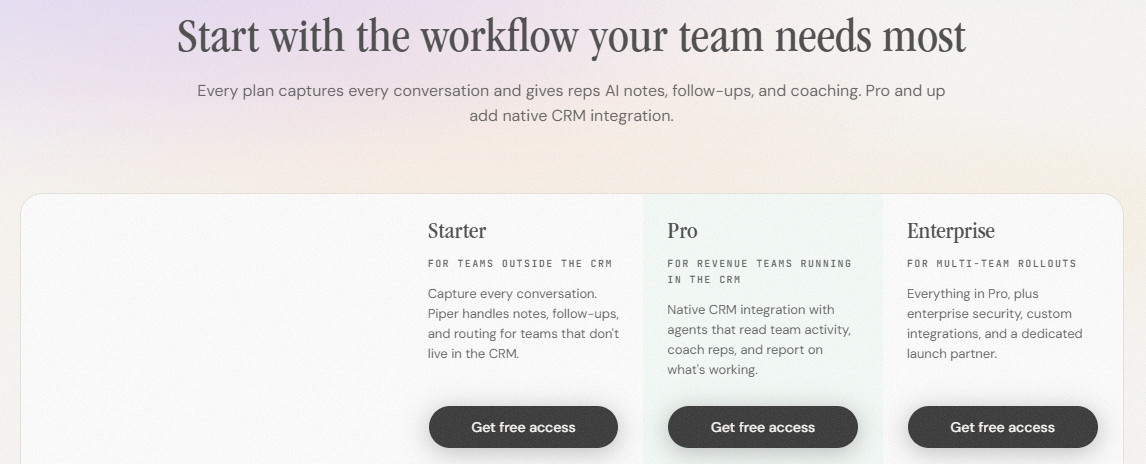
Even having established a clear understanding of what Aircall has to offer and how Piper AI will integrate with it, the question remains of who will benefit from it most.
The sweet spot for Aircall with Piper is B2B companies with 25 to 300 commercial reps, Salesforce or HubSpot as their CRM, and a sales process that runs across both video and phone. Common industries that fit this profile include SaaS, professional services, fintech, logistics, and recruiting: in short, anywhere where deals involve multiple stakeholders across a multi-week cycle.
It’s not as well-suited to small sales teams running simple inbound-only flows, or enterprise organizations at 1,000+ reps with established Gong contracts.
For mid‑market teams, especially those frustrated by the gap between what happens on calls and what actually ends up in the CRM, the combined Aircall and Piper AI platform tackles the problem more directly than most alternatives at this price point.
The full Aircall announcement is live at aircall.io/blog/news/aircall-piper-ai/.