


Last Updated on May 28, 2026 by Ewen Finser
Stax is a leading payment processor that’s unique from many others in that it uses subscription-based pricing. You pay a fixed monthly fee each month to keep transaction fees low, with the idea being that if your transaction volume is high enough, it will more than pay for the subscription fee and save you a lot of money. As a result, many e-commerce merchants go with Stax with the goal of cutting processing costs.
However, there’s a major caveat here: For lower-volume merchants, the subscription-based pricing ends up being more expensive, not less. They’re simply not selling enough to reach the cost savings.
In these situations, the smartest move would be to switch from Stax to another processor that’s easier on the wallet. Specifically, flat-rate and interchange plus providers will be the most cost-effective for sellers with low transaction volumes.
So here’s a look at some of the best alternatives to Stax, leading with a bit of context around payment structures if you need a refresher.
Common Payment Processor Cost Structures

If your accountant typically handles stuff like this and a conversation around payment processors sounds a bit foreign to you, here’s a bit of helpful context about the most common pricing models you’ll encounter:
- Flat rate: This is where you’re charged a fixed percentage fee for every transaction.
- Interchange-plus (IC+): With this pricing model, there are a few fees you’ll pay:
- Interchange fee: Charged by the customer’s bank
- Card network fee: Charged by the card network
- Processor fee: Charged by the payment processor (this is where the “plus” comes from)
- Subscription-based: You pay a set monthly subscription fee each month, in addition to lower processing costs.
- Tiered: Here, transactions into a few different tiers: typically qualified, mid-qualified, and non-qualified. Each tier has its own fee structure, and tiered pricing tends to be very costly compared to other pricing models.
With that out of the way, let’s go over my top picks for Stax alternatives.
The Best Stax Alternatives: At a Glance
Best For | Pricing Structure | Online Card Fees | Fee Estimate: $2,000, 50 Transactions | Fee Estimate: $10,000, 200 Transactions | |
Stripe | Developers | Flat rate | 2.9% + $0.30 | $73 | $350 |
Luqra | Growing e-commerce businesses | Flat rate, custom pricing | As low as 2.3% + $0.20 | $56 | $270 |
Helcim | Volume discounts | Interchange-plus (IC+) | Interchange + 0.50% + $0.25, volume discounts | $65.10 | $305 |
Square | Businesses with physical locations | Flat rate, optional monthly subscriptions | 3.3% + $0.30 (Square Free) | $81 | $390 |
Stripe: Best for Developers
Stripe is one of the most popular payment processors in the world, with the name widely recognized by both sellers and consumers alike. It’s an especially attractive option due to its flat-rate pricing, and developers tend to like it due to its thorough documentation and well-designed API.
Processing Fees
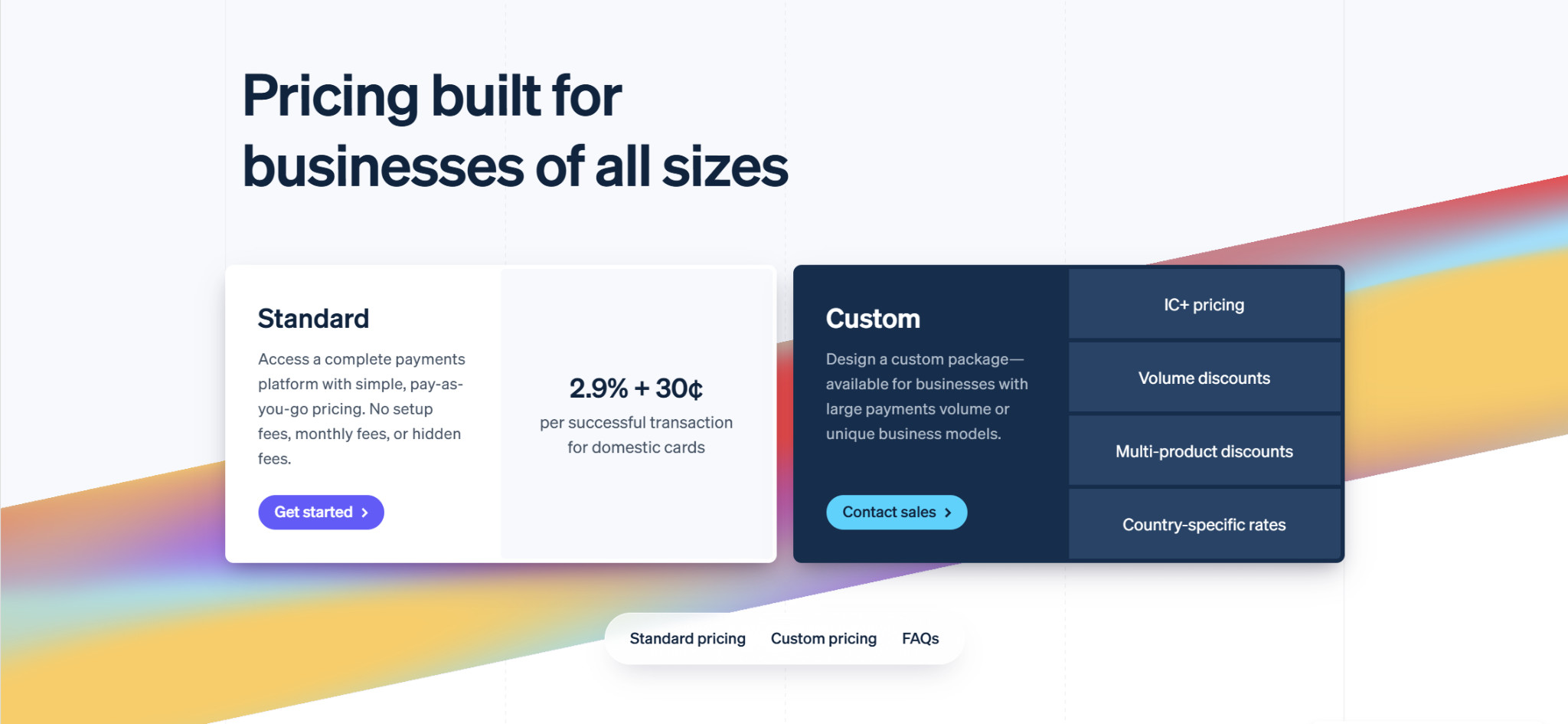
Stripe offers two cost structures: Standard and Custom. Since custom is reserved for the most complex, high-volume businesses, only Standard pricing is listed below.
- ACH: 0.8%, $5 cap
- Cards: 2.9% + $0.30
- Additional fees:
- 0.5% for manually entered cards
- 1.5% for international cards
- 1% for currency conversion
- Additional fees:
The price for physical domestic card payment is 2.7% + $0.05.
Additional fees you could face include:
- 1.5% for international cards
- $0.10 for Tap to Pay
- $0.05 for point-to-point encryption
Processing Fee Examples
Monthly Volume: 50 Transactions, $2,000
Let’s say that you run a small e-commerce business as a side gig. You had 50 transactions during the month, totaling $2,000, and all your customers paid with domestic credit cards. Here’s a breakdown of how much you’d pay in Stripe processing fees:
- $2,000 × 2.9% = $58
- 50 transactions × $0.30 = $15
- Total processing costs: $73
Now, let’s compare that to what you’d be paying with Stax. Their cheapest plan is $99 monthly, and the transaction fee for each online payment is $0.15. You’d also have to pay interchange fees.
While interchange can vary based on the type of card, the transaction size, the transaction method, and other factors, we’ll use 2% to keep things simple:
- Monthly subscription cost: $99
- $2,000 × 2% interchange = $40
- 50 transactions × $0.15 = $7.50
- Total subscription and processing costs: $146.50
This is significantly more expensive than what you’d pay with Stripe, and the price difference would only add up over time.
Monthly Volume: 200 Transactions, $10,000
To compare, I’ll show you a situation where Stax would actually end up saving you money. Suppose you have 200 transactions during the month, totalling $10,000. Here’s what you’d pay with Stripe:
- $10,000 × 2.9% = $290
- 200 transactions × $0.30 = $60
- Total processing costs: $350
With Stax, with a $10,000 monthly processing volume, you’d still be at the $99/month subscription tier, since this goes up to $150,000 in yearly volume:
- Monthly subscription cost: $99
- $10,000 × 2% interchange = $200
- 200 transactions × $0.15 = $30
- Total subscription and processing costs: $329
Customer Support
Stripe offers 24/7 customer support through phone, email, and live chat. However, you might get stuck with AI support.
Pros
- One of the most well-known payment processors
- Plenty of developer resources
- Transparent, flat-rate pricing
Cons
- Heavily relies on AI support
- Not the cheapest option for high-volume businesses
- May encounter account freezes and holds with rapid scaling
Luqra: Best for Growing E-commerce Businesses
Luqra is a lesser-known processor, but working with a smaller processor can have some advantages, particularly when it comes to customer service.
While it also supports in-person payment processing, Luqra was built specifically with e-commerce at the forefront. It’s also built for scaling and has uncapped processing, so it won’t freeze your account or hold funds due to a sudden spike in volume.
Processing Fees
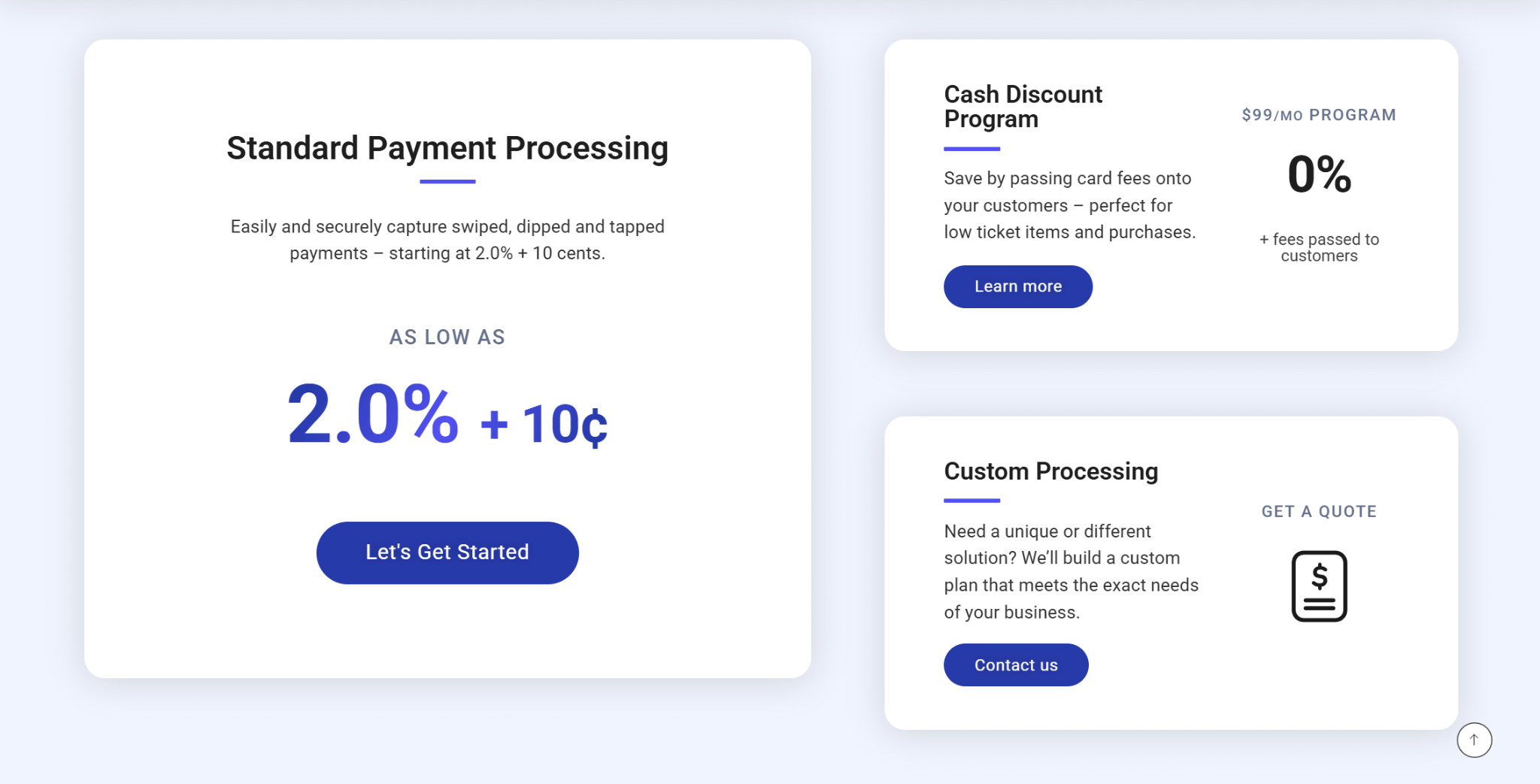
Luqra doesn’t have standardized rates that apply to every single business. The fees follow a flat-rate structure, and they’ll be customized to the nature of your business.
Here’s an idea of what you could be looking at:
- Online: As low as 2.3% + $0.20
- In-Person: As low as 2% + $0.10
Something unique about Luqra is that they have “meet or beat” rates, and they promise that they won’t raise your rates at any time.
Processing Fee Examples (Online)
Monthly Volume: 50 Transactions, $2,000
- $2,000 × 2.3% = $46
- 50 transactions × $0.20 = $10
- Total processing costs: $56
Provided you qualify for Luqra’s lowest price point, this is far lower than Stax’s $146.50 — and it’s actually lower than all the other options on this list as well.
Monthly Volume: 200 Transactions, $10,000
- $10,000 × 2.3% = $230
- 200 transactions × $0.20 = $40
- Total processing costs: $270
Luqra is still cheaper here, compared to Stax’s $329.
Customer Support
Luqra’s team has extensive e-commerce experience, and they provide 24/7/365 U.S.-based phone support. This is one of the most significant advantages that comes with using a smaller payment processor, since they aren’t overwhelmed with calls. Each of their customers also gets their own account representative.
Pros
- Committed to maintaining low fees
- 24/7/365 U.S.-based phone support
- Uncapped processing volume
Cons
- Less of a proven track record
- Subscription-based processors may be cheaper at high volumes
- Fewer integrations
Helcim: Best for Volume Discounts
While its main specialty lies with in-person payment collection for industries like healthcare, retail, automotive, and wholesale, Helcim supports online payment processing as well, making it a valid option for e-commerce merchants. Its fee structure is distinct from Stax, Stripe, and Luqra, as it uses interchange-plus (IC+) pricing.
Processing Fees
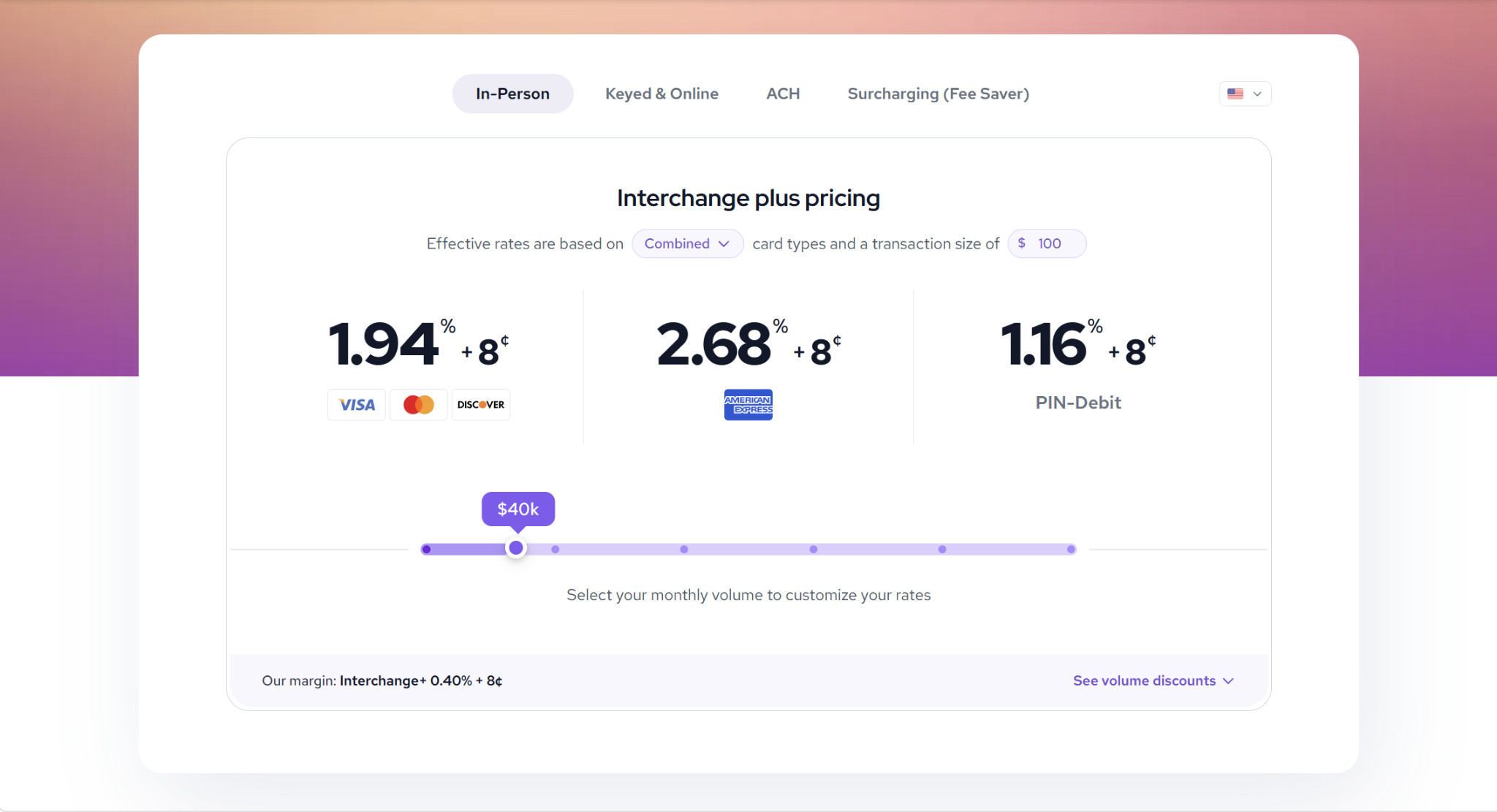
With Helcim, costs go down as payment volume increases. This may sound similar to Stax, but unlike Stax, Helcim doesn’t charge any monthly fees.
Here are the fees you’re looking at for card payments, with the tiers based on monthly volume:
- Online:
- $0–$50,000: Interchange + 0.50% + $0.25
- $50,000–$100,000: Interchange + 0.45% + $0.20
- $100,000–$500,000: Interchange + 0.35% + $0.20
- $500,000–$1,000,000: Interchange + 0.25% + $0.15
- $1,000,000–$5,000,000: Interchange + 0.15% + $0.15
- $5,000,000 & above: Custom
- In-person:
- $0–$50,000: Interchange + 0.40% + $0.08
- $50,000–$100,000: Interchange + 0.35% + $0.07
- $100,000–$500,000: Interchange + 0.25% + $0.07
- $500,000–$1,000,000: Interchange + 0.20% + $0.06
- $1,000,000–$5,000,000: Interchange + 0.15% + $0.06
The fees for ACH are 0.5% + $0.25, with a $6 cap. However, an additional 0.05% applies to transactions above $25,000.
Processing Fee Examples
It’s not as easy to run through the math for an interchange-plus processor like Helcim, compared to Stripe or other flat-rate processors. However, I’ll show you some simplified examples so you can get an idea of the cost, basing the calculations on Helcim’s interactive rate calculator.
Monthly Volume: 50 Transactions, $2,000
Let’s say that each transaction amounted to $40, and all transactions were processed online. We’ll also assume that the payment method for each transaction was a Visa credit card.
For a $40 transaction size at a business that processes less than $50,000 monthly, Helcim shows the average Visa cost being 2.63% + $0.25.
- $2,000 × 2.63% = $52.60
- 50 transactions × $0.25 = $12.50
- Total processing costs: $65.10
This is significantly less than the $146.50 you’d pay with Stax.
Monthly Volume: 200 Transactions, $10,000
We’ll make the same assumption here that everyone’s paying online with a Visa, and that the business processes less than $50,000 monthly. Let’s say that every transaction totaled $50. Based on these parameters, Helcim shows the average Visa cost being 2.55% + $0.25.
- $10,000 × 2.55% = $255
- 200 transactions × $0.25 = $50
- Total processing costs: $305
Again, still cheaper than the Stax’s $329.
Customer Support
To get in touch with someone at Helcim, you can either fill out an online form or call them. When you submit a ticket, their team aims to respond within 12 business hours, and phone support is available from Monday through Saturday.
Pros
- Transparent pricing
- Phone support
- Volume discounts
Cons
- Less of a focus on online payment processing
- Potentially confusing interchange-plus cost structure
- Not the cheapest option for low-volume merchants
Square: Best for Businesses with Physical Locations

Even if you haven’t used it in your own business, you’re likely familiar with Square. It’s often used for card-present purchases, such as those at restaurants, salons, and clothing stores.
Square also sells a range of payment hardware options, including handheld options, terminals, and iPad POS systems. However, you can use Square even if your business has no physical storefront.
Processing Fees
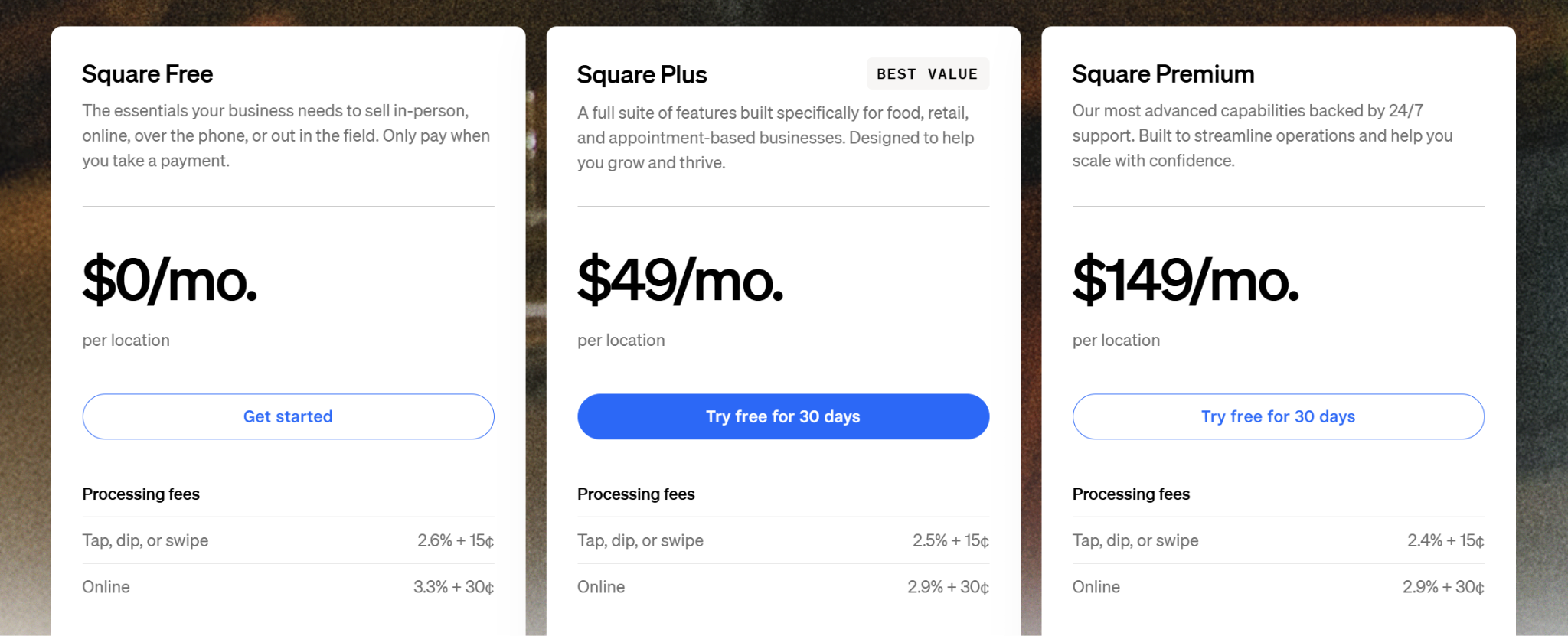
Square’s cost structure can seem a little confusing at first, since they have three monthly subscriptions to choose from. This may remind you of Stax, but it’s actually much different, since online businesses really only need the Square Free plan. Their other plans, Square Plus and Square Premium, are geared toward sellers with physical locations.
Here are Square’s online payment processing fees under the Square Free plan:
- ACH: 1%, $1 minimum
- Card: 3.3% + $0.30
- Additional 1.5% for international cards
For reference, the in-person processing fees under the Square Free plan are 2.6% + $0.15 per transaction.
Processing Fee Examples
As long as you’re on the Square Free plan, you’ll face a flat-rate structure with no subscription costs. Like Stripe and Luqra, this makes it fairly straightforward to get an idea of the online payment processing fees you’ll owe.
Monthly Volume: 50 Transactions, $2,000
- $2,000 × 3.3% = $66
- 50 transactions × $0.30 = $15
- Total processing costs: $81
This is much lower than Stax’s $146.50, quickly translating to hundreds of dollars in savings over the course of the year.
Monthly Volume: 200 Transactions, $10,000
- $10,000 × 3.3% = $330
- 200 transactions × $0.30 = $60
- Total processing costs: $390
For a $10,000 monthly processing volume, Stax is the clear winner cost-wise, with fees totalling $329.
Customer Support
Square offers chat, phone, and email support. The live chat is initially done through their Support Assistant, which is AI-based, though they will transfer you to a human if needed.
Phone support is only available for 90 days under the Square Free plan. With the Square Plus plan, phone support is available Monday through Friday, and there’s 24/7 phone support under the Square Premium plan. The platform also has a community forum where Square customers can help each other out.
Pros
- Transparent, flat-rate pricing
- No monthly fee on the Square Free plan
- Appropriate for many industries
Cons
- Not the cheapest flat-rate option
- Heavy focus on in-person over online processing
- Paid subscription required for lower transaction fees
Which Stax Alternative Is Best for Low-Volume Merchants?
If Stax’s subscription-based pricing model seems too expensive for your business’s transaction volume, the good news is that there are several alternatives out there. In fact, the majority of processors don’t charge monthly fees like Stax, making them friendlier for low-volume merchants.
The best choice for you will depend on your business. For example, Stripe could be a good option if you want to go with something widely known and with transparent, flat-rate pricing. Helcim and Square are solid choices if your business has both online and physical storefronts. Luqra is emerging as a top choice for e-commerce merchants looking to scale at a low cost and who want a personalized customer experience.
Whichever path you’re on, remember to do thorough research before signing up!