


Last Updated on May 25, 2026 by Ewen Finser
As a startup, the payment processor you choose on day one is rarely the financial engine that will carry you to an exit. What works flawlessly during your seed round when you’re testing product-market fit can become a massive liability once you secure Series A funding and start pushing volume.
For example, Stripe is the default recommendation for almost every new startup — and for good reason. It offers unmatched developer tools and instant onboarding, making it the perfect choice when your primary goal is simply getting your checkout page live. However, as revenue scales, the automated risk algorithms that made onboarding so easy suddenly become a massive threat to your cash flow. Revenue gets frozen, and now you’re scrambling to meet payroll.
So today, we’re breaking down the best payment processors for startups.
At a Glance
Ideal Growth Stage | Setup Speed | Pricing Model | Risk of Freezes | Support Quality | |
Stripe | Early-stage, MVP, pre-seed | Instant algorithmic onboarding | 2.9% + $0.30 flat rate | High (automated algorithmic risk) | 24/7 basic support; rigid risk teams |
Braintree | Developer-heavy apps needing PayPal | Fast; robust developer SDKs | 2.59% to 3.49% flat rates | Moderate to high (PayPal risk network) | Good technical support; slow risk appeals |
Adyen | Enterprise, global scale, post-Series B | Slow; requires heavy engineering resources | Interchange++ (requires high volume) | Very low (extensive upfront underwriting) | Dedicated enterprise teams |
Luqra | Post-traction startups needing high stability | Fast API; requires 24–48 hours of underwriting | Custom interchange-plus; “meet or beat” policy | Very low (upfront underwriting) | Dedicated U.S.-based account manager |
Stripe: The Default Start
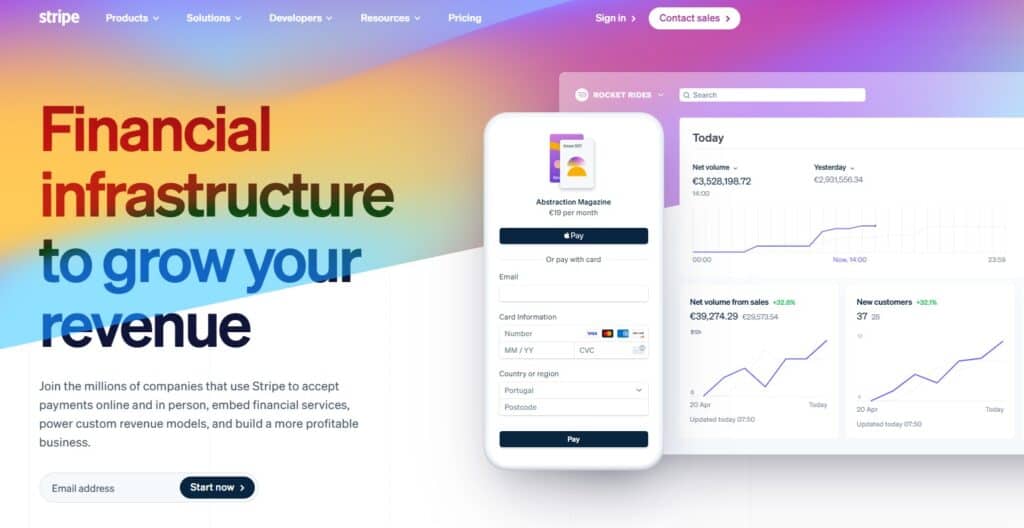
Stripe is universally recognized as the default payment processor for early-stage startups. Founded with a developer-first ethos, it fundamentally changed how businesses accept money on the internet by turning complex financial infrastructure into simple API calls, allowing founders to focus on building their product rather than worrying about banking regulations.
And when it comes to developer experience and setup complexity, Stripe is the undisputed gold standard in the tech industry. Their documentation is clean, interactive, and easy for any junior engineer to implement. They provide pre-built checkout flows, customizable UI components, and SDKs for almost every programming language and framework used by modern startups.
As a result, your engineering team won’t have to waste weeks deciphering bank APIs or dealing with legacy gateways. Integration is usually seamless, with extensive sandbox environments that allow you to thoroughly test every edge case before going into production.
Account Stability
Stripe acts as a master merchant aggregator, pooling the risk of millions of startups under its own massive merchant account. This model removes the traditional underwriting barriers to entry, allowing you to create an account and accept your first payment in under ten minutes.
However, this convenience comes with trade-offs in long-term account stability. Because they don’t perform deep underwriting when you sign up, Stripe relies heavily on automated machine-learning algorithms to monitor your account for risk. If your startup experiences a massive launch that causes a sudden, exponential spike in sales, Stripe’s algorithms often misinterpret this success as a fraud ring.
That’s why you’ll often hear of founders receiving automated emails stating that their payouts have been paused or that a rolling reserve has been placed on their funds. There’s usually little explanation given, and it’s very frustrating. And for a startup burning cash to acquire customers, having hundreds of thousands of dollars trapped in a frozen Stripe account can be a fatal blow to operations.
Fee Structure
Stripe operates on a predictable, flat-rate pricing model that’s perfectly suited for early-stage financial planning. The standard cost is 2.9% plus $0.30 per successful online transaction, with no monthly fees, hidden setup costs, or long-term contracts.
However, startups are forced to pay the same flat rate regardless of the actual interchange costs associated with different types of credit cards. While Stripe does offer custom pricing for massive enterprises, getting them to negotiate rates requires significant leverage and millions of dollars in consistent monthly volume.
Braintree: The Developer Alternative
Braintree, an independent subsidiary of PayPal, was built specifically to cater to high-growth tech companies and developers, serving as the primary alternative to Stripe for startups that need deep API access but prefer to tap into PayPal’s massive global network. Their primary advantage is their ability to seamlessly process standard credit cards alongside native integrations for PayPal, Venmo, and major digital wallets. As such, Braintree is heavily favored by startups with complex marketplace dynamics or those relying on high-volume micro-transactions.
Braintree was designed by developers, for developers, and its setup process reflects that core philosophy. While it might require slightly more custom coding than Stripe’s pre-built drop-in UI, the Braintree SDKs are incredibly robust and well-documented. The sandbox environment also mirrors production perfectly, allowing for aggressive testing of complex recurring billing or split-payment marketplace models.
Account Stability
Because Braintree is backed by PayPal’s massive risk infrastructure, it suffers from some of the same hyper-sensitive risk management issues as its parent company. Startups that experience rapid, unexpected scale or operate in industries with higher-than-average chargeback rates are heavily scrutinized.
And because they act as a payment aggregator, their default mechanism for protecting themselves against potential losses is to hold your funds. Sudden spikes in processing volume can easily trigger a manual review, resulting in delayed payouts right when you need liquidity the most.
Also, while generally more stable than a standard consumer PayPal account, Braintree still heavily favors the buyer in dispute resolutions, leading to unpredictable revenue clawbacks.
Fee Structure
Like Stripe, Braintree utilizes a standard flat-rate pricing model for its standard integrations: 2.59% plus $0.49 for credit cards and Venmo, and 3.49% plus $0.49 for PayPal checkout. However, they’re generally known to be slightly more flexible with custom pricing tiers for mid-stage startups than Stripe. But while their custom rates can be competitive, processing international payments still incurs significant cross-border and currency conversion markups.
There are no hidden monthly minimums or gateway fees, making it a low-risk option to install and test. And once your startup hits a certain volume threshold, their sales team is often willing to discuss interchange-plus pricing models.
Adyen: The Global Enterprise Scale
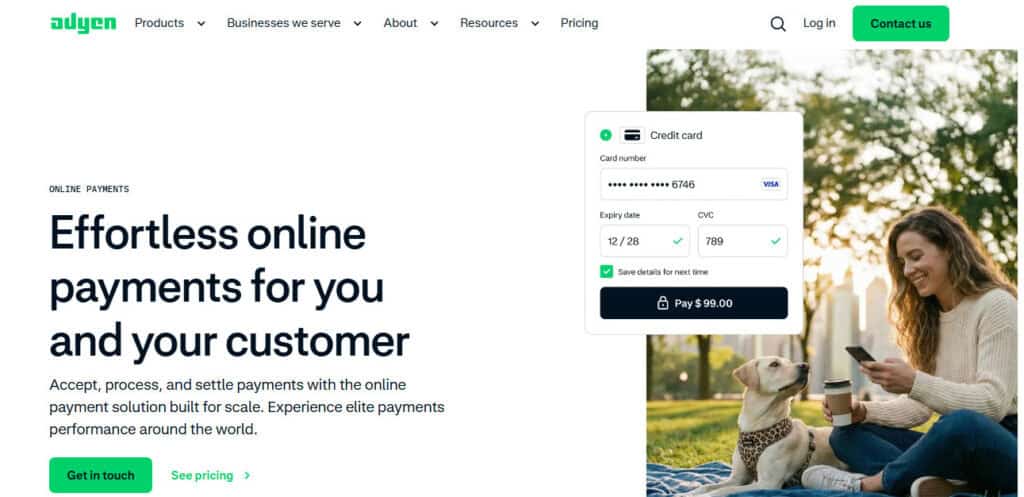
Adyen is not built for the scrappy, pre-seed startup operating out of a garage. It is an enterprise-grade financial technology platform designed for post-Series B companies that are expanding internationally and dealing with immense complexity.
They bypass the traditional patchwork of gateways and acquiring banks by building a single, global platform that connects directly to Visa, Mastercard, and localized payment methods around the world. If your startup has proven its product-market fit and is aggressively scaling into Europe or Asia, Adyen is the infrastructure that will prevent international payment failures. They’re also the preferred processor for massive tech giants like Uber and Spotify, signaling their capability to handle virtually unlimited transaction volume.
However, because Adyen is built for enterprise scale, the integration process requires significant engineering resources and financial compliance work. This is not a platform you can sign up for and deploy over a weekend… the onboarding process involves rigorous underwriting, deep architectural planning, and a dedicated deployment team to ensure that their API connects seamlessly with your global database.
The technical documentation is highly sophisticated but assumes you have a dedicated payments engineering team managing the integration. Startups must be prepared for a multi-week onboarding and testing phase before they can process their first live transaction.
Account Stability
Account stability with Adyen is exceptionally high, specifically because they act as a direct acquirer and perform exhaustive underwriting before you ever process a dollar. They don’t rely on trigger-happy algorithms to freeze accounts because they understand your business model deeply before signing the contract. They provide advanced, customizable risk management tools that allow your team to set specific fraud parameters rather than relying on a black-box algorithm.
Rapid growth and massive sales spikes are expected and handled smoothly without the threat of automated fund holds. Plus, their direct connection to the card networks results in higher authorization rates and fewer false declines, stabilizing your revenue streams globally.
Fee Structure
Adyen completely abandons the flat-rate pricing model in favor of a highly transparent Interchange++ structure. This means you pay exactly what the credit card network charges, plus a fixed acquiring markup and a small processing fee. For startups doing massive volume, this model eliminates the hidden margins that flat-rate processors pocket, resulting in hundreds of thousands of dollars in annual savings. However, this model is entirely inaccessible for early-stage startups with low transaction counts.
Besides, Adyen typically enforces strict minimum monthly invoice requirements, which means you must be processing millions before their platform makes financial sense.
Luqra: The Post-Traction Growth Partner
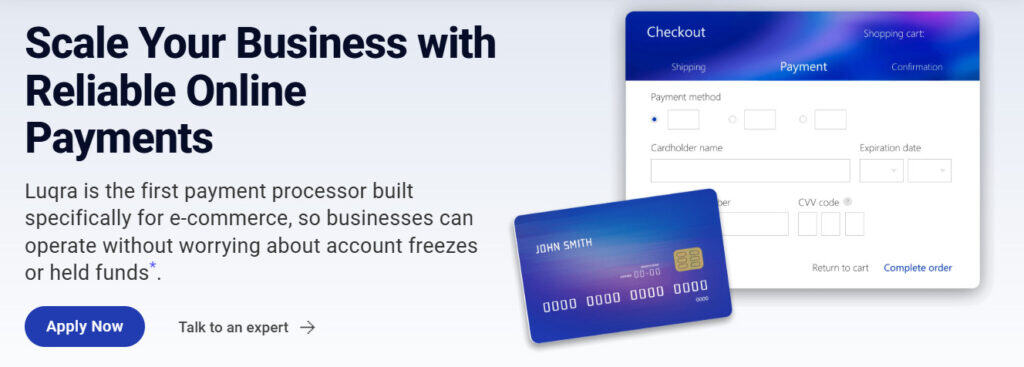
Luqra occupies a vital, often-overlooked space in the startup ecosystem: the processor for companies that have passed the proof-of-concept stage and are now dealing with real volume, real customers, and the intense growing pains that come with scaling. When a startup outgrows the algorithmic instability of Stripe but isn’t yet ready for the massive enterprise deployment of Adyen, Luqra is the perfect bridge.
They replace automated algorithmic risk profiling with upfront, human-led underwriting, guaranteeing that your funds will not be frozen due to rapid growth. They also provide a single pane of glass for managing payments, chargebacks, and financial analytics, operating as an integrated ERP rather than a simple gateway.
The onboarding process is deliberately more involved than Stripe’s, as Luqra requires you to go through a proper underwriting procedure before you begin processing. You must provide documentation about your business model, past processing statements, and corporate identity to ensure your account is properly vetted.
So while it takes more time to be approved and connected, this upfront friction is precisely what prevents the sudden account freezes that plague aggregator platforms. Furthermore, their API is modern and well-documented, allowing your engineers to easily pipe transaction data directly into your existing dashboard or custom application.
Account Stability
Account stability is Luqra’s strongest asset for a scaling startup. Because they underwrite your business upfront and understand your specific model before you start processing, you’re fundamentally protected from arbitrary, algorithmic fund freezes. When your marketing campaign goes viral and sales spike exponentially overnight, Luqra views this as a success to be celebrated rather than a risk factor requiring a suspended account.
They also explicitly advertise zero account holds or unexpected freezes for approved merchants, offering a level of operational security that Stripe simply cannot match. This stability is crucial for startups that rely on consistent, daily cash flow to fund inventory restocking, payroll, and aggressive ad spend.
Fee Structure
Luqra breaks away from rigid flat-rate pricing models and instead offers highly transparent, interchange-plus pricing tailored to your startup’s specific volume. They operate on a highly competitive “meet or beat” strategy, where they will analyze your current processing statements from Stripe or Braintree and guarantee a lower effective rate. Because they eliminate the middleman aggregator fees, high-growth startups can instantly improve their profit margins without changing their product pricing.
Most notably, they also promise that there will be no surprise rate increases over the lifetime of your account, providing massive financial predictability for growing operations.
Choosing Among the Best Payment Processors for Startups
The payment processor you launch with is rarely the one you scale with. If you’re a founder hacking together an MVP over the weekend, Stripe remains the undisputed king of simplicity and developer experience, and it will get you live faster than any other platform. If your consumer-facing app relies heavily on reducing checkout friction, integrating Braintree to leverage the PayPal and Venmo networks is a strategic move that can boost early conversions.
However, once your startup proves its product-market fit and begins processing significant, consistent volume, the rules of the game fundamentally change. You can no longer afford to risk your runway on automated risk algorithms that freeze funds without warning.
That’s why, for growing startups that have moved past the proof-of-concept stage and require guaranteed account stability, transparent pricing, and a financial partner, Luqra is the definitive choice. By combining modern tech integrations with traditional underwriting stability, Luqra ensures your cash flow remains uninterrupted, allowing you to focus entirely on scaling your vision to the next level.