

Last Updated on February 23, 2026 by The Digital Merchant Team
A good cell phone plan can feel hard to come by. It can be a real challenge to find a plan that has the whole package: low prices, reliable customer support, and solid coverage. Add in the sheer amount of options that are out there, and the decision becomes even more difficult.
Whether you need a dependable phone plan to make work calls or to a plan that lets you keep up with family and friends, you’ll want to guarantee you’re investing in a cell phone plan that you can really trust. Two options that remain popular for a reason are Total Wireless and Metro. Total Wireless is part of the Verizon portfolio, while Metro is affiliated with T-Mobile. In this article, I’ll show you the ins and outs of both of these carriers so you can decide which one is the best choice for you.
Total Wireless vs Metro: At a Glance
Pricing | Three plans: $40/line/month, $50/line/month, $60/line/month No one-time fees | Three plans: $40/line/month, $50/line/month, $60/line/month $25 one-time device activation/change fee |
Network Coverage | Extensive 5G coverage 99% 4G LTE coverage | 80% 5G coverage 99% 4G LTE coverage |
Top Speeds | Download Speed: 195-634 Mbps Upload Speed: 10-53 Mbps Latency: 37-57 ms | Download Speed: 127-455 Mbps Upload Speed: 6-33 Mbps Latency: 15-27 ms |
Mobile Hotspot Data | $40/month plan: 5 GB $50/month plan: 15 GB $60/month plan: Unlimited | $40/month plan: None $50/month plan: 8 GB $60/month plan: 25 GB |
International Use | Included in all plans | Included only in the $60/month plan |
Customer Service | Text helpline Online chat Phone support | Online chat Phone support |
Plans and Pricing
Total Wireless
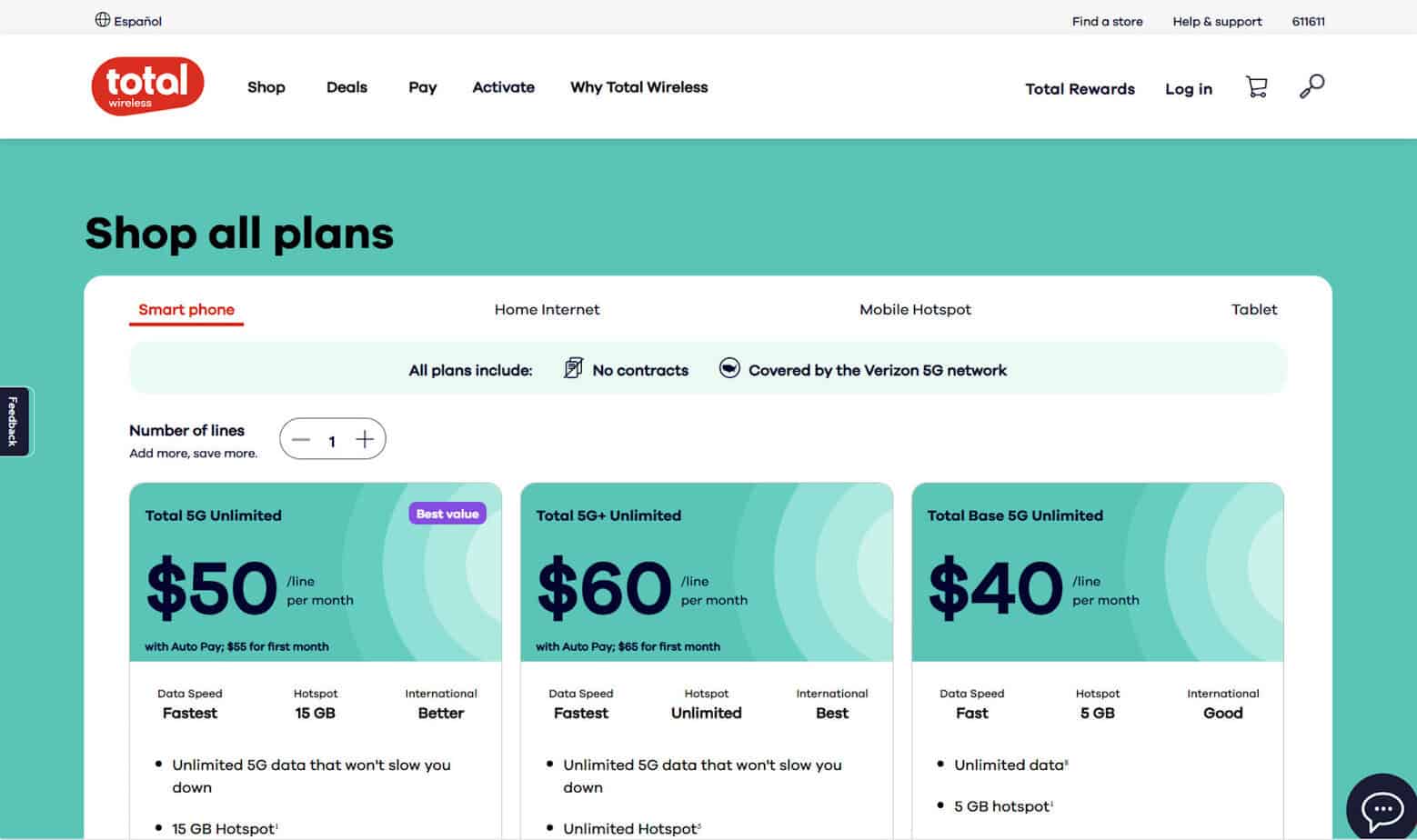
Total Wireless plans fall under four distinct categories: smart phone, home internet, mobile hotspot, and tablet. None of the plans require contracts, and they’re all covered by Verizon’s 5G network. For smart phones, Total Wireless offers three plans, each with their own strengths and weaknesses.
An important note about pricing is that the per-line monthly prices shown below are for one line only. The price per-line decreases when the plan has more lines. For example, if you have four lines, instead of the per-line prices being $40, $50, and $60, they’re $25, $27.50, and $30.
Read the Total Wireless full review here!
Total 5G Unlimited ($50/line per month)
- Data Speed: Total Wireless highlights this plan as being tied with Total 5G+ for having the fastest data speed, so if you value efficiency, it should have you covered.
- Hotspot Data: 15 GB, limited to one device
- International Use:
- Calling: 180 countries
- Texting: 200+ countries
- Roaming: Canada and Mexico, along with 30 additional countries
- Long Distance Credit: None
Ranked alongside Total Wireless’s other plan, the Total 5G unlimited plan is tied for first when it comes to data speed, and falls in the middle of the three plans for both hotspot data and international use.
Total 5G+ Unlimited ($60/line per month)
- Data Speed: The 5G+ plan’s data speed is tied with the 5G plan as having the fastest data speed that Total Wireless offers.
- Hotspot Data: Unlimited hotspot data, limited to one device
- International Use:
- Calling: 180 countries
- Texting: 200+ countries
- Roaming: Canada and Mexico, along with 30 additional countries
- Long Distance Credit: $10 credit to 120+ countries
Of Total Wireless’s three plans, the 5G+ plan is top of the line in all three categories: data speed, mobile hotspot data, and international use. Of course, it’s also the priciest of Total Wireless’s offerings, so you’ll have to look at which features are most important to you to decide whether it’s worth it.
Total Base 5G Unlimited ($40/line per month)
- Data Speed: While this plan’s data speed is still fast, it’s the slowest out of the plans that Total Wireless offers. Specifically, you may face slower data speeds at times of heavy traffic.
- Hotspot Data: 5 GB, limited to one device
- International Use:
- Calling: 85+ countries
- Texting: 200+ countries
- Roaming: Canada and Mexico
- Long Distance Credit: None
This is the lowest-tier plan that Total Wireless offers, and this is true across all categories: data speed, hotspot data, and international features. However, it’s also the cheapest of the three plans, and it could easily be sufficient depending on your needs.
One-Time Fees
Total Wireless doesn’t charge any one-time fees, such as those for device activation.
Metro by T-Mobile
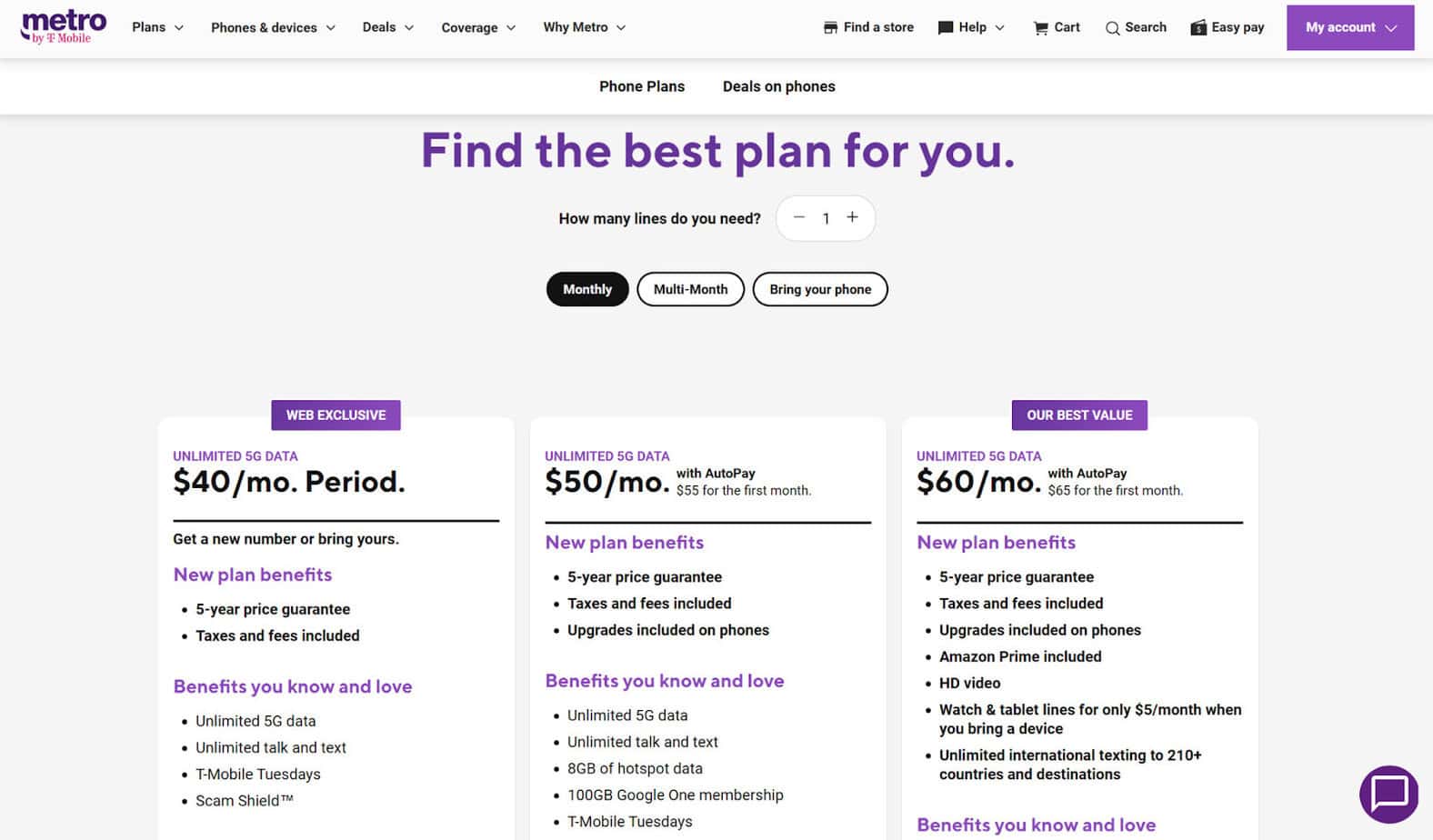
Like Total Wireless, Metro has a variety of plan options. This includes plans for cell phones, smart watches and tablets, and home internet. In this article, we’re only focusing on cell phone plans. In this area, Metro looks pretty similar to Total Wireless — they offer three plans at the monthly price points of $40, $50, and $60 per line.
Each plan comes with unlimited 5G data and unlimited talk and text, with taxes and fees included in the price. Metro doesn’t name their plans like Total Wireless does — the plans are known solely by their per-line prices. And, as with Total Wireless, the per-line charge decreases as the number of lines decreases. For instance, if you have four lines on your plan instead of one, the monthly per-line prices are reduced to $25, $30, and $35, respectively.
Let’s dive into the details of each plan to see how they stack up.
$40/month
- Data Speed: While the data of the $40/month plan is generally high-speed, your data speed may slow down if you use greater than 35 GB of data per month.
- Hotspot Data: None
- International Use: None
$50/month
- Data Speed: This plan can handle more use than the $40/month plan. Data speed should only start slowing down during heavy traffic if you use greater than 50 GB per month.
- Hotspot Data: 8 GB
- International Use: None
$60/month
- Data Speed: This plan can handle the heaviest usage out of the three plans that Metro offers. You’ll only face slower speeds if traffic is busy and you use over 70 GB per month of data.
- Hotspot Data: 25 GB
- International Use: Unlimited international texting to 210+ jurisdictions
One-Time Fees
Metro charges a one-time fee of $25 per line for device activation or change.
Verdict
If you only have one line on your plan, the monthly prices are going to be the same regardless of whether you choose Total Wireless or Metro. However, Metro has a $25/line device activation fee, while Total Wireless doesn’t. Also, the capabilities you get differ. With Total Wireless’s lowest-tier plan, you get 5 GB in mobile hotspot data, as well as texting to over 200 countries.
However, with Metro’s lowest-tier plan, you don’t have access to either of those. With Metro, mobile hotspot data isn’t included until you hit the $50/month plan, and international texting is only available with the $60/month plan. These differences make Total Wireless the better value carrier as far as pricing and features go.
Network Coverage
Total Wireless and Metro are pretty similar when it comes to their coverage areas. Total Wireless (Verizon), has 99% of Americans covered with 4G LTE. The 4G LTE coverage percentage is identical for Metro (T-Mobile).
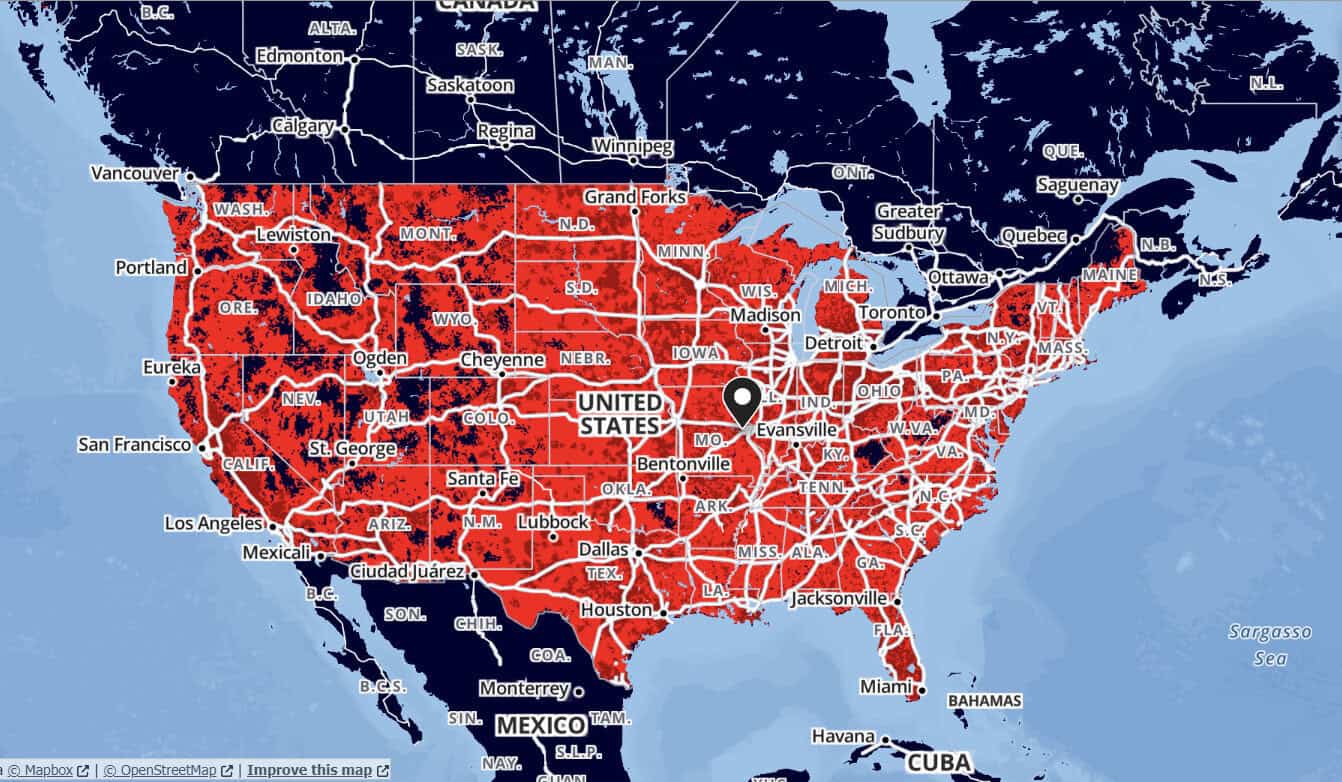
Metro’s site states that 80% of Americans have access to T-Mobile 5G. While Total Wireless doesn’t give a precise statistic, its coverage map appears to be nearly identical to Metro’s.
Total Wireless:
Metro:
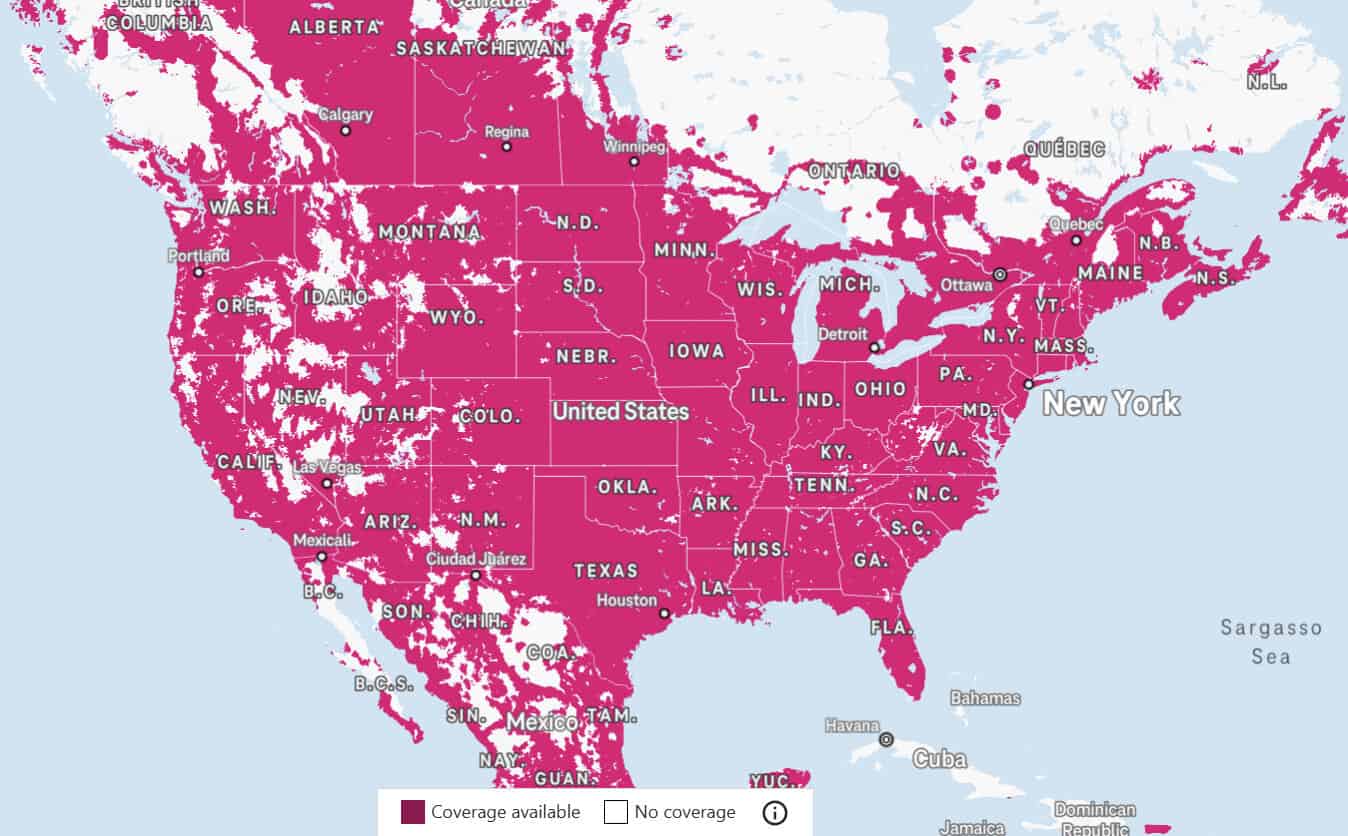
Based on the maps, coverage appears to be the spottiest in rural parts of the country, particularly in the West, but also in pockets of other states like Oklahoma and West Virginia. Both sites have a search bar where you can type in your zip code and see whether your area has 5G coverage.
Verdict
Neither Total Wireless nor Metro is the clear winner when it comes to network coverage. Both carriers cover most of the U.S. for both 5G and 4G LTE. Be sure to use each carrier’s interactive coverage map to see whether you’re covered. This is particularly important if you live in the rural U.S., where coverage could be more iffy. There are some pockets of the country where you might have access to Total Wireless’s 5G but not Metro’s, and vice versa.
Performance and Speed

While pricing is one important factor to weigh when choosing a cell phone carrier, it’s not everything. Speed is also critical, and slow data can be a real headache. Here are a few terms to keep in mind when assessing speed:
- Download Speed: This is a measure of how long it takes for data to transfer from the Internet to your device. Measured in megabits per second (Mbps).
- Upload Speed: Upload speed is the opposite of download speed. It’s the speed at which data is transferred from your device to the Internet. Measured in megabits per second (Mbps).
- Latency: This is the length of the delay between the time you interact with the Internet and the network response. Measured in milliseconds (ms).
Below is a 5G speed comparison between Total Wireless and Metro.
Total Wireless
The typical download speed, upload speed, and latency depends on which Total Wireless plan you have. Except for the Base 5G plan, the speeds shown below are for 5G Ultra Wideband, which is Verizon’s highest-performing 5G. The Base 5G plan includes 5G but not 5G Ultra Wideband.
- Total 5G Unlimited and Total 5G+ Unlimited
- Typical Download Speed: 195-634 Mbps
- Typical Upload Speed: 10-53 Mbps
- Typical Latency: 37-57 ms
- Total Base 5G Unlimited
- Typical Download Speed: 35-143 Mbps
- Typical Upload Speed: 5-31 Mbps
- Typical Latency: 42-64 ms
Metro
As with Total Wireless, the speeds vary depending on your plan. Metro’s lowest-tier plan has the slowest 5G speeds, while the other two plans have the same speeds.
- $40/Month Plan
- Typical Download Speed: 79-357 Mbps
- Typical Upload Speed: 6-30 Mbps
- Typical Latency: 17-32 Mbps
- $50/Month and $60/Month Plans
- Typical Download Speed: 127-455 Mbps
- Typical Upload Speed: 6-33 Mbps
- Typical Latency: 15-27 ms
Verdict
When looking at their top speed capabilities, Total Wireless wins out for both download speed and upload speed, although Metro’s latency is superior. Since its speed is faster for two of the three measures, Total Wireless is generally going to be the top pick here.
Customer Service

Even if the features, pricing, and speed all look good on paper, how you’re treated as a customer can be the deciding factor in whether to choose a cell phone carrier. There are several ways to get in touch with someone at both Total Wireless and Metro. Here’s a quick look.
Total Wireless
- Text helpline
- Online chat available between 8AM and 2:45 AM EST, 7 days a week
- Phone support available between 8 AM and 11:45 PM EST, 7 days a week
Metro
- Online chat
- Phone support available from 4AM to 9PM PT, 7 days a week
Verdict
Both companies have support agents available every day of the week, which is a major plus. Although the specific options and support hours differ a bit, there isn’t a clear winner in this area.
So, Who Wins: Total Wireless or Metro?
Deciding between Total Wireless and Metro can be a tough decision. Both carriers have similar pricing, network coverage, and customer service, so the winner isn’t obvious at first glance. However, when looking at the specific features, as well as speed, it becomes more clear that Total Wireless is going to be the superior option for most people.
All Total Wireless plans, even the lowest-tier plan, come with hotspot data and some international capabilities. This isn’t the case with Metro; Metro’s cheapest plan doesn’t come with any hotspot data or global options. In addition, Total Wireless’s upload and download speeds are faster than Metro’s.
For these reasons, Total Wireless takes the cake. However, there may still be instances where Metro is preferable. For example, in certain rural areas of the country, you might have access to Metro’s 5G coverage but not Total Wireless’s. In general, however, Total Wireless is decidedly the best pick.