


Last Updated on March 24, 2026 by Ewen Finser
If you’ve landed here because you’re comparing Emberos against Scrunch, then you probably already know just how much AI visibility actually matters, and your brand’s presence (or lack of) is becoming a serious business issue.
Even though both platforms show up in a lot of the same conversations, they’re not two versions of the same kind of tool.
Key Takeaways:
- Scrunch is primarily a monitoring-first platform, while Emberos is built for orchestration and governance.
- Monitoring focuses on visibility tracking and helps you to understand how your brand appears, where your competitors are showing up, and how things are changing over time.
- Orchestration includes monitoring, but turns those signals into actionable measures that can be implemented and then validated later.
The contrast between the two platforms is less about feature parity and more about fit.
Emberos And Scrunch At A Glance
Compare | Emberos | Scrunch |
Primary Focus | AI visibility, orchestration, and governance | Surface-level AI visibility monitoring |
Philosophy | Influencing AI landscapes | Observing AI landscapes |
Core Strengths | Presence tracking, strategy, execution, validation | Presence tracking |
Competitive Analysis | Yes | Yes |
Actionable Recs | Core feature | Limited |
Lift Validation | Core feature | Limited |
Prompt Intent Segmentation | Yes | Partial |
Forcasting | Core feature | No |
I’ll share everything you need to understand about Emberos and Scrunch, including how they differ, their biggest strengths and limitations, and how to decide which one will work best for your needs and priorities.
Emberos & Scrunch Are Two Very Different Tools
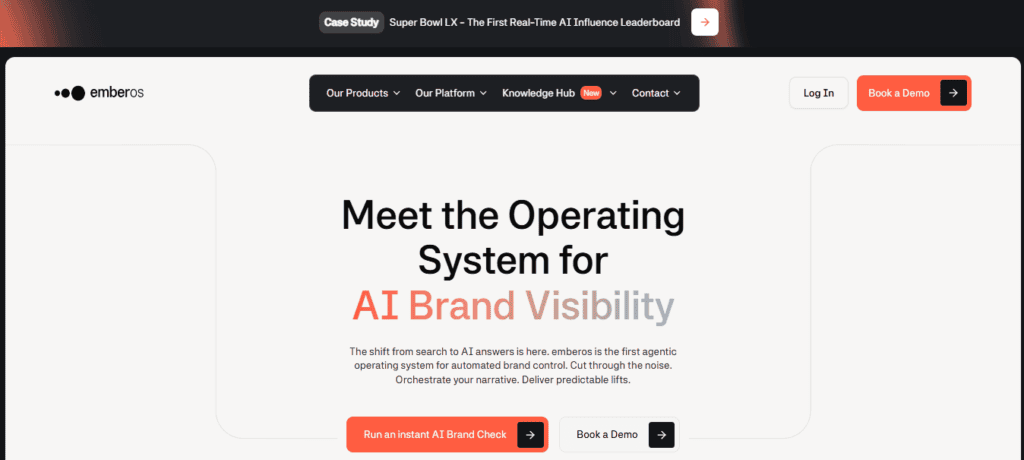
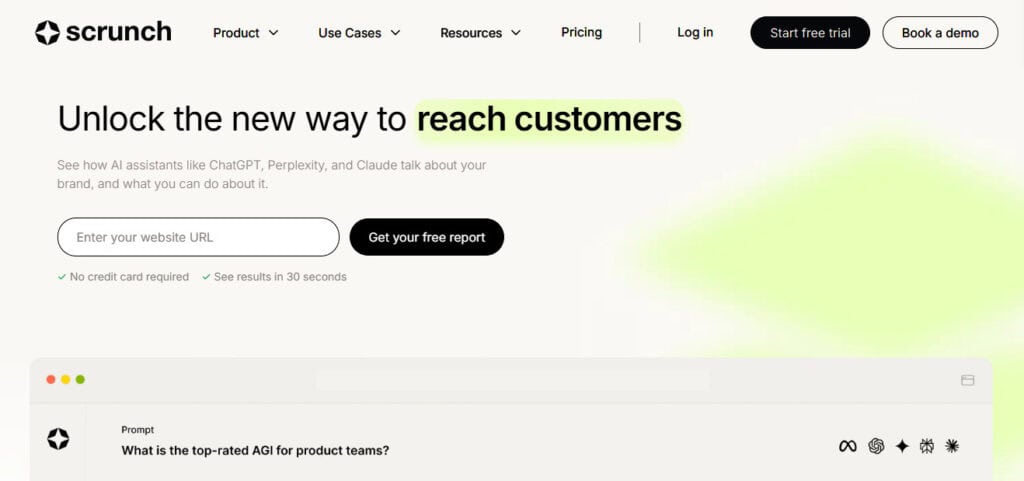
On the surface, Emberos and Scrunch can seem like they belong in the same bucket because they both talk about visibility, prompts, and competitive presence in LLMs (which makes sense; they both offer that kind of monitoring.)
But stripping them down to the nuts and bolts, they’re barely in the same league as one another.
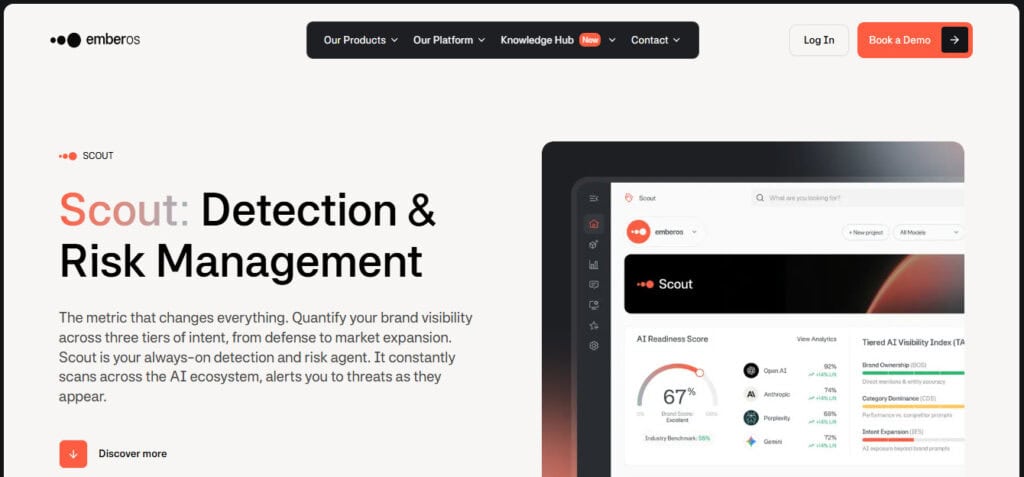
The easiest way to describe how they differ: Scrunch tells you what is happening, while Emberos helps you change what happens, predict what will happen before you even make the changes, and then prove your efforts had a hand in the change later on.
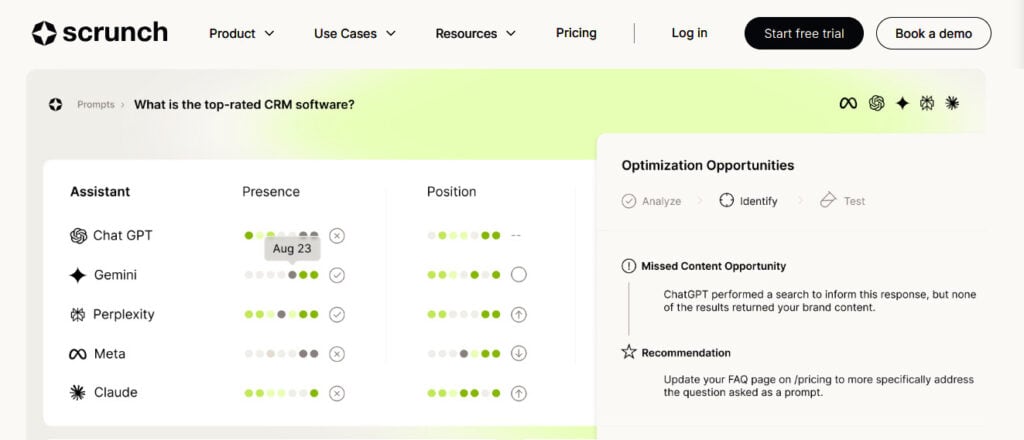
Scrunch is an intelligence layer that observes where your brand is showing up in AI answers, how (and how often) you’re being mentioned, where your competitors are popping up, and how everything is shifting over time.
That’s really important data, don’t get me wrong, but it’s pretty surface-level and it’s only the first piece of the puzzle. You need to understand what’s going on if you’re going to strategize or take active steps to improve your presence, and Scrunch gives you that information in a clean, easy-to-understand way.
But once you have that data, new questions arise: Which gaps matter most? What should we actually do about all this? If we fix XYZ, how do we know if it worked? Are we improving in ways that impact our revenue?
Those are things that Scrunch can’t answer, but Emberos can.
Emberos treats AI visibility as something you can actively manage and govern. The data and insights are far deeper because you see the signals (monitoring), but then decide what matters, take action, predict what that action will do, and then validate the result later on.
What Scrunch Does Well: Monitoring
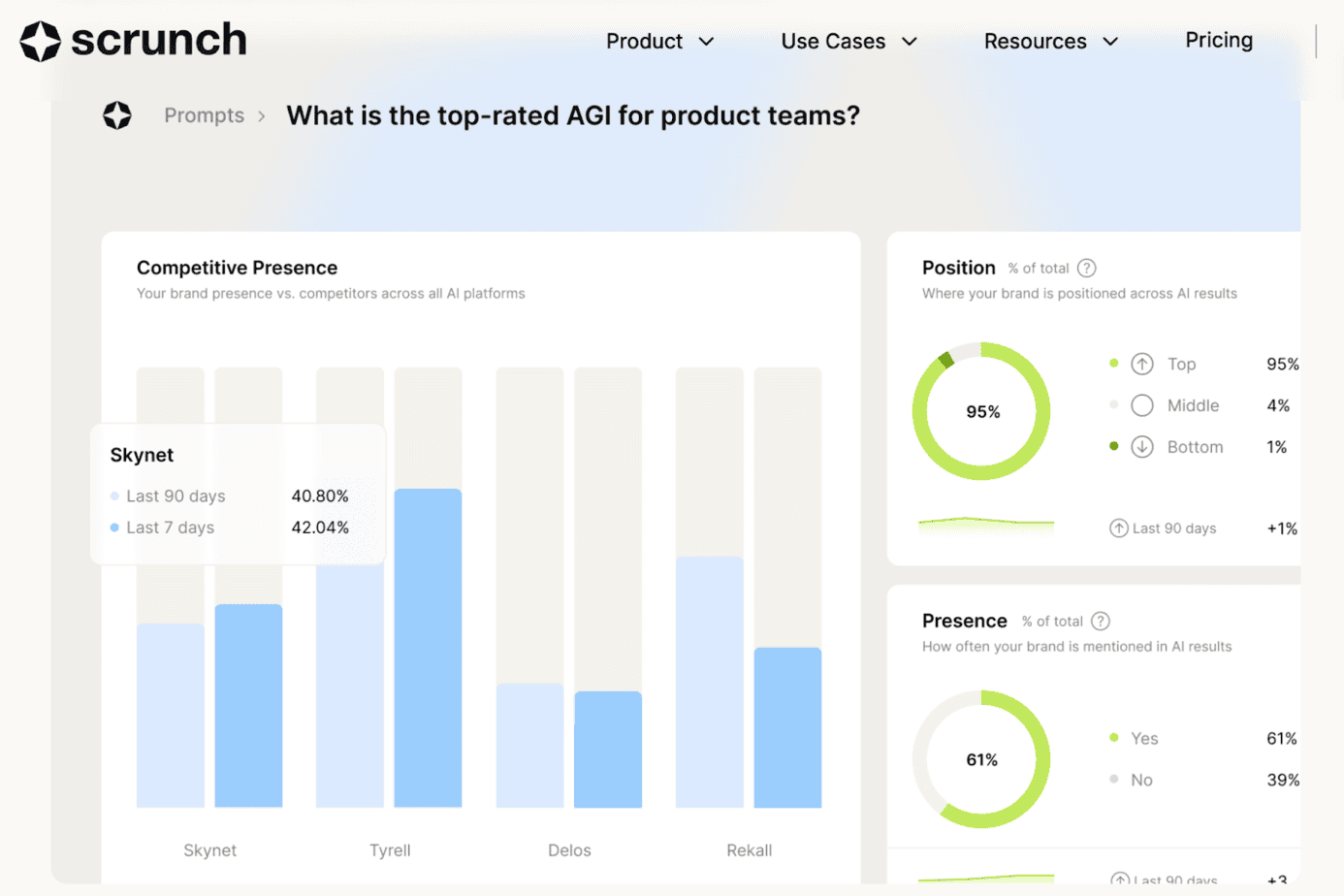
Scrunch is great for sharing what’s happening and provides prompt-level tracking for citations, mentions, sentiment, visibility trends, and competitor comparisons.
You cannot improve what you cannot see, so Scrunch makes a lot of sense if:
- You’re just getting started with AI visibility and need baseline insights into where your brand is showing up, and how.
- Your team is still deciding what AI visibility even means for your brand.
- You primarily need dashboards and reporting for positioning, brand sentiment, and competitor benchmarking.
- You have internal resources that can interpret the data and strategize based on what you’re seeing.
It’s a very strong intelligence layer, and a necessary one, but it isn’t enough to close the loop.
Limitations Of Monitoring Tools Like Scrunch
Although important, monitoring is just one layer of AI visibility optimization. Most teams using a monitoring platform like Scrunch will eventually hit the same wall because they’ve got all the dashboards and data on hand, but they can’t answer the questions leadership cares about the most. At least, not confidently.
Some things that basic AI visibility monitoring platforms can’t answer:
- Which changes are worth investing in, and what should we do next?
- Did XYZ update actually move the needle?
- Was the lift meaningful, or did we only gain low-value mentions?
When it comes to optimization, flying blind means you’re more likely to focus on the wrong things, or worse, spend valuable time and resources that could have been put to better use elsewhere.
Now if you’ve got internal resources or team members who can parse the data and strategize effectively, you might do well enough with simple monitoring for a while. But for most, it leads to a lot of internal debate, guesswork, and, for lack of a better word… hope.
(What’s that saying about “hope in one hand?”)
Monitoring tools like Scrunch will collect data and visualize it, but all of the execution lives elsewhere entirely. And while you can show movement, you can’t prove impact with it, either.
So you might be able to look at things and say “We’re doing better,” but you can’t explain why, or show the real business impact.
What Emberos Does Differently: Orchestration
Emberos goes beyond monitoring; the focus is on orchestration and governance, and it’s built for teams that:
- Are already investing in content, AI optimization, or PR.
- Want (or need) to control the narrative and/or maintain a close and continuous watch on information that’s surfacing in LLM environments.
- Want to connect AI visibility directly to business outcomes and who need to prove ROI.
- Need to prioritize optimization efforts based on expected results.
- Are held accountable for incremental (and verifiable) lift.
All of this is especially relevant for growth teams, SEO/AEO teams under revenue pressure, performance marketing teams, and agencies who are managing client outcomes.
Orchestration platforms like Emberos are designed to help teams act on visibility signals in a structured way. But it takes things a step further by validating whether the actions worked, and to what effect.
How Emberos Ties Everything Together
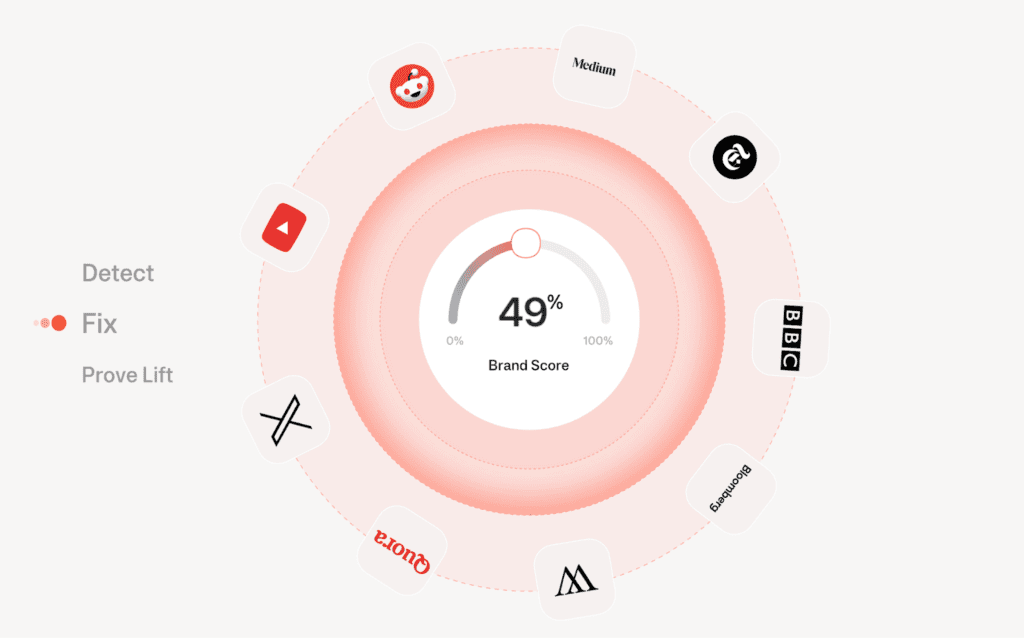
Emberos provides continuous monitoring to provide real-time insights into where a brand is being mentioned and what AI is saying about it. This includes “share of voice” (or “share of prompt”) against competitors and positioning, as well as information inaccuracies surfacing within LLMs.
These signals become action items (“Fix Packs”) when Emberos translates them into gap-filling content opportunities, source-level influence strategies, and prioritized initiatives based on expected impact. As of this writing, Emberos is the only platform that provides predictive analytics (with 70%+ accuracy) that will forecast lift and business impacts.
Workflow orchestration is the next part of the process, which automates (human-approved) tasks for seamless execution and implementation through tool integrations like HubSpot, Jira, or Slack. This is an especially important step when your brand needs to manage risk or ensure brand safety, compliance, and accurate presentation within AI environments. Any actions that need to be taken will move through the workflows for fast updates, and every change is logged.
The next step involves tying the actions to valued lift and KPIs. Monitoring tools like Scrunch can show you when something has changed, but not why, or whether the change was meaningful. As an example, a rise in low-intent mentions is not the same as gaining stronger visibility in high-intent comparison, buying, or recommendation prompts, but they can look the same through a surface-level monitoring overview.
Emberos breaks visibility into tiers and can tell you whether change happened in high-intent prompts and how they connect to business outcomes, and provides C-suite reporting to share visibility, risk management, and investment performance.
Deciding Between Emberos And Scrunch
Both platforms are good at what they do, and the decision really comes down to this:
Are you trying to understand AI visibility, or actively manage it as a growth channel?
What You Need | Emberos | Scrunch |
Understand current visibility | Strong fit | Strong fit |
Monitor citations & competitors | Strong fit | Strong fit |
Establish baseline | Strong fit | Strong fit |
Intent-level segmentation | Stronger fit | More limited |
Turn current visibility into prioritized action | Core strength | More limited |
Forecast impact | Core strength | N/A |
Support strategy decisions and resource allocation | Stronger fit | More limited |
Validate/prove if changes led to meaningful lift | Core strength | More limited |
I think it’s important to be honest about what stage you’re in right now and base the decision on that.
If you’re still in the process of casually figuring things out, I’d lean toward Scrunch because it’ll give you a lot of clarity that can help your team build internal awareness. Think of it like you’re going on a hike in an unfamiliar forest: Scrunch is the compass that helps you to get your bearings and understand exactly where you are.
On the other hand, if you already “get it” and you’re at the point where you need to know what to fix first, you’re in a position to start implementing changes that are going to improve things, or you need to connect actions to outcomes, I’d lean toward Emberos.
It’s worth noting that most teams will evolve through both. A lot of teams start with Scrunch-type tools to understand the landscape before moving toward orchestration tools like Emberos. That’s a pretty common progression that’s happening across the market right now, and I don’t think that’s going to change anytime soon.
Closing Thoughts
From a bird’s-eye view, Emberos and Scrunch can seem like they’re solving the same problem, but that changes once you look a little closer: one is designed to help you understand your visibility, the other is built to help you influence it.
But visibility alone isn’t enough. Teams need ways to prioritize, act, and validate impact, and that’s where the gap between Scrunch and Emberos widens into a canyon.