


- Why Teams Look for Profound Alternatives
- Quick Comparison: Profound Alternatives at a Glance
- Peec AI: Best for Affordable Multi-Engine Monitoring
- OtterlyAI: Best Budget Entry Point
- Gumshoe: Best for Periodic Audits Without a Subscription
- Scrunch: Best for Technical AI Crawler Accessibility
- AirOps: Best All-in-One Platform for Monitoring + Execution
- Emberos: Best for Enterprise Orchestration and Governance
- Ahrefs Brand Radar: Best for Teams Already in the Ahrefs Ecosystem
- How to Choose the Right Profound Alternative
Last Updated on July 14, 2026 by The Digital Merchant Team
Achieving and maintaining visibility across multiple LLM platforms has become a non-negotiable component of most marketing strategies. Thankfully, there are an increasing number of platforms that can accomplish just this.
Profound is one of the better tools for figuring out where you stand across AI platforms and what to do about it. It’s a very capable platform, with customers praising the depth of the provided analytics, how quickly you can see the impact of LLM optimization work, and the high quality of customer support.
It tracks visibility across up to 10 AI engines at the Enterprise tier, surfaces content optimization opportunities automatically, and bundles article generation into its Growth plan. This gives teams all of the tools they need to track and manage AI visibility, plus features to execute playbooks to increase brand mentions and citations.
For enterprise teams with the budget and internal resources to act on those analytics, Profound delivers. However, it has a few glaring shortcomings that keep it from being the end-all, be-all of LLM visibility tracking, and as a result, many companies look for more affordable alternatives, platforms with extended content creation capabilities, or more agentic solutions with an integrated execution layer.
Why Teams Look for Profound Alternatives
Teams typically start looking for alternatives when they hit one of three walls:
Budget and Engine Coverage Limitations
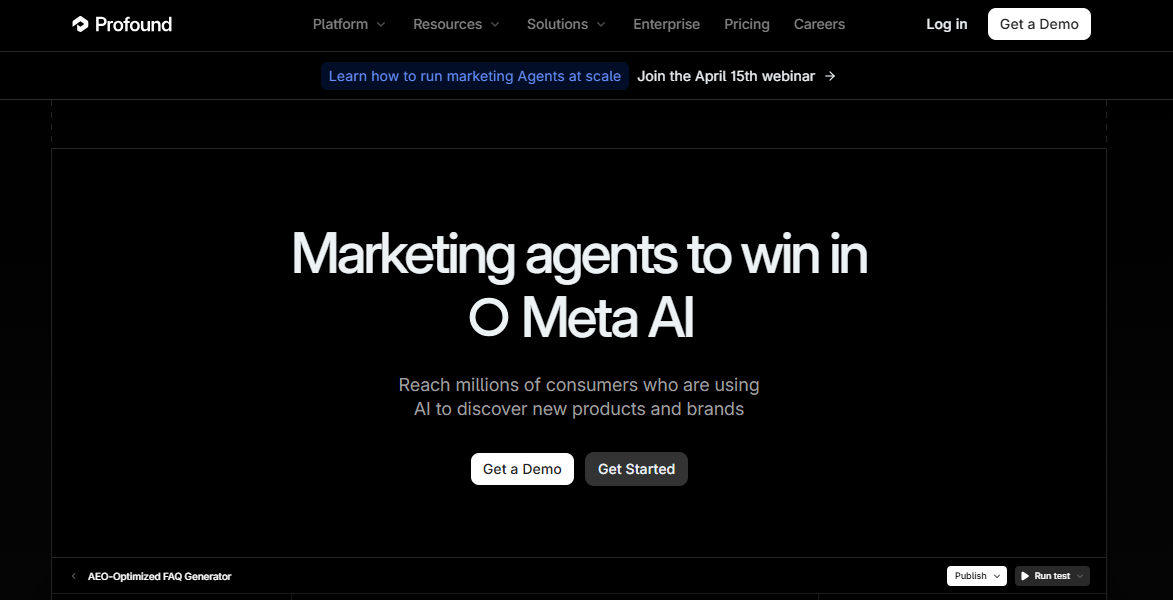
Profound’s Starter plan costs $99/month and monitors ChatGPT only. That’s one engine out of the five or more that matter in 2026, which is like running an SEO analysis that only checks a fraction of your target keywords and ignores the rest.
The Growth plan at $399/month adds Perplexity and Google AI Overviews and includes content generation, but this puts Profound at 2–4x the cost of competitors offering comparable or broader monitoring coverage.
Execution Gap
Profound shows where you stand, but it doesn’t provide workflows for content refresh, technical fixes, or scaled content production — a major limitation for teams who are looking for more of an end-to-end solution.
Instead, Profound is focused more on bundling execution as a service layer rather than providing tools within the platform to allow teams to execute content and optimization work independently.
Lack of Autonomy
Enterprise brands managing visibility across dozens of product lines need systems that act on data automatically, not just dashboards. Unfortunately, while Profound offers a strong visibility layer, it hasn’t yet moved into agentic or autonomous systems that can remediate or deploy fixes based on the analytics.
To be fair, the sector is still immature, and most platforms do not yet provide this level of functionality. However, it’s not unheard of.
Quick Comparison: Profound Alternatives at a Glance

The best way to think about this hunt for a better Profound is to look at these tools on a spectrum: those that monitor your AI visibility, those that help you optimize it, and those that orchestrate your brand presence autonomously.
With that in mind, here are some of the top tools on the market to help you achieve these goals, grouped together by these categories rather than ranked arbitrarily.
Tool | Category | Starting Price | LLMs Tracked | Best For | Key Limitation |
Monitoring | ~$105/month | 3 (+ add-ons) | Affordable multi-engine monitoring with unlimited seats | No content execution or optimization workflows | |
Monitoring | $29/month | 4 (+ add-ons) | Budget entry point for AI visibility tracking | Pure tracker with no recommendations or execution | |
Monitoring | $0.10/conversation | 7 | Periodic audits without a subscription commitment | Costs scale unpredictably at higher volumes | |
Optimization | $250/month | 4 | Technical AI crawler accessibility (AXP) | AXP in limited pilot; premium pricing for monitoring alone | |
Optimization | Custom (~$199+ est.) | 4 (Pro) | Monitoring + scaled content production in one platform | No public pricing; steep learning curve | |
Orchestration | Custom | 5+ | Enterprise brand orchestration with predictive analytics and governance | Enterprise-only; requires cross-team buy-in | |
Monitoring | $199/month (per index) | 6 | Teams already using Ahrefs who want AI visibility overlaid on SEO data | $699/month bundle + $129/month Ahrefs base |
Peec AI: Best for Affordable Multi-Engine Monitoring
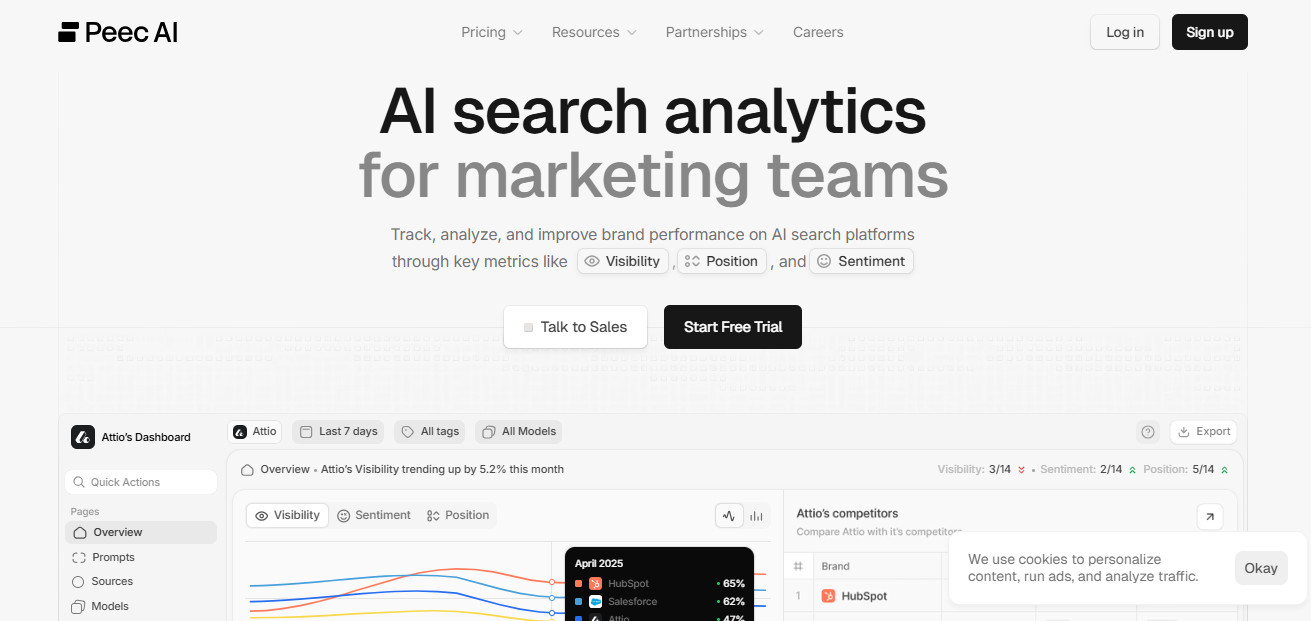
Peec AI is a strong mid-tier monitoring option for teams that want daily AI visibility tracking without paying for execution features they won’t use. It tracks brand visibility across ChatGPT, Perplexity, and Google AI Overviews on the Starter plan ($105/month), with additional engines available as add-ons.
What’s worth noting here is that every plan includes unlimited seats, which is one of the most important differentiators in this market.
Pros
- Entry-level plan with 3-model tracking
- Unlimited seats on every plan
- Daily prompt monitoring
- Visibility and sentiment scores
- Competitive benchmarking
- Citation analysis
- Direct Slack access to the founding team
Cons
- Simple dashboard reporting without additional features to explain why or execute fixes
- No automated optimization
- No technical auditing
- No public API
Best for: Mid-market teams and agencies wanting affordable daily monitoring across multiple AI engines without per-seat pricing surprises.
Not for: Teams that need content execution tools, enterprise compliance features, or a platform that goes beyond showing data.
OtterlyAI: Best Budget Entry Point
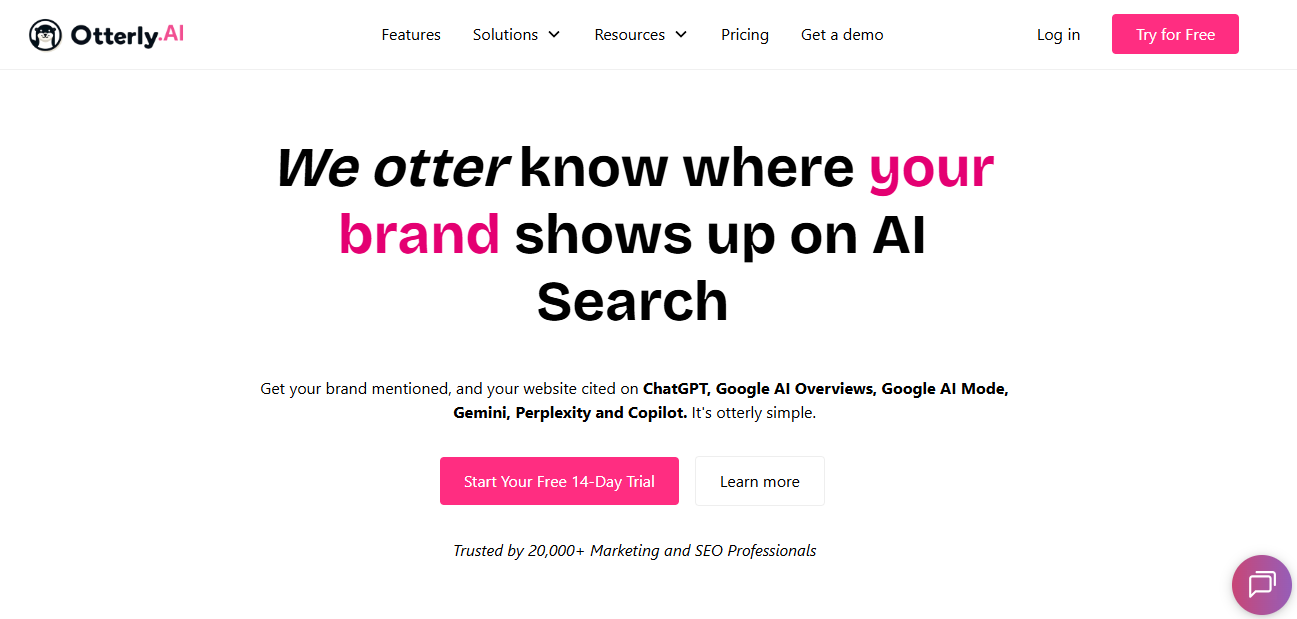
OtterlyAI costs $29/month and tracks four AI engines. If you’re not sure whether AI visibility monitoring deserves a budget line item, this is the lowest-risk way to find out.
The Lite plan includes 15 tracked prompts across ChatGPT, Google AI Overviews, Perplexity, and Copilot. That’s four engines at roughly 30% of what Profound charges for one. Other plans scale up to 100 prompts with unlimited workspaces, unlimited team members, and a Looker Studio connector for custom reporting. Add-on engines like AI Mode and Gemini are available for an extra fee.
Pros
- Strong basic visibility tracking
- Brand Visibility Index that scores overall AI presence
- GEO URL audits that check how individual pages perform in AI
- Clean UI and clear data presentation
- Great reputation for ease of use and setup
Cons
- Few other features outside of pure visibility tracking
- No content recommendations
- No optimization workflows
Best for: Budget-conscious teams, startups, and solo marketers testing whether AI visibility monitoring is worth the investment.
Not for: Teams that need actionable recommendations or any form of content execution alongside monitoring.
Gumshoe: Best for Periodic Audits Without a Subscription
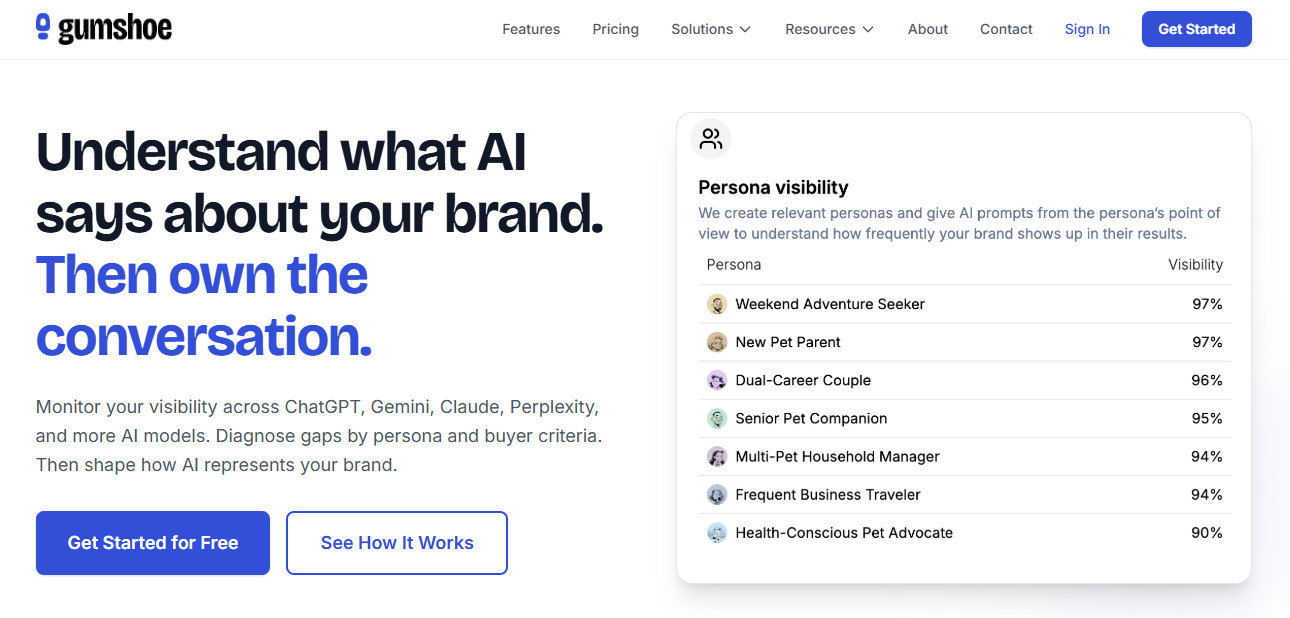
Gumshoe offers a pay-per-use model that costs $0.10 per conversation (one prompt sent to one AI model) with no subscription required. It tracks seven AI engines in its base offering: Claude, DeepSeek, AI Overviews, ChatGPT, Perplexity, Google Gemini, and Grok. That’s the widest engine coverage of any budget tool.
Gumshoe includes brand perception analysis, citation tracking, tactical recommendations, and scheduled reports. However, its API is gated behind a custom-priced Enterprise plan — a deal-breaker for agencies wanting to pull data into client dashboards.
Pros
- No subscription required
- Widest engine coverage of any budget tool
- Brand perception analysis
- Citation tracking
- Tactical recommendations
- Scheduled reports
Cons
- Per-use costs add up quickly across models, and regular visibility checks
- Not great for daily or weekly monitoring at scale
- API access is locked behind a custom-priced Enterprise plan
Best for: Periodic audits, agency prospecting, and teams exploring AI visibility with zero subscription commitment.
Not for: Daily monitoring at scale. The usage-based model loses its cost advantage above ~$150/month in spend.
Scrunch: Best for Technical AI Crawler Accessibility
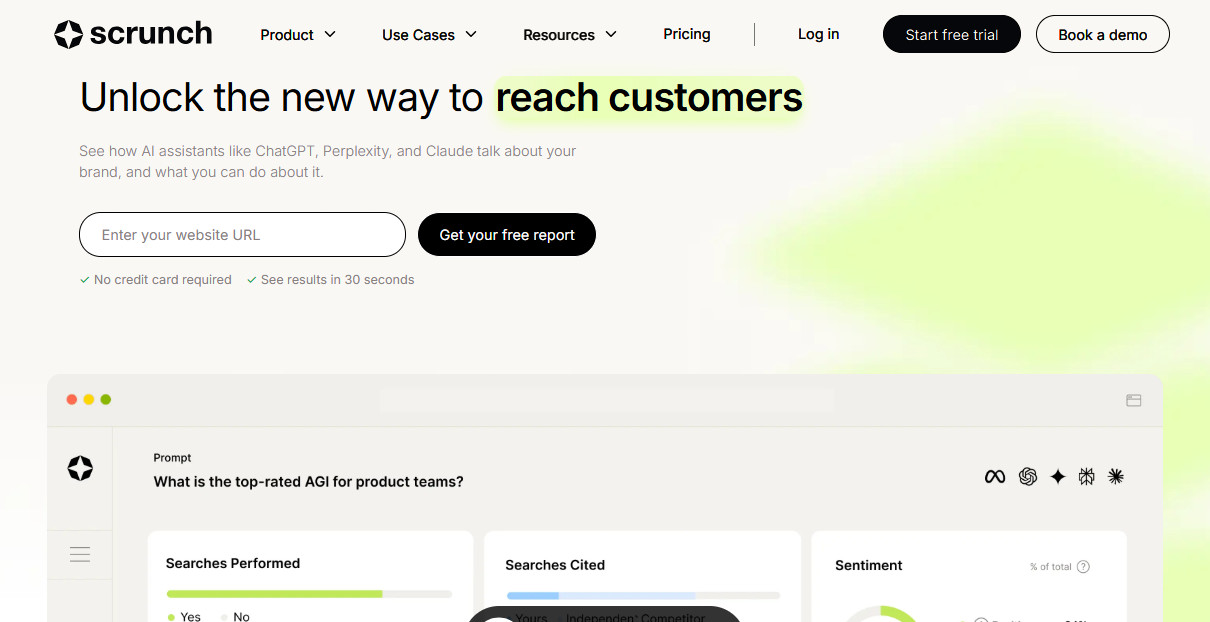
Scrunch rests firmly in the premium monitoring tier, starting at $250/month for 125 prompts across 4 AI models.
However, its Agent Experience Platform (AXP) is what sets it apart. Essentially, it detects when an AI bot visits your site and serves it an optimized, code-light version that AI crawlers can easily parse — rather than the JavaScript-heavy, interactive page that human visitors see.
If your visibility problem is fundamentally a crawling and rendering issue, Scrunch has a strong case. Just keep in mind that AXP is still in a limited pilot, and availability isn’t guaranteed for new customers.
Pros
- Citation analytics
- Sentiment analysis
- Ability to bypass AI readability issues for JavaScript-heavy sites
- Persona-based tracking (up to 5 personas on higher tiers)
Cons
- AXP is still in a limited pilot, and availability for new customers is not guaranteed
- Core plan starts at a premium monitoring price of $250/month
- Focus on technical crawlability may not be a major factor for many brands
Best for: Companies with JavaScript-heavy sites where AI crawler accessibility is a known or suspected problem.
Not for: Teams whose visibility issues are content-related rather than technical. The $250/month premium over pure monitoring tools isn’t justified without the AXP use case.
AirOps: Best All-in-One Platform for Monitoring + Execution
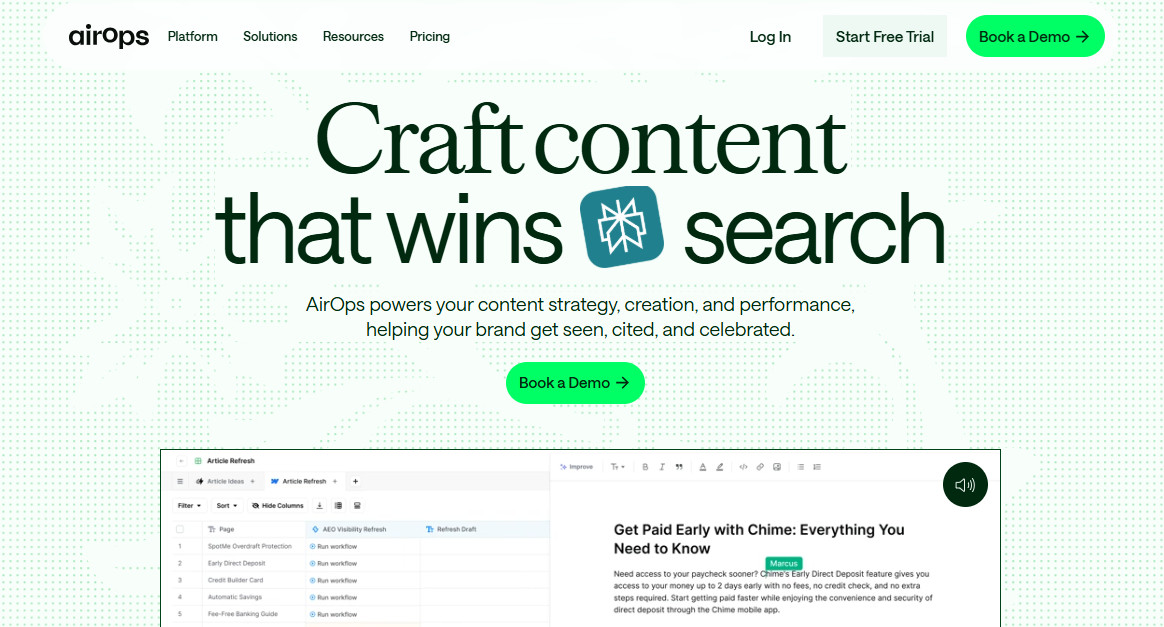
AirOps is the closest thing to a full-stack AI visibility platform in 2026.
Its Insights module tracks prompt visibility, surfaces opportunity reports, and provides page-level analytics. Its Actions module is where AirOps sets itself apart, however, with task-based content creation and refresh workflows, CMS integrations (WordPress, Webflow, Contentful), brand knowledge bases that keep AI-generated content on-brand, and bulk optimization capabilities.
I’ve seen the AirOps workflow engine turn a content team’s monthly output from 10 articles to 50+. However, this comes at the cost of vague pricing and a steep learning curve, with Power Agents and Grids (AirOps’ automation tools) requiring significant setup before producing useful output.
Pros
- Prompt visibility tracking
- Opportunity reports
- Page-level analytics
- Task-based content creation and refresh workflows
- CMS integrations (WordPress, Webflow, Contentful)
Cons
- No public pricing; requires a sales conversation (I can personally confirm the pricing I have seen is $200/month for the entry level plan and $2,000/month for Pro)
- Steep learning curve for automations and workflow features
- Power Agents and automation tools require significant setup
- Limited AI engine coverage
Best for: Mid-size to enterprise teams that want monitoring and scaled content production in a single platform and have the budget for a sales-led purchase.
Not for: Teams that want simple monitoring dashboards, budget-conscious teams that can’t commit to a sales conversation, or organizations that prioritize broad engine coverage over execution capabilities.
Emberos: Best for Enterprise Orchestration and Governance
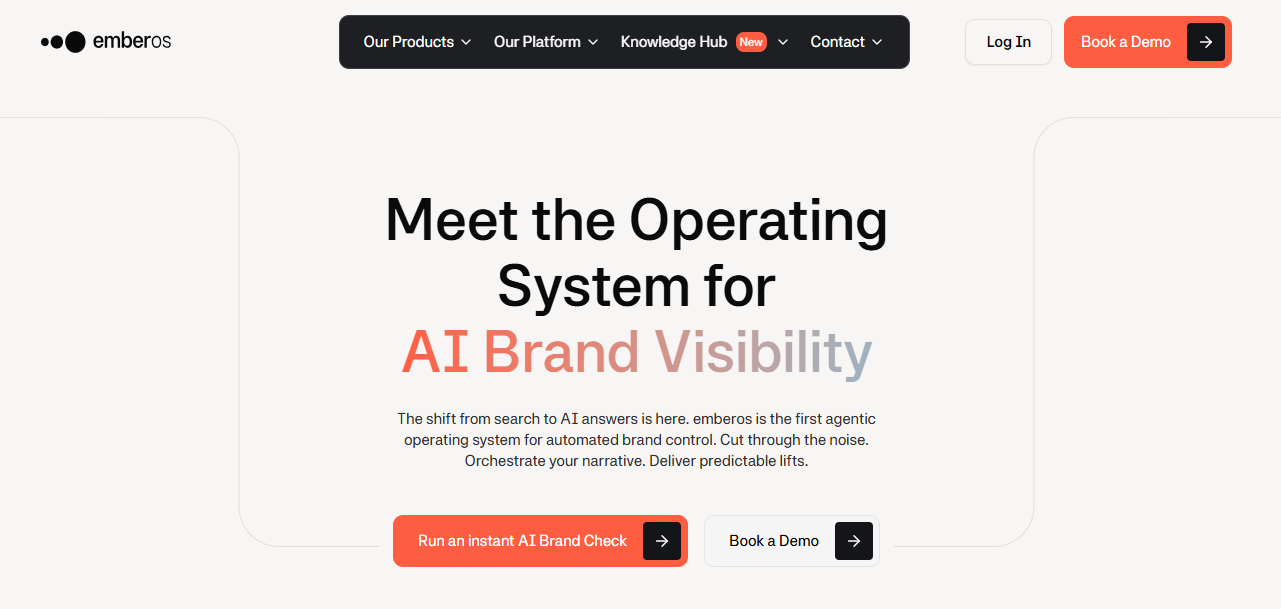
Emberos operates in a different category than every other tool on this list. Where monitoring tools show data and optimization platforms help you create content, Emberos orchestrates brand visibility autonomously across AI platforms.
Monitoring major AI platforms (including ChatGPT, Google AI Overviews, Claude, Perplexity, and Grok), Emberos describes itself as an “operating system for AI brand visibility,” using a multi-agent architecture where specialized agents handle different functions:
- Monitoring for visibility shifts and competitive overlap
- Simulating fixes and predicting ROI before execution
- Automating workflows across integrated systems
- Optimizing individual product visibility in AI shopping results
- Governing compliance and brand safety across all automated actions
Emberos also uses a proprietary metric for measuring AI brand visibility: Share-of-Prompt (SoP). This metric gives you a clear idea of your brand’s presence in AI responses versus your competitors and relative to the “total opportunity space.” Emberos calls it “the AI-era equivalent of market share, but for conversational discovery.”
Pros
- Autonomous brand visibility orchestration across AI platforms
- Monitoring of visibility shifts and competitive overlap
- Simulation of fixes and predicts ROI before execution
- Governance layer ensures actions stay within brand guidelines (GDPR, CCPA)
- Tracking of major AI platforms, including ChatGPT, Google AI Overviews, Claude, Perplexity, and Grok
Cons
- Pricing is fully custom across all tiers
- Enterprise-only focus
- Not for establishing visibility from scratch
- Not for SMBs or organizations without cross-functional alignment for deployment
Best for: Large enterprises managing brand reputation at scale across AI platforms, organizations fighting misinformation in AI responses, and teams that need predictive analytics with compliance guardrails.
Not for: SMBs, teams establishing initial AI visibility, or organizations without cross-functional alignment for enterprise platform deployment.
Ahrefs Brand Radar: Best for Teams Already in the Ahrefs Ecosystem
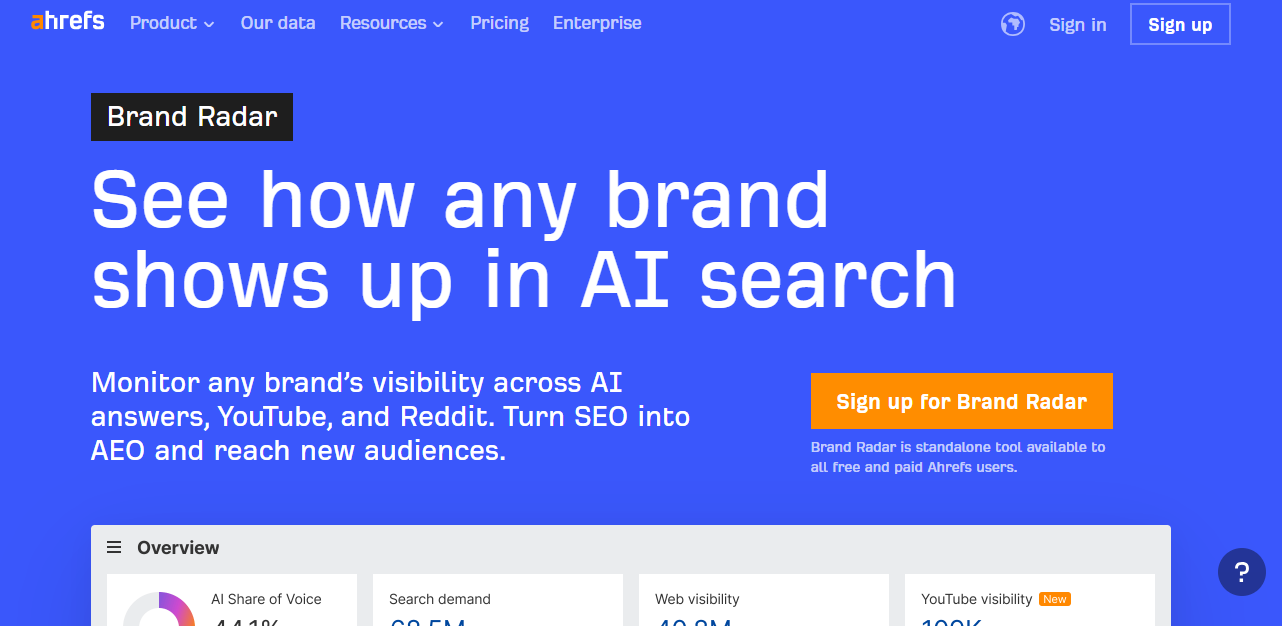
Ahrefs Brand Radar is the simplest option for teams that already pay for Ahrefs and want AI visibility data without adding another vendor to their stack.
Brand Radar tracks approximately 346 million monthly prompts across six platforms: AI Overviews, AI Mode, ChatGPT, Copilot, Gemini, and Perplexity. Unlike many AI visibility tools that generate synthetic prompts, Brand Radar uses search-backed prompts derived from actual user behavior, not hypothetical prompts the tool decided to test.
While you can purchase individual platform indices à la carte at $199/month each, the all-platform bundle costs only $699/month. However, Brand Radar requires an active Ahrefs subscription, which is $129+/month minimum.
Pros
- Simplest option for Ahrefs users who want AI visibility data
- Tracking of AI Overviews, AI Mode, ChatGPT, Copilot, Gemini, and Perplexity
- Based on search-backed prompts derived from actual user behavior
- AI visibility data overlaid against traditional SEO performance in the same interface
Cons
- High combined cost for Ahrefs subscription plus individual engine tracking
- Pulls from a database of pre-established prompts versus a custom prompt library
- No persona-based prompt generation or tracking
Best for: Ahrefs power users who want AI visibility data integrated into their existing SEO workflow without another platform.
Not for: Teams that don’t already use Ahrefs. The combined cost is the highest on this list for what’s primarily a monitoring add-on.
How to Choose the Right Profound Alternative
While it’s tempting to make a choice based on what you deem is the best dashboard, it’s better to ask yourself what you actually need to do with the data once you have it.
The answer falls into one of three categories: monitoring, optimization, and orchestration.
Category | Monitoring | Optimization | Orchestration |
What it does | Tracking of brand mentions, visibility scores, and competitive positioning across AI engines | Monitoring + content creation, technical fixes, or workflow tools to improve visibility | Autonomous detection, remediation, governance, and compliance across AI platforms |
Who it’s for | Teams establishing an AI visibility baseline or proving the business case for investment | Teams ready to act on visibility data with content or technical changes | Enterprise brands managing reputation at scale, fighting misinformation, and requiring compliance guardrails |
Price range | $29 to $235/month | $250 to $2,000+/month | Custom enterprise pricing |
Examples | Peec AI, OtterlyAI, Gumshoe | Scrunch, AirOps, Profound | Emberos |
Most teams should start with monitoring. You’ll learn more from 30 days of tracking data than from any amount of feature comparison. Once you know what problems you’re solving, you can decide whether you need optimization workflows or full orchestration.
If you’re still unsure which is the best fit, here’s a quick decision tree:
- If you’re just starting, OtterlyAI gives you four engines and clean dashboards. Gumshoe lets you run a one-time audit for $25–35 with zero subscription commitment. Either one proves (or disproves) the value of AI visibility tracking before you commit a real budget.
- If you want reliable daily monitoring: Peec AI delivers the best balance of engine coverage, unlimited seats, and responsive support at a predictable monthly cost. This is where most mid-market teams should land.
- If your site has technical crawling issues: Scrunch with AXP addresses AI crawler rendering problems at the infrastructure level. No other tool solves this specific problem.
- If you need monitoring plus content execution: AirOps combines visibility tracking with scaled content production workflows.
- If you’re an enterprise managing brand reputation at scale: Emberos provides autonomous orchestration, predictive analytics, and governance capabilities that no monitoring or optimization tool can match.
- If you’re already an Ahrefs customer: Brand Radar keeps AI visibility data inside a familiar interface. But the combined cost ($828+/month) makes it hard to justify unless Ahrefs integration is a non-negotiable requirement.
Once you understand your specific visibility gaps and build a workflow for measurement and execution, you can choose the best tool for your long-term goals.