


Last Updated on October 6, 2026 by Ewen Finser
I’ve spoken with sales leaders who are being asked to generate more pipeline without adding more people to the top of the funnel. When lead follow-up, qualification, and appointment setting start taking up more of the team’s time, the usual answer is to hire another SDR. But that brings its own costs: recruiting, ramp time, training, and the time it takes for a new hire to become productive.
AI appointment setters offer another option. They can respond to new leads within seconds, handle routine qualification, and book meetings without requiring a salesperson to manage every first conversation.
After nearly two decades of deploying voice platforms and advising sales teams on telephony, I’ve watched this technology evolve quickly. What began as a simple auto-dialer has become a range of AI agents that can hold conversations, qualify leads, and book meetings. The technology has moved beyond simply making calls; it can now take part in the first stage of the sales process, from qualifying a lead to deciding whether a salesperson should step in.
What Does a Salesperson Actually Do?

Before deciding which parts of the role can be automated, it helps to look at what a setter is responsible for. The job is to contact inbound leads or targeted accounts, start a conversation, work out whether there is a genuine opportunity, and book a meeting when there is. In many cases, the setter is the first person from the company a prospect speaks to. Their job is not to sell the whole product but instead to find out whether there is enough interest and fit to justify a conversation with an account executive.
The final step is the handoff. The setter books the meeting, updates the CRM, and records what they learned during the conversation. A useful handoff gives the account executive a reason for the meeting, the prospect’s situation, their requirements, and any concerns or constraints that came up on the call. Without that context, the AE can end up spending the first few minutes of the meeting figuring out why the prospect agreed to speak in the first place.
What About Automation?
The clearest opportunity is speed. An AI agent can respond within seconds of an inbound enquiry rather than waiting for a salesperson to become available. That matters when a prospect has just submitted a form or requested information and is still actively looking for a solution. It also changes the economics of coverage. Someone who submits a form at 9 PM on a Saturday doesn’t necessarily have to wait until Monday for a response. An AI setter can handle the initial conversation and pass qualified prospects to a human when the sales team is back online.
Then there are the routine qualification questions: when are you looking to buy, how large is the team, and which product or package are you considering? These questions have relatively clear answers, and an AI agent can ask them consistently without getting distracted or skipping questions when the team is busy.
A lead might have the right budget and a reasonable buying timeline, but that doesn’t tell you everything an AE needs to know. Does the person have decision-making authority? Who else needs to be involved? Is there an internal issue that could delay the purchase? How urgent is the problem? Voice AI can pick up signals such as pauses, changes in pace and tone, but recognizing a signal is different from understanding what it means for a particular deal.
For many teams, that points to a division of labor rather than a full replacement. AI can handle the first response and basic qualification, while a human setter or AE takes over when the conversation requires judgment, account context, or a more nuanced understanding of the opportunity.
When Is a Human Needed?
Some parts of the setter role are difficult to reduce to a script. Objection handling is one of them. A prospect might question the price, mention a competitor, raise a technical concern, or introduce an issue that the AI was not trained to address. An AI agent can handle common objections within its defined workflows, but unusual or complicated objections may still require a person.
Relationship development is another consideration. For enterprise and named accounts, the first conversation can be the beginning of a much longer sales process. The setter needs to understand the account, recognize who is involved, and know when to push the conversation forward and when to step back. An AI can manage the mechanics of that interaction, but the relationship itself may still benefit from human involvement.
Multi-stakeholder deals create a similar problem. Once procurement, legal, IT, or another department becomes involved, moving the opportunity forward requires more than identifying another stakeholder. Someone has to understand how those people influence the decision, when to involve them, and what information each one needs. AI can flag that more stakeholders are involved, but a human may still need to manage what happens next.
The Stack Consolidation Argument
An AI appointment setter is another piece of software for a team that may already have a phone system, CRM, dialer, scheduling tool, and other sales applications. Adding another platform means another integration to maintain and another place where sales activity can end up being recorded.
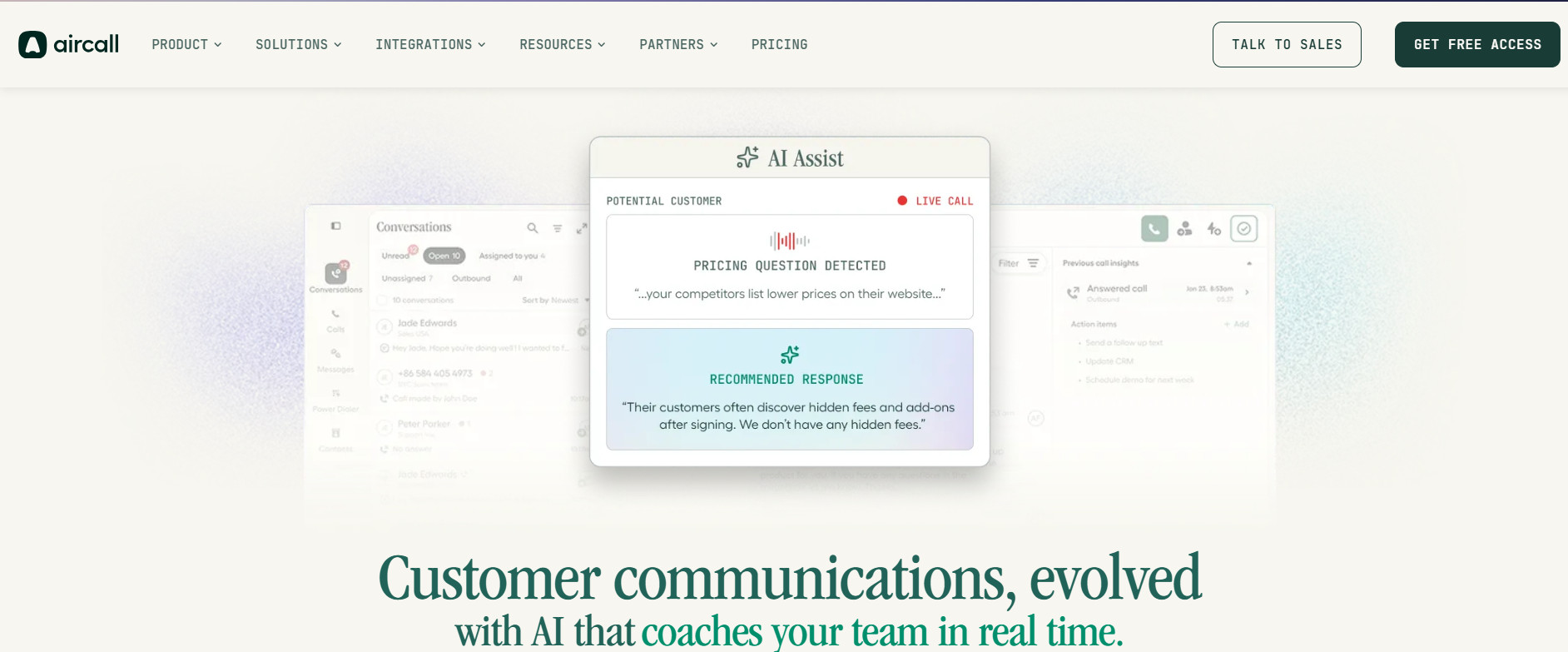
That makes the existing tech stack part of the buying decision. An AI setter that works within the same communications platform as the phone system can keep the initial conversation, qualification details, and handoff in the same workflow. A standalone tool may require more work to connect those systems and keep information synchronized.
For teams already using a platform such as Aircall for their business phone system, this changes things. Instead of automatically adding another vendor, they can look at whether the AI capabilities already available within their communications platform can handle the part of the appointment-setting process they want to automate.
That doesn’t remove the need to test the AI itself. Teams still need to look at response times, qualification quality, meeting rates, handoffs, and how well the system handles conversations outside the standard script. But the number of tools involved is worth considering alongside those performance measures.
How to Compare the Solutions
If you’re trying to decide whether to buy an AI appointment setter for your sales teams versus hiring an individual, this is the framework that I use to get teams to work through the same question.
Start with the costs. Human sales development reps are costing you in the range of $70,000-95,000 per year when factoring in salary, insurance, ramp time and turnover. In the real world, average tenure is 14 months, and ramp time is two to three months. The cost of an AI setter ranges from $200-$500 per month for a standalone tool, or it can be configured into a platform you already pay for. On cost alone, the comparison usually favors AI. But does quality matter for your application?
Next describe what you are trying to do. AI usually performs better if your first priority is volume of transactional appointment setting, where qualification criteria are simple and the deal cycle is short. If you need nuanced qualification of complex deals involving multiple stakeholders, AI is simply a first pass filter, not a replacement.
Also, consider your integration requirements. If implementing an AI setter tool results in your human reps juggling four tools rather than two, the added switching costs offset some of your productivity gains. Put simply, if the AI is built into your current phone system and CRM, processes stay simple.
Then validate and test. Set up a test with an AI setter against the same type of inbound leads for 30 days. Measure response time, qualification rate and meeting show rate. Compare against your human setters. The results will be more convincing than any vendor pitch.
Final Thoughts

AI can respond quickly, handle repetitive qualification, provide coverage outside business hours, and manage routine scheduling. Human setters and AEs can step in when a prospect raises an unusual objection, brings additional stakeholders into the process, or needs a more nuanced conversation.
For teams that already have a phone system and CRM in place, the technology stack is part of that decision too. Before adding another standalone tool, it is worth checking whether outbound AI can work within the systems the sales team already uses.
The result doesn’t have to be an AI-versus-human choice. You can let AI handle the repetitive first steps and give human sellers the conversations where judgment and context have the greatest impact.