


Last Updated on November 28, 2026 by The Digital Merchant Editorial Team
If you’ve been using Gorgias and have been hit with a higher support bill than you expected, you may be wondering if it’s the right choice. Still, pricing alone isn’t a good reason to ditch your current helpdesk platform and start over.
Gorgias has been building its ecommerce-focused platform since 2015, and it’s fair to say that it’s an established name in this space. It combines a shared inbox with Shopify order management, and a configurable AI agent that can answer questions and perform actions via connected services.
Its Shopify integration is worth special mention, as it can handle refunds, cancellations, and order edits without leaving a ticket. The AI Agent can also perform these actions autonomously, if it’s configured in the right way. That’s a useful feature, but not essential for every setup.
The alternatives to Gorgias that we’ve explored in this guide address different problems, like automating post-purchase work to replacing the human support workspace altogether.
Why consider alternatives to Gorgias
Given the platform’s reputation, it’s natural to assume that Gorgias is a catchall solution for every organization’s needs. But the reality is that there may be a mismatch between what’s driving your cost and what your team truly needs.
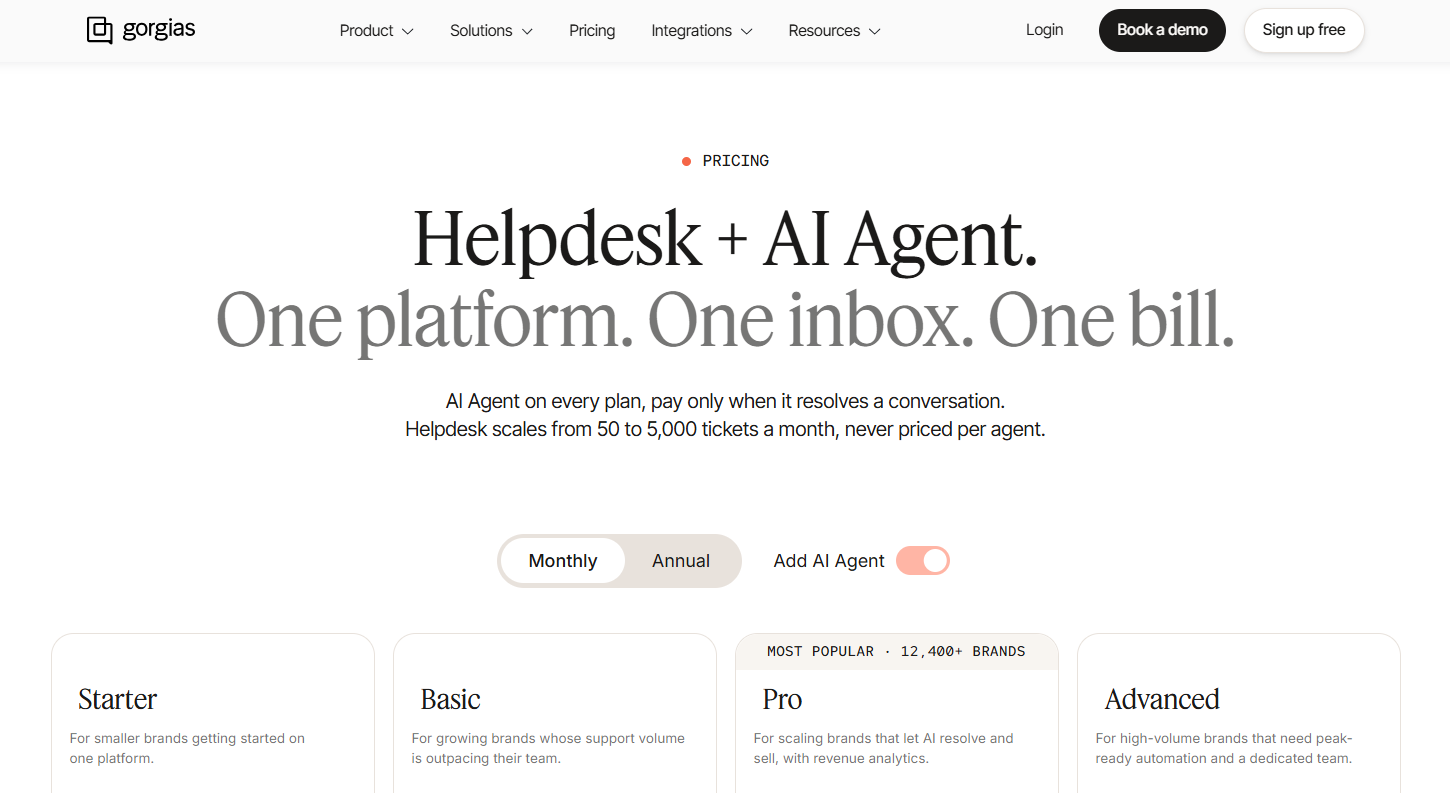
The fact that Gorgias charges according to ticket volume rather than agent count is arguably one of the most logical reasons to consider other options: Its monthly Helpdesk-plus-AI packages currently start at $40 for 50 tickets and 30 automated interactions. The ‘Pro’ package (which Gorgias claims is its most popular) costs $550 per month for 2,000 tickets and 190 automated interactions.
Of course, this pricing model could be ideal for a large team sharing a modest queue. But if you’re managing a small team that has to handle thousands of conversations, then you should also compare seat-based alternatives. Just be mindful that these platforms may charge separately for AI.
Operational scope is another good reason to consider moving away from Gorgias. For instance, Zendesk offers more sophisticated cross-channel routing, as well as skills-based assignment, and workflow configuration. Help Scout takes a more streamlined approach, centering its support experience around shared inboxes, customer management, and knowledge resources.
Naturally, if your team is strongly Shopify-focused, these broader operational capabilities may not be as much of an advantage.
The other main reason to switch could be because you want different AI without replacing the inbox. For example, Chatbase can integrate directly with Gorgias, which means you can introduce a separate AI agent while keeping your existing helpdesk and support workflows.
Seel has a similar approach through its Support Agency service. This can connect to existing helpdesks, although its current product page specifically lists Zendesk rather than Gorgias.
Bottom Line Up Front
Seel’s Support Agent is my recommended starting point for ecommerce teams that prioritize completing post-purchase work and outcome-based billing. Its published pay-as-you-go rate is $0.99 per resolved ticket, rather than charging for each seat or individual message.
Seel’s ‘Support Agency’ also has strong operational capabilities. These include processing exchanges, updating shipping information, and working within a connected helpdesk.
Before choosing this option, confirm that it works with your existing helpdesk. Seel’s current product information specifically lists Zendesk, but doesn’t mention Gorgias, so Gorgias users should check directly with Seel before assuming the two are compatible.
If this is vital for your operation, Chatbase does AI deployment alongside Gorgias. You should also consider Help Scout for a shared-inbox replacement, Zendesk for broader service operations, or Richpanel for ecommerce self-service. We will explore these other platforms, along with their merits and drawbacks in more detail in this guide.
For now, Seel earns the lead for its managed-service approach and resolution-based pricing, not because its AI necessarily outperforms every competitor in every scenario.
Seel Support Agency

- Pay-as-you-go support costs $0.99 per resolved ticket
- Documented actions include exchanges, shipping updates, and other post-purchase tasks
- Training mode and an AI Manager can support supervised rollout and ongoing improvement
- Full Gorgias compatibility requires confirmation with the platform
The best way to describe Seel’s approach to support is that it’s as work to be performed, not yet another interface to be managed. Its Support Agency uses merchant playbooks and policies. AI reps can operate alongside the existing support operation.
Its dedicated product page also lists other capabilities, including:
- Email ticket resolution
- Storefront live chat
- Multilingual replies
- Reporting on resolution rates
- Customer satisfaction (CSAT)
- Response times
This means that it’s worth considering seriously if your team’s time is being taken up with repetitive order questions and post-purchase that they could otherwise spend on exceptions.
Entry level pricing is fairly straightforward. The ‘Free’ plan has no monthly platform fee and bills support usage at $0.99 per resolved ticket. ‘Growth’ costs $99 per store monthly and includes up to 100 resolved tickets alongside capped usage across other Seel agencies. Any additional support usage follows the Free plan’s previously-mentioned rate.
If you only want support, 100 pay-as-you-go resolutions also cost $99. So, in this case, Growth’s extra appeal comes from its other included services, not a lower support-only unit price.
Seel’s Support Agency is a good option if you’re open to a supported helpdesk configuration. But not a verified drop-in replacement for Gorgias’ AI itself. Make sure to confirm the connection, escalation rules, and billable-resolution definition before committing to a contract.
Chatbase
- Lists integrations with both Gorgias and Shopify
- Has a human helpdesk inbox, routing, internal notes, and ticketing
- Actions and Procedures support connected, multistep workflows
- Message-credit billing is not tied directly to successful resolutions
- Basic plan limits configuration to eight Actions and four Procedures per agent
- Advanced analytics requires a Business or Enterprise plan
The main reason we’ve included Chatbase in this shortlist is that it’s a good illustration of how replacing your AI doesn’t have to mean replacing the entire human workspace. Its integration list includes Gorgias while the Chatbase helpdesk offers another adoption path for teams looking for a more drastic change.
You can connect approved systems and define procedures while retaining human escalation. The trade-off is forecasting: 4,000 credits should not be read as 4,000 resolved tickets.
Chatbase is likely to be your best choice if keeping Gorgias is nonnegotiable. But you should compare its incremental cost with the Gorgias AI component that you plan to replace, not a full Gorgias subscription. In other words, keeping the inbox means keeping its underlying costs.
Help Scout
- Can combine shared inboxes, knowledge bases, and live chat
- Paid plans can offer unlimited contacts under user-based pricing
- Envoy supports monthly spending caps for AI resolutions
- Subscription costs increase with the number of paid user accounts
- Envoy adds $0.75 per resolution to the subscription
- Round Robin routing needs a Plus or Pro plan
If the human support workflow is the main problem, then Help Scout can be a sensible option.
Its shared inbox, saved replies, customer history, and knowledge resources offer a refreshing working environment when compared to, say, a heavily order-centered helpdesk.
Its current AI offering, Envoy, costs $0.75 per resolution. But Help Scout says that a conversation doesn’t qualify if the customer requests further help or escalation. It also charges only once per resolved conversation. Spending caps automatically disable the AI when the preconfigured monthly limit is reached.
This lower AI unit rate is competitive, but it doesn’t necessarily mean that the total cost is lower than rivals like Chatbase and Seel. Human seats, required functionality, and the work each system can complete are still critical factors here.
Still, Help Scout would be my pick for teams that want inbox collaboration first and foremost.
Zendesk
- Suite combines ticketing, messaging, live chat, help centers, and voice
- Higher tiers add skills-based routing and more advanced operational tools
- Marketplace integrations and APIs support connected workflows
- Subscription costs can go up with agent seats
- Additional AI resolutions are billed separately
- Copilot, workforce tools, and contact-center capabilities can add extra costs
When considering Gorgias alternatives, Zendesk can make sense where support needs to go beyond simple retail order questions. Its routing, workflow tools, APIs, and reporting can certainly support a much broader service operation than a single ecommerce use case.
AI Agents are available across Zendesk’s Support and Suite plans. The pricing table lists five included automated resolutions per agent monthly on Support Team and Suite Team, and ten on Suite Professional. But additional resolutions cost $1.50 with a commitment or $2 pay as you go.
Prices start at $19, but you can’t simply match this against Gorgias or other platforms on its own, as channels, agents, AI volume, and add-ons can raise costs.
Overall, Zendesk is the strongest fit for teams that need broader operational control.
Richpanel

- Has a self-service portal for supported order tasks
- Offers migration assistance and multibrand support
- Supports order and subscription updates with human handoff
- Helpdesk seats cost $99 monthly on an annual commitment
- AI is priced at $200 monthly minimum
- Advertised $0.20 conversation cost is an estimate, not a fixed resolution fee
Richpanel can work as a replacement for Gorgias if you want customers to handle more routine order work themselves.
Its portal supports tracking, address updates, order changes, and eligible returns, exchanges, and cancellations. Human agents can also work from a shared workspace that includes customer and order history.
Still, you should consider Richpanel’s pricing carefully. Annual commitments cost $99 per helpdesk seat monthly, while monthly commitments cost $119. AI uses tokens, billed through credits, with an estimated cost of about $0.20 per handled conversation. But the actual usage varies with model and token consumption.
It costs $299 per month (paid annually) for one seat plus the AI minimum. I couldn’t establish whether it currently offers its helpdesk as a standalone subscription without that additional metered AI commitment, so interested readers should check with the vendor.
That means Richpanel is most likely to be the best solution in situations where self-service and order workflows can justify that combined commitment. If you’re running a low-volume store, I’d advise modelling that minimum before assuming that it offers savings.
What to test before choosing a Gorgias alternative
Start with a representative sample of historical tickets for each of the candidates on your shortlist. Use the same sample across each platform to make any comparisons meaningful.
These should include routine tracking questions, address changes, return exceptions, as well as some cases that require a human to step in.
Next, ask each vendor to demonstrate:
- Completed work: Did the system change the order correctly or just tell you how to do it yourself?
- Safe escalation: Can a human easily take over the conversation while viewing attempted actions, and any relevant context?
- Migration coverage: Which tickets, attachments, tags, macros, and custom fields can be transferred from Gorgias?
- Integration depth: Can the system perform your required Shopify, shipping, returns, and subscription actions (if applicable)?
- Peak-month cost: What happens when usage exceeds allowances. How do reopened conversations, partial completions, and escalations affect billing?
Once you’ve worked through this list, make sure to price the entire configuration. For example, an AI layer, like Chatbase’s, that works alongside Gorgias won’t automatically remove your Gorgias subscription costs.
Moving to any new system also means migration and training costs. Only you can decide if the pilot has demonstrated enough operational value for your organizations to justify these obstacles.
What is the best Gorgias alternative?
My overall recommendation for outcome-based ecommerce support is Seel’s Support Agent, with the caveat that it supported deployment must fit your operation. In particular, its $0.99 resolved-ticket model and documented post-purchase actions can give buyers a concrete starting point.
The other choices we’ve explored in this guide solve concrete problems: Chatbase is a strong option for keeping Gorgias while changing AI. Help Scout is great for inbox collaboration, while ZenDesk is ideal for broader service operations. Richpanel is a strong contender for ecommerce self-service.
Whatever platform you select, make sure that it completes the work you need for an acceptable total cost. Don’t be taken in by the one with the cheapest-looking advertised billing unit.