


Last Updated on November 22, 2026 by The Digital Merchant Team
For many companies who use HubSpot, they don’t need an outside AI agent when there are natively provided features. The fundamental distinction between HubSpot’s native features and an outside AI agent is in the automation’s location. The native features accounted for in HubSpot act as an in-app connection to your CRM. It can go beyond simple CRM with reporting and analytics to meet your specific needs and reporting requirements.
One thing HubSpot has issues with is automation of inflection points. An inflection point is the seconds during an inbound or outbound call where a contact is speaking, and the context needs to be confirmed in real time. A call can be terminated at any time by accident or intentionally, and HubSpot has trouble reconciling the need to document the need to engage the contact again, either immediately or at a later date.
An AI agent compatible with HubSpot automates these inflection points. This means adding an external system that integrates bi-directionally with HubSpot’s contact, company and deal APIs. It can read and write to these records as needed. Rather than requiring reps to stop mid-sentence to look up data, an integrated agent can confirm customer details, order information, or whatever your company needs to properly speak to clients.
This differentiation between recording data asynchronously and collecting data in real time during calls determines the impact the agent has on sales and support teams. The agent does not need to manage the entire sales funnel. Its job is to manage low-level tasks efficiently and hand off edge cases to the sales rep.
Why the question is bigger than “AI for HubSpot”

Industry discussions concentrate on the built-in CRM functionalities and stop there, which is understandable. HubSpot is the commercial centerpiece of hundreds of thousands of growing businesses. Understandably, buyers want to understand whether default tools are adequate. HubSpot offers practical features for generative drafting, pipeline forecasting, and workflow automation, evidenced through HubSpot AI and HubSpot Sales Hub.
An administrative CRM assistant and live call automation perform distinct functions.
CRM tools are well suited to handle asynchronous workflows that occur in a separate browser tab (i.e. drafting a follow-up email, completing a form, taking meeting notes, etc.). However, live calls, especially inbound calls, have a different dynamic. Callers can dial in from unlisted numbers and ask random, out of sequence, and technical questions. A rep can’t wait for an AI assistant to summarize a record and draft an email.
An external AI agent can connect to the voice stream and work in the background to provide the necessary intelligence before the next dial. For example, when a prospect calls, the external AI agent queries HubSpot Contact API using the caller ID and provides a context for the deal before the next dial. This provides a much tighter integration compared to traditional CRM.
Teams can use this set-up to optimise their use of a small number of agents. Agents are often used to ease friction by resolving qualifications or by verifying the size of a company. However, the benefits these systems can provide are only truly understood when the term “HubSpot compatibility” is considered outside of API token authorizations.
Immediate and adverse effects on sales operations occur when HubSpot and AI Agent integration is weak or poorly configured: duplicate contact records, overwritten deal stages, and loss of confidence by the sales team in the reporting system. The goal is to improve the time it takes to move pipeline velocity after a prospect has expressed interest, and not mimic a generative chatbot.
Why do some native HubSpot tools not suffice?

Where HubSpot is good is for the initial customer interaction. HubSpot is great for when a prospective client fills out a form on your website, passes through automation, and schedules something. When it gets to a high-speed sales team, native HubSpot tools can be a hindrance.
Imagine a high-value prospect calling you unexpectedly from a number that is not associated with their record. Or an inbound lead who wants to schedule a TQM and is available to talk, but their account executive is tied up in a meeting. In these types of situations, you need something more than basic CRM data to extract and operate on the data to call the prospect. The automation and integration between the audio stream and HubSpot should be nearly instant, or else the opportunity may be lost.
This challenge is compounded by a high volume of calls. Consider a sales rep handling 30-40 calls a day. Reps cannot memorize all the information about each prospective account and what they should be asking to determine the next best course of action. An agent integrated with HubSpot can help with this by pulling account data and suggesting the best course of action based on a prospect’s objection.
Also important is the velocity at which actions are taken. Research shows that the likelihood of being qualified by a lead declines drastically within the first few minutes of the first point of contact.
- The AI agent reviews the signaling information and asks the HubSpot Contact API.
- If a matching contact is found, the agent gets deal stages, recent notes, and ownership of the contact.
- If the caller is of an unmapped number, the agent collects ID data points via natural language conversation and checks the company’s web domains for a presence.
- The agent asks two qualifying questions and evaluates the response against strict qualification rules to determine if it is a “sales ready” lead.
- If the response is affirmative, the agent schedules a meeting on the sales representative’s calendar and books it on their behalf.
- The agent does a summary of the call and sets up a deal task in the CRM. Also modifies the lifecycle stage for the contact.
If the prospect doesn’t meet the basic qualification criteria, the agent asks more complex enterprise security and legal questions, or the prospect seems to be interested in buying multiple SaaS products (and, therefore, might not be sales ready), the agent immediately hands off the call to a live salesperson.
Reliable performance of the agent depends on its strict adherence to the integration and not the creativity of the LLM. The agent has to decide based on confidence, understand which custom CRM fields have more weight and work in declared permission boundaries. When confident, the AI will implement automation, and when not, it will seek human assistance.
Aircall and the mid-call meeting workflow
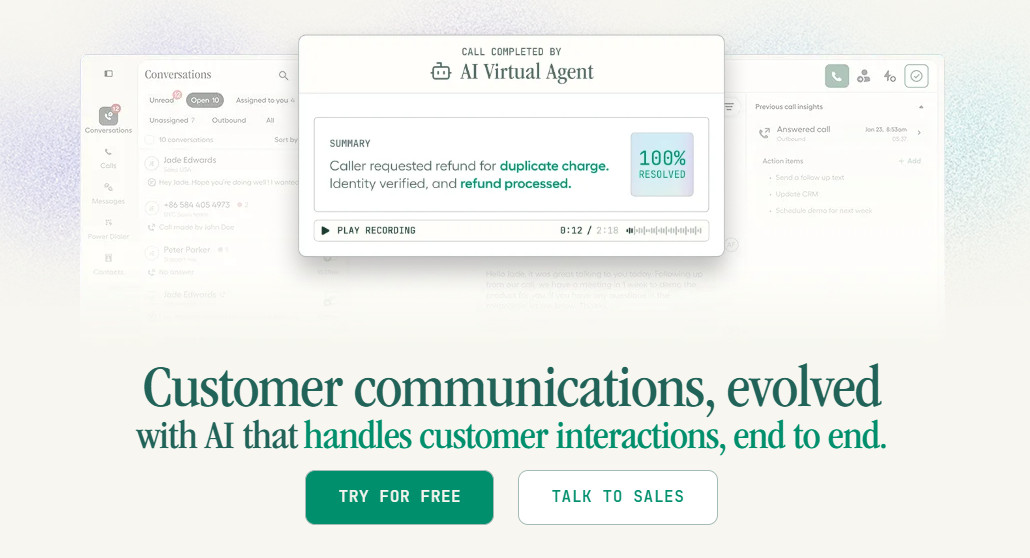
Cloud communication platforms include this workflow in their live production environments. For example, Aircall, a telephony cloud communication platform, integrates workflow capabilities with CRM platforms to build a suite of products targeted at sales teams.
In one use case, a sales agent integrated with Aircall intercepts incoming calls and queries HubSpot for company records to provide context to reps during mid-call meetings. In the presence of high buying intent, the agent flags and confirms participant availability to choose and schedule a qualified meeting in HubSpot on behalf of the rep, which eliminates administrative latency.
Reps can also avoid asking the same qualifying questions multiple times, improve pipeline management, maintain the highest level of engagement with the prospect and be assured the prospect is committed.
A telephony system designed for the workflow integrates with CRM and launches automation workflows to solve the main problem that mid-market sales teams have qualifying and securing meetings on live prospect calls.
While evaluating external AI agents, prioritize five operations criteria:
- Bi-directional read/write access: Many AI agent integrations are read-only, meaning they are merely lookup tools. HubSpot’s AI agents should be able to create records, book meetings, change data properties, and perform other similar functions.
- Deduplication/conflict resolution: An AI agent may create a new contact record for a lead if the agent doesn’t have sufficient information to match to an existing contact record. It may also create multiple contact records for the same lead due to differences in company domains. An AI agent should either disable contact creation if there’s a chance of creating duplicate contact records, or put in place rules to determine contact creation.
- Clear governance: Automated decisions should be based on rules set by the user and should include an option for a human to review the case if the automated system is not sure about the outcome.
- Real-time audio processing: AI agents should process audio streams in real time, and interact with HubSpot and your business phone solution in real time, for continuous meeting scheduling, real time interaction with HubSpot, and dynamic call routing.
- Management controls: Agents should allow the user to define when to activate the agent.
Alignment with existing pipeline architecture
Agents that operate seamlessly within your existing processes are preferable. The agent should integrate easily with your existing definition of sales lifecycles, your deal pipelines, and your properties and workflows, without requiring major architecture changes to your CRM.
The operational risk: treating AI as a complete replacement
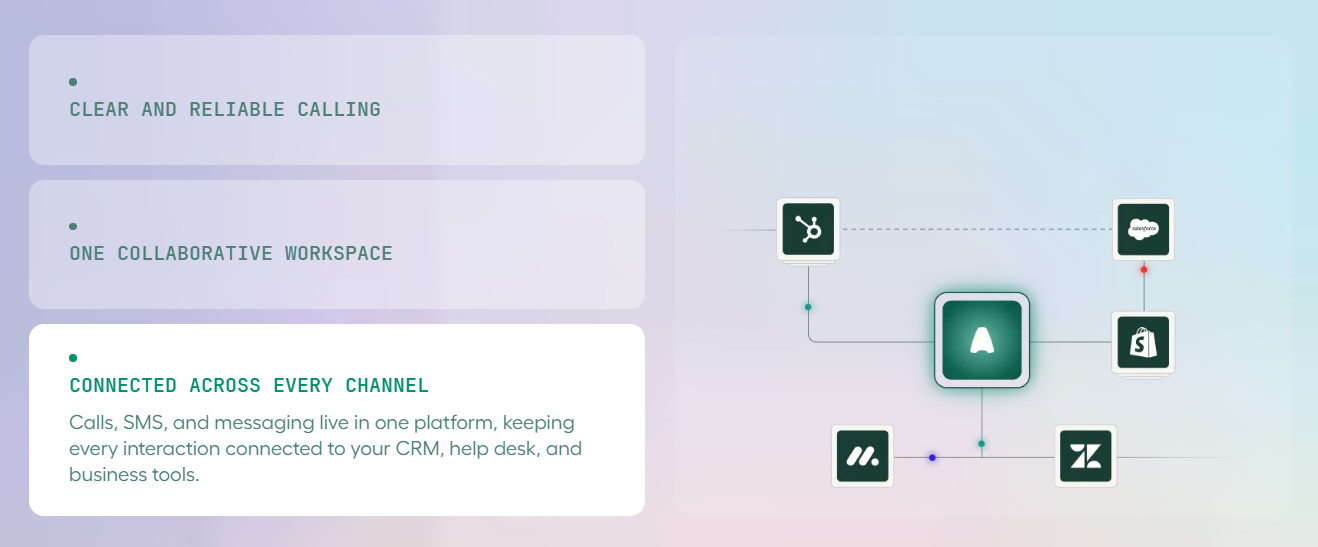
The biggest blunder made by most leadership teams is deploying an AI agent as a complete sales staff replacement.
The main value added by a HubSpot compatible AI agent is helping sales reps eliminate administrative tasks and friction associated with the sale. It can automatically log information, and even book the next meeting, all while the rep is having a live conversation with a lead. It can also help reps stay on top of their pipelines and ensure they’re properly maintained. The AI agent can alleviate the burden on the sales representative and allow them to concentrate on engaging with leads and customers while minimizing repetitive tasks.
Summary: HubSpot + AI Agent = Velocity

As the Single Source of Truth for all things pipeline, deal, revenue, and customer data, HubSpot is extremely valuable. But for the CRM to be effective, it relies on external communication channels for timely and accurate data entry.
Using AI to augment the CRM alters this relationship. The agent books meetings and logs deals in the CRM before calls end.
Revenue leaders must be attuned to the tools in their tech stack. Choose automation that eliminates admin work and increases the velocity of your sales. While it may seem like an AI agent is replacing your sales team, it’s important to implement it with focused boundaries. After all, the agent gives your team operational leverage to scale.