


Last Updated on October 27, 2026 by The Digital Merchant Team
If you’ve been researching business phone systems, you’ll want one that saves your team time, not one that creates more inboxes to juggle. Aircall and JustCall combine calling, messaging, integrations, and AI tools, making them both plausible options for a growing sales or support team.
While you can already find guides online exploring both platforms in detail, some of these oversimplify their features by saying that Aircall is a strong option for inbound calling and CRM integration, while JustCall is better for outbound and AI. The reality is more nuanced: Aircall does support outbound campaigns and even autonomous AI calling. JustCall also offers inbound routing and CRM automation.
That’s why if Aircall and JustCall have made your organization’s shortlist, you need to look beyond product summaries and focus on key factors, like calling patterns, existing software, budget, and your preferred workflows. In particular, you also need to consider how much work is left for reps after a customer hangs up.
What is Aircall?
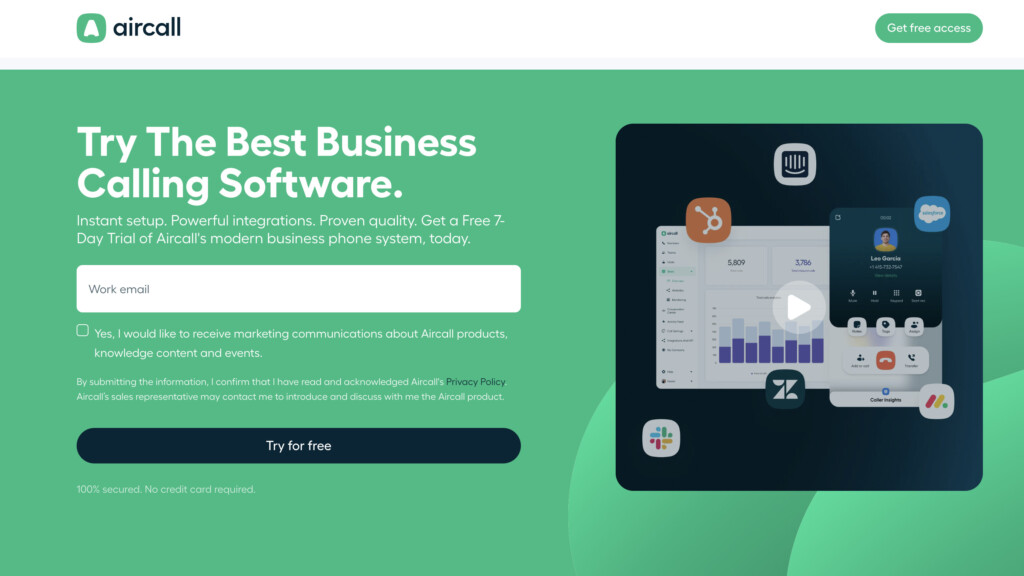
Aircall describes itself as an AI-powered customer communications platform built for sales and support teams. The company was founded in 2014, and has offices in locations that include Paris, New York, and San Francisco. Its main features include calling, intelligent virtual agents, automated workflows, and coaching. It also supports integrations for over 250 business applications.
Aircall’s main focus is on sales and support teams that need to have customer conversations connected to their CRM or help desk, not just a standalone telephone service.
What is JustCall?
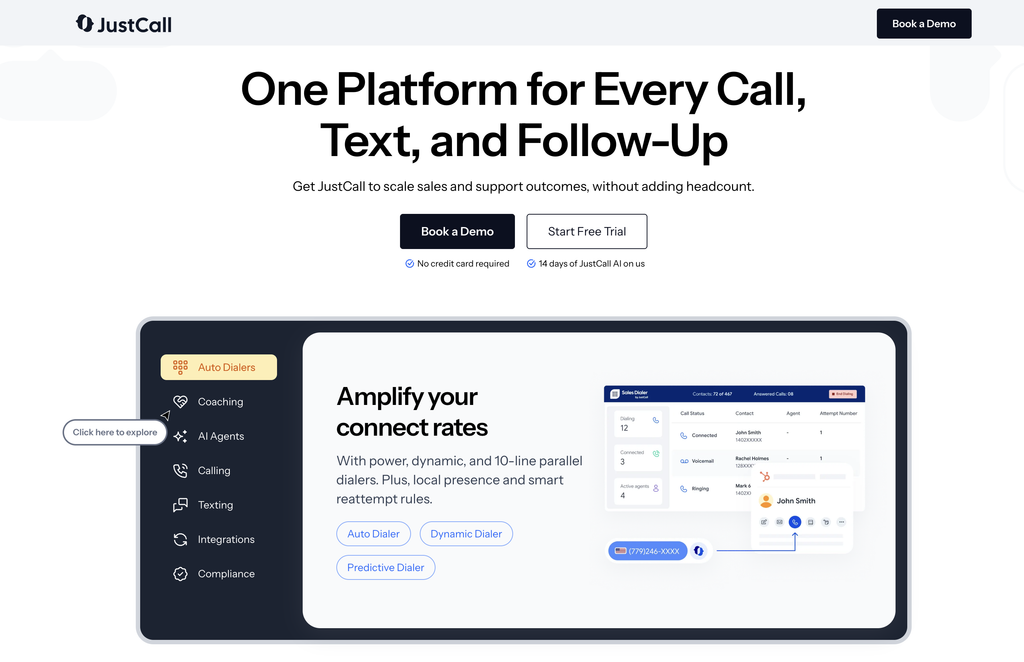
JustCall is a cloud-based communications platform that operates under its parent company SaaS Labs. It was launched in California in late 2016.
Like Aircall, the platform targets sales and support teams. It also combines calls, SMS, AI tools, and CRM-connected workflows. But it differs from Aircall in terms of dialing modes, integration depth, configuration, and packaging.
Nevertheless, JustCall has an impressive product line, including an AI Communication Suite, the SalesPro suite for higher-volume outreach, and an AI Voice Agent add-on that can support inbound and outbound calls.
Aircall vs. JustCall At a Glance
Factor | Aircall | JustCall |
Annual-billing starting price | ||
Sales calling | Pro plan includes Power Dialer; SalesPro adds predictive and dynamic dialing. | |
Autonomous AI calling | ||
Integrations | ||
Reporting | ||
Live AI coaching |
Bottom Line Up Front
Aircall is the better choice for growing organizations that need to balance inbound support, outbound sales, and CRM-related productivity. The platform’s main advantage over others like JustCall is the combination of features it offers to sales or support teams in this scenario: routing, shared conversation management, outbound tools, and practical AI, all located inside one customer communication platform.
That’s why we challenged the assumption that “Aircall is for inbound and JustCall is for outbound.” The distinction is too simplistic: Aircall’s outbound AI can qualify leads and follow up proactively, while JustCall also supports inbound routing and CRM automation.
However, JustCall may be worth considering if your organization relies heavily on predictive dialing, SMS campaigns, or configurable API-driven agent actions.
Aircall vs. JustCall: Pricing
Aircall
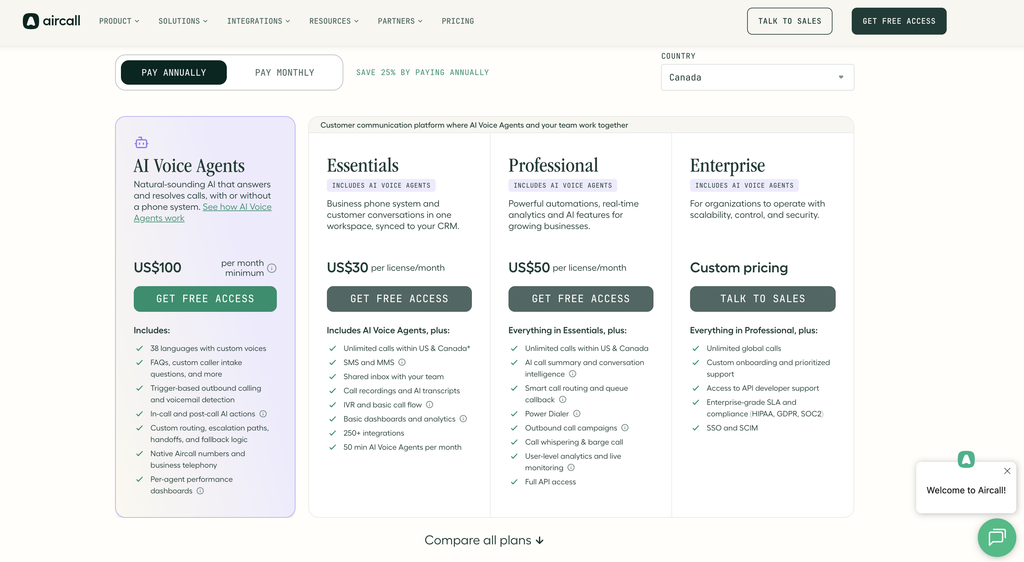
The platform’s lowest-priced ‘Essentials’ tier costs $30/user/month, with annual billing. The ‘Professional’ plan costs $50/user/month. Whichever plan you choose, subscribers must sign up for a minimum of three licenses, so the minimum monthly amounts are $90 and $150 respectively.
The ‘Essentials’ plan includes call recording, transcription, IVR, basic analytics, and integrations. Subscribing to the ‘Professional’ plan adds conversation intelligence, call summaries, more advanced analytics, smart routing, queue callback, Power Dialer, full Salesforce CTI integration, and outbound campaigns.
Users who want real-time coaching can also subscribe to the ‘AI Assist Pro’ add-on for an additional $49 per seat, per month. Analytics+, available for an additional $15 per seat per month, adds advanced reporting features such as per-rep insights and unlimited history.
Aircall’s pricing page includes a helpful calculator to help you work out how much a given number of minutes will cost (either on a pay as you go basis or as part of a subscription), depending on your organization’s needs.
JustCall
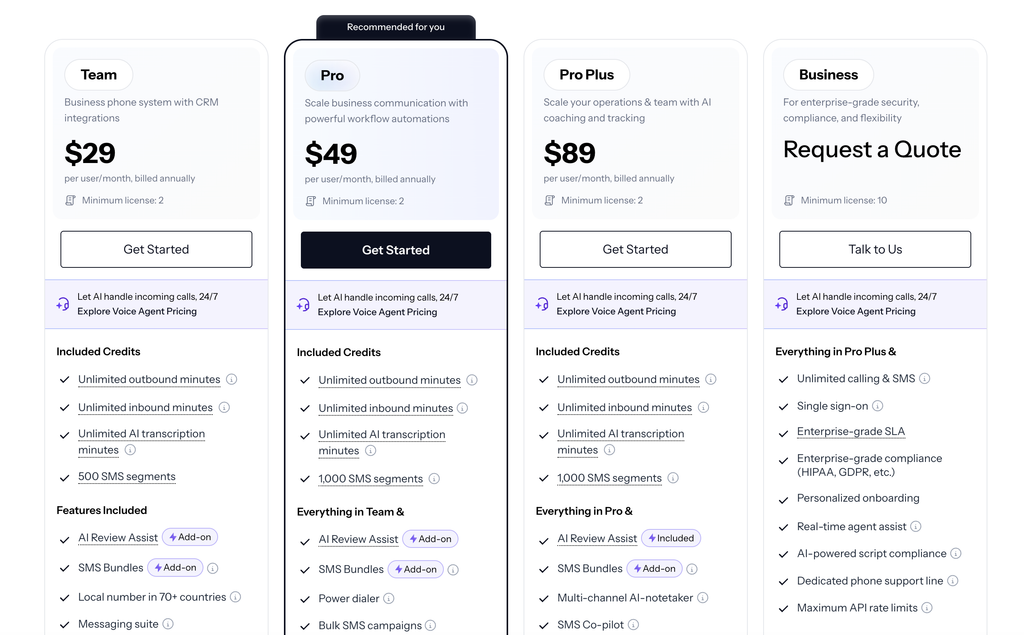
The platform’s pricing starts at $29/user/month, billed annually for the “Team” plan. The ‘Pro’ and ‘Pro Plus’ plans cost $49 and $89 per user, per month respectively. All of these have a two-license minimum, meaning subscribers pay a minimum monthly rate of $58.
The ‘Pro’ plan adds a Power Dialer, bulk SMS, queue callback, intelligent routing, and Salesforce CTI. ‘Pro Plus’ adds real-time assistance, AI scoring, and script compliance. The platform includes predictive dialer software on the ‘SalesPro’ plan but we couldn’t find prices listed for this on the main site.
JustCall’s AI Voice Agent is priced via an account manager (though we noted that overusage is billed at $0.99/minute). There’s also a 100-minute free trial.
Winner: It’s a tie
JustCall’s slightly lower starting price and two-seat minimum versus Aircall’s three makes it cheaper for the smallest teams to get started. But Aircall’s ‘Professional’ tier offers good value when you need outbound calling, conversation intelligence, and operational reporting together.
To get comparable post-call intelligence from JustCall, you’d need a ‘Pro’ plan plus its $9 AI Review Assist add-on which comes to $58 per user, versus Aircall’s ‘Professional’ at $50/user.
Aircall vs. JustCall: AI Agent Workflows
Aircall
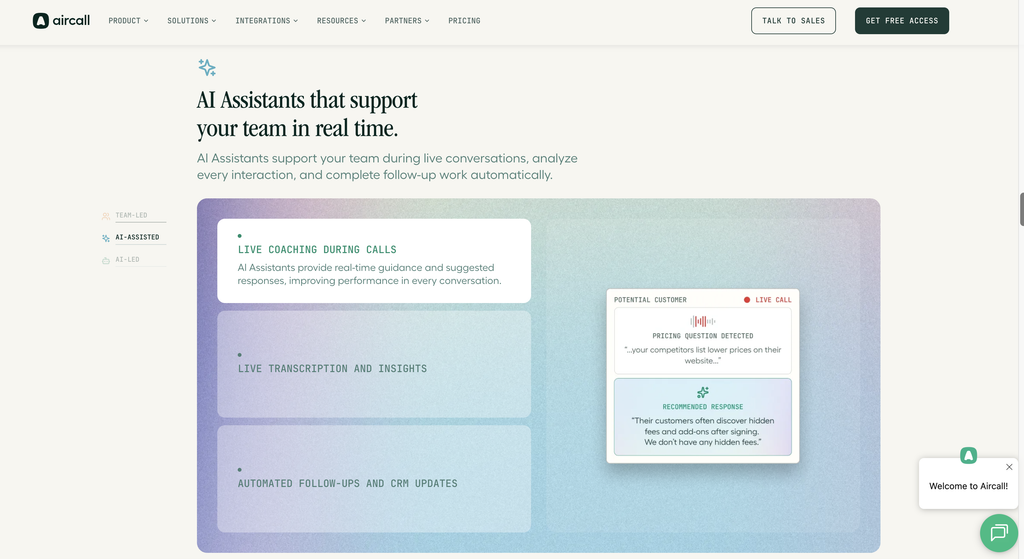
The platform markets its virtual agents as ‘AI Voice Agents’. They can handle inbound and outbound calls. The platform’s website documents outbound use cases like lead qualification, appointment reminders, and billing follow-ups.
Aircall’s AI Voice Agent can also perform actions in connected business systems during calls. For example, HubSpot actions include retrieving or updating contacts, as well as checking availability and booking meetings, assuming that those AI actions are available and correctly configured.
In this scenario, an outbound qualification workflow could automatically call a new HubSpot lead, retrieve their contact record, use the available CRM context during qualification, and update the record with the outcome.
However, there are limitations: Aircall currently only documents integration-powered AI Actions for Shopify, HubSpot, Salesforce, and Zendesk, although other types of AI Agent actions may also be available. Salesforce AI Actions are currently supported for inbound calls only.
JustCall
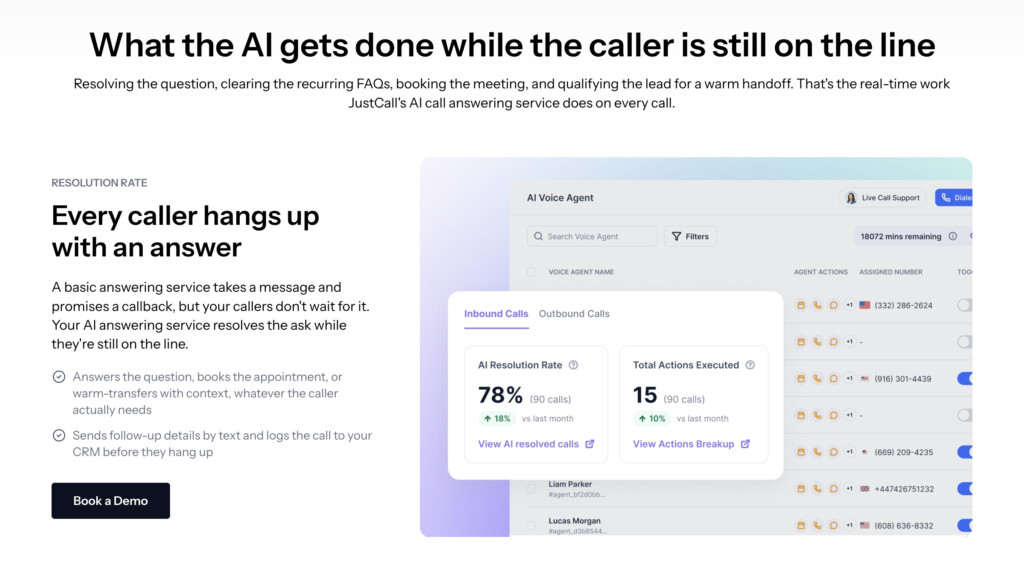
The platform’s AI agent supports appointment booking, SMS, transfers, custom API actions, and outbound IVR navigation. Its pre-call custom actions can also fetch external data through GET API requests and then make selected response fields available as conversation context before an incoming call.
HubSpot workflows can trigger personalized outbound AI calls using dynamic variables, assuming that outbound AI calling is enabled on the account.
This makes JustCall worthy of consideration if, say, an agent must follow a specialized process across custom systems. However the fact that the API is flexible doesn’t automatically mean that the finished workflow will be smoother than other platforms, as it still needs configuration and testing.
Winner: Aircall
Aircall is a strong option when predefined CRM and help-desk actions cover your required workflows. JustCall may be a better fit when outbound IVR navigation is needed or its specific custom-action capabilities better suit your integration requirements.
Aircall vs. JustCall: Outbound
Aircall
The ‘Professional’ plan includes sequential Power Dialer calling and voicemail drop. Aircall’s ‘Outbound Campaigns‘ can also:
- Coordinate multiple reps using a shared contact list
- Manage retries
- Track outcomes
- Stop two agents from calling the same contact at the same time
AI campaigns can also handle outreach autonomously, using contact lists, calling hours, personalization, and preconfigured retry settings.
Still, Outbound Campaigns are managed through Aircall’s Dashboard and Workspace rather than embedded CTI dialers, and direct Salesforce campaign imports are not currently supported.
Outbound AI also currently limits concurrent calls to five per company and one per number.
JustCall
The platform offers Power, Dynamic, and Predictive dialers. Power Dialer is included in ‘Pro’ and higher plans, while SalesPro offers unlimited Dynamic and Predictive Dialer campaigns. Lower-tier plans have limited campaign allowances.
Predictive dialing can automatically call multiple contacts and connect answered calls to available agents. JustCall also supports bulk SMS campaigns on ‘Pro’ plans and above, meaning teams can combine phone and text outreach.
Winner: JustCall
For outbound operations where dialing-mode flexibility and predictive dialing are your main priorities, JustCall wins.
Still, that’s only true for this narrow use case: Aircall is still a strong choice when outbound sits alongside inbound service and CRM-driven follow-through.
Aircall vs. JustCall: Integrations
Aircall
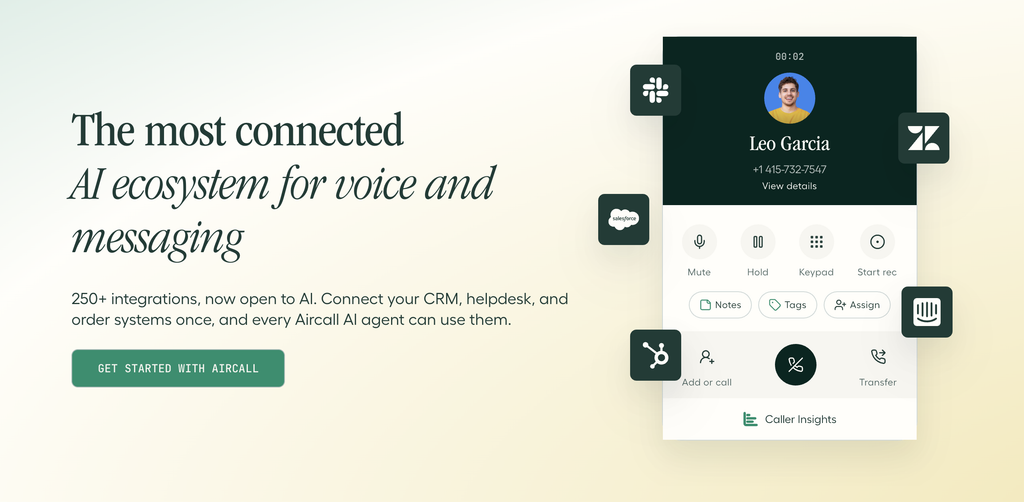
The platform advertises over 250 native integrations. These include HubSpot, Salesforce, Zendesk, and Pipedrive. However, full Salesforce CTI integration requires a ‘Professional’ or ‘Enterprise’ plan.
Of course, many platforms claim to offer integration for hundreds of tools but Aircall offers deeper workflows than basic call logging in a number of its integrations.
For instance, the HubSpot CTI Quick Actions feature (currently in beta) lets representatives associate calls with contacts, companies, deals, and tickets, create follow-up tasks, and enroll contacts in HubSpot sequences, from the end-call screen.
Assuming that the right AI features and logging settings are correctly configured, AI playbook summaries and custom summaries can also load into HubSpot call notes.
JustCall
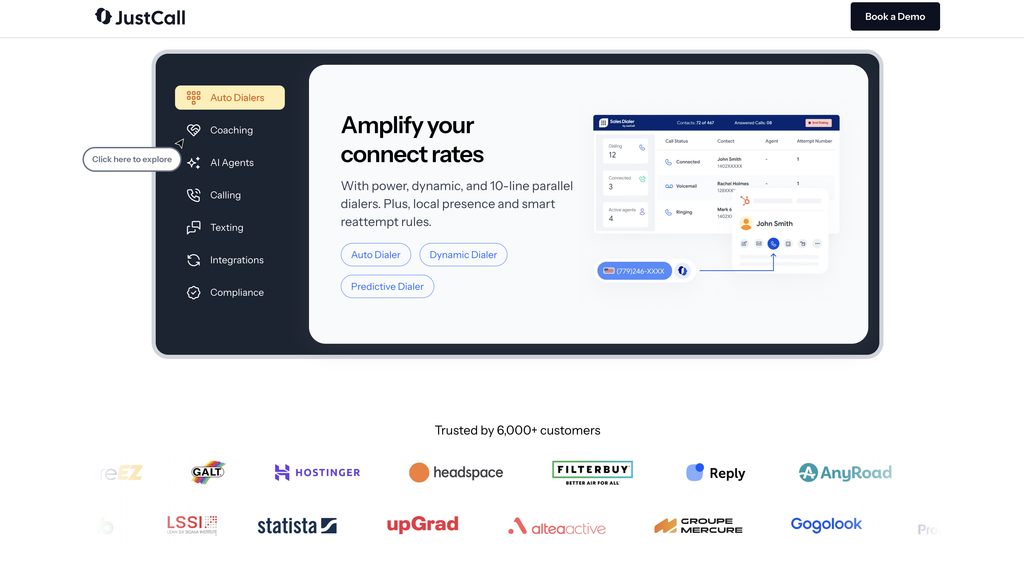
The platform advertises over one hundred CRM and data integrations. Full Salesforce CTI is included on the ‘Pro’ plan and beyond.
For example, JustCall’s HubSpot connection, when configured correctly, supports embedded calling, activity logging, record associations, and task automation.
AI summary logging requires the ‘Pro Plus’ plan or the ‘AI Review Assist’ add-on on lower tiers. Subscribers who need to log analysis data also need at least the ‘Pro Plus’ plan.
Winner: Aircall
When it comes to CRM workflows, Aircall has a broader integration catalogue and documents particularly detailed workflows for platforms like HubSpot, including embedded actions and structured AI logging.
Naturally, workflow depth counts more than the overall connector count. JustCall could be a better option if your chosen integration handles the records, actions, and follow-ups your team needs more capably than other platforms.
Aircall vs. JustCall: Overall Winner
Aircall is the stronger overall choice for growing teams that want to connect sales, support, AI, and CRM workflows in one platform. It combines inbound routing, outbound dialing, conversation intelligence, and CRM integrations, making it particularly appealing to teams that want customer conversations to lead directly to follow-up actions.
JustCall may still be a better option for situations where you need predictive dialing or specialized agent workflows. Its SalesPro predictive dialer, bulk SMS campaigns on the ‘Pro’ plan and higher plans, and configurable API actions make it worth considering for high-volume outreach or processes involving custom systems, although plan restrictions and usage charges should be checked.
Whichever platform you choose, ask the vendor to demonstrate an inbound escalation, an outbound follow-up, and the resulting CRM records on your intended subscription. Test with synthetic or anonymized data first, then validate the workflow with authorized production data where appropriate. Check any add-ons, usage charges, and configuration requirements before committing.