


- At a Glance
- Oracle NetSuite: Best for Businesses with Inventory
- Sage Intacct: Best for Industry Customization
- QuickBooks Online Advanced: Best for Existing QuickBooks Users
- Digits: Best for Agentic Accounting, AP, and AR
- Rillet: Best for Agentic ERP
- LiveFlow: Best for Multi-Entity Physical Businesses
- Which is the Best Accounting Software for a Medium-Sized Business?
Last Updated on September 27, 2026 by Ewen Finser
A solopreneur and a business with 100 employees might both fit the definition of a small or medium-sized business (SMB), but their needs couldn’t be more different, and accounting is one area where this becomes glaringly obvious as you grow. There’s no universal definition of a “medium-sized business,” with much of it coming down to your industry, number of employees, and revenue. But statistics aside, you’ll know that you’re no longer super small when your current accounting software can’t keep up with you.
User caps, a lack of multi-entity support, rigid workflows, and absent AI features are just a few of the many limitations that traditional small business accounting software can have. Here are some accounting platforms that fill in these gaps, supporting the complexity of medium-sized businesses.
At a Glance
Best For | Key Features | Integrations | Pricing | |
Oracle NetSuite | Businesses with inventory | AI journal entries, reconciliation, month-end close, tax management | NetSuite products, bank integrations, NetSuite Connector, NetSuite AI Connector | Custom, paid annually |
Sage Intacct | Industry customization | AI agents, industry-specific workflows, multi-entity support, dashboards | Hundreds of pre-builts, custom API integrations, AI Gateway | Custom, paid annually |
QuickBooks Online Advanced | Existing QuickBooks users | Categorization, reconciliation, quality checks, workflow automation | 3,000+ | $340/mo (Advanced) |
Digits | Agentic accounting, AR, and AP | AI bookkeeping, automated schedules, dimensional accounting, Ask Digits | 12,000+ (Digits Connect API), MCP server | $100/mo (Core), $250/mo (Pro) |
Rillet | Agentic ERP | Automated GL, AI reconciliation, close management, Aura AI | Thousands, MCP server | Custom |
LiveFlow | Multi-entity physical businesses | AI agents, GAAP-compliant reporting, multi-entity accounting | 12,000+ financial institutions, additional software integrations | Custom |
Oracle NetSuite: Best for Businesses with Inventory
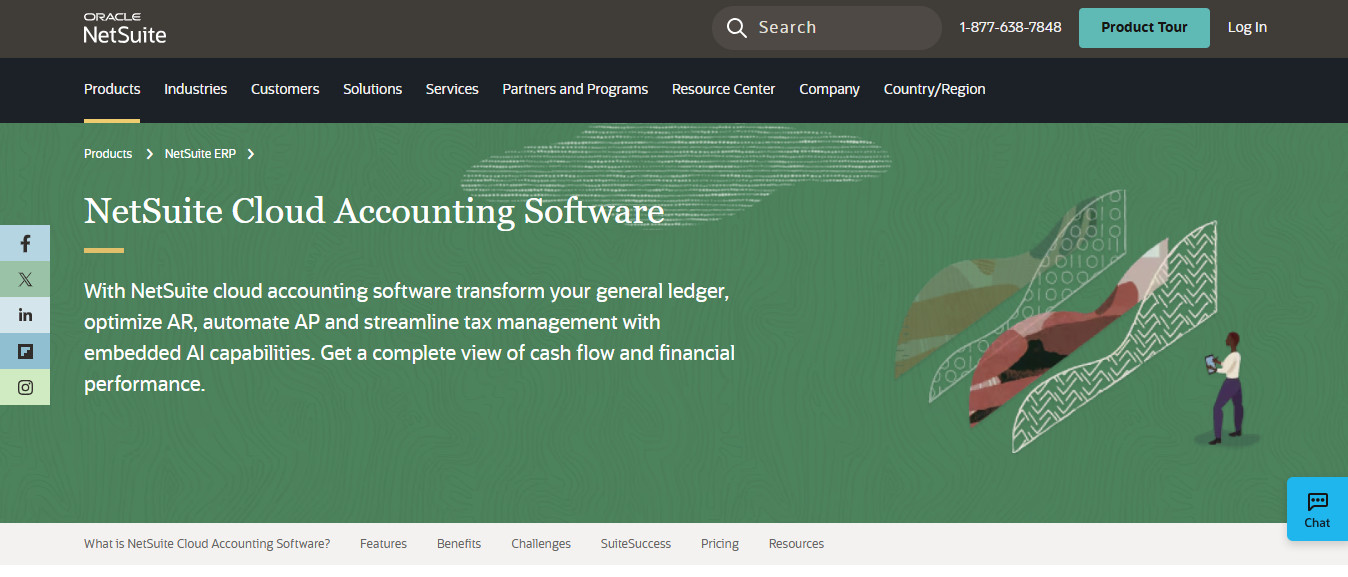
Oracle NetSuite is a software company selling business products for accounting, inventory, and warehouse management, CRM, human resources, and AI, among others. Its cloud accounting software is used by businesses ranging from small startups to scaling enterprises, although its pricing and setup make it a better match for mid-sized companies than for very small ones.
Key Features
NetSuite’s accounting software includes AI and automation capabilities, auto-posting journal entries, matching transactions, performing bank reconciliations, and filling out schedules for depreciation and amortization. For month-end close, the NetSuite Intelligent Close Manager continuously monitors the close process, surfacing time-sensitive tasks and potential errors for review.
Beyond the ledger itself, you can use NetSuite to manage both accounts receivable (AR) and accounts payable (AP). On the receivables side, it automatically converts sales orders to invoices, and you can accept payment directly through the platform. For bill pay, you can use NetSuite’s AI-powered invoice capture to import data, and you can send payment through multiple payment methods.
Some of the more advanced features that come with the NetSuite cloud accounting software are tax and grant management. For international accounting and multi-entity support, you will need NetSuite OneWorld.
Integrations
If you have other NetSuite products, you can easily sync data across platforms, such as inventory and supply chain data. The accounting software can import data from thousands of banks globally, and you can use the optional NetSuite Connector to sync with platforms across e-commerce, marketplaces (Amazon, eBay, Walmart), logistics, POS systems, CRM systems, and payroll. NetSuite also has an AI Connector for Claude and ChatGPT.
Pricing
The cost of NetSuite’s accounting software is customized to each business, and it’s paid annually. The price includes that of the core platform, the number of users, and any optional modules (like the NetSuite Connector). There’s also a one-time implementation fee.
Sage Intacct: Best for Industry Customization
Sage occupies a similar space in the market as NetSuite, providing solutions for both small and medium-sized businesses but mostly targeting the midrange. Its products span categories like financial management and ERP, accounting and bookkeeping, HR, expense management, and inventory planning.
For accounting, your business may be able to skirt by with Sage 50, but Sage Intacct is its dedicated platform for mid-size companies. It’s designed for those with over $4 million in annual revenue or over 20 employees.
Key Features
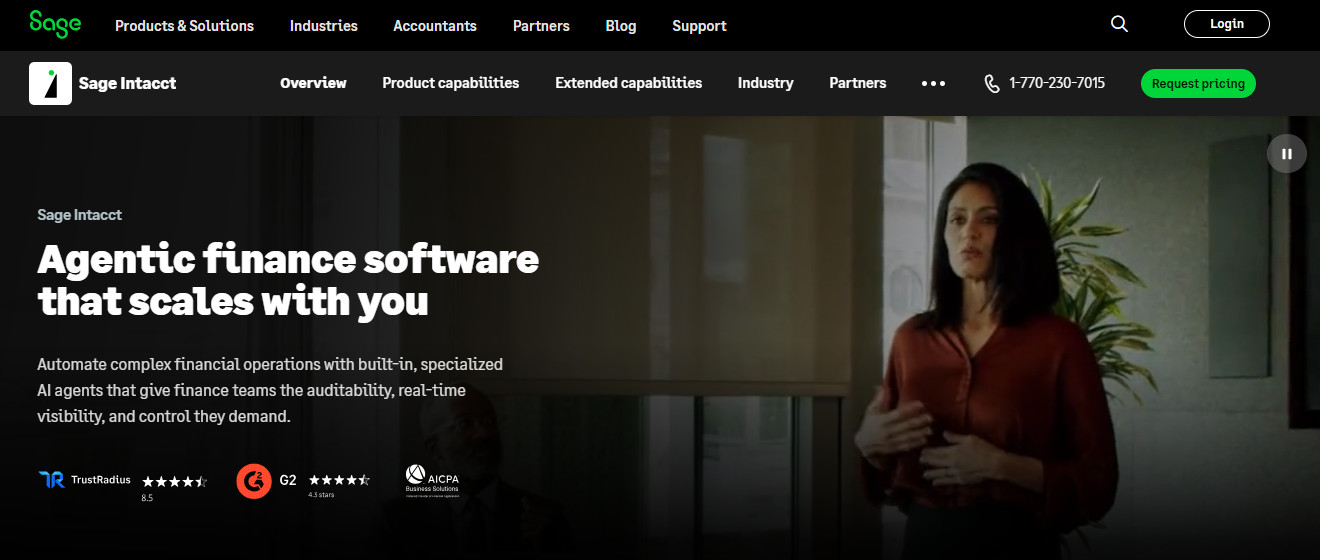
The company’s site describes Sage Intacct as an “agentic finance software,” as it contains embedded AI agents. There is a close agent, a financial assurance agent, an AP automation agent, and a financial intelligence agent, among others. The close agent tracks your progress and surfaces potential issues, the financial assurance agent points out unusual journal entries, the AP automation agent takes care of bill entry, and the financial intelligence provides answers to questions you ask in plain language.
There are industry-specific workflows for construction, SaaS, healthcare, and more. Sage Intacct’s multi-entity support is strong, as you can consolidate hundreds of entities worldwide. Plus, it maintains real-time, customizable dashboards and reports to keep you updated on any of the latest changes.
Integrations
Through the Sage Intacct Marketplace, you can sync with hundreds of platforms across construction, field services, financial services, healthcare, hospitality, nonprofit, professional services, retail, and SaaS. To build custom integrations, you can use Sage Intacct Data Flow, and the Sage Intacct AI Gateway connects with external AI assistants.
Pricing
Sage Intacct uses custom pricing, billed annually. The cost considers your industry, size, and the specific features you need.
QuickBooks Online Advanced: Best for Existing QuickBooks Users
While QuickBooks is often synonymous with small business, its Advanced plan can be appropriate for those in the midrange. If that isn’t enough, companies can use the Intuit Enterprise Suite, which is an AI-native ERP rather than purely an accounting software. However, I’ll be focusing here on QuickBooks Online Advanced, as it’s more relevant to SMBs.
Key Features
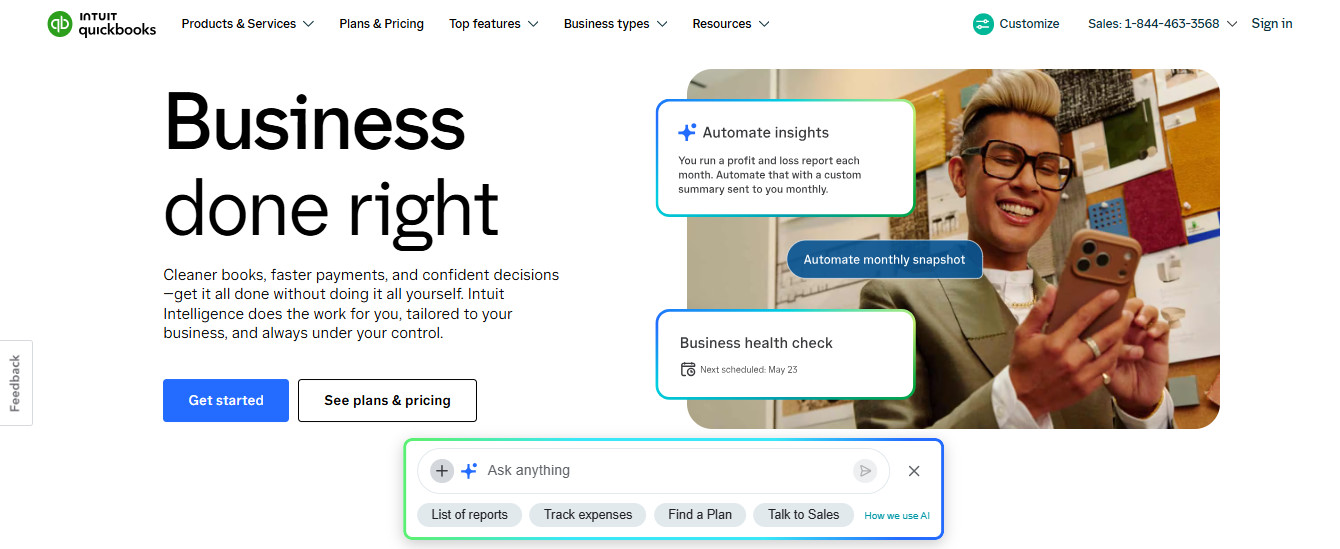
QuickBooks Online Advanced is the highest-tier plan that QuickBooks Online offers. It contains several Intuit Intelligence features, which incorporate AI and automation into the accounting lifecycle. Some of the platform’s capabilities that fall under this category are continuous quality checks, financial insights, customizable dashboards, transaction categorization, invoice creation, reconciliation, and project creation. You can use AI chat, which is currently in beta, to ask plain-language questions about your finances.
Beyond Intuit Intelligence, QBO Advanced covers AR and AP, inventory tracking and management, class and location tracking, free 1099 e-filing, workflow automation, advanced project financials, a construction financials solution, and more.
Note that QBO Advanced is limited to 25 user seats with access for three accountants.
Integrations
The QuickBooks App Marketplace houses over 3,000 app integrations. You can sync with products across functions like customer management, marketing, invoicing, inventory, project management, e-commerce, banking, data, and tax.
Pricing
QuickBooks Online Advanced costs $340 monthly, although there are frequent discounts and promotional offers.
Digits: Best for Agentic Accounting, AP, and AR
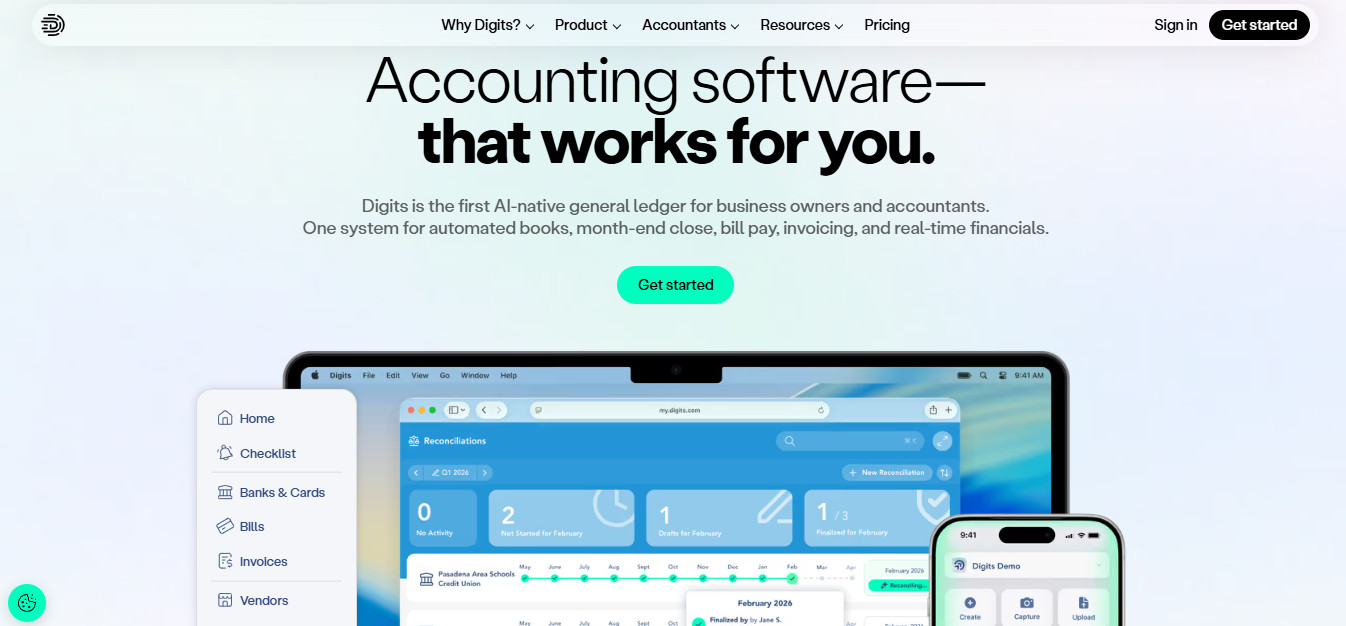
Digits may not yet be as well known as NetSuite, Sage, or QuickBooks, but it’s quickly making waves in the accounting industry. The company describes its product as an “agentic general ledger,” and it develops its own proprietary accounting-specific LLMs in-house, outperforming models from Anthropic, Open AI, Google, and DeepSeek.
Key Features
The exact features you can access depend on which Digits plan you have. However, all plans come with 24/7 AI bookkeeping and reconciliation, with automated journal entries categorization. Plus, Digits continuously performs quality checks to catch potential errors or inconsistencies. There is also an “Ask Digits” AI assistant, where you can ask questions about your books.
Some of the more advanced accounting features that Digits offers are automated schedules, detecting when one is needed and auto-populating it. It also supports dimensional accounting, with department and location tracking. Multi-entity support is available as well, though each business or location would need its own Digits plan.
Outside the ledger, you can use Digits to send and receive payments.
Integrations
Digits has native integrations with several leading platforms, including Ramp, Gusto, BILL, and Stripe. You can integrate with over 12,000 additional financial institutions through its Digits Connect API, and there is also an official MCP server to connect with ChatGPT, Claude, and other models.
Pricing
For a medium-sized business, the best Digits plan available currently is the Core plan, at a cost of $100 monthly. Coming soon is the Pro plan, which includes advanced analytics features, like comparing the budget versus actuals. The Pro plan will cost $250 monthly.
Rillet: Best for Agentic ERP
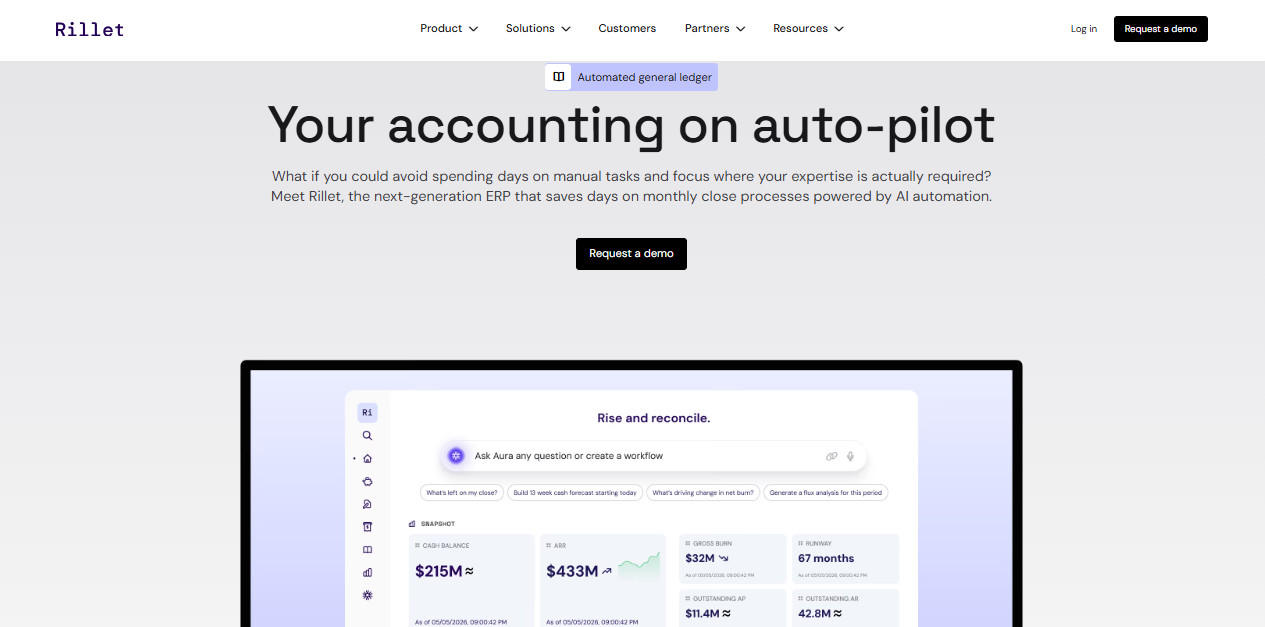
Rillet, an AI-native finance ERP, is gaining momentum among mid-size companies and larger enterprises, having recently been valued at $1 billion. It covers both general bookkeeping and complex processes like revenue recognition and accounting consolidation.
Key Features
Rillet’s automated general ledger can generate journal entries and schedules. The supported schedules are for revenue waterfall, deferred revenue, prepaid expenses, and fixed assets. Its AI handles bank reconciliations, boasting that it can reconcile thousands of transactions within just seconds. Close management is another of Rillet’s specialities, with built-in approval workflows, error detection, and close checklists. Additionally, you can use its Aura AI to ask plain-language questions and perform accounting tasks for you.
While Rillet can also manage both invoicing and bill pay, where the platform shines is through its more advanced features. It works with complex revenue recognition models, such as flat-rate, usage-based, and milestone pricing, ensuring compliance with ASC 606 (the US standard for revenue recognition). Its multi-entity support is strong as well, especially for international companies juggling multiple currencies.
Integrations
Rillet supports thousands of integrations across AR, AP, procurement, banking, CRM, payroll, and other functions. It also has an MCP server for connecting with Claude and other AI assistants.
Pricing
Rillet uses custom pricing, considering the features you use and the complexity of your business.
LiveFlow: Best for Multi-Entity Physical Businesses
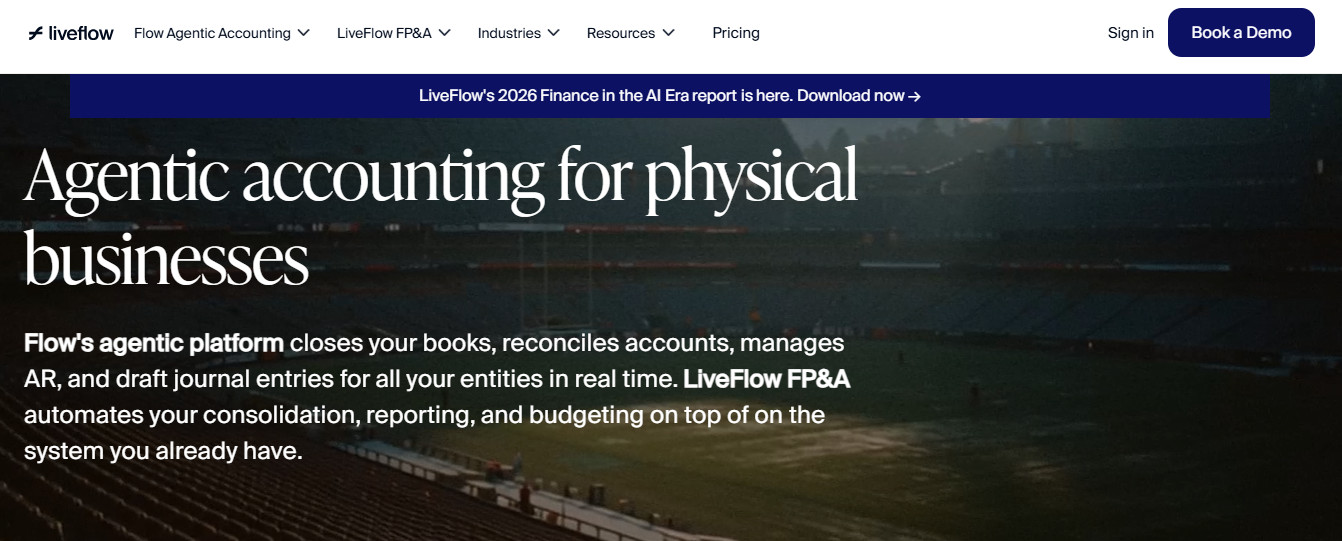
LiveFlow offers a couple of distinct products: Flow, which is an agentic accounting platform, and LiveFlow FP&A, which provides live reporting in Google Sheets and Excel. For both platforms, the target customer base consists of medium-sized businesses through multi-entity enterprises. The products are geared toward physical businesses, such as those in construction, food, and healthcare. Here, I will be focusing on Flow.
Key Features
Flow, an AI-native ERP, uses eight AI agents to help you manage your finances. These agents cover your day-to-day bookkeeping, AR, AP, categorization, reconciliations, month-end close, intercompany eliminations, and reporting. While the AI agents perform much of the manual tasks, you can still go in and approve actions, plus it maintains a full audit trail.
Flow’s reports are both highly customizable and GAAP-compliant. Additionally, you can use the platform to create consolidated reports and conduct variance analysis. Multi-entity accounting is a particular strength of Flow’s, including international companies and those with multiple physical locations. The company prides itself on fast migration, claiming you can go live within days.
Integrations
LiveFlow lets you connect to over 12,000 banks and financial institutions. Other integrations include those with platforms like BILL, Ramp, Square, and Gusto.
Pricing
LiveFlow uses custom pricing tailored to a business’s unique needs.
Which is the Best Accounting Software for a Medium-Sized Business?
Depending on the size and complexity of your medium-sized business, some of these tools may be overkill, while others may fit right in the sweet spot of what you’re looking for.
For example, if you’re on the hunt for a full-fledged ERP, then you might want to consider NetSuite, Sage, Rillet, or LiveFlow, while Digits and QuickBooks Online are relatively lighter-weight tools specific to accounting.
But you shouldn’t only base your decision on this binary, as every tool is distinct. NetSuite is particularly strong for businesses dealing with inventory, Sage Intacct has solid industry-specific workflows, and Flow has a niche in physical businesses, especially those with multiple locations.
The implementation timeline is also something to consider. NetSuite, Sage, and Rillet implementation can take several weeks to months, while Digits, QuickBooks Online, and LiveFlow can get you up and running quickly, within days or even sooner. And then there’s your budget—of these tools, QuickBooks and Digits tend to be easier on the wallet. As with any business decision, it all comes down to what you need.