


- How Much Do Business Brokers Typically Charge?
- How Does a Business Broker Commission Work?
- Why Do Broker Commissions Decrease on Larger Deals?
- Are Business Brokers Paid Only When the Business Sells?
- What Is a Minimum Broker Fee?
- What Are You Paying a Business Broker to Do?
- What Should You Look for in the Listing Agreement?
- Is a Higher Commission Always More Expensive?
- Which Broker Fits Your Business?
- The Bottom Line
Last Updated on September 23, 2026 by Ewen Finser
If you’re thinking about selling your business, one of the first questions you’re likely to have is, “How much is the broker going to cost me?”
Business broker commissions can look pretty straightforward at first. But once you start comparing brokers, you’ll find that the percentage isn’t always the whole story.
Some brokers use a sliding commission scale. Others have minimum fees. Some charge an upfront retainer or listing fee, while others work entirely on a success-fee basis. The length and terms of the engagement are also important.
With so many different fee structures, it’s easy to assume the lowest number is the best deal. But before deciding one broker is cheaper than another, it helps to understand how the fee is calculated and what you’re really getting for it.
How Much Do Business Brokers Typically Charge?

For smaller business transactions, a commission of 10% to 15% of the sale price is a commonly cited range.
BizBuySell, for example, says 10% to 15% is typical for businesses sold between $100,000 and $1 million, with lower percentages often applying to larger transactions. Fees are negotiated between the broker and seller, so there isn’t one standard commission that applies to every business sale.
That range is useful as a starting point, but a broker charging 10% isn’t necessarily less expensive than one charging 12%. Brokers don’t always apply their percentage in the same way. For example the 10% broker may take longer to sell your company then the 12%, thereby costing time and potentially money.
Another example is, one broker might charge 10% on the first $1 million and then reduce the percentage rate on amounts above $1 million. Another might charge 12% on a smaller transaction but have a lower rate on larger portions of the sale. Minimum or up front fees can also change the math, particularly on smaller businesses.
When comparing brokers, calculating the commission isn’t as simple as multiplying the percentage by your expected sale price. You need to understand how each broker structures their fee: tiered rates, minimums, and upfront costs can all change the real number.
How Does a Business Broker Commission Work?

In a typical success-fee arrangement, the broker receives a percentage of the transaction value when the business sells.
For example, if you sell a business for $500,000 and the agreed commission is 10%, the broker’s fee would be $50,000.
The engagement agreement is where the important details are spelled out. You’ll want to know exactly what the broker considers the transaction value, whether there are additional fees or charges, and how the commission changes at different sale prices.
My opinion is that although the commission amount is extremely important, so too is the experience of the broker as well as their expertise and closing track record. So I’d definitely keep those things in mind as you move forward. It may be well worth paying another one or two percent for a proven success record.
Why Do Broker Commissions Decrease on Larger Deals?

There’s a practical reason commission rates often decline as the transaction gets larger.
Selling a $500,000 business and selling a $5 million business are obviously different transactions, but the broker’s compensation doesn’t necessarily need to increase at the same rate as the sale price. A sliding scale lets the broker earn a substantial fee on a larger transaction while keeping the effective percentage from becoming excessive.
You can see this when comparing online business broker fee structures, like the ones below.
Quiet Light uses a very modern commission structure. The rate starts at 10% on the first $1 million, then steps down as the transaction gets larger. The next $1 million is charged at 9%, followed by lower percentages on additional portions of the transaction. Quiet Light also uses a success-based model, so the broker is paid when the business sells rather than charging a commission simply for taking the listing or even charging an upfront selling fee.
For a seller, that’s a big difference that shows up in your payout. It means a $3 million sale isn’t charged 10% across the board.
Empire Flippers uses a different blended structure. The basic starting commission is $10,000 on businesses up to $66,666.66, then it goes to 15% up to $699,999. The rate then drops to 8% on the portion between $700,000 and $4,999,999, and finally it’s 2.5% on the portion above $5 million.
Flippa also uses a sliding success-fee structure, with lower percentages at higher transaction values. Its published materials show a 10% rate below $1 million, 9% from $1 million to $2 million, and 8% from $2 million to $3 million, with further reductions at higher values.
The takeaway is simple: don’t just look at the percentage a broker advertises, calculate what that percentage actually adds up to in dollars at the sale price you expect, and compare brokers on that dollar figure instead.
Are Business Brokers Paid Only When the Business Sells?

Many business brokers use what’s called a success fee, like Quiet Light for example. The broker earns the commission when the transaction closes rather than charging the seller simply for taking the listing.
For sellers, there’s an obvious advantage. If the business doesn’t sell, you don’t owe a commission.
Not every broker uses exactly the same model, though. Some firms charge upfront retainers, listing fees, marketing fees, or other expenses in addition to a success fee so definitely keep this in mind. Also some may credit certain upfront payments toward the final commission, while others may not.
Before signing an engagement, ask whether there are any costs you’ll pay before closing and what happens to those costs if the business doesn’t sell.
What Is a Minimum Broker Fee?

Minimum fees can make a big difference on smaller transactions.
Suppose a broker charges 10% with a $25,000 minimum. If you sell your business for $150,000, 10% would normally be $15,000. Because of the minimum, however, you’d end up paying the entire $25,000.
This doesn’t necessarily make the broker’s fee unreasonable. A broker may have to spend nearly as much time preparing, marketing, and negotiating a smaller transaction as a larger one. But it does mean you need to know whether a minimum applies before comparing percentages.
Minimum fees should be clearly spelled out & understandable within the engagement agreement.
What Are You Paying a Business Broker to Do?

It’s easy to focus on the commission because it’s the most visible cost. But the more useful question is what the broker is doing to earn it.
A good business broker can help with much more than putting a listing online. Depending on the broker and transaction, that can include helping determine an appropriate asking price, preparing the business for market, creating marketing materials, finding and screening buyers, handling and keeping the process confidential, negotiating offers, managing due diligence, and keeping the transaction moving toward closing.
That last part can be very easy to underestimate.
A business sale can generate a surprising number of questions, requests for documents, changes to deal terms, and moments when either the buyer or seller starts having second thoughts. Having someone who has been through the process before can make a very meaningful difference.
In my experience, this is where a broker can earn their fee. A deal can look straightforward at the beginning and become much more complicated once the buyer starts digging into the numbers and asking questions.
The goal isn’t simply to find a buyer. It’s to find a qualified buyer and get the transaction across the finish line on terms that work for you.
What Should You Look for in the Listing Agreement?

Before you sign with a broker, make sure you understand the fee structure and the rest of the engagement.
At the very least, look for:
- The commission percentage and any sliding scale
- The minimum commission, if there is one
- Any upfront retainer, listing, marketing, or other fees
- Exactly what transaction value the commission is based on
- The length of the engagement
- Whether the engagement is exclusive
- What happens if you find a buyer yourself
- What happens if a buyer introduced during the engagement walks
- Any termination provisions
- Any post-termination “tail” or trailer period
Exclusivity is particularly important. Many broker agreements require the seller to work exclusively with the broker for a defined period. The agreement should make clear what happens if you find a buyer independently or decide to end the relationship.
The post-termination period matters, too. A broker may continue to have rights to a commission if a buyer they introduced purchases the business after the formal engagement ends. The exact terms vary, so read that section carefully rather than assuming the obligation ends the day the agreement does.
Is a Higher Commission Always More Expensive?

Not necessarily.
Imagine one broker charges 8% but sells your business for $1 million, while another charges 10% and helps you sell it for $1.2 million.
The first broker’s fee would be $80,000, leaving you with $920,000. The second broker’s fee would be $120,000, leaving you with $1.08 million.
In other words, you’d pay the second broker $40,000 more in commission, but you’d also receive $200,000 more from the sale. That’s an overly simple example because real transactions involve deal terms, taxes, legal fees, and other factors. Still, it illustrates why commission percentage shouldn’t be viewed in isolation.
The right question is not simply, “Who has the lowest fee?”
It’s, “What am I likely to net after the broker’s fee, and what am I getting for that fee?”
Which Broker Fits Your Business?
Commission structure is only part of the decision. The brokers mentioned earlier tend to serve different types of sellers.
Quiet Light
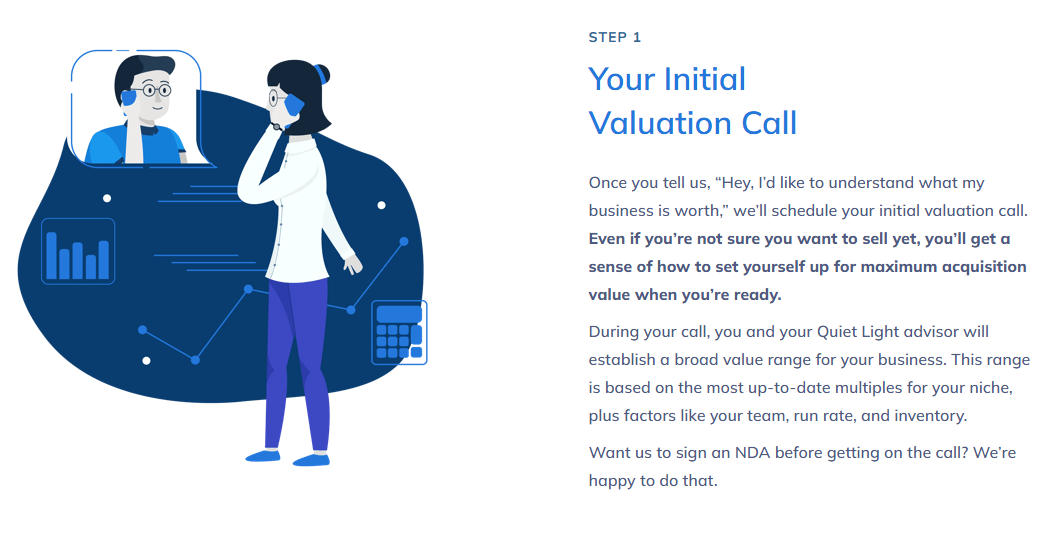
Quiet Light focuses specifically on online businesses, including ecommerce, SaaS, content, and affiliate sites, generally in the $250,000 to $25 million range. Its advisors average around 15 years of direct online business experience, through founding and owning businesses themselves, and the brand also has a strong content and podcast presence, which tends to draw in buyers who already understand the space.
Quiet Light is also a good fit if you want to stay closely involved in the process rather than hand everything off; their advisors are collaborative, not just transactional, and sellers who want a broker managing things end to end but still expect to be consulted at each step tend to like this approach. I always recommend Quiet Light for this reason, their brokers are true industry experts, many having built and sold online businesses themselves, so they understand exactly what sellers are going through.
Empire Flippers
Empire Flippers runs a more curated, vetted marketplace. It works well for sellers with established businesses making $50,000 or more a year, particularly smaller to mid-sized content sites and Amazon FBA brands where speed and a smooth seller experience are priorities. The vetting process is stricter, and the sale is more fully managed on the broker’s end, which suits sellers who’d rather not be hands-on during the process.
Flippa

Flippa is the most self-serve of the three. It’s built for sellers who want to list and manage the sale themselves rather than hand it off entirely, and it covers a much wider range of deal sizes, working well for smaller businesses that don’t need the higher commission of a full-service broker. For larger or more complex deals, Flippa also offers an in-house broker service that handles valuation, listing prep, and buyer outreach for a success fee.
The Bottom Line

As we’ve touched on earlier, business broker commissions usually fall somewhere around 10% to 15% for smaller transactions, but again that is only a starting point. Larger transactions will often use the sliding scales that reduce the effective percentage as the sale price increases.
Before choosing a broker, remember to calculate the actual commission based on the sale price you expect. Then look at the minimum fee, any upfront costs, the length and exclusivity of the engagement, and exactly what services are included.
Most importantly, don’t judge a broker solely by the percentage they charge. The broker’s job is to help you get the business sold, but the best outcome isn’t necessarily the one with the lowest commission. It’s the one that leaves you with the strongest overall result when the deal is done.
By understanding the broker’s compensation before you list, it gives you a much clearer picture of what the sale will really cost and what you should expect in return.