


Last Updated on September 9, 2026 by Ewen Finser
The abilities of AI and LLMs seem to change practically by the day, if not by the minute, so if you’ve heard or read that you can wire your partner marketing platform up to your favorite AI assistant, you might be wondering what you can do with that kind of connection and how much of it is hype.
The truth is that many partner marketing platforms are launching their own MCP connections that allow their tools to talk directly to your favorite AI, but what these connections can actually help you accomplish varies by platform.
So let’s break down which partner marketing platforms have MCPs and what you can do with them:
Platform | MCP status | What assistant does | Setup | Best for |
First-party hosted MCP | Read, write, recruitment, reporting and analytics, payouts | Connect existing API key to Claude, ChatGPT, Cursor | B2B SaaS partner operations | |
First-party / public MCP | MCP connector and broader AI/agent capabilities | Connect AI client to Impact and authenticate account | Enterprise and multi-channel partnerships | |
First-party hosted MCP | Read-only analytics/data | Connect existing API / network credentials and MCP to client | Affiliate performance analytics | |
First-party hosted MCP | Read-only analytics/data | Connect AI client to Tapfiliate and authenticate | Conversational analytics | |
First-party hosted MCP | Read-only analytics/data | OAuth to Claude or ChatGPT | Ecommerce creator and affiliate analytics | |
First-party hosted MCP | Read, write, and operational workflows | Generate MCP token → paste into AI client | AI-native affiliate operations |
Partner Marketing MCPs Are Doing Four Main Jobs

These partner marketing platforms all have MCP connections that can talk to your favorite AI, but what those MCPs actually do fall into four different jobs. You can choose the best match for your organization based on the job you need an AI connection to accomplish and the level of risk tolerance your organization has.
This isn’t necessarily a “beginner-to-advanced” spectrum, either. Each of these MCPs can be powerful, but they were built to accomplish different things.
First, it’s important to understand that some MCPs are read-only, meaning they can only pull data from your partner marketing platform into the AI. Others are read-and-write capable, which means they can also edit and change the data in your platform. That’s a very important distinction depending on what you hope to do with AI.
Because of that distinction, the platforms above sort themselves into four main categories that we’ve turned into jobs you may need the AI to help you do. The four jobs these MCPs help you accomplish are as follows:
Affiliate Analyst: Tapfiliate + Levanta
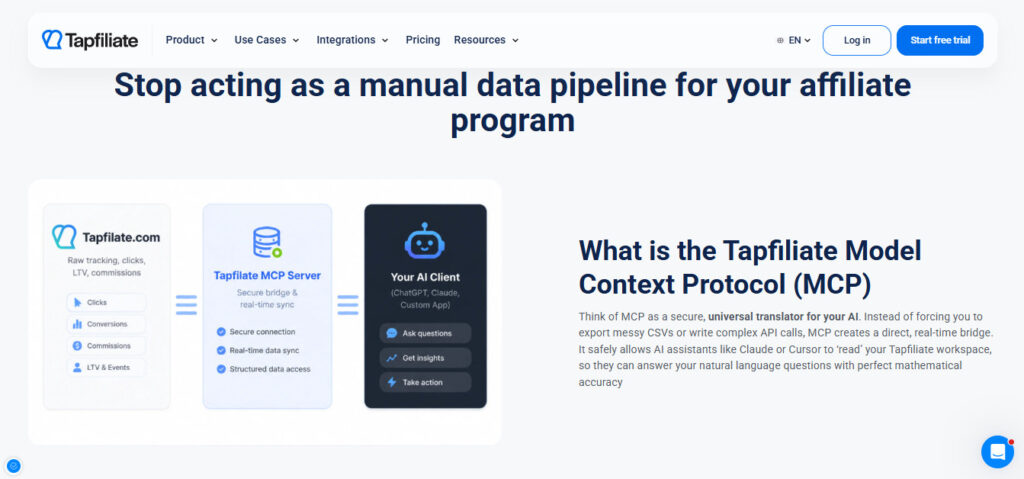
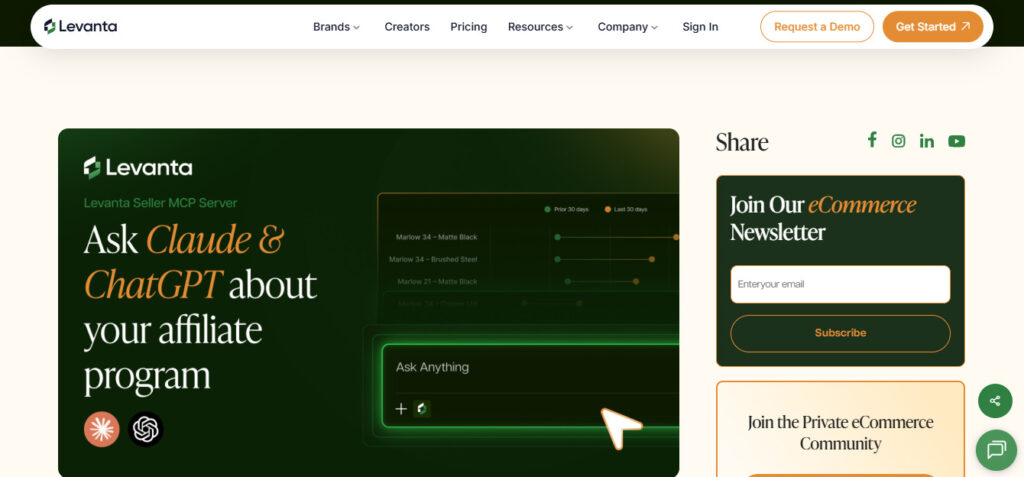
As an Affiliate Analyst, the MCPs for these programs will allow you to ask your AI questions about your affiliate or creator program and get the answers. They’re more conversational, like talking to an expert on your team. But what they can actually do is somewhat limited.
The main question for this job is, “Help me understand my affiliate/creator program.” So as a user, you might ask more specific questions like:
- Who are my top 10 creators by revenue this month?
- How much commission did we pay out last month?
- Which affiliates are generating lots of clicks, but few conversions?
- Which products have the best ROAS?
Tapfiliate is built to manage all types of partner marketing platforms for SaaS brands and DTC brands using platforms like Shopify, WooCommerce, or Stripe. They’re great at commissions for recurring subscriptions, but they’re not built to be native to bigger marketplaces like Amazon.
Levanta, on the other hand, offers native integration with Amazon and works with Walmart and Shopify to help manage partner marketing for omnichannel ecommerce brands, but they aren’t designed to support the needs of SaaS products.
These Analysts are good at reporting, but can’t take any direct action. They can answer conversational questions about your program, but you have to manually implement any suggestions or changes.
Performance Analyst: Everflow
On the surface, this seems similar to the Affiliate Analyst job, but Everflow is a bit different because its entire MCP philosophy is to provide the AI with very rich performance data, and its underlying data model is performance-centric. It can provide real program insights instead of just analytics.
The main question you’d ask this job is, “Tell me exactly what’s happening with my partners and why.” You’re going to get more detailed answers because you have richer data to answer questions like:
- What changed in our conversion rate this month?
- Why did conversions drop last week?
- Which partners are at risk of going dormant?
- Which traffic sources are generating the most high-value customers?
Everflow is built with high-performance, high-volume, enterprise-level brands in mind, and that’s why they have a greater depth of data focused on performance for advanced partner marketing. But their pricing and level of service aren’t meant for startups or smaller brands.
The Performance Analyst can reliably analyze and diagnose what’s going on with your program, but it can’t act; the insights it comes up with still need to be manually translated inside the program. This means it’s lower risk than some other MCPs because it won’t be changing your data on its own.
Operator: Partnerstack + Impact
The Operator job takes things one step further, allowing the MCP to not just read data from your platform, but also execute workflows.
The main task you’d be giving this job is, “Help me understand my partners and help me run the program.” Because these MCPs can execute within the platform, they can help you accomplish tasks beyond analysis and reporting, like:
- Which partners haven’t been contacted recently?
- Identify partners who qualify for our new commission tier.
- Create a deal for our top-performing partners.
Partnerstack is designed specifically for B2B software companies managing affiliates, referral partners, agencies, and resellers, but it’s not meant to support ecommerce or retail brands.
Impact, on the other hand, is designed to support large retail, DTC, and ecommerce businesses, but the setup is complex and is best suited to large brands.
The Operator can move from analysis into action, but it still needs human oversight. It can perform specific tasks, but can’t run your program independently.
Agent: Rekomi
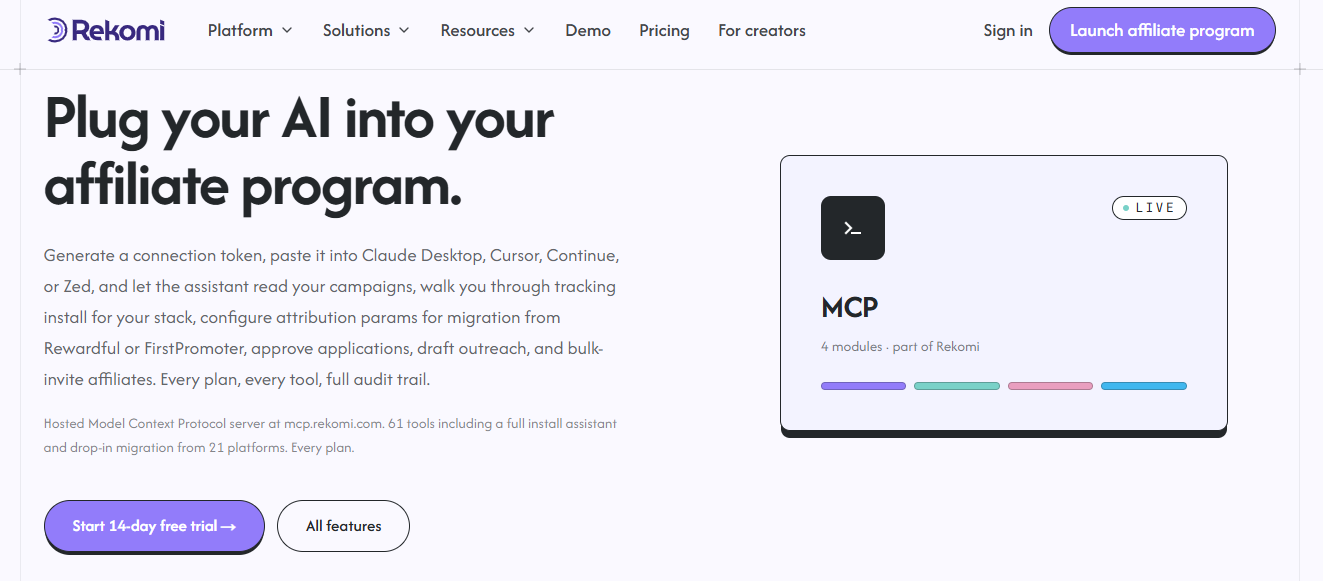
While the Agent is similar to the Operator, it takes things one step further. Rekomi’s MCP has more than 60 tools and workflows you can use to have your favorite AI help you run your entire partner program. It goes beyond what the Operator is capable of doing and can become an integral part of running your program.
The main task you’d assign to this job is literally, “Run my partner program for me.”
That might look like:
- Find and invite 50 new partners who fit our profile.
- Review pending partner applications and approve those that match our profile.
- Create a campaign for our new product and invite the relevant partners to participate.
- Draft outreach to inactive partners and prepare for my approval.
These tasks are much more autonomous than anything the Operator is capable of doing, which is why the Agent has its own category. But more automation means more risk and complexity. Because it can actually change your program and communicate with your partners, you need to be clear and cautious about what you tell it to do.
Rekomi caters to a range of business types, including SaaS, AI applications, and ecommerce brands, and it offers lower-tier pricing without the need for enterprise-level contracts, but it’s designed to integrate with Shopify and Drip Pro, so if you’re not using that tech stack, it won’t be useful.
The Philosophical Differences

What’s interesting is that these platforms seem to be dividing themselves into two distinct philosophical camps: AI as analyst vs. AI as operator.
AI as an analyst starts by providing the model with access to data about the program and then letting the human decide what to do with that data and execute the plan.
AI as an operator gives the model data and permissions to execute workflows with appropriate guardrails and permissions.
Everflow, Tapfiliate, and Levanta fall clearly in the first camp, with Rekomi strongly in the second and PartnerStack and Impact coming somewhere in the middle.
The two philosophies create a clear spectrum. At the analyst end, you have much less risk, but more manual input. At the operator end, you have more capability and leverage, but also more risk and more governance required.
How to Choose
In the end, if you’re looking to choose a partner marketing platform based on its MCP and AI capabilities, how you choose will come down to the job you need the AI to help you do:
- If you only need help interpreting your analytics, an Analyst MCP will be sufficient for your needs (Tapfiliate + Levanta).
- If you want deeper insight into your program performance, the Performance Analyst (Everflow) is the best choice.
- If you want the AI to help you complete tasks within your partner marketing platform, you’ll want an Operator (Partnerstack + Impact).
- And if you want AI to run your entire program, you need the Agent (Rekomi).
And these also go from least risk with the Analyst to the most risk with the Agent, simply because the Agent has the most control over your data and the ability to change your program.
Understanding the job you want MCPs to do and your tolerance for risk can help you find the right combination of capabilities and choose a partner marketing platform that’s right for you.