


Last Updated on August 13, 2026 by Ewen Finser
Most accounting software was built for a business that sends an invoice and waits to get paid. As we all know, e-commerce does not work that way. You sell through a storefront, a marketplace, a social channel, and maybe a wholesale portal, and each one settles on its own schedule, nets its own fees, and hands you a single lump deposit that bears no resemblance to what you sold, seemingly. Somewhere in that deposit is gross revenue, refunds, referral fees, fulfillment charges, ad spend, chargebacks, and sales tax the platform may or may not have remitted on your behalf.
If you are running a single storefront, this is annoying but manageable. If you are running three or four channels, it becomes the thing that absolutely wreaks your financials. Your gross margin looks fine until you realize fees were netted against revenue. Your inventory balance drifts because COGS is being recognized on payout dates instead of ship dates. Your sales tax exposure grows in states because you never thought about remitting there. The right software does not just record these transactions; it structures them so you can still answer the only question that matters: are we making money on each order, or not?
Bottom Line Up Front
There is no single winner here, because the right answer depends on how much of the work you want to own.
If you are e-commerce-only and want the books handled for you alongside inventory, Finaloop is the strongest done-for-you option.
If you want maximum flexibility and already have a bookkeeper, QuickBooks Online or Xero paired with A2X remain the default choices for good reason, depending on where you sell.
Synder is the better connector if your revenue is scattered across more channels and processors than A2X covers.
And if you want a ledger that handles subscription and service revenue alongside product sales, Puzzle is the modern alternative to the legacy-plus-connectors approach.

What Actually Breaks When You Have Multiple Channels
Before comparing platforms, it helps to name the four failure points, because every tool below is really just a different answer to them.
The first is settlement accounting. A marketplace payout is a net number, and booking it as revenue understates your top line and hides your fee load. Clean books require splitting each settlement into its component accounts and matching it to the right period, not the deposit date.
The second is inventory and COGS. E-commerce COGS is a landed-cost problem. Costs from product, freight, duties, and inbound handling are recognized when the unit ships, not when you paid the supplier. Get this wrong, and your gross margin is wrong.
The third is unit economics visibility. Contribution margin by channel and by SKU is the number that tells you where to spend. Most general ledgers were never designed to produce it.
The fourth is sales tax. Marketplace facilitator laws shift collection to the platform for marketplace sales, but your direct channel is still yours to manage, and economic nexus thresholds accumulate across states.
Puzzle
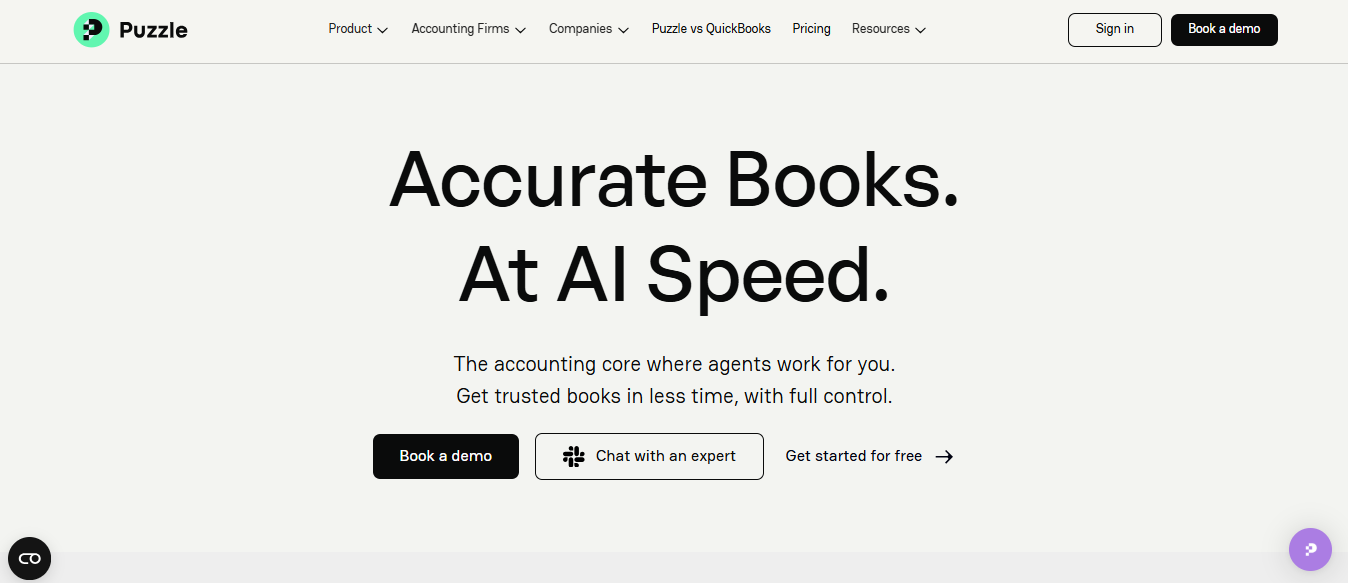
Puzzle takes a different structural position: rather than a legacy ledger with AI features added, it is a double-entry general ledger built around AI from the start. The practical effect is that categorization, reconciliation, and much of the close sequence are drafted automatically. Transaction data streams in continuously through native connections to Stripe, Mercury, Brex, Ramp, Gusto, Rippling, and Bill.com, plus broad bank coverage through Plaid, so financial statements update as the business runs rather than in a monthly batch.
The trade-off is that Puzzle is a ledger, not an e-commerce suite. It does not replace a settlement connector for marketplace payouts, and it is not an inventory management system. You are choosing a modern ledger that scales as you add revenue models with the understanding that you’re pairing it with the channel tooling you may need later, rather than buying an all-in-one built exclusively for physical product.
Where It’s Strong
- The AI-native ledger produces continuously current financials with approval-gated automation, so you get speed without giving up control.
- Simultaneous cash and accrual views from a single ledger solve a reporting problem that legacy platforms handle awkwardly at best.
- Because it is general-purpose, it handles subscription and service revenue alongside product sales without workarounds.
Where It’s Limited
- It is US-only with no multi-currency support, which rules it out for brands holding foreign balances.
- It does not file taxes or run payroll, so those stay with separate providers.
- Inventory and marketplace settlement still require complementary tooling, so it is not a single-vendor answer for a pure product brand.
Pricing: Free under roughly $20K in transaction volume, with paid tiers being about $30/month up to roughly $300–$360/month for the top plan. Revenue recognition unlocks on the mid-tier plan.
Best fit: Founders who want to own their ledger, are running or heading toward mixed revenue models, and value real-time visibility over a fully outsourced close.
Finaloop
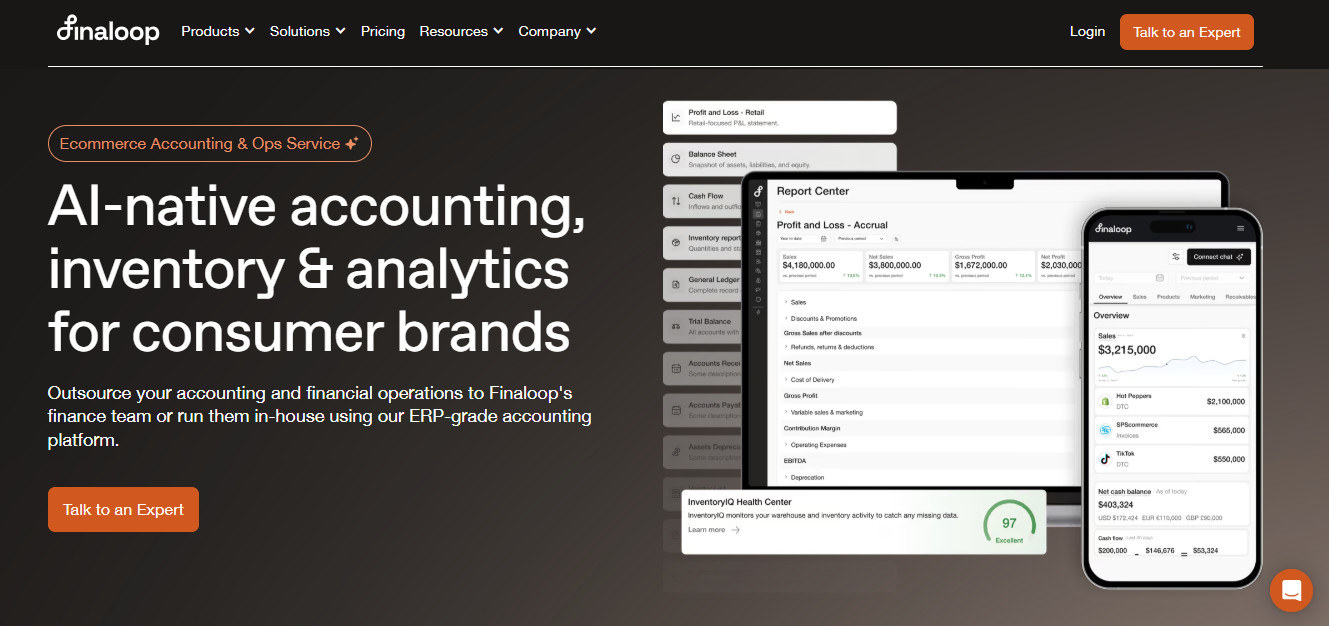
Finaloop is purpose-built for consumer brands and sits closest to the “done-for-you” end of the spectrum. It replaces the accounting software, the bookkeeper, and in many cases the inventory tool with a single platform staffed by accountants who work in e-commerce all day. Integrations run natively to Shopify, Amazon, TikTok Shop, Etsy, eBay, Faire, and the major payment processors, so you are not buying a separate bridge to get settlement data into the ledger.
The differentiator is real-time close. Books update continuously rather than sitting in a queue until the tenth of the following month, and inventory and COGS are tracked inside the same system that produces the financials, which eliminates the reconciliation gap that opens up when your inventory tool and your ledger disagree.
Where It’s Strong
- Multi-channel payout reconciliation is native, so you avoid paying separately for a settlement connector on every channel you add.
- Inventory and COGS live inside the accounting platform rather than in a bolted-on tool, which keeps gross margin trustworthy.
- Every plan includes access to accountants who actually understand e-commerce, which is a meaningful difference from generic support.
Where It’s Limited
- The platform is built around e-commerce and retail, so subscription, SaaS, or service revenue is handled poorly or not at all.
- Reporting is relatively lean compared with a general-purpose ledger, and heavy wholesale or B2B activity strains this platform.
- It is a proprietary platform, so you should ask direct questions about data portability before you commit.
Pricing: Revenue-banded. Core runs roughly $245/month under $1.5M in annual sales, scaling to about $415, $745, and $995 as you cross $3M, $6M, and $10M, with a one-time implementation fee near $850. Premium adds controllership and dedicated management starting around $850/month. Basically, it’s a great platform, but it’s going to cost you.
Best fit: Pure-play e-commerce brands between roughly $1M and $10M who want the books handled and are willing to pay for it.
QuickBooks Online + A2X
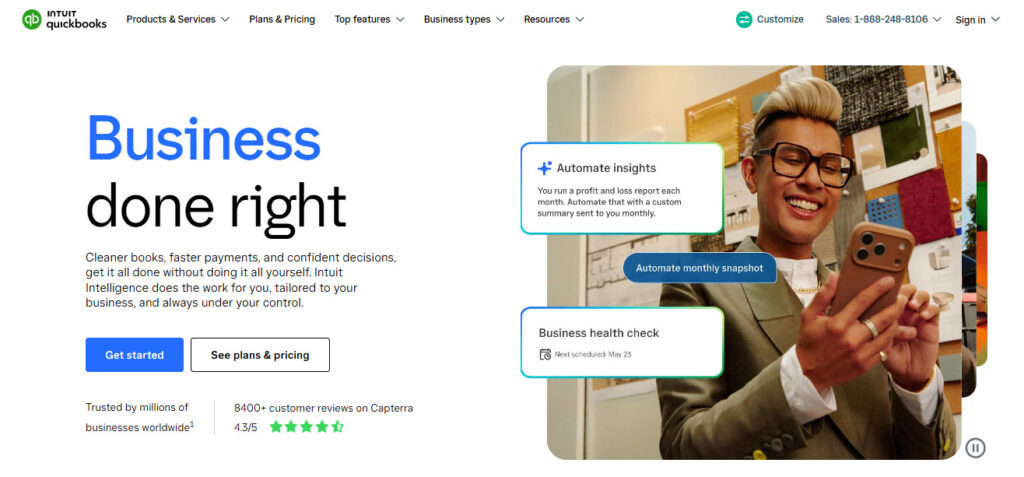
This is the incumbent stack, and it earns its position. QBO is the most widely supported ledger in the United States, which means your CPA already knows it, your lender already accepts its output, and virtually every app you might ever want integrates with it. What it does not do is understand e-commerce natively. QBO has no serious marketplace connector, and pushing raw order data into it stops working somewhere past a few hundred orders a month.
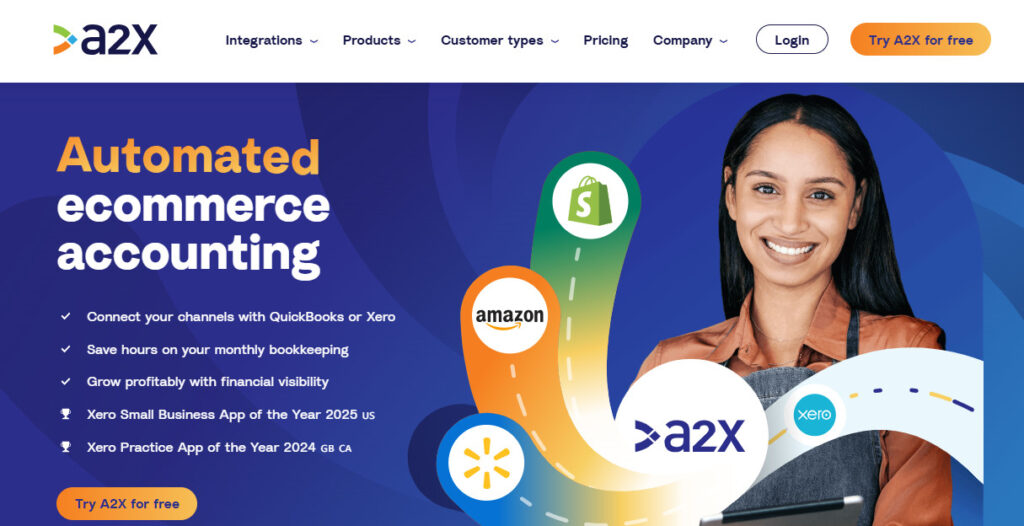
A2X fills that gap. It sits between the channel and the ledger, pulls the settlement detail, splits it into the correct accounts, and posts one summarized journal entry per payout period that reconciles cleanly against the bank feed. It is not a bookkeeping platform and does not pretend to be. It solves the lump-deposit problem, and it solves it well.
Where It’s Strong
- The combination produces clean books, with revenue, fees, refunds, and reimbursements landing in separate accounts by period.
- QBO’s ecosystem depth means you can add payroll, bill pay, inventory, or sales tax tooling without leaving the stack.
- Your books stay in an account you own, which matters if you ever change accountants or raise outside capital.
Where It’s Limited
- Cost compounds with growth, because A2X prices by order volume and channel count on top of your QBO subscription.
- You are assembling and maintaining a stack rather than buying a system, and the integration points are yours to monitor.
- Real inventory depth still requires a third layer, since neither QBO nor A2X is a serious inventory management system.
Pricing: QBO plans generally run $38 to $250+/month depending on tier. A2X starts around $29/month for a single low-volume channel, with multi-channel plans commonly landing in the $89 to $229 range and climbing well past that at high order volume. Basically said, it can get surprisingly expensive quickly.
Best fit: Founders who already have a bookkeeper or accountant and want a conventional, portable, lender-friendly ledger.
Xero and A Connector
Xero is the same architectural bet as QBO with a different personality. It is a clean, well-designed general ledger with a strong app marketplace and, notably, better multi-currency handling on its upper tiers. This matters if you are selling into Canada, the UK, or the EU and holding balances in more than one currency.
Like QBO, Xero needs a bridge. A2X, Link My Books, and similar connectors all support it, and the resulting stack looks nearly identical in structure to QBO. The practical difference is regional: Xero has deeper roots outside the US, and if your accountant is in Australia, New Zealand, or the UK, it is often the path of least resistance.
Where It’s Strong
- Multi-currency support on higher plans is more capable than what you get from comparable US-first ledgers.
- The interface and bank reconciliation workflow are cleaner than most competitors, which lowers the cost of doing your own review.
- Unlimited users on all plans means you are not penalized for giving your bookkeeper, CPA, and ops lead access.
Where It’s Limited
- US sales tax and payroll support is thinner than QBO’s, which is a real friction point for domestic multi-state sellers.
- The same connector-per-channel economics apply, so cost scales with channel count just as it does on the QBO stack.
- Some US-based accountants and lenders are less fluent in Xero, which can slow diligence and lending conversations.
Pricing: Roughly $29/month for Starter, $46 for Standard, and $69 for Premium, plus your settlement connector on top. When it’s all said and done, you can expect it to be cheaper than QBO, but there are feature tradeoffs due to that.
Best fit: Multi-currency or internationally oriented brands, and founders whose accountant already works in Xero.
Synder
Synder occupies the same layer as A2X as it moves channel data into your ledger, but it makes a different bet. Where A2X goes deep on marketplace settlements, Synder goes wide, connecting 30+ sales channels and payment processors including Shopify, Amazon, eBay, Etsy, WooCommerce, Square, Stripe, and PayPal, then posting into QuickBooks Online, Xero, Sage Intacct, or NetSuite. If your revenue runs through a storefront, two marketplaces, a Stripe subscription, and a Square terminal at pop-ups, that breadth is the argument.
The other real difference is granularity. Synder can sync per transaction, with each sale posting as its own receipt or invoice with line-item detail, SKU, taxes, and fees, or it can aggregate into daily or payout-period summaries. Per-transaction detail is useful for SKU-level and channel-level margin analysis, and Synder layers its own reporting on top so you can slice profitability by platform or product. It also carries Smart Rules for automated categorization, duplicate detection with rollback, multi-currency handling, a revenue recognition module for subscription income, and SOC 2 Type II certification.
Where It’s Strong
- Channel and processor coverage is the broadest in the category, so you are not adding a second connector when you open a new sales channel.
- Per-transaction sync preserves SKU and customer detail, which makes channel-level and product-level margin analysis possible without a separate BI layer.
- Multi-currency support is unusually capable for a connector, so it’s a big plus for anyone dealing internationally
Where It’s Limited
- The default methodology routes sales through a clearing account that you still reconcile against bank deposits separately, which is more month-end work than a settlement-matched entry.
- Per-transaction sync inflates general ledger volume quickly, and at high order counts most accountants will push you toward summary mode anyway.
- There is a steeper learning curve than single-purpose connectors, and some users flag friction with annual contract terms, so read the agreement before you pay.
Pricing: Roughly $65/month for Basic, $115 for Essential, and $275 for Pro, with Premium quoted custom. Tiers gate on monthly transaction volume and integration slots, and overage is billed separately, so estimate against your actual order count rather than the headline price.
Best fit: Multi-channel founders whose revenue is spread across more platforms and processors than a marketplace-focused connector cleanly supports.
Making the Call
It comes down to one question: how much of the accounting do you want to own?
Almost none, and you sell physical product exclusively, consider Finaloop. For control, real-time numbers, and a ledger that will not box you in as the revenue mix evolves, try Puzzle. If you have a bookkeeper and want a conventional, portable ledger, then utilize QBO or Xero, paired with A2X if your volume sits in marketplaces, or Synder if it is scattered across more channels and processors.
Whichever way you lean, test it against your own data. Connect one live channel, close a real month, and see whether the gross margin it produces matches what you know to be true. That tells you more than any comparison table, including this one.