


Last Updated on May 29, 2026 by Ewen Finser
Boost Mobile has carved out a niche for itself in the prepaid cellphone market, especially given that its $25/month ‘unlimited’ plan is available for $10/month for the first three months.
Still, an affordable wireless carrier isn’t necessarily one that’s reliable or delivers the best speeds.
The prepaid space has gotten genuinely competitive in the last few years, and several of Boost’s rivals are now offering more for the same money – sometimes even for less.
Why Consider Boost Mobile Alternatives?
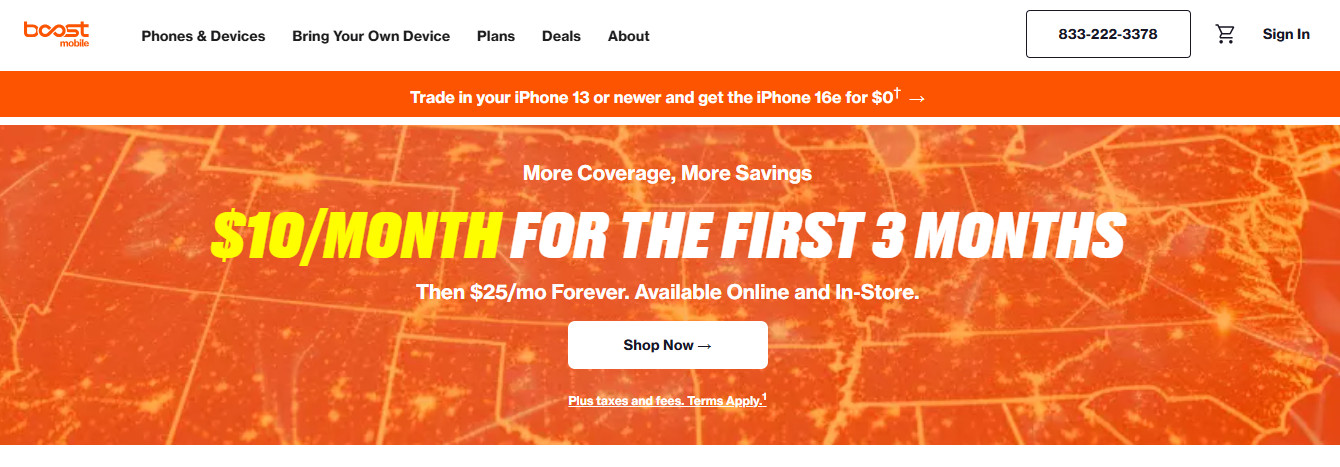
Boost Mobile‘s main appeal lies in its pricing: at $25 per month with autopay (and indeed $10 for the first three months), the baseline ‘unlimited’ plan is very hard to argue with on paper.
But when you drill into the details, you’ll find a few things which are worth knowing before committing to an ongoing subscription.
Boost runs on a hybrid setup. Admittedly, it has its own 5G network, which covers roughly 80% of the population. However, where its reach doesn’t extend, it has to top up its coverage with roaming agreements from T-Mobile and AT&T.
This doesn’t automatically mean worse day-to-day coverage or call quality, but in April 2025 the National Advertising Division stated that Boost’s claim of offering 99% 5G coverage in the USA didn’t seem to be supported by the evidence available at the time. Boost Mobile agreed to modify its advertising in line with the NAD’s recommendations.
Ookla research in the same month showed that while Boost Mobile’s network performance had improved, it still wasn’t on a par with major competitors when customers used its 5G infrastructure.
On the subject of speed, Boost Mobile’s main prepaid plans offer a certain amount of ‘Premium’ data – for instance, the lowest tier is 30 GB, after which speeds are throttled to 512 Kbps. This is enough for basic web surfing, but you’d be very unlikely to stream HD/4K videos smoothly.
Bottom Line Up Front
Metro by T-Mobile is one of the strongest overall alternatives to Boost Mobile, especially for users who prioritize T-Mobile’s network and in-person support.
I’ve previously examined both carriers’ offerings in-depth when compared to each other, and T-Mobile offers multiple advantages. Its entry-level price plan is higher than Boost’s ($40/month), but you can bring this down to as little as $25/month per person by leasing four lines.
Metro runs directly on T-Mobile’s nationwide 5G network, whereas Boost relies on a mix of its own infrastructure and roaming partnerships in some areas.
Data also isn’t throttled, though on some plans it may be deprioritized behind customers on branded T-Mobile subscriptions during times of peak network congestion.
Metro isn’t necessarily the perfect solution for everyone: For instance, Visible by Verizon offers more generous hotspot allowances on its main prepaid plans. Competitors like Boost Mobile and Mint can also undercut Metro on pricing for certain subscriptions.
Read on for a full breakdown for what Boost Mobile alternatives like these have to offer.
Top Mistakes When Choosing a Wireless Plan
There are some common pitfalls that can trap anyone shopping around for a prepaid wireless plan. These can include:

Comparing “Unlimited” Plans at Face Value
This word doesn’t mean the same thing to every wireless carrier. For example, we’ve already learned that Boost awards subscribers a certain amount of ‘premium’ data, after which speeds are throttled to 512 Kbps. ‘Unlimited’ plans may also only apply to web data you access directly on your phone, not when you use it as a hotspot, where a quota may apply. Traffic may also sometimes be ‘deprioritized’ behind that of other users, as Metro does to customers in favor of postpaid T-Mobile subscribers on certain plans when network congestion is heavy.
Ignoring Network Ownership vs. Network Access
There is a huge difference between a wireless carrier, like say, T-Mobile, and another carrier that resells its infrastructure wholesale. For instance, while it does have its own 5G infrastructure, Boost Mobile is technically a mobile virtual network operator (MVNO) on two wholesale networks, which means its prepay customers’ traffic may sit behind postpaid customers in congestion priority in some setups.
Not Accounting for Taxes and Fees
While certain carriers will quote prices inclusive of taxes and fees, others may only display before-tax prices. If you’re not careful, you may only see that extra $3 to $8 on your bill after you’ve signed up.
Choosing a Carrier Without Checking Domestic Coverage First
While no carrier covers every area equally, most major providers have a feature on their website to let you input your zip code to check coverage in your area before signing up. Make use of this, and check online reviews from people in your area to get a clear idea of signal strength.
Locking Yourself Into a 12-Month Plan Without Testing First
Certain wireless carriers, like Mint Mobile and US Mobile, offer deals that require an upfront payment for an annual subscription. If, for any reason, you find the plan isn’t working for you, then you may be able to apply for a prorated refund, but it’s far easier to sign up for a plan for one month to test it instead, then decide if you want to continue.
Metro by T-Mobile
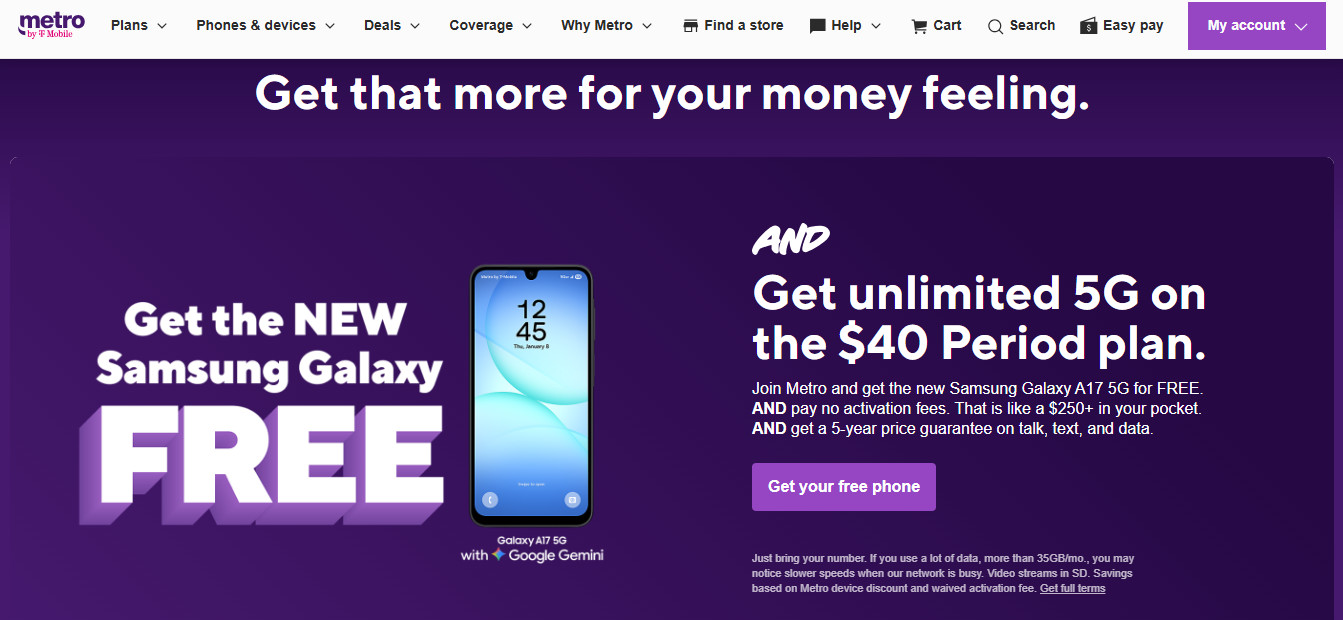
- Five-year price lock on talk, text, and data
- Main advertised plans include all taxes and fees
- Operates directly over T-Mobile’s 5G network
- Data deprioritized in favor of postpaid T-Mobile customers on some plans
- Phone selection and upgrade flexibility isn’t as strong as some competitors
Metro’s main advantage is that it runs on T-Mobile’s nationwide 5G network. This is the same infrastructure used by T-Mobile’s own customers, not a wholesale leasing arrangement. This can be an important distinction if you’ve used a hybrid carrier like Boost in the past and experienced problems with device handoff between different networks.
Metro is best for people who want a prepaid wireless solution for a similar price to Boost Mobile but with more reliable network performance.
While the main entry-level prepaid plan costs $40/month for a single line, unlike Boost Mobile’s listed prices, this includes all taxes and charges. You can also avoid the data deprioritization problem by signing up for a top-tier plan ($60/month), in which case your traffic will be treated in the same way as postpaid T-Mobile customers.
Metro offers hundreds of physical stores people can visit if they want to activate their line there (there’s an extra fee for this, though) or troubleshoot any issues.
While Boost also has an extensive store network, Metro’s advantages include the fact that its prepaid plans don’t automatically throttle data past a certain threshold. Depending on the plan, subscribers can also benefit from discounts through ‘T-Mobile Tuesdays,’ 100 GB of Google One Storage, and even Amazon Prime membership.
Keep reading: Metro by T-Mobile Review 2026: Plans, Speeds, Hotspot Limits & Value
Cricket Wireless
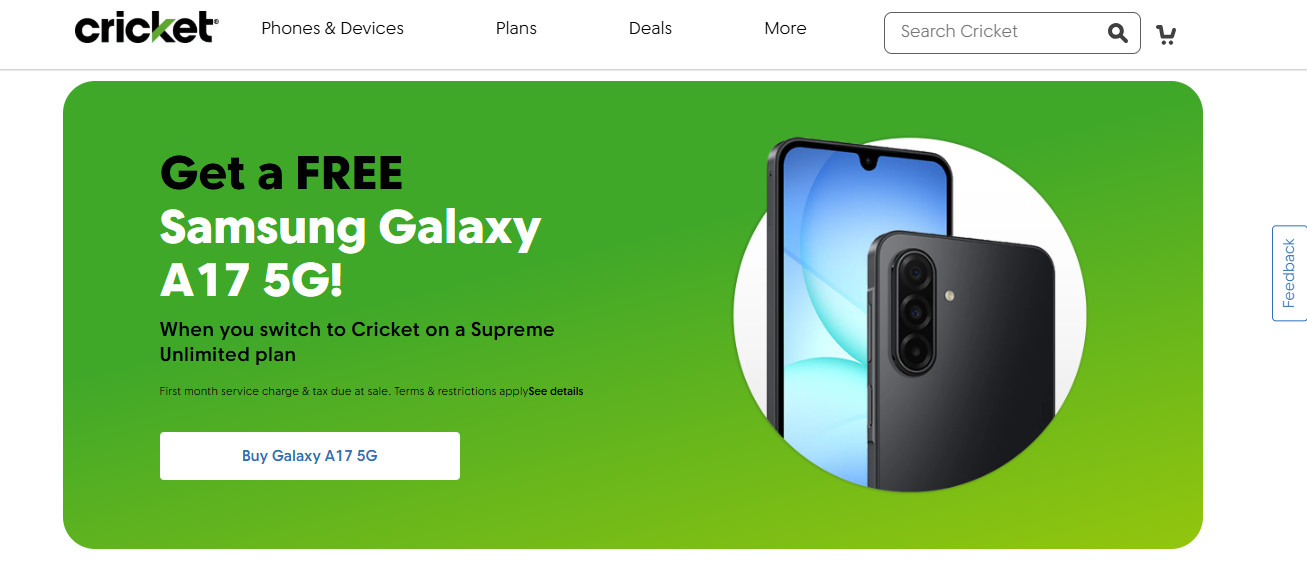
- Runs on AT&T’s full network. Strong rural coverage.
- Multi-month prepay option (12 months) brings down cost of unlimited plans
- Reasonably generous hotspot allowances on certain plans
- Video streaming capped at SD (480p)
- Higher first-month costs
- Data deprioritization can apply during congestion
Cricket is AT&T’s prepaid offering, which can matter if you’re in a location where AT&T offers better coverage than competitors like Verizon or T-Mobile, such as in rural areas.
Prices start at $35/month (with autopay), but its mid-tier ‘Smart Unlimited’ plan ($45/month) is worth considering, as it includes 100 GB of cloud storage and 15 GB of hotspot data. Whatever subscription you choose, government taxes are included, but there’s a surcharge for the first month’s payment, e.g., $40 for the first month on the $35/month plan.
Cricket Wireless is best for those who are in rural areas or other regions where AT&T has better coverage, as well as those who are happy to subscribe to a MVNO but want a brand name with bricks-and-mortar support.
Using AT&T’s infrastructure means that Cricket Wireless likely won’t suffer any network switching issues that can occur when using a hybrid setup like Boost Mobile’s. Pricing tiers are clearly laid out, and if you’re willing to subscribe to a multi-month plan, fees work out to around the same as Boost Mobile’s per-month.
That said, traffic on both Cricket’s “Select Unlimited” and “Smart Unlimited” plans mentioned above can be deprioritized when the network is busy. Streaming video is also limited to Standard Definition (SD).
You can avoid deprioritization by signing up for Cricket’s most expensive “Supreme Unlimited” plan ($55/month), but even on this subscription, video may still be limited to SD.
Visible by Verizon
- Runs on Verizon’s 5G and 4G LTE network, extensive US coverage.
- Taxes and fees are included on all main prepaid plans.
- Visible+ and Visible+ Pro offer unlimited premium data with Verizon’s 5G Ultra Wideband and unlimited hotspot
- Entry-level plan limited to SD video, and hotspot speeds are capped at 5 Mbps
- No physical store presence
Visible is Verizon’s fully digital prepaid brand. The underlying network is Verizon’s full 5G and LTE infrastructure. That makes it a sensible choice for subscribers in areas where Verizon’s coverage outmatches that of other carriers like AT&T.
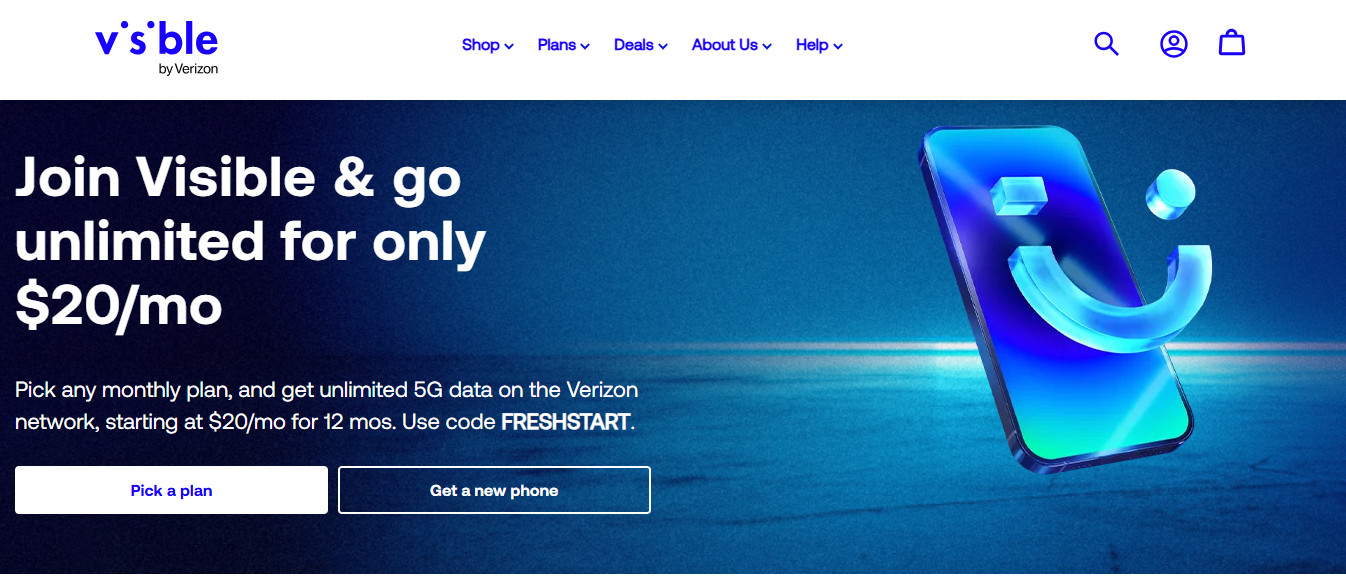
There are three main prepaid plans. The entry-level subscription costs $20, including taxes. For this, you get unlimited data, talk, and text, but video is limited to 480p (SD quality), and hotspot speeds are capped at 5 Mbps.
The mid-tier ‘Visible+’ subscription costs $30/month and includes HD video and ‘premium’ data speeds. Unlike many other prepaid plans, Visible includes unlimited use of your phone as a hotspot, though speeds will vary depending on your pricing tier.
This makes Visible a good choice for customers who want Verizon’s coverage footprint with a no-contract, all-in price and genuinely unlimited data without throttling on the premium tiers.
Unfortunately, there’s no in-store support, so line activation and any troubleshooting have to be done online, unlike with Boost. Visible’s entry-level plan also restricts hotspot speeds more severely than Boost Mobile’s.
Mint Mobile
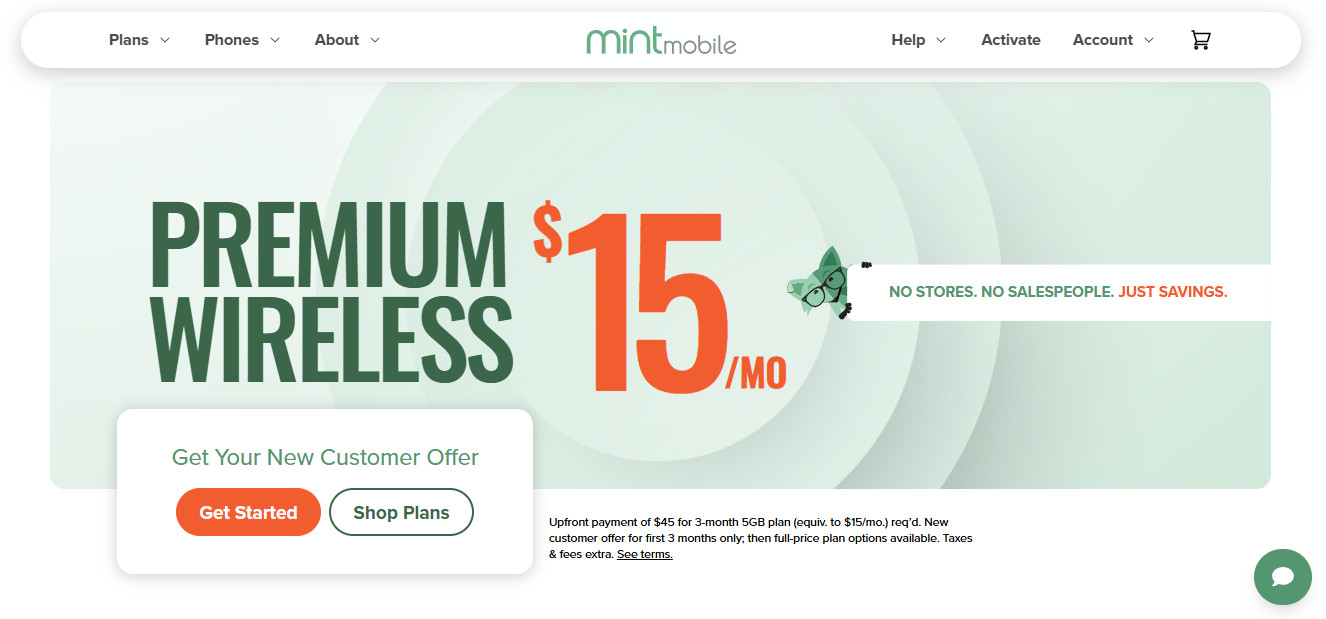
- Runs on T-Mobile’s 5G network
- Introductory rate for unlimited plans of $25/month when paid per quarter
- 7-day money-back guarantee
- 3-month prices are promotional rates and can increase
- Taxes and fees aren’t included in prices
- Video ‘optimization’ limits quality to SD and deprioritization for ‘Heavy Data’ users
Mint Mobile is a T-Mobile MVNO (and as anyone who’s seen the commercials starring Ryan Reynolds will tell you), the carrier has built a loyal following centered on one pitch: pay upfront for a fixed-length subscription to save money.
For instance, the introductory rate for Mint Mobile’s three-month ‘Unlimited’ plan works at $25/month ($75 paid upfront). However, this is an introductory rate, after which the standard monthly price of $40/month applies.
Mint Mobile doesn’t automatically throttle all web traffic for users of its plans, but its ‘video optimization’ limits streaming to around 1.5 Mbps, which will likely result in SD video. The carrier’s “network management policy” also states that “heavy data” users who go over 50 GB per month may find their traffic is deprioritized.
Nevertheless, it remains a particularly solid choice for light-to-moderate data users who want T-Mobile’s network without T-Mobile’s prices.
T-Mobile’s mobile 5G network is also well-established, and Mint’s per-month cost for annual plans undercuts Boost’s by a meaningful margin.
There’s a 7-day money-back guarantee, but you may need longer than this to establish if coverage works well in your area.
Straight Talk
- Available in Walmart stores nationwide
- Multiple network options (AT&T, T-Mobile, Verizon)
- Gold plan includes truly unlimited data and generous hotspot allowance
- Plan structure can be confusing
- Certain plans have a high-speed data cap
- No price-lock guarantee
Straight Talk is Walmart’s house-brand prepaid carrier. Its main advantage is accessibility, as you can buy a plan refill card at any Walmart checkout lane.
It also offers a way to access top-tier infrastructure, like Verizon or T-Mobile’s, without paying premium prices.
The ‘Gold Unlimited’ plan ($55/month) truly is unlimited, comes with 30 GB of hotspot data, and even Walmart membership, which includes a subscription to either Paramount+ or Peacock.
Other pricing plans don’t offer as good value for money relative to Boost Mobile’s, such as ‘Silver Unlimited’ ($45/month). Network quality and coverage will also vary depending on which SIM you buy.
US Mobile
- Choose your network: Dark Star (AT&T, Light Speed (T-Mobile), or Warp (Verizon)
- Entry-level plan ($25/month) includes taxes and fees
- Annual plans offer very competitive pricing
- No physical stores
- Auto-renewal rates can jump
- Best pricing requires annual upfront payment
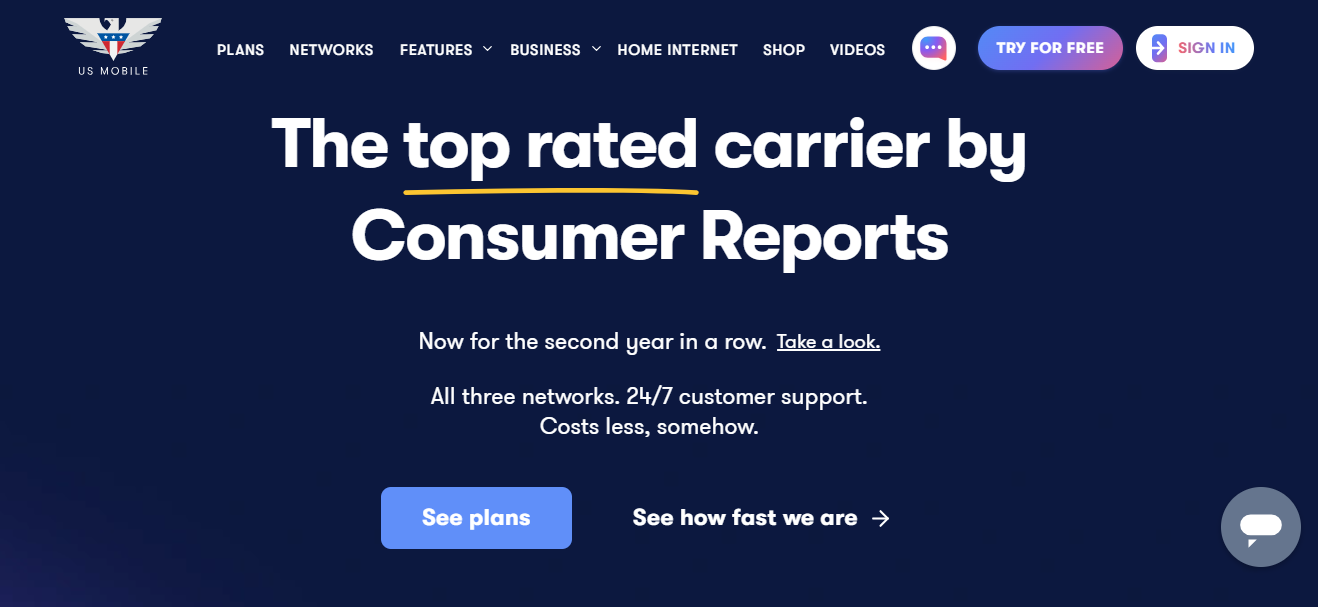
US Mobile has positioned itself as the “super carrier”: an MVNO that offers access to all three major US networks.
The ‘Unlimited Starter’ plan is just $25/month with tax and includes unlimited ‘high speed’ data (network dependent) and 20 GB of hotspot data.
The ability to choose your own network depending on your location is useful. You can also pay $2 to switch networks, or $10/month for a second line on another network, so you can switch between them.
This can get a little complicated, which means US Mobile is a better option for tech-savvy users who want maximum control over their network and plan, and are willing to do some homework upfront.
For best value for money, you can sign up for an annual plan, but this requires an upfront commitment, and renewal rates can cost more than your original subscription.
My Verdict
I stand by my original assessment that Metro by T-Mobile is the strongest offering of all the alternatives to Boost Mobile reviewed here.
It not only matches Boost closely on price, depending on your chosen plan, but this is backed by a five-year guarantee. It also offers a network of physical stores you can visit to set up your line and troubleshoot any issues.
Although traffic may be deprioritized behind postpaid T-Mobile customers on some plans, there’s no automatic throttling of traffic, and hotspot allowances are generous. Piggybacking on T-Mobile’s infrastructure means Metro customers are also likely to enjoy good coverage.
That said, the best prepaid wireless plan for you will always depend on your needs, location, and budget. For instance, Visible by Verizon may be a better choice if you’re in an area where the carrier offers better coverage, or you need large amounts of hotspot data. US Mobile’s also a good option if multi-network flexibility matters.
Mint is great for annual planners who want rock-bottom pricing with no-frills. Straight Talk is ideal for anyone who’d rather solve their phone problem at Walmart than spend time online comparing plans. Cricket is AT&T’s prepaid answer for customers in those rural areas where AT&T out-covers the competition.
Each of these carriers approaches prepaid service a little differently, whether that means stronger hotspot allowances, simpler pricing, broader coverage, or more flexibility around network access. The best fit ultimately depends on your location, usage habits, and budget priorities. That means you can often get the same kind of value for money Boost Mobile offers for its entry-level $25/month plan without any of the potential pain points.