


- The Best Rate Shopping Software Tools Compared
- What To Look For in Rate Shopping Software
- 1. Shippo: The Best Starting Point for Most Sellers
- 2. ShipStation: Best for High-Volume Enterprise Businesses
- 3. Easyship: Best for International Sellers
- 4. ShippingEasy: Best for Simple Rate Shopping (U.S.-Based Sellers Only)
- 5. EasyPost: Rate Shopping for Custom Systems
- Which Rate Shopping Software is Best for Your Team?
Last Updated on June 9, 2026 by Ewen Finser
FTC Disclaimer: We do make money from this blog and may receive compensation for this work in the form of commissions, fees and complimentary product access. Review our full FTC disclosure here.
I used to use USPS for everything, but when I finally did the math on rate comparisons across multiple shipping carriers, I realized I could be doing better.
Rate shopping software (and shipping software) helps you compare prices in real-time. They help you know what you’re actually paying, and what you could be paying instead, by comparing carriers for you. You can even automate the prices that you want to pay (max or minimum) based on weight and size, so you’re always shipping at the right price.
If you’re still manually checking rates or just picking the same carrier out of habit, you’re leaving real money on the table. Here’s what’s actually worth your time in 2026.
The Best Rate Shopping Software Tools Compared
Software | Best For | Carrier Access | Rate Shopping Strength | Pros | Cons |
SMB eCommerce sellers | 40+ carriers | Real-time comparison, simple setup | No volume minimums or contracts, easy to use, full features | Limited analytics | |
High-volume operations | Broad (many carriers) | Advanced automation rules | Deep automation + workflows | Setup complexity, cost | |
International shipping | 550+ carriers | Strong global rate visibility (duties and taxes included) | Duties/taxes built into rates | Heavier interface | |
U.S.-focused SMBs | 3 carriers | Simple and reliable | Simple setup + automation | Limited carrier range | |
Custom-built systems | 100+ carriers | Fully customizable via API | API-level control | Requires development |
What To Look For in Rate Shopping Software
Most software comparison posts will tell you to evaluate “scalability” and “robust feature sets.” That’s not helpful. Here’s what actually matters when evaluating one of these tools:

Real-Time Multi-Carrier Comparison
This is the whole point of the category. If the rates aren’t live and pulling from multiple carriers at once (USPS, UPS, FedEx, and DHL at minimum), the tool isn’t doing its job.
Delayed estimates or a thin carrier roster defeat the purpose entirely. Double-check coverage if you ship internationally, because that’s where gaps tend to show up.
Access to Discounted Rates
Some platforms bury their best rates behind volume commitments or require you to bring your own carrier contracts. For a bootstrapped seller who’s not shipping 10,000 packages a month, that’s a dealbreaker.
The platforms that offer pre-negotiated rates with no minimums are the ones worth paying attention to first.
Automation Capabilities
Once you’ve set your preferences (lowest cost under 2 lbs, 2-day for orders over $150, whatever your logic is), you shouldn’t have to make that call again every single time.
Good automation rules handle that in the background, and this matters more the more orders you’re processing.
Multi-Channel Order Syncing
If you’re selling on Shopify, Amazon, Etsy, and eBay all at once, you need one place where all those orders show up. Jumping between platforms to manage shipping is a time sink you can’t afford.
International Shipping Support
For cross-border orders, you want built-in handling of duties, taxes, and customs documentation. Quoting a customer one price and watching their package get held up because landed costs weren’t accounted for is an awful experience, for them and for you.
Ease of Use
A tool that requires a week of onboarding and a dedicated ops person to maintain is not a tool for a solo or small-team operation. The best platforms make shipping feel like the easiest part of your workflow, not a project that needs managing.
1. Shippo: The Best Starting Point for Most Sellers
If you’re running a small to mid-sized store and want to stop overpaying for shipping without rebuilding your entire workflow, Shippo is where I’d start. It’s been around since 2013 and has gotten genuinely good at being the most practical option in the room: not the flashiest, but reliably solid for what most sellers actually need.
The thing that sets it apart for bootstrapped sellers specifically is that discounted rates across 40+ carriers are available with no volume minimums and no requirement to bring your own carrier accounts. You can start saving on your first label, not after you’ve hit some threshold that doesn’t apply to you yet.
Shippo also includes API access on all plans, including the free tier, which is worth noting if you ever want to build on top of it down the road.
Setup is fast, the interface is clean, and it connects to basically every major sales channel: Shopify, Amazon, Etsy, eBay, Walmart, Wix, Squarespace, and more. Automation rules are simple to configure and cover most common scenarios without requiring you to think too hard about them.
The reporting is basic, and that’s probably the most legitimate knock against it. If you need deep analytics on shipping performance across multiple warehouses or teams, you’ll hit a ceiling. For most sellers, though, the data available is more than enough.
Pros:
- Real-time comparison across 40+ carriers
- Discounted rates available immediately, no volume commitments
- Fast, intuitive setup with minimal learning curve
- Strong integrations across all major platforms
- API included on all plans
Cons:
- Reporting and analytics are pretty minimal
- Not designed for complex, multi-warehouse enterprise operations
2. ShipStation: Best for High-Volume Enterprise Businesses
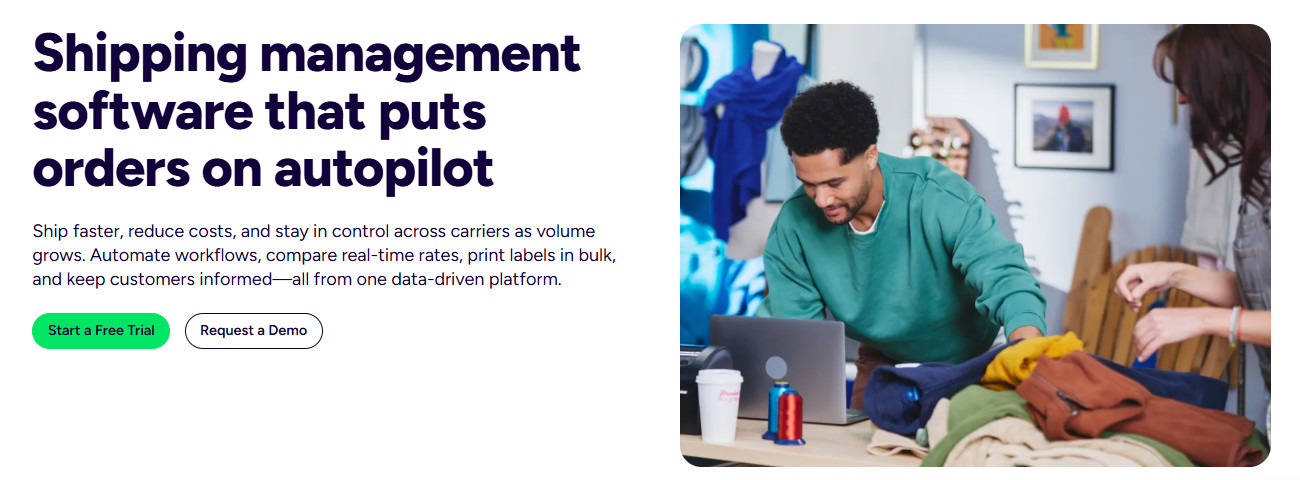
ShipStation has been around since 2011 and was built from the start to handle complexity. The automation engine is sophisticated, and the reporting is thorough.
You can build detailed rule sets that determine how rates are selected based on weight, destination, product type, warehouse location, customer tier, and more. If you’re managing shipping across multiple warehouses or a larger team, it handles that level of coordination well.
What I’d push back on is the assumption that more features means better value for everyone. ShipStation recently tightened its API access, moving it behind Gold and Scale tier plans, which means if you want API access and more than a handful of shipments per month, the cost climbs faster than it used to.
The free plan caps at 10 shipments a month. At 5,000 labels a month, you’re looking at a meaningful monthly cost depending on your tier, and that’s before factoring in the setup time. Someone on your team will need to own the configuration, and it’s not a weekend project.
For the right operation (high volume, complex rules, dedicated ops support) it earns its place.
Pros:
- Sophisticated rule-based rate selection and automation
- Strong reporting and analytics
- Built for multi-warehouse and team-based operations
Cons:
- Steep learning curve and significant setup time required
- API access now restricted to higher-cost plans
- Costs scale up quickly, and can become expensive at volume
3. Easyship: Best for International Sellers
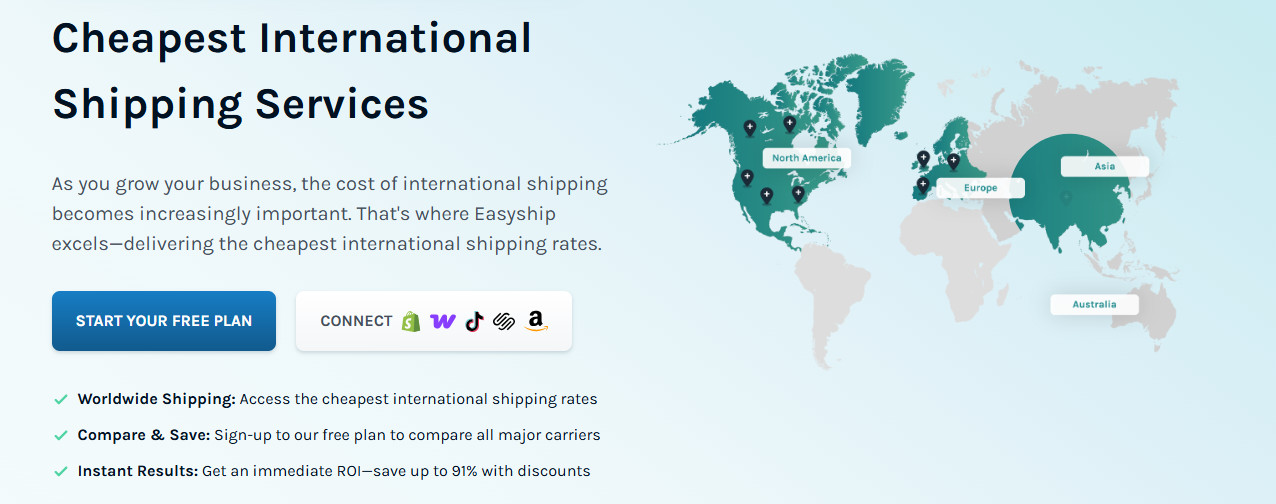
Easyship was built specifically for global shipping: it shows you duties, taxes, and fees upfront alongside carrier rates, at the time of shipping, not after the fact.
It also surfaces dynamic, real-time shipping costs (including taxes and duties) directly to buyers at checkout based on their location, which removes one of the most common sources of post-purchase friction in cross-border commerce.
The carrier network is impressive, covering 550+ couriers globally, including regional specialists like Aramex and SF Express that the other platforms on this list don’t touch. For a seller shipping into Southeast Asia, the Middle East, or Latin America, that depth of local carrier access can make a difference in both cost and delivery reliability.
The tradeoffs are real, though. The interface is heavier and clunkier than Shippo or ShipStation. It’s also more expensive than most alternatives, and if you’re shipping domestic only, there’s really no reason to use it.
Pros:
- 550+ carrier options across global markets, including strong regional coverage
- Duties and tax calculations built into the rate shopping view
- Real-time landed cost shown to buyers at checkout
Cons:
- Overkill and overpriced for domestic-only sellers
- Interface feels heavy compared to the competition
- Higher cost than most alternatives
4. ShippingEasy: Best for Simple Rate Shopping (U.S.-Based Sellers Only)
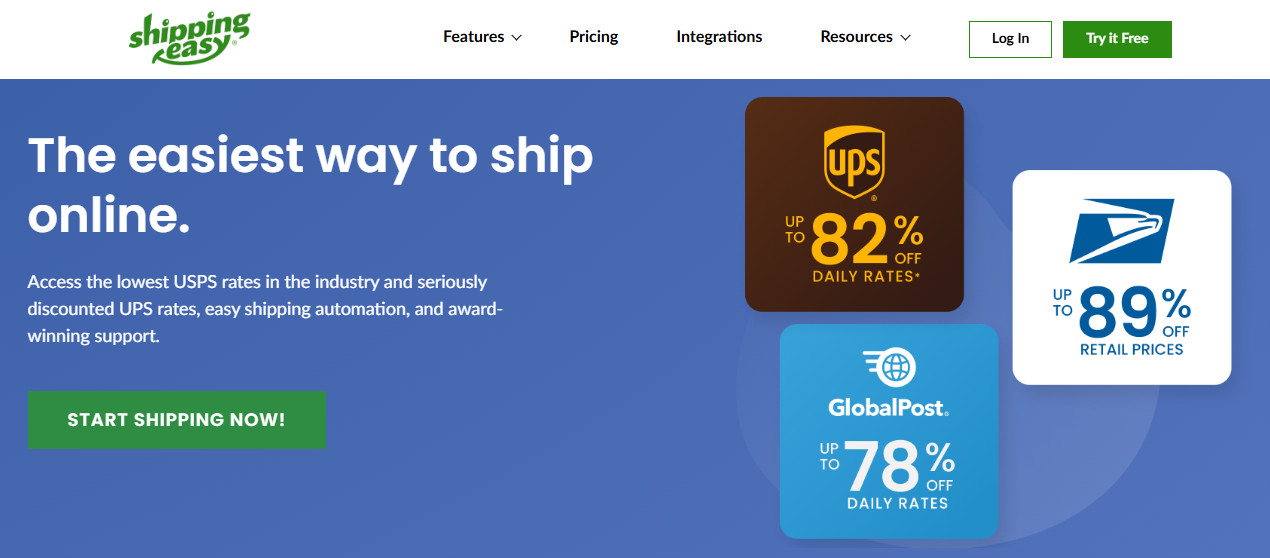
ShippingEasy is straightforward by design. It’s fast to set up, and the automation covers common scenarios reliably.
There’s also a built-in email marketing and CRM layer that the other tools on this list don’t offer. With it, you get customer segmentation, abandoned cart campaigns, and post-purchase email sequences built into the same platform you use to buy labels.
For a small U.S.-based seller who wants to consolidate tools, that bundling has real value.
The carrier limitation is a hard constraint, though. ShippingEasy connects to USPS, UPS, FedEx, and DHL, and that’s largely it. If you ever want to branch into regional carriers, explore better rates through alternatives, or do any international shipping beyond the basics, you might have trouble.
Pros:
- Very fast setup from day one
- Reliable automation for standard domestic scenarios
- Built-in email marketing and customer segmentation tools (genuinely useful)
Cons:
- Carrier selection is limited to major domestic players
- Not flexible enough to scale with a growing operation
- Add-ons can push costs higher than the headline price suggests
5. EasyPost: Rate Shopping for Custom Systems

EasyPost is a different category entirely, being that this is a platform that you will have to build out. If you are a large enterprise business wanting to build a custom logistics system with set-and-forget optimizations, EasyPost may be the solution you are looking for.
Instead of providing a pre-built dashboard that automatically pulls in rates and your orders, it gives you the building blocks to create your own rate shopping system via API. That means you can fully customize how rates are compared and selected, but you will need the know-how or internal developer resources to make it happen.
The platform was also named FedEx’s 2026 Diamond Award winner and Solution of the Year, the highest tier in FedEx’s compatible program, which reflects both the technical depth and the reliability of the integration.
The catch is what you’d expect: there’s no out-of-the-box interface, no orders dashboard, no quick setup. You’re building everything yourself, or you’re not using it at all. For most sellers, that’s a dealbreaker, and it should be.
Pros:
- Full control over rate logic and carrier selection
- 100+ carrier integrations with normalized, consistent API responses
- Highly reliable infrastructure (no monthly fees, pay per shipment)
- Strong FedEx integration specifically
Cons:
- Requires real developer resources to implement and maintain
- No pre-built interface or order management dashboard
- No direct eCommerce platform integrations out of the box
Which Rate Shopping Software is Best for Your Team?
For most eCommerce sellers, the decision comes down to balancing carrier access, ease of use, and how much control you actually need over shipping logic.
Shippo is typically the most practical starting point because it’s easy to use and combines real-time rate comparison across 40+ carriers with pre-negotiated discounts. It does not require volume commitments or separate carrier contracts, and offers most or all of the functionality of other options.
This removes a common barrier for small and mid-sized sellers and allows you to capture savings immediately. It also keeps implementation relatively simple, which reduces operational overhead.
Other platforms are better suited to specific scenarios:
- ShipStation: when you’re running a larger operation, have dedicated ops support, and the automation complexity genuinely justifies the cost and setup time
- Easyship: when international shipping is a core part of your business, and you need landed cost visibility at checkout
- ShippingEasy: when you ship domestic only, need three or four carriers at most, and want email marketing bundled into the same tool
- EasyPost: when you have engineering resources and want to build a fully custom logistics layer that you own and control
Most of the time, though, the edge you’re looking for is consistent execution on the basics: find the best rate, print the label, ship the order. The right platform will (hopefully) make that feel easy and slot neatly into your daily workflow.