


Last Updated on March 10, 2026 by The Digital Merchant Team
In recent years, I’ve watched the monthly close evolve from a standard operating procedure into a liability.
These days, a month is an eternity. Founders who wait until the 15th of the following month to see a report of their previous month’s performance are effectively flying a jet by looking at a map of where they were ten miles ago.
This has naturally given rise to a new generation of intelligent financial systems. Among these, Finaloop has gained significant ground by offering a specialized, automated bookkeeping service tailored primarily for the e-commerce sector. It was designed to solve a very specific, very painful problem: the chaos of multichannel e-commerce data.
Its strength is its marketplace reconciliation, which untangles deposits and matches them to individual orders, providing a clean view of COGS and inventory. As such, it’s a brilliant utility for those whose primary business is moving product. But as business models diversify into AI, SaaS, and hybrid services, many founders find themselves looking for alternatives that offer more than just clean books — they need a platform that acts as a financial brain, providing real-time dashboards, startup-specific workflows, and an architecture built for venture-scale growth.
With that in mind, let’s dive into the top Finaloop alternatives for 2026, with a focus on how these platforms compare across automation, data accessibility, and strategic value.
At a Glance
Provider | Primary Focus | Key Strength | Ideal Stage |
E-commerce / DTC | Automated marketplace reconciliation | Seed to Series A (retail) | |
Venture-backed Tech | Real-time intelligent ledger | Pre-seed to Series B | |
High-growth enterprise | CFO-led hybrid support | Series A+ | |
AI-first finance ops | Full-stack bill pay & accounting | High-growth tech | |
“Main Street” SMB | Simple, cash-basis bookkeeping | Bootstrapped / pre-seed |
1. Puzzle: The Intelligent Operating System for Startups

As a CPA, I find Puzzle’s architecture fundamentally different from almost every other platform on this list. While most services act as a wrapper around an existing ledger or provide a person-in-the-loop experience, Puzzle has built a smart general ledger from the ground up. In the Finaloop world, while automation is high, there is still a reliance on a month-end finalization process. Puzzle has effectively eliminated this.
Because Puzzle utilizes direct API integrations with the modern fintech stack (including Mercury, Brex, Ramp, and Stripe), it doesn’t just scrape transactions; it ingests rich, structured metadata. This allows the platform to perform continuous reconciliation. When a founder logs into Puzzle at 10:00 AM on a Tuesday, they aren’t looking at last month’s data… they’re looking at their live burn rate, their live runway, and their live ARR.
I also love how it handles rev rec. If you sign a $100,000 contract today, your cash position is great, but your accrual revenue must be spread over the life of the contract. Here’s where Puzzle’s automated ASC 606 compliance is a differentiator. Most Finaloop alternatives require manual spreadsheets or expensive third-party tools to manage deferred revenue, but Puzzle automates this directly from your Stripe data.
2. Pilot: The Hybrid Enterprise Solution

Pilot is often the first name founders hear when they look for outsourced accounting, and it’s probably the closest alternative to Finaloop on this list in terms of similarity. Their model is a human-in-the-loop hybrid, where they use proprietary software to automate the data entry but rely on a dedicated account manager to verify the books.
The greatest advantage here is the depth of service. Pilot offers fractional CFO services, complex tax preparation, and R&D tax credit assistance (for the right price, of course). They also use QuickBooks Online as their backend, which ensures that your data is portable to any reputable accounting firm.
However, the human element of Pilot is also its primary friction point. Because a human must ultimately review and close the books, Pilot typically delivers financials on a 15- to 20-day lag. For a high-speed startup, this can feel restrictive. Additionally, Pilot’s pricing starts significantly higher than that of more automated platforms, making it a better fit for Series A+ companies with a dedicated budget for finance.
3. Zeni: The Full-Stack AI Finance Room
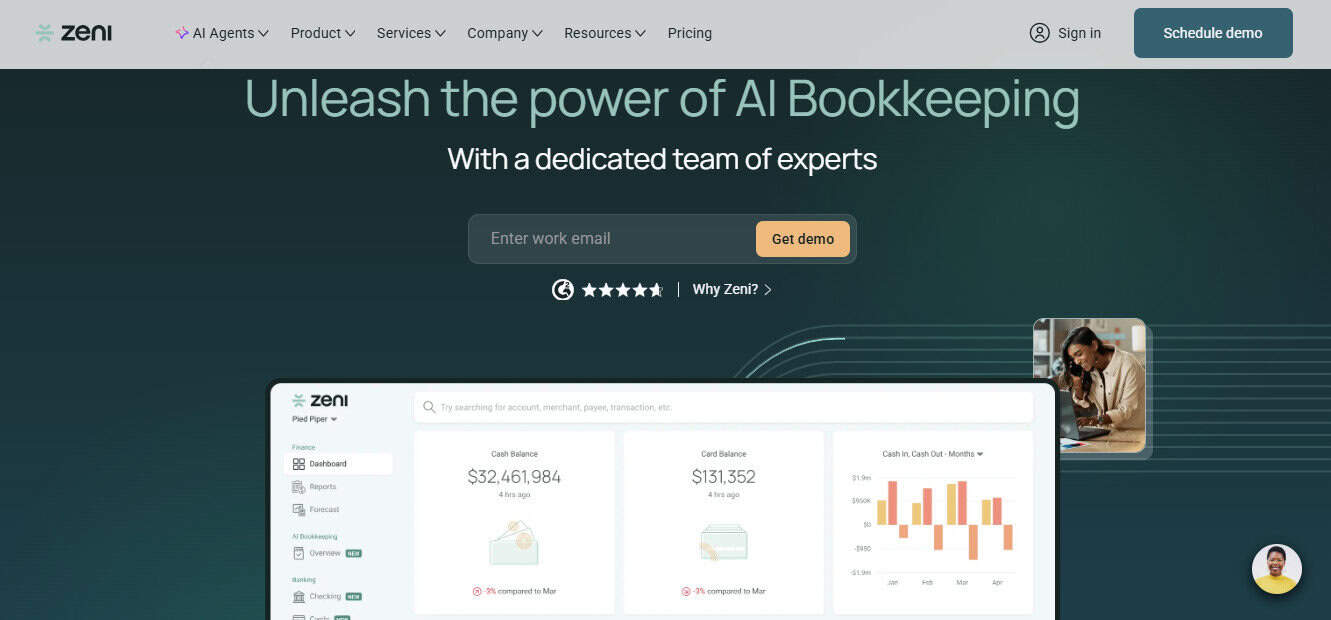
Zeni positions itself as a finance-as-a-service platform, aiming to replace not just your bookkeeper but your bill pay system, your expense management, and your controller. Basically, they want to be your entire back office, and they offer a compelling service and proposal to do so.
They use AI to categorize transactions daily, similar to Puzzle. However, Zeni’s scope is broader, handling bill pay and invoicing as parts of their core service. You may not receive this with some of the other platforms on this list unless you pay for some of the higher-cost subscriptions.
But while Zeni is a very complete solution, it’s also a very closed one. While platforms like Puzzle integrate with the best-of-breed tools you already use (like Ramp or Mercury), Zeni encourages you to move your entire financial life into their ecosystem. For founders who value data ownership and the flexibility to use different tools for different tasks, Zeni can sometimes feel like a cage.
4. Bench: The Simplified Entry Point
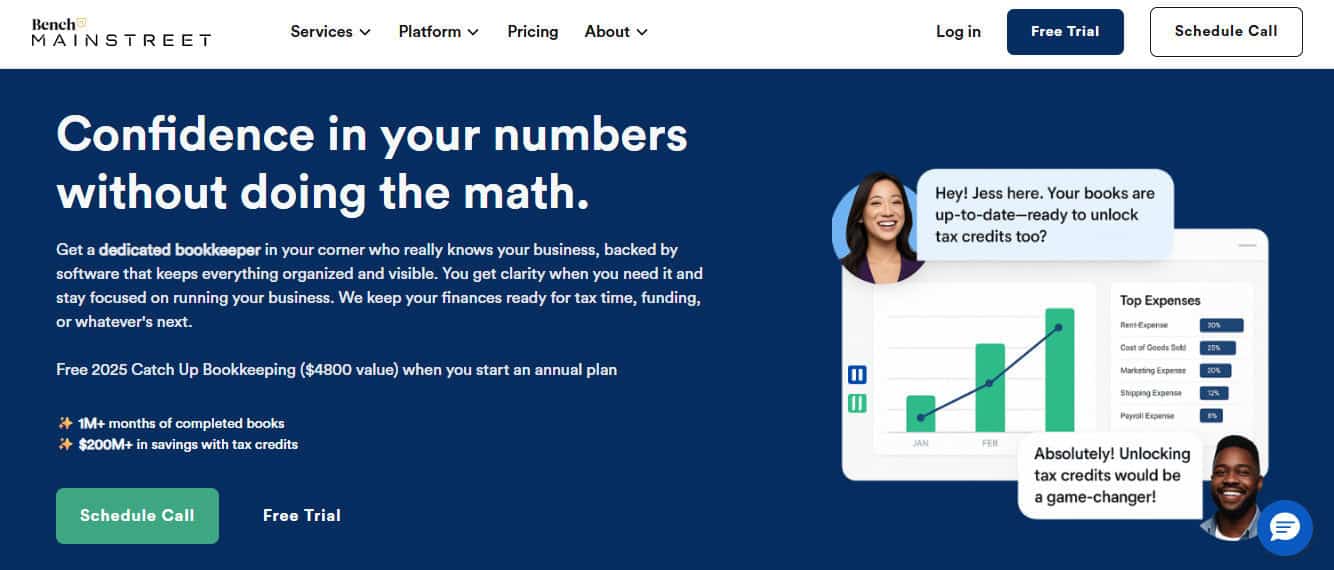
Bench is the old guard of the automated bookkeeping space. They pioneered the idea of a dedicated bookkeeping team paired with a simple, proprietary app.
It’s an exceptionally user-friendly interface that simplifies financial management for entrepreneurs who prefer a straightforward, service-oriented approach to keeping the books. Providing access to a dedicated team of professional bookkeepers, Bench ensures that small business owners receive human oversight and personalized support without the overhead of a traditional accounting firm.
This combination of intuitive software and reliable human expertise makes it an ideal solution for those who prioritize a stress-free tax season and consistently clean financial records over complex, high-velocity analytics — the “Main Street” small business or the solo founder who just needs their taxes done.
However, Bench has a significant limitation for startups: it is cash-basis accounting only.
In the venture world, accrual accounting is the law, so if you intend to raise money from a professional VC, you cannot use Bench. Additionally, because Bench uses its own proprietary software rather than a standard general ledger, exporting your data to a new system as you grow is easier said than done.
The Strategic Choice: Data Ownership and Data Processing

As a CPA, I often tell founders that the most important feature of an accounting platform isn’t the price or how easy it is to do a reconciliation or journal entry (they can all do this fluidly now). What’s really important is how the system manages your data — and if it applies logic to the data.
The “Scraper” Problem
Many Finaloop alternatives rely on scraping technology (like Plaid) to get your bank data. If you’ve ever had to re-authenticate your bank account five times in a month, you know how brittle this is.
Puzzle has taken the lead here by prioritizing direct API connections. By building native integrations with the modern fintech stack (Mercury, Brex, Ramp, Stripe), Puzzle ensures that the data is not just imported but also synced and mapped appropriately.
This stability is what allows for true real-time reporting. If your bank feed breaks for three days, your real-time dashboard is no longer real-time.
Is That Same Data Audit Ready?
Another big mistake founders make is choosing a “light” bookkeeping service (like a basic Finaloop plan) and then realizing three years later that their books are a mess when they try to go through an audit for a Series B.
For example, Bench only offers cash-basis accounting, which won’t help much when trying to gauge the health of your business. You could have immense liabilities that aren’t being recognized, which means you might be sunk months before you ever realize it.
A system like Puzzle or Pilot is built with these records in mind. Because these platforms can run their books on an accrual basis, they’re built to survive the scrutiny of an auditor. It allows a founder to stay audit-ready without having to hire a full-time controller in the early days.
My Final Verdict
Choosing a Finaloop alternative comes down to deciding what kind of company you’re building.
- Choose Pilot if you’re a Series B+ company that wants a white-glove human team and doesn’t mind a 15-day delay in reporting for the sake of deep, personalized CFO advice.
- Choose Bench if you’re a solo entrepreneur or a local service business that just needs a simple way to keep the IRS happy.
- Choose Zeni if you want to outsource your entire finance department (including bill pay) to a single, AI-driven provider and don’t mind the “walled garden” approach.
- Choose Puzzle if you’re the high-growth tech founder who needs to see their burn rate daily, the one who’s scaling a subscription model, and the one who wants enterprise-level financial intelligence without the enterprise-level price tag.
By building a smart ledger that automates the boring parts of accounting (categorization and reconciliation) while surfacing the critical parts, financial systems can work toward your advantage and not be just another logistical headache. That’s why the best Finaloop alternative isn’t just the platform that does bookkeeping better… it’s the platform that keeps you in front of your liabilities and helps you understand every facet of your business.