


Last Updated on March 16, 2026 by Ewen Finser
Whether you are an e-commerce merchant scaling past your first eight figures or a construction firm managing a complex web of subcontractors and progress billings, there comes a point where the numbers stop being a scoreboard and start becoming a bottleneck.
As a CPA, I’ve seen this movie before. You start with a local bookkeeper. Then, as things get hairy, you look for a fractional CFO or hire a controller in house. If you’re outsourcing, the first name that pops up a lot of times is NOW CFO. They are ubiquitous in the outsourced accounting and finance space; massive, consistent, and essentially a high-end temp agency for finance talent.
But here is the truth regarding a large company like this: NOW CFO is built for a specific season, and for many mid-market companies, that season has passed.
When your business moves from growing to complex, you don’t just need a person to fill a seat for 10 hours a week. You need an execution-heavy finance partner, someone that doesn’t just point at the hole in the bucket but actually picks up the tools needed to fix your leak.
In this deep dive, we’re going to look at why firms outgrow the traditional fractional model, and I’ll break down five alternatives to NOW CFO, ranging from tech-heavy startup darlings to the heavy hitters at Pillar Advisors, so you can decide which one actually fits your current stage.
The “NOW CFO” Ceiling: Why Generalists Eventually Fail You

NOW CFO operates on a simple model: they have a deep bench of consultants they can deploy to your office. If you need a Controller to clean up a messy year-end or a CFO to sit in on a bank meeting, they can provide someone to meet your needs.
Okay, well, so far so good. So what’s the problem? To me, I feel it’s often that these types don’t roll up their sleeves and jump in.
When you hire a traditional fractional CFO, you are essentially buying a slice of one person’s brain and a slice of their time. That person is likely juggling 5 to 10 other clients, which isn’t always a bad thing because they can bring a wealth of experience over. However, they are advisory by nature due to those constraints. They’ll tell you that your accounts receivable (AR) aging is getting out of control, but they aren’t the ones getting on the phone with customers or re-engineering your billing workflow because they don’t have the time. It’s on you or your team to take their advice and implement their suggestions.
Signs You’ve Outgrown the Traditional Model:
- The “To-Do” List Paradox: Your CFO gives you great advice, but your internal team (or you) is too buried in the day-to-day to actually implement it.
- System Fragmentation: Your ERP, your payment processor, and your inventory management don’t talk to each other, and your “CFO” says, “That’s an IT issue.”
- Data Latency: You’re getting “strategic insights” on the 20th of the following month. In a fast-moving business, that’s too long of a delay and you can’t take actionable insight with data that is that old.
- Lack of Industry Nuance: You need someone who understands the specific tax implications of Section 460 for construction or the “anti-freeze” risk of merchant processors, not a generalist who “knows GAAP.”
If this sounds familiar, you don’t need a “fractional” person. You need a strategic outsourced finance department.
1. Pillar Advisors: The Execution-Heavy Powerhouse
I’ll start with Pillar Advisors because they represent the most significant shift away from the temp agency model, in my opinion. If NOW CFO is a person you hire, Pillar is a system you integrate that comes with partners, not advisors.
The Play:
Pillar doesn’t just provide a CFO. They can provide a tiered team such as CFO, Controller, and specialized analysts, who take ownership of the actual execution. They are designed for mid-market companies that have moved past the startup phase and are now dealing with real-world complexity: multi-entity structures, complex debt covenants, and the need for integrated tax strategy.
Pros:
- Deep Execution: They don’t just produce reports; they build the workflows that generate the data. They act as your internal finance team, not just an external advisor.
- Strategic Alignment: As a CPA, what I appreciate most is their focus on aligning business growth with personal wealth and tax strategy. They look at the bottom line for the owner, not just the P&L of the company.
- Mid-Market Focus: They aren’t distracted by the silicon valley hype. They understand the “meat and potatoes” of businesses with $10M–$100M in revenue.
Cons:
- Price Point: This is not a budget option. If you’re looking for a cheap bookkeeper, this isn’t it. This is true of anyone that offers expert level services, be prepared to pay for the results that will be delivered.
- Not for Micro-Businesses: If you’re under $3M in revenue, their full-stack approach might be overkill.
2. Pilot: The Tech-Forward “Standard”
Pilot has become the go-to for the venture-backed world. They’ve raised a ton of money to build software that automates the “boring” parts of bookkeeping.
The Play:
If your business is a relatively clean tech startup or a straightforward service business, Pilot is hard to beat on efficiency. They use a proprietary software layer to handle the monthly close, which (in theory) reduces human error.
Pros:
- Fixed Pricing: Their pricing is transparent and scales with your expenses, which is a breath of fresh air compared to the hourly billing of many CFO firms.
- Clean Tech Stack: They are experts at QuickBooks Online, Stripe, and Gusto integrations. All of these are platforms that many start ups are going to find themselves using.
- Investor Ready: If you are preparing for a Series A or B, their reports are formatted exactly how VCs like to see them.
Cons:
- The “Software” Trap: Sometimes, when things get complex (like inventory reconciliations or multi-state nexus issues), the automated “Pilot” way can feel rigid.
- Lower Touch: You might feel like just another ticket in a system rather than a client with a dedicated partner.
3. CFO Hub: The Specialized Talent Agency

If NOW CFO is a generalist body shop, CFO Hub is more like a high-end talent agency. They are excellent when you have a specific mission rather than an ongoing need for a full department.
The Play:
Need someone to lead you through an M&A deal? Need a pro to parachute in and manage a messy ERP migration? CFO Hub has a bench of specialists who do exactly that.
Pros:
- Project Excellence: They are fantastic for the one-off high-stakes events.
- Vetted Talent: Their partners typically come from high-level corporate backgrounds (Big 4, Fortune 500) so they’re going to be extremely knowledgeable in their fields of expertise.
- Flexibility: They can scale up or down based on the project lifecycle.
Cons:
- Continuity Issues: Because they are often project-based, you might lose the institutional knowledge once the project ends.
- Variable Quality: Like any firm with a large bench, your experience depends heavily on the specific person assigned to your account.
4. B2B CFO: The On-Site Veteran Model

B2B CFO is one of the oldest players in the game. They operate on a partner-led model where seasoned CFOs (usually with years and years of experience) act as independent contractors under the B2B brand.
The Play:
This is for the business owner who wants an “Old School” partner; someone who is going to show up at the office, walk the floor, and sit down with the CEO.
Pros:
- Experience: You aren’t getting a junior analyst. You’re getting a veteran who has probably seen three recessions and two industry shifts.
- On-Site Presence: They value face-to-face interaction, which is rare in my opinion is very rare in the virtual CFO era.
- Partner Accountability: You deal directly with the partner who owns their own practice.
Cons:
- Tech Lag: Because many partners are old school, they may not be as savvy with the latest agentic AI accounting tools or complex API integrations.
- Single Point of Failure: If your partner is on vacation or gets sick, there isn’t always a team behind them to keep the gears turning.
5. Zeni: The AI-Driven Finance Concierge
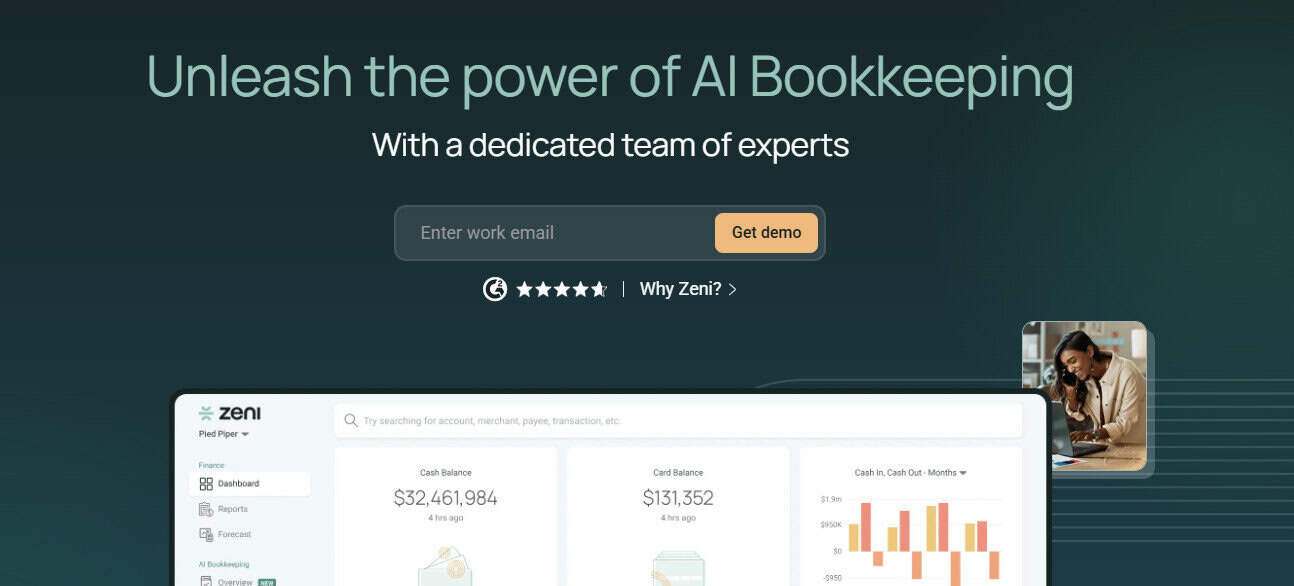
Zeni is the new kid on the block that leans heavily into artificial intelligence. They position themselves as a finance operations platform rather than just a CFO service.
The Play:
Zeni is for the business owner who wants a real-time dashboard and metrics above all else. They use AI to categorize transactions daily, giving you a pulse on your business that traditional monthly reporting can’t match.
Pros:
- Real-Time Data: No more waiting until the 15th to see how you did last month.
- Unified Dashboard: They pull in data from your bank, credit cards, and payroll into one view.
- Cost Effective: For the level of tech you get, the monthly subscription is often lower than hiring a fractional CFO and a separate bookkeeper. However, it can still run about $500 per month, and takes so me time to implement.
Cons:
- AI Limits: AI is great at categorizing a Starbucks run; it’s not great at nuanced revenue recognition or complex intercompany eliminations.
- Lack of “Grey Hair”: If you need someone to navigate a high-stakes negotiation with a predatory lender, an AI-first firm might lack the human leverage you need.
The CPA’s Takeaway: How to Choose?
When I look at a client’s books, I’m not just looking for accuracy; I’m looking for velocity. Does your finance function help you move faster, or is it a ball and chain?
- Choose NOW CFO if you have a temporary fire (like a Controller quitting) and you just need a body to keep the lights on for 90 days.
- Choose Pilot or Zeni if you are a high-growth tech startup with relatively clean bookkeeping needs and you live or die by your burn rate.
- Choose CFO Hub if you are staring down a specific transaction, like an exit or an acquisition.
- Choose Pillar Advisors if you have outgrown the part-time advisor model and need a professionalized, execution-heavy finance department that handles everything from the daily operations to the tax strategy and C-suite leadership.
In my experience, the most expensive hire is the one you have to replace 12 months later because they couldn’t keep up with your complexity. Stop looking for a fractional slice of a person and start looking for a partner that can handle the heavy lifting.