


- What “Finance-Ready” Affiliate Software Actually Needs to Handle
- How I Evaluate Platforms
- Top Affiliate Software for Finance (2025)
- Everflow — The All-Rounder for Finance
- Impact — Best for Large, Global Financial Enterprises
- Partnerize — Great for Complex Partnership Ecosystems
- Fintel Connect — Niche Platform Built for Finance
- Trackier — Strong, Budget-Friendly Option for Fintechs
- Rewardful — The Lightweight Choice for Early-Stage Fintech
- How I Recommend Choosing the Right Platform
- Implementation Roadmap — What a Good Rollout Looks Like
- To Sum Up — Build a Scalable, Compliant Affiliate Engine
Last Updated on April 16, 2026 by Ewen Finser
If there’s one thing I’ve learned from working with financial institutions and fast-scaling fintechs, it’s that affiliate marketing in finance doesn’t behave like any other vertical. Not eCommerce. Not SaaS. Not lead gen. Finance is its own universe — shaped by regulation, multi-step funnels, internal approvals, and fraud threats that simply don’t exist in lighter categories.
And because of that, the software you choose will determine whether your program scales smoothly or becomes a constant operational headache.
I’ve helped banks, credit unions, neobanks, brokerages, investment apps, loan marketplaces, and crypto platforms build or rebuild their affiliate strategies. I’ve tested almost every major platform in this space. Some tools break at the first sign of multi-step conversions. Some collapse when compliance gets involved. Some become manual-work monsters at scale. A few manage to do most things well.
Let’s go over everything I wish finance teams knew before picking a platform. I’ll break down what truly matters in a regulated environment, what tends to break first, and which platforms I’ve repeatedly seen succeed in real-world finance setups.
What “Finance-Ready” Affiliate Software Actually Needs to Handle

Finance funnels aren’t simple. They involve long approval paths, strict compliance, higher fraud risk, and payout structures that change based on user quality — which is why generic affiliate tools usually break once the program scales.
A finance-ready platform must support four things:
1. Real Compliance Controls
Finance teams need audit logs, partner approvals, creative governance, and exportable records. If compliance can’t sign off, the entire program stalls.
2. Multi-Step, Server-Side Event Tracking
A typical finance journey includes lead submission, KYC/identity checks, credit review, approval, funding, and first transaction.
The payout rarely ties to the first event — it usually relies on “approved” or “funded” milestones.
Your platform must handle server-to-server updates, dedupe events, and map internal status changes back to the original click. If it can’t, payout errors and reconciliation headaches follow.
3. Fraud Prevention Built for Finance
Fraud here isn’t coupon misuse — it’s synthetic identities, bot signups, multi-accounting, and bonus-gaming.
A viable platform needs device fingerprinting, IP controls, velocity rules, and API validation to prevent expensive abuse.
4. Complex, Logic-Driven Payouts
Finance payouts depend on creditworthiness, deposit amounts, account type, or AUM.
Programs often require tiered CPA, milestone payouts, hybrid CPA + revenue share, or deposit-based incentives.
If the software relies on hacks or spreadsheets to handle this, it will collapse at scale.
Why Generic Tools Fail
Most “one-event-per-click” platforms can’t handle multi-event funnels, compliance workflows, fraud-sensitive attribution, or variable CPA logic.
Once your partner count passes ~50, gaps turn into real financial risk.

Everflow makes partner management simple, fast, and transparent. Real-time data, clean reporting, and tools built for affiliate managers who want to scale with confidence.
How I Evaluate Platforms
To assess platforms for finance, I don’t rely on sales demos. I recreate real workflows and try to break the system.
I’m looking for:
- Custom Events -I build multi-step funnels and fire internal approval events. If it’s hard, the platform won’t survive real-world finance operations.
- API Reliability-I test how easily internal systems (CRM, underwriting, KYC) can send approved/funded events. Weak APIs always lead to broken attribution.
- Tracking Link Durability – I check links across mobile browsers, VPNs, private browsing, and cookie-restricted environments. Finance users often run strict privacy settings, so tracking must hold up everywhere.
- Reporting Quality – I look for click-to-event paths, event-level transparency, audit-friendly exports, and partner-level filters. If I can’t find key data fast, internal teams won’t either.
- Usability – Power is good. Complexity for its own sake isn’t. A finance-ready platform should empower teams without requiring a specialist for every change.
- Scalability Under Real Load – I simulate 100+ partners, 10,000+ monthly conversions, multi-step events, and rapid payout cycles. Many tools “work” in low volume — the real test is whether they hold steady when the program grows.
Top Affiliate Software for Finance (2025)
Below is a simplified, high-level comparison of the platforms I’ve worked with most often in finance.
Platform | Strengths | Limitations | Best Use Case | Finance-Specific Advantages |
|---|---|---|---|---|
Extremely flexible, event-based tracking, strong reporting, scalable, excellent fraud tools | Learning curve; more than small teams need | Fintechs and FI teams needing a scalable, compliant solution | Multi-event funnels, fraud rules, automated payouts, safe for regulated environments | |
Enterprise workflows, strong contract logic, global support | Heavy to implement, best for large teams | Large banks, global FS brands | Governance, territory controls, detailed approvals | |
Great for structured workflows, approvals, multi-market operations | UI can feel complex, requires ops support | Global insurers, international banks | Strong compliance controls and partner governance | |
Finance-native platform + publisher network | Less flexible outside finance, niche tool | Banks, credit unions, older institutions entering affiliate marketing | Built-in finance publishers, compliance-focused | |
Affordable, strong performance tracking, solid fraud filters | More technical interface, less polished | Performance-focused fintechs and networks | Fraud filtering, secure tracking, customizable events | |
Very easy to use, ideal for SaaS-style products | Limited compliance and event depth | Early-stage fintech SaaS | Simple recurring commissions, fast launch |
As you can see, each platform has strengths and weaknesses — and the right fit depends heavily on your team size, product, regulatory environment, and growth plans. Let’s understand these tools a bit better.
Everflow — The All-Rounder for Finance
I work with a wide range of financial brands, and no matter the vertical — lending, investing, neobanking, insurance, or B2B fintech — Everflow is the platform I end up recommending the most often. Not because it’s perfect, but because it strikes the most effective balance between flexibility, compliance-readiness, and operational usability.
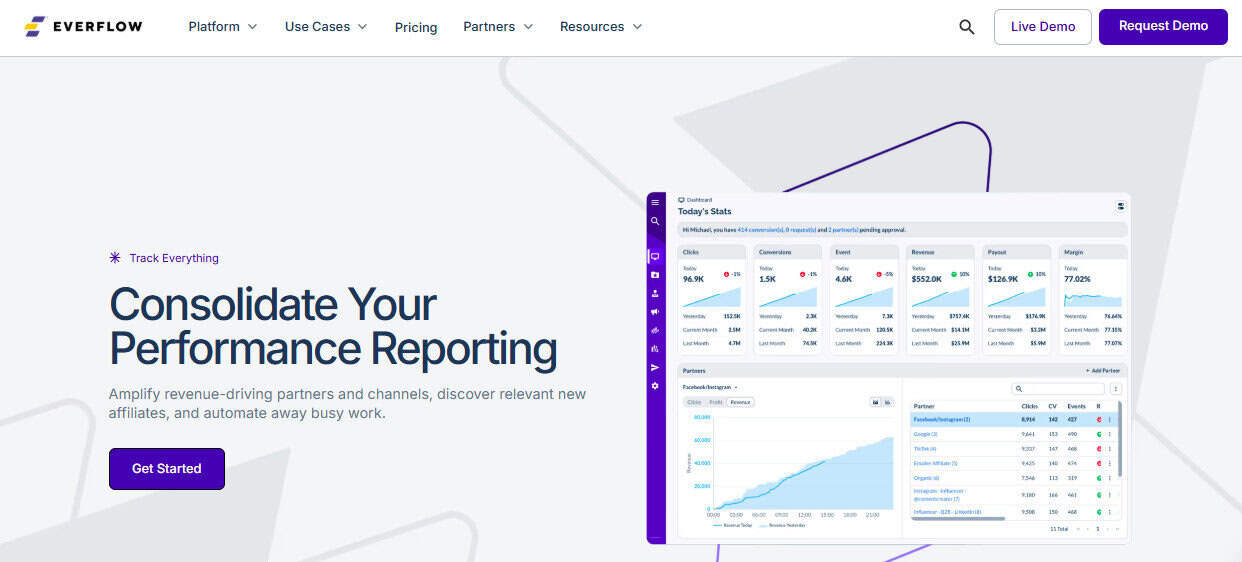
In my experience, Everflow is the most adaptable option for finance teams that:
- Want accurate event-based tracking
- Need fraud controls
- Require transparent reporting
- Support multiple partner types (affiliates, influencers, aggregators, referrals)
- Plan to scale their program within the next 6–18 months
It’s not positioned as a “finance-only” tool, but it’s built in a way that naturally supports regulated workflows. It’s flexible enough for startups and robust enough for enterprise fintechs — something very few platforms manage to pull off.
Where Everflow Excels
- Multi-event conversions (critical for finance)
- Transparent, granular reporting
- Built-in fraud controls
- Customizable attribution
- Smooth partner management
- API depth and Webhook flexibility
- Automated payout workflows
Finance payouts are complicated by nature. Everflow’s automation options reduce operational pressure and minimize mistakes.
Where Everflow Has Limitations
- There’s a learning curve.
- It can be overkill for small teams.
- Operational discipline is required.
Who Everflow Is Best For
- Fintechs planning to scale
- Banks and credit unions
- Programs with multi-step conversion logic
- Teams managing multiple partner types
Impact — Best for Large, Global Financial Enterprises
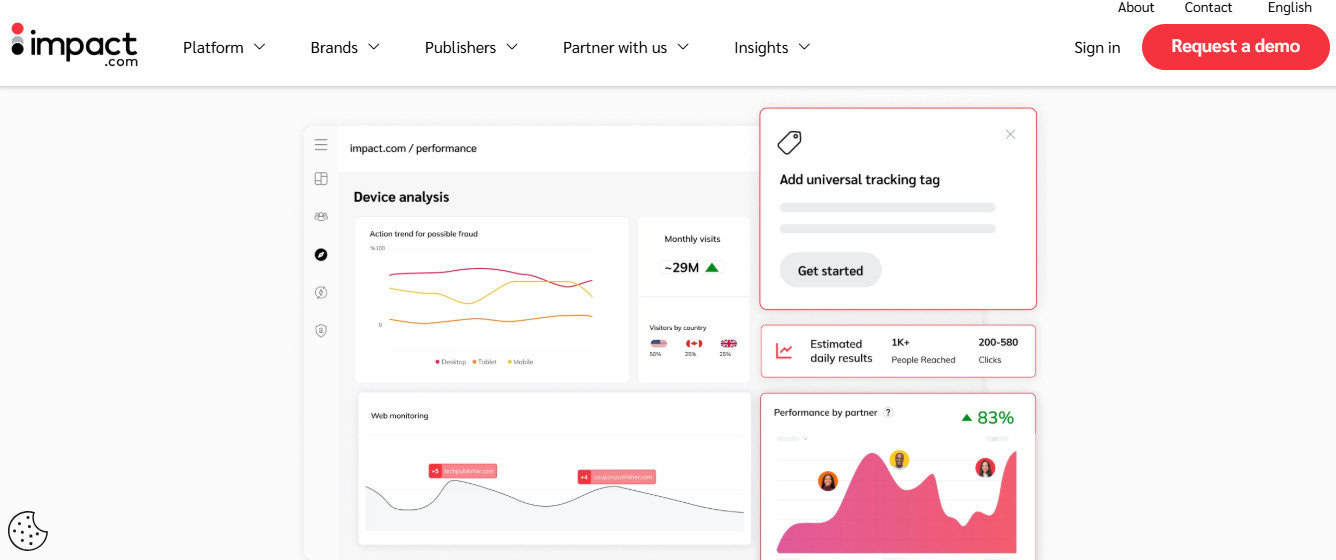
Impact is one of the largest partnership platforms in the world, and it shows. Whenever I work with big financial institutions — global banks, multinational insurers, enterprise credit-card issuers — Impact is often already on their radar.
It’s a serious platform built for serious organizations.
Where Impact Excels
Impact shines when a company has:
- Multiple teams involved in partner management
- International operations
- Strict contract rules
- Cross-department workflows
- Legal review processes
- Complex multi-market tracking requirements
Many enterprise finance teams love its structured governance and contract logic. It gives them the kind of operational oversight they’re used to in other enterprise tools.
Where Impact Has Limitations
Impact is powerful, but it’s heavy.
The implementation time can feel long, especially if you don’t have an internal technical team dedicated to the rollout. Smaller or fast-moving fintechs often find it overwhelming.
Who Impact Is Best For
In my experience:
- Global banks
- Enterprise credit-card issuers
- Multinational insurers
- Fortune 500 financial brands
These teams value structure and governance over agility, and Impact fits that mold perfectly.
Partnerize — Great for Complex Partnership Ecosystems
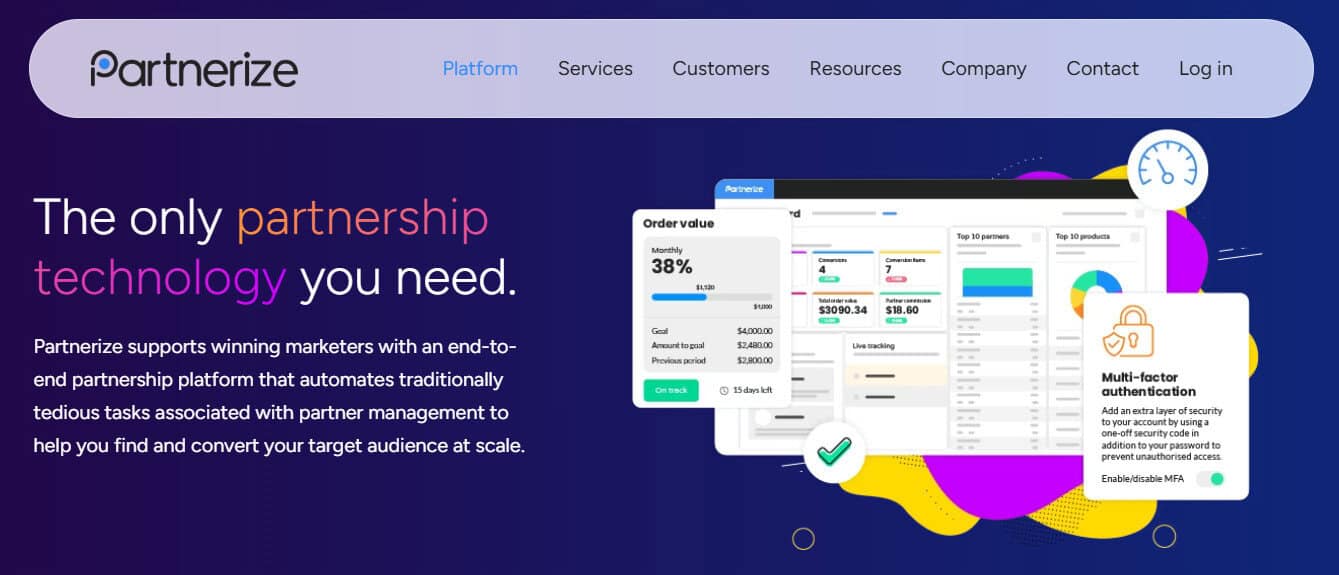
Partnerize sits in a similar tier as Impact; it’s designed for organizations with complex partnership structures, strict compliance workflows, and multi-region operations. I’ve seen it adopted by financial services companies that already have multiple internal stakeholders managing different partner categories.
Where Partnerize Excels
What Partnerize does extremely well is help enterprises:
- Manage approvals across multiple teams
- Maintain brand safety and creative compliance
- Operate across regions with different rules
- Navigate intricate internal workflows
If your compliance team requires extremely tight controls, Partnerize has the infrastructure to support that.
Where Partnerize Has Limitations
Partnerize is powerful, but not always intuitive. It sometimes requires specialists or operations managers dedicated to partner governance. For fast-scaling fintechs, it may feel like too much structure too soon.
Who Partnerize is Best For
I recommend Partnerize for:
- Global insurers
- Large banks with multi-team ecosystems
- Companies with strict brand governance
- Organizations operating across several regulated regions
Fintel Connect — Niche Platform Built for Finance
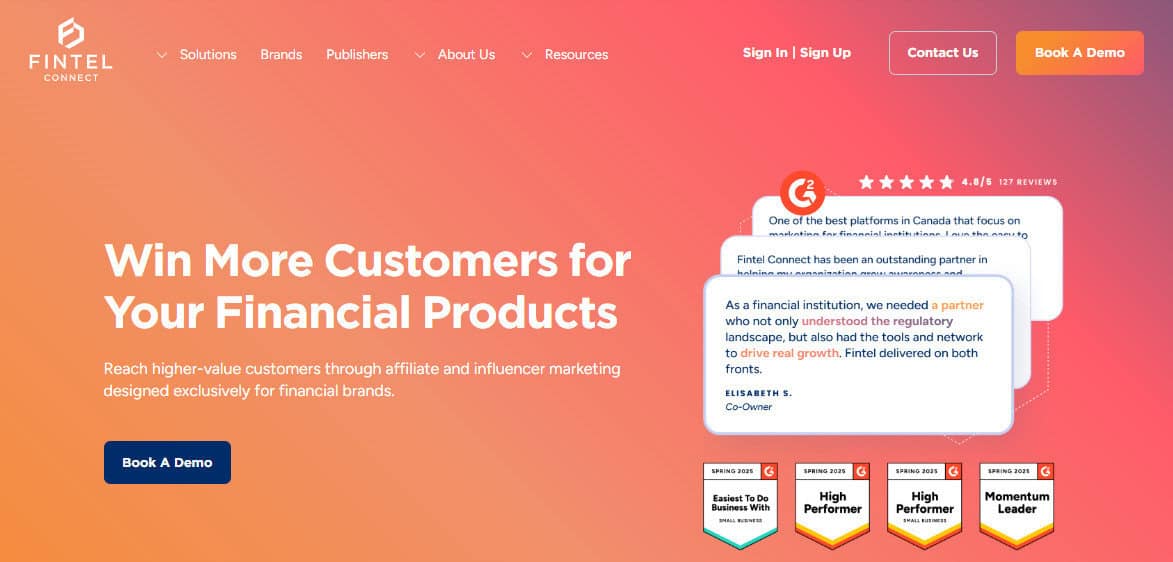
Fintel Connect is unique because it’s one of the only platforms built specifically for financial services. When I work with traditional financial institutions — especially banks and credit unions — this platform often comes up as a top contender.
Where Fintel Connect Excels
The biggest advantage: It comes with a built-in network of vetted finance publishers.
This is a massive time-saver, especially for teams that don’t already have affiliate relationships.
It also handles:
- Compliance requirements
- Financial product workflows
- Specialized creative approval processes
- Publisher due diligence
Fintel “gets” finance in a way many generic tools don’t.
Where Fintel Has Limitations
Because it’s finance-focused:
- It’s less flexible for non-finance products
- it may not be ideal for fintechs with very technical event-tracking needs
- teams wanting a more customizable performance tool may feel constrained
Who Fintel Connect is Best For
I’ve found it works especially well for:
- Banks entering affiliate marketing for the first time
- Credit unions
- Financial institutions that need pre-vetted publishers
- Teams prioritizing compliance above all else
Trackier — Strong, Budget-Friendly Option for Fintechs
Trackier is a performance marketing platform with a growing footprint in fintech. I’ve worked with smaller to mid-sized fintech teams that choose Trackier because it’s affordable, flexible, and strong on the tracking side.
Where Trackier Excels
Trackier offers:
- Solid fraud checks
- Customizable tracking options
- Cost-effective pricing
- Support for multiple event types
- Decent analytics for optimization
It’s a good fit for teams who are technical enough to configure the platform themselves.
Where Trackier Has Limitations
The interface isn’t as polished as some of the enterprise tools, and the learning curve can feel more technical. Reporting is solid, but not as intuitive as tools like Everflow.
Who Trackier is Best For
I typically recommend Trackier to:
- performance-driven fintechs
- teams with technical expertise
- affiliate networks focused on finance
- companies needing flexibility on a budget
Rewardful — The Lightweight Choice for Early-Stage Fintech
Rewardful is the simplest tool on this list, and I mean that in a good way. For early-stage fintech SaaS products — especially subscription-based tools — Rewardful gets the job done fast.
Where Rewardful Excels
I’ve used Rewardful with teams that needed:
- Instant setup
- Simple recurring commissions
- Lightweight management
- Low operational overhead
It’s perfect for companies in early traction stages.
Where Rewardful Has Limitations
For regulated financial products — things like loans, credit cards, trading, or banking — Rewardful simply doesn’t have the compliance controls or multi-event tracking needed.
Who Rewardful is Best For
- Early-stage fintech SaaS
- Productized financial tools
- Startups wanting to validate affiliate traction quickly
How I Recommend Choosing the Right Platform

When advising finance brands, I always start with the same principle:
Match the tool to your maturity, funnel complexity, and regulatory needs — not your current traffic volume.
Here’s how I approach selection.
Start With Your Funnel
If your conversion journey has more than two steps (and in finance it usually does), you need an event-based system.
Assess Compliance Needs
If your compliance team is strict, or if you’re in a heavily regulated sub-vertical (credit cards, investing, insurance), platform governance matters more than UI.
Check What Your Internal Systems Can Support
If your engineering team can send clean server-side events reliably, you can be more flexible. If not, choose a platform with easy integration and clear documentation.
Don’t Choose the “Cheapest” Option
The cost of the wrong platform — in fraud, lost tracking, bad data, and manual reconciliation — is always higher.
How I Usually Map Recommendations
- Everflow → for most fintechs and financial institutions; best all-around choice
- Impact → for global enterprise brands
- Partnerize → for heavily governed, multi-team ecosystems
- Fintel Connect → for banks/credit unions needing a finance publisher network
- Trackier → for mid-size fintechs with technical capability
- Rewardful → for early-stage fintech SaaS
Everflow makes partner management simple, fast, and transparent. Real-time data, clean reporting, and tools built for affiliate managers who want to scale with confidence.
Implementation Roadmap — What a Good Rollout Looks Like

A platform is only as good as its implementation. Here’s the rollout plan I usually guide finance teams through.
Days 1–30: Foundation and Tracking Setup
- Define your funnel stages
- Set up events in the platform
- Map internal statuses to those events
- Build fraud rules
- Configure compliance approvals
- Integrate via API or webhook
Days 31–60: Partner Migration & Validation
- Onboard top-tier partners
- Run dual tracking (old + new system)
- Validate data accuracy
- Review early fraud flags
- Test payout rules
Days 61–90: Optimization & Scaling
- Expand partner list
- Launch additional creatives
- Review click-to-event timelines
- Adjust rules based on quality
- Establish reporting cadences
- Automate payouts once data is trusted
This timeline is realistic, not rushed, and ensures compliance teams stay comfortable throughout the rollout.
To Sum Up — Build a Scalable, Compliant Affiliate Engine
Finance affiliate programs are powerful when executed well — but they’re also unforgiving when the technology isn’t built for regulated products. The right platform should support your compliance requirements, handle multi-step funnels, prevent fraud, and automate the complex payouts that financial products require.
From my experience working across fintech and traditional financial institutions, Everflow consistently delivers the best mix of flexibility, transparency, scale, and compliance support. That said, Impact, Partnerize, Fintel Connect, Trackier, and Rewardful each have strong use cases depending on your structure and maturity.
If you’re evaluating tools now, start by mapping your funnel, defining your compliance constraints, and identifying where your internal systems may limit you. The rest becomes much easier when you know what you’re solving for.