

Last Updated on March 25, 2026 by Ewen Finser
It seems like in today’s economy, everything just keeps getting pricier. Your morning coffee run, groceries that somehow add up to way more than last week, insurance premiums, and even your streaming subscriptions. It’s refreshing when you stumble on a service that’s genuinely trying to help you keep cash in your pocket, and does this without cutting corners on quality.
Enter Total Wireless, a prepaid MVNO (Mobile Virtual Network Operator) that’s part of the Verizon family. Total Wireless offers unlimited data plans at prices that don’t make you wince. Simply, Total is aimed at people who want a simple, no-nonsense service. Think of families or those who have multiple lines, and are tired of gouging bills from the major carriers, but still need the coverage and reliability that big wireless guarantees.
In this Total Wireless Review, we’ll break it down together: value for your money, network coverage that actually works where you need it, customer support highs and lows, speeds and reliability, plus what it’s like using it every day. If you’re thinking about ditching a pricey plan or just browsing options, hopefully this can help move you in the right direction!
Value For Your Money
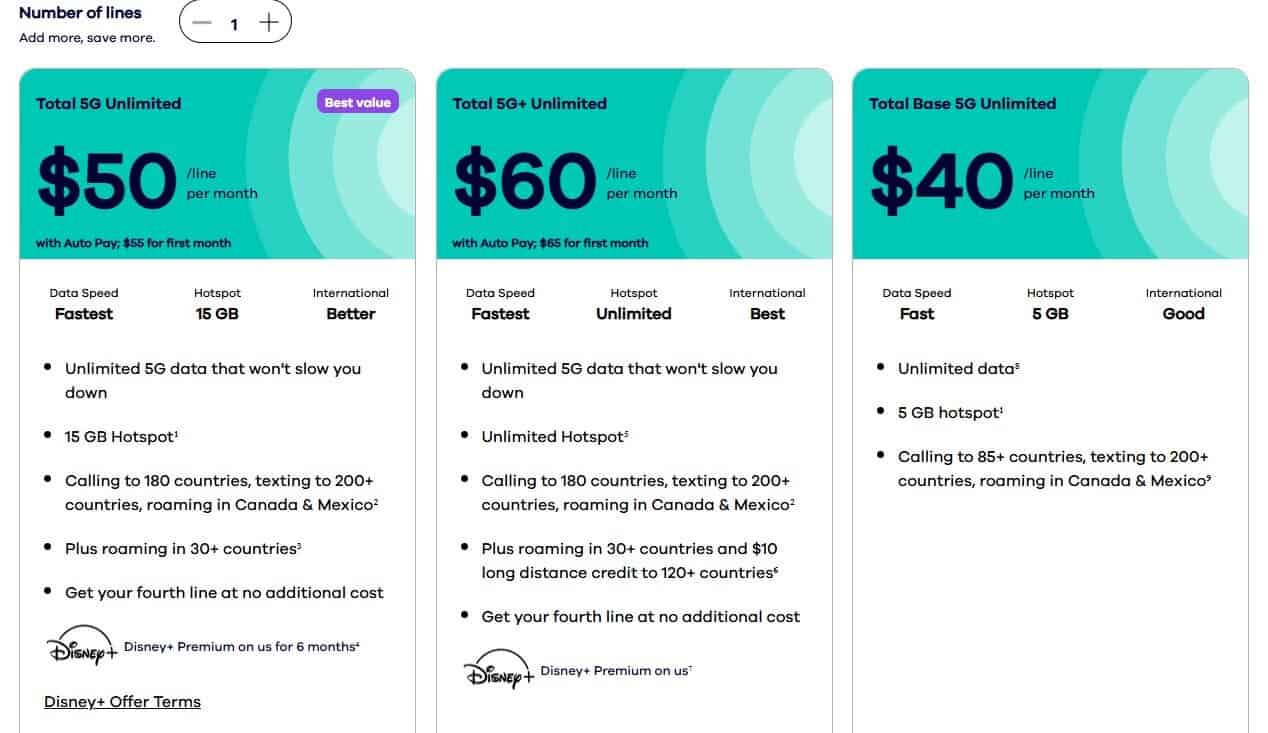
What pulls most people in? Generally, it’s the prices, especially if you’ve got a few lines to manage. For families or groups sharing, you can grab unlimited data for as low as $25 a month per line. Just bring your own phone and add multiple lines. That’s a steal next to Verizon’s own unlimited setups. One line might hit you for $65 or more before all the taxes and extras pile on. Imagine a family of four: with Total Wireless, you’re looking at $100 total for the base plan. That’s real savings over time!
As of early 2026, their plans are straightforward. Here’s the lineup (consider that the first month might be a tad higher without it):
– Base 5G Unlimited Plan: $40 a month gets you unlimited talk, text, and data on Verizon’s 5G network. It includes a 5GB hotspot thrown in which is great if you’re not bingeing 4K videos nonstop. This one’s perfect for everyday users whose main activities are scrolling social media, checking emails, or light streaming. You get access to Verizon’s nationwide 5G, though speeds might dip during busy times if you’re not on premium.
– Total 5G Unlimited Plan: Jump to $50, and you score 10GB hotspot data plus a free six-month Disney+ sub. Perfect for homes with kids or anyone who needs a bit more hotspot flexibility. If you occasionally tether your laptop or tablet, that extra data helps. Plus, the Disney+ perk can save you around $150 over those months. It’s a nice touch for families.
– Total 5G+ Unlimited Plan: At $60, this is for the heavy users. It has priority data, so speeds stay zippy even in crowds. Unlimited hotspot with 15GB high speed before any slowdown. If you’re always connected on the move, this one will hit the spot. Priority data means less throttling when the network gets crowded. Think concerts, busy cities, or peak hours. You also get international calling to some countries, which is handy for folks with family abroad.
Do You Have Multiple Lines?
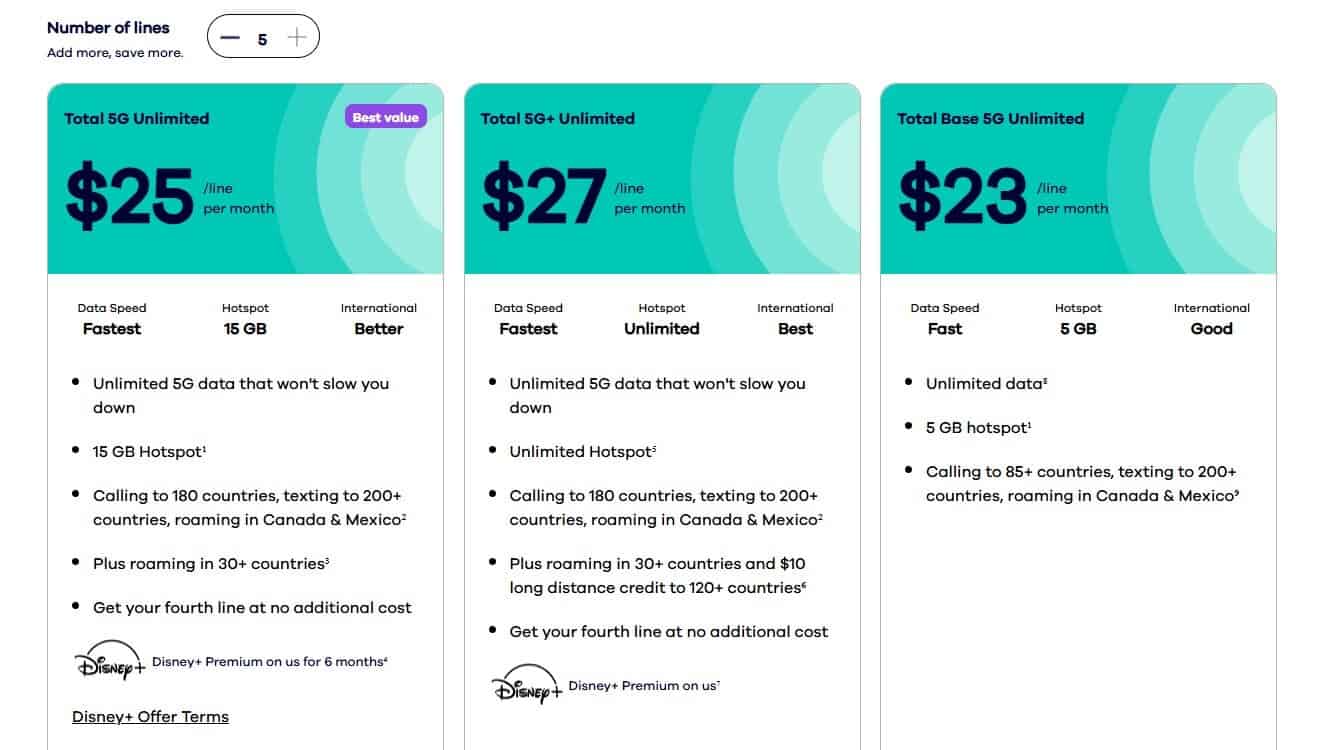
That’s where Total really pays off. Four on the base plan? Just $100 total, or $25 each. Go premium, it’s now $200 for four, or $50 a line. Compare that to Verizon’s family deals, which can top $200 easy after add-ons. So you’re saving big, and it’s on the same network.
Another way to approach it: if you’re switching, a family paying $180 on Verizon postpaid plans could drop to $100/mo. There are also no contracts, meaning you can bail anytime if it doesn’t work for you.
Is It Worth It?
In a word: yes. Total Wireless is a strong option for budget-conscious consumers. Based on recently published reviews, it compares favorably to competitors like US Mobile and Visible. Visible’s $25 unlimited plan is appealing for individual users, but it does not offer multi-line discounts and tends to experience heavier throttling during periods of network congestion. Total Wireless, by contrast, provides more competitive pricing for families and includes priority data options on higher-tier plans. Financial expert Clark Howard highlighted Total Wireless as a top family-friendly choice in a July 2025 review.
That said, Total Wireless is not the best fit for every user. The carrier primarily offers unlimited plans, so individuals who consistently use less than 10GB of data per month may find better value with a lower-cost, limited-data option from another provider.
Total Wireless also sells smartphones, though the selection is largely limited to entry-level and older models. Available devices typically include budget-friendly options such as Samsung’s A-series phones and previous-generation iPhones, often offered at discounted prices. These devices are well suited for users who prioritize affordability over access to the latest flagship models.
For customers who prefer to bring their own device, Total Wireless supports BYOD activation. Most unlocked phones are compatible, and the activation process can be completed online in just a few steps. Users simply need to confirm device compatibility on the Total Wireless website prior to switching.
Total Wireless delivers the strongest value for households and multi-line accounts, though individual users can still benefit if an unlimited plan aligns with their usage needs. Key advantages include significant cost savings, straightforward plan structures, and added perks such as Disney+. Limitations include a lack of tiered data plans and fewer premium add-ons compared to some competitors.
Network Coverage
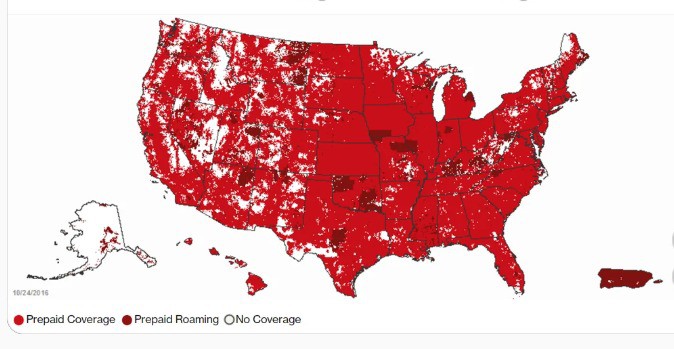
Because Total Wireless operates on Verizon’s network, coverage is one of its strongest advantages. Verizon consistently ranks among the most reliable wireless networks in the U.S., and by early 2026, its 5G network reached approximately 90% of the population. In areas where 5G is not yet fully available, Verizon’s extensive 4G LTE network helps fill coverage gaps, particularly in rural regions.
Verizon’s coverage map is easy to navigate and allows users to check voice, data, and 5G availability by ZIP code. Its low-band 5G network is designed for broad reach, performing especially well in less densely populated areas and often outperforming competitors like T-Mobile in rural locations. Coverage data from BroadbandMap in 2026 supports these findings.
As with most MVNOs, Total Wireless customers on standard plans may experience slower speeds during periods of network congestion due to deprioritization. While this is generally not disruptive for everyday use, it is an important consideration. Higher-tier plans include priority data access, which helps maintain faster speeds during peak usage times. In performance testing, urban areas typically achieve Ultra Wideband 5G speeds, while rural locations rely on stable LTE service. RootMetrics reports from late 2025 continue to rank Verizon highly for overall network reliability.
Customer Service
Support with prepaid carriers can be hit or miss, and Total Wireless fits that bill. Decent overall, but not flawless. On the good side, their app and website make account management a breeze; swap plans, pay up, and check data without calling anyone. The app is intuitive, and you can track usage in real time, which helps avoid surprises.
Walmart’s a big spot, with store reviews hovering around 3.5 stars. People like the quick billing fixes and face-to-face help. If you’re near a Walmart, popping in for setup or issues is handy. They’ve expanded to over 2000 stores by 2026, so access isn’t too far away.
Self-help is solid, too. Chatbots and FAQs are available, and if that doesn’t work, there’s a round-the-clock call line (1-866-663-3635) or online chat that you can leverage. The chatbot handles basics like balance checks or plan changes fast.
Shortcomings
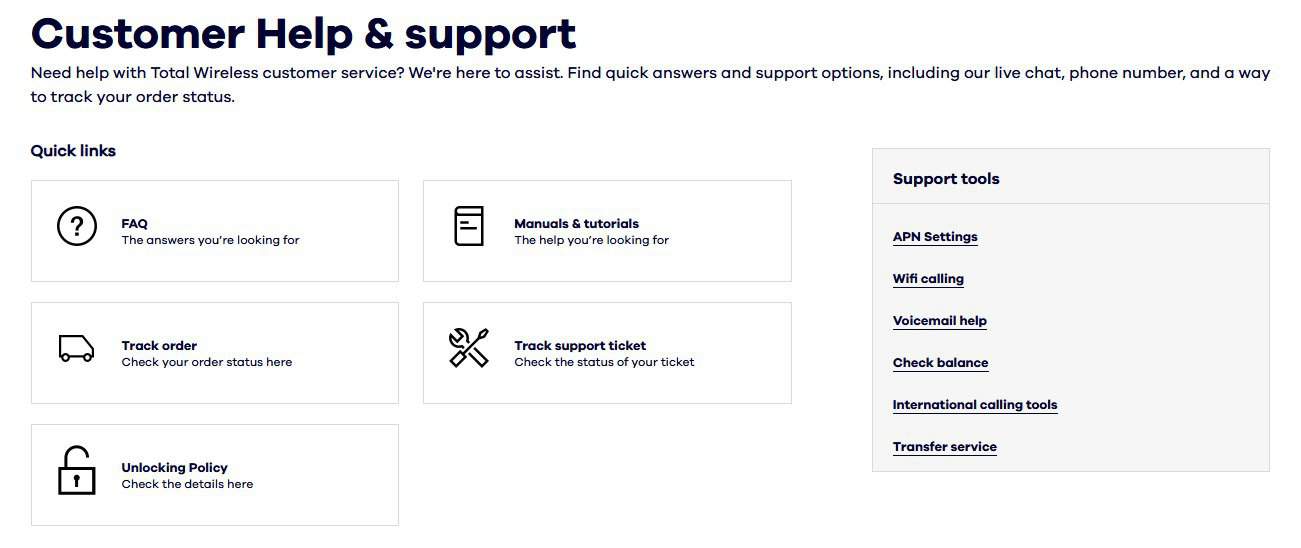
While Total Wireless performs well in several areas, customer support remains a point of frustration for some users. Because support is largely handled through outsourced call centers, customers occasionally report long wait times, communication issues, and inconsistent resolutions. The Better Business Bureau notes recurring complaints related to billing errors and delayed refunds, while Trustpilot reviews from 2025–2026 average between one and two stars, frequently citing unresponsive or unhelpful support experiences.
For routine tasks such as payments, plan changes, or usage checks, the Total Wireless app is often the most efficient option. However, more complex requests (such as number porting or account disputes) may require additional patience and careful review of online support documentation to avoid delays.
Overall, customer service is adequate for basic needs but less reliable for more involved issues. Users who are comfortable managing their accounts digitally are likely to have a smoother look, while those who rely heavily on live support may encounter challenges.
Performance
On a daily basis, Total Wireless performs well on Verizon’s 5G network. Tests show download speeds averaging 50–150 Mbps, with peaks reaching 250–300 Mbps or more in optimal areas. A YouTube comparison from last year tested Total Wireless head-to-head against Visible on iPhone 14s using Speedtest and Fast.com. Both providers, running on Verizon, consistently hit these speeds.
With performance like this, streaming from Netflix, Disney+, or Hulu shouldn’t be an issue. Video calls are smooth and clear, without grainy images or buffering. You might even be able to do some light gaming through a hotspot. I personally tethered a laptop while traveling for a few nights, and it worked seamlessly. One thing: base plans cap at lower speeds sometimes. Premium avoids that and deprioritization rarely interferes in a significant way. Still, if you’re a high data user, consider going premium.
The Final Verdict

Overall, Total Wireless stands out as a strong option for consumers seeking affordable, reliable phone service without long-term commitments. Its most notable strengths include competitive pricing, access to Verizon’s nationwide network, straightforward plan structures, and added perks such as Disney+ on select plans. The primary drawbacks are inconsistent customer support experiences and potential data throttling on base plans during periods of heavy usage.
Total Wireless is particularly well suited for families, multi-line households, budget-conscious users, and those in rural areas who benefit from Verizon’s extensive coverage. Customers switching from major carriers or from value-focused providers may find that Total Wireless offers a more balanced combination of savings and network reliability. For single-line users with minimal data needs, alternatives such as Visible may offer lower-cost simplicity.
In terms of overall value, Total Wireless delivers dependable performance, strong coverage, and meaningful cost savings, making it a compelling choice in the prepaid wireless market. With improvements to customer support, it could be an even stronger contender among budget-friendly carriers.