


- The Short Answer
- Refersion: Built for Single-Storefront Simplicity
- Levanta: Built for Multi-Channel Sellers
- Off Shopify, Refersion Has a Case
- The Catch for Omnichannel Brands
- How Levanta Is Built Differently
- Reporting Depth: Aggregate Numbers Vs. Attributable Detail
- Pricing Structure and What It Signals
- A Practical Way to Think About the Decision
- The Honest Trade-off
Last Updated on August 13, 2026 by Ewen Finser
You’re probably familiar with Refersion. It’s been around since 2014, and for good reasons. It shows up everywhere Shopify affiliate programs get discussed. It’s one of the most established names in e-commerce affiliate software and has a huge user base. To top it off, it has a strong reputation for being easy to set up. If your entire business lives on a single storefront, it’s a proven, dependable pick.
However, the moment you start selling on Amazon, or you already do as a part of Shopify, the evaluation changes. The question stops being “which tool runs a solid affiliate program?” and becomes “which tool can track and pay creators across every place I sell?”
That’s where we reach the real fork in the road between Levanta vs Refersion. So the decision comes down to what fits your specific setup.
The Short Answer
Pick Refersion if you’re a single-storefront brand like Shopify, BigCommerce, WooCommerce, or similar that wants a mature, well-integrated affiliate and ambassador tool. With this in mind, you have no near-term plans to sell on a marketplace like Amazon or Walmart.
Pick Levanta if you sell on Amazon, Walmart, or some combination of marketplaces and Shopify. You will need to have creator and affiliate performance that can be tied back to marketplace sales, not just clicks on a link from your own site.
There’s a real difference between the two platforms, and it comes down to one structural choice. Refersion was built as a general-purpose affiliate platform. Levanta was built around marketplace attribution. That starting point shapes how each one handles integration, tracking, payouts, and reporting. Neither platform is “better” so to say, the right choice depends on where and how your customers are buying.
Refersion: Built for Single-Storefront Simplicity

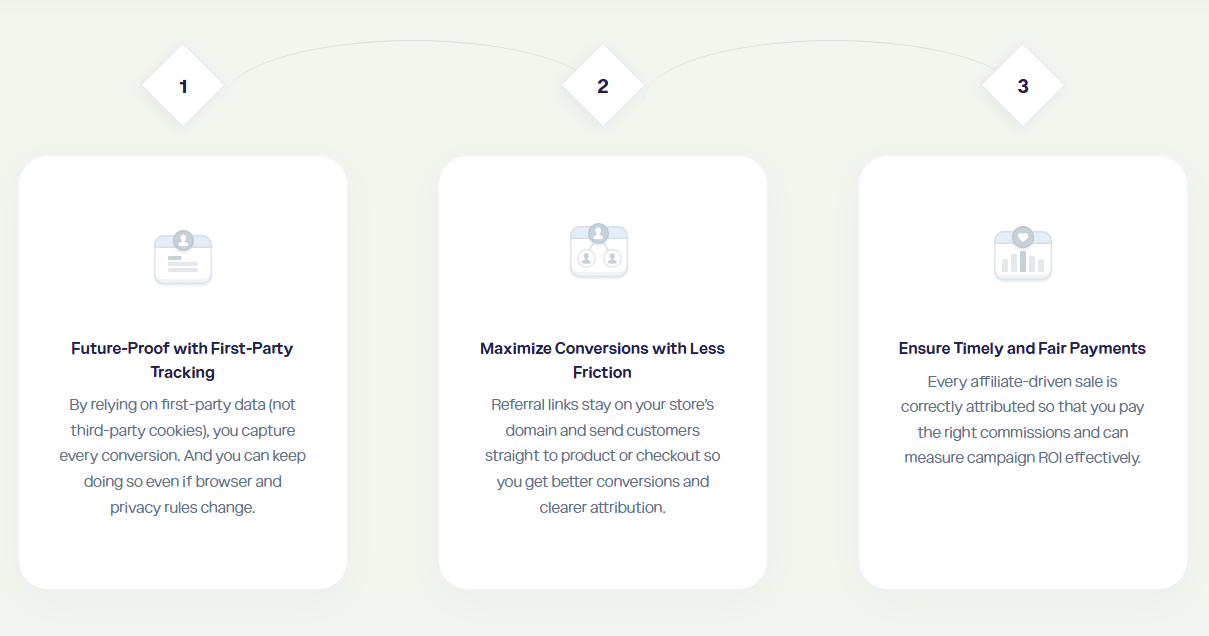
Built for e-commerce brands, Refersion is a broad, general-purpose affiliate and influencer marketing platform. It handles the core mechanics of an affiliate program with flexible commission structures for different types of partners, whether they’re bloggers, content creators, brand ambassadors, or your own repeat customers. It features first-party sales tracking that holds up well against the browser privacy changes that have made cookie-based tracking increasingly unreliable.
They offer automated payouts which include their own built-in payment processing. You can also use several other methods like PayPal, check, or direct deposit to receive your funds. Whether you’re a merchant or affiliate, you’ll get your own dashboard. This way brands can monitor program performance while affiliates track their own referral activity in real time.
Beyond Shopify, and on sites like BigCommerce, Salesforce Commerce Cloud, and others, Refersion integrates with a wide range of storefront platforms. This will be of interest to you if your stack isn’t purely Shopify-based. Combined with a long operating history and a large existing customer base, Refersion is a familiar, low-risk starting point for a brand with a straightforward, single-channel affiliate program. It can also come in handy for a brand that is migrating to an existing program without wanting to relearn a new system from scratch.
Levanta: Built for Multi-Channel Sellers
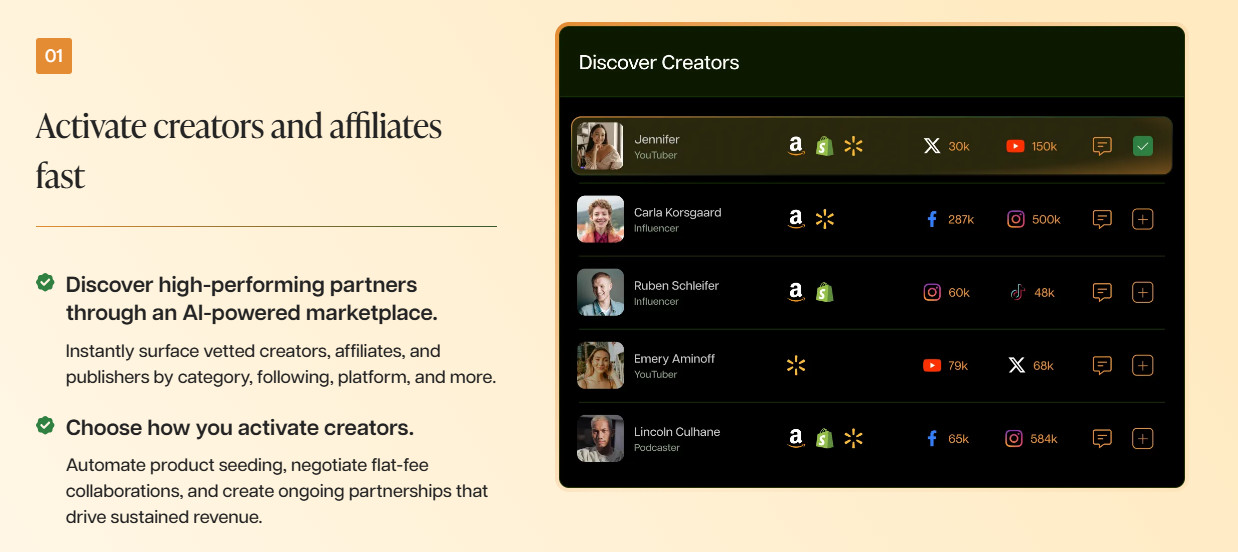
Levanta is a creator and affiliate platform built specifically for modern e-commerce brands that sell across more than one channel. It was built to handle marketplace selling from day one. Running one program across Amazon, Shopify, and Walmart in a single system, it covers the full life cycle from creator discovery to payout. The defining feature is native Amazon API integration paired with ASIN-level attribution. This means creator-driven sales on Amazon get tracked with the same precision as a click-through sale on a Shopify storefront.
Off Shopify, Refersion Has a Case
Refersion’s core strength is that it has been doing this for over a decade and works with a wide range of platforms, not just Shopify, but also BigCommerce, WooCommerce, Magento etc. Its first-party tracking approach is also a real advantage. Rather than depending on third-party cookies, it ties attribution to data collected directly through the merchant’s own store. This approach has become increasingly important as browsers keep tightening cross-site tracking restrictions.
And thanks to its maturity, Refersion has made it possible to iron out the rough edges that some newer platforms still discover during production.
Documentation is thorough, the interface is well understood by a large community of existing users, and on-board support resources help with migration assistance for brands moving their affiliate programs over to Refersion. For a marketing team that wants predictability over cutting-edge features, Refersion is a good option.
The Catch for Omnichannel Brands
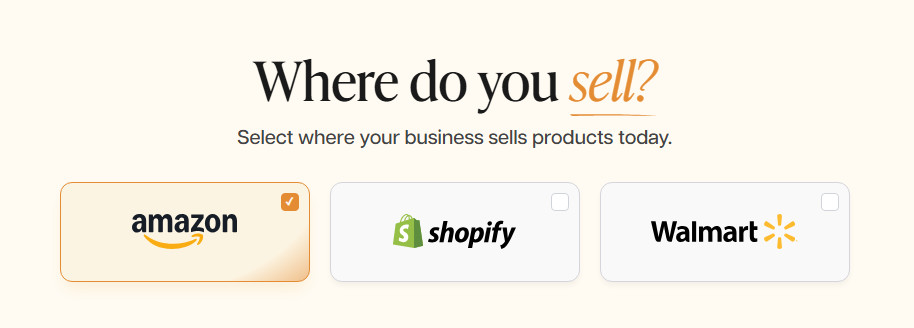
Once the marketplace enters the picture, it’s easy to see the gap between the two platforms. Refersion’s architecture was never built with Amazon or Walmart attribution in mind. It was built around the storefront-plus-cookie (or first-party-tracking) model. Working best for Shopify checkouts, it doesn’t map cleanly onto a marketplace where the brand doesn’t control the checkout flow. Some Refersion users have reported that Amazon integration, when available, doesn’t function as advertised. Often, it isn’t available at all in certain regions despite being sold as a feature. That kind of gap is less about isolated bugs and more about the platform not being designed around marketplace attribution in the first place.
Regardless of channel, there’s also a scope limitation worth pointing out. Several reviewers note that Refersion does the following well: affiliate relationship management, tracking, and payouts. It leaves affiliate and influencer discovery to other tools entirely. For a brand that wants a single system covering recruitment through payout, that means stitching together a separate discovery or outreach tool on top of Refersion. This adds an unnecessary level of complexity rather than removing it.
None of this makes Refersion a bad platform. It just makes it a platform optimized for a specific shape of business. That business should be one storefront, one checkout, and one attribution model. For a brand operating that way, these aren’t limitations at all, they’re simply outside the platform’s intended scope. If you’re a brand trying to run one creator program across Amazon, Walmart, and Shopify with a single source of truth, the reporting is bound to break up. Amazon’s numbers are kept in one place, while Shopify’s numbers are in Refersion. What this means is that someone on the brand’s team will end up manually reconciling both every reporting cycle.
How Levanta Is Built Differently

Levanta’s advantage isn’t a longer feature list. It’s that the feature list is organized around a different starting assumption. Instead of building marketplace support as an add-on to a storefront-first product, Levanta starts by assuming that the e-commerce brand sells in more than one place and builds an attribution model to match. Native integration with Amazon’s API means that creator links can be tracked down to the ASIN level. This gives brand visibility into exactly which products a given creator is selling most. It’s just an aggregate sales number loosely tied to a campaign window.
That same infrastructure extends to Walmart and Shopify. A single creator relationship, and commission structure, can span all three channels without needing separate tools or reporting dashboards. From a brand’s perspective: three fragmented data sources become one program with one payout cycle and one performance view. For a marketing team trying to answer a simple question, “which creators are actually driving revenue, and where?,” that consolidation is the difference between a five-minute dashboard check and a multi-hour spreadsheet reconciliation exercise every month.
This design choice also shapes how creator discovery and relationship management work inside Levanta. Because the platform already understands things like Amazon’s Brand Referral Bonus program, and how attribution windows differ across channels, it can surface and manage those details without anyone having to become Amazon API experts. That’s a big difference from using a marketplace plugin on a system that was never designed to think in those terms.
Reporting Depth: Aggregate Numbers Vs. Attributable Detail
It helps to separate the term “tracking” from “attribution.” The two platforms differ more on the second than the first. Refersion tracks sales reliably within its own domain. For example, a purchase made through a tracked link or code on Shopify will get attributed to the right affiliate. It can’t, however, extend that same ability onto a marketplace checkout that it doesn’t control. On Amazon, a brand doesn’t own the checkout flow, in the same way it does on its own storefront. Any tool utilized after the fact works with a narrower, less direct signal.
Levanta’s ASIN-level attribution works directly with Amazon’s own API rather than trying to work in the marketplace activity indirectly. That distinction matters most at the reporting stage. At this stage, brands are deciding which creators to renew, which to cut, and which commission structures are working. A brand relying on rough, channel-by-channel estimates are likely making those calls with less confidence than one working from attributed, per-product data. Over a full fiscal year, that difference in reporting shows the difference in how efficiently a brand uses its affiliate and creator budget.
Pricing Structure and What It Signals

Pricing models are a useful signal of what each platform is built for. Refersion’s plans scale primarily with affiliate-driven sales volume. They keep the entry cost low and make it desirable for brands testing an affiliate program for the first time. That structure works perfectly when there’s only one sales channel to measure. It gets a little harder once a brand tries to apply a single sales-volume-based plan across a storefront and one or more marketplaces.
Refersion pricing:
- Marketplace Listing: Free (brand visibility with affiliates)
- Launch: $39/month + 3% of affiliate-driven sales (for new brands)
- Growth: $199/month + 2% (for brands nearing $1M GMV)
Levanta’s model is built around the assumption that program value gets measured across channels rather than within just one, which avoids that mismatch.
Levanta pricing:
- Gold: $750/month + 3.5%
- Enterprise: custom pricing
Honestly, neither approach is better, they’re just optimized for different starting conditions. A brand should treat pricing less as a simple cost comparison and more as a diagnostic for determining which platform’s underlying assumptions match its own business.
A Practical Way to Think About the Decision
If you’re mapping this to your own business, a few questions cut through most of the ambiguity quickly.
Where do your sales happen today? If it’s entirely on one storefront and there’s no marketplace expansion, Refersion’s integration and lower entry cost make it a sensible, low-risk choice. There’s really no reason to pay for marketplace-native infrastructure that you’re not using.
In the next 12 to 24 months, is marketplace expansion a realistic goal? If Amazon or Walmart are part of the plan, it’s worth weighing the cost of switching platforms later against starting on the right one now. A migration means rebuilding creator relationships, historical data, and payout history from scratch. Doing it twice costs more than doing it once.
How much manual reconciliation are you willing to tolerate? A brand running affiliate programs on two or three disconnected tools, one per channel, can make it work with spreadsheet discipline. However, this discipline will cost you and your team valuable time. It also tends to break down during high-volume sales periods, which is exactly when accurate, real-time attribution matters.
Do you need influencer discovery built in, or do you already have that covered? Refersion’s scope stops at program management. If your team already sources creators through another channel, then it’s a non-issue. If you’re hoping for a single platform that handles discovery through payout, however, that’s a point in Levanta’s favor.
The Honest Trade-off

Refersion is a capable, established platform, and it does the job well for brands that live entirely on one storefront. Its integration, first-party tracking, and long operating history are real strengths. For the right brand, it remains one of the more dependable choices in the category.
But if you’re already, or plan to be selling on Amazon or Walmart, Levanta is built exactly for that. It evolves as your brand grows and helps you see where to channel your resources. This is a huge difference from others that may force your team to reconstruct that picture by hand every month.
Piecing together your impact across platforms manually is a headache. Using the wrong tool to do so just locks that headache in permanently.
Weigh which features are crucial to your strategy. Don’t simply settle for a familiar name if it doesn’t line up with where you want your business to go.