


- Quick Comparison Table
- What Each Platform is Built to Solve
- Onboarding & Setup: Operational Friction Matters
- Tracking & Attribution: The Biggest Strategic Divide
- Recruitment & Activation: How Brands Find and Manage Partners
- Commission Structures & Payment Operations
- Day-to-Day Program Management: Which Feels More Efficient?
- Strengths, Limitations & Ideal Fit
- How Brands Should Choose between Levanta and Awin
- Final Takeaway
Last Updated on March 11, 2026 by Ewen Finser
At some point, every growing eCommerce brand hits the same wall.
The spreadsheets get messy. Influencer codes are floating around in emails. Amazon traffic is going up, but attribution is fuzzy. Shopify conversions look clean, but Walmart doesn’t. You know partnerships are working… but you can’t prove exactly how or where.
That’s usually when the affiliate conversation gets serious. If you’re a brand selling on Amazon, Shopify, Walmart, or all three, scaling partnerships isn’t optional anymore. It’s infrastructure.
The question stops being “Should we run affiliate programs?” and becomes: “What system should we build this on?”
- On one side, there’s Awin: a massive, traditional affiliate network with global scale and deep publisher relationships.
- On the other, there’s Levanta: a newer platform designed specifically for modern eCommerce brands operating across Amazon, Shopify, and Walmart.
Both platforms solve real problems. But they solve them for different kinds of brands, with different revenue mixes, team structures, and growth strategies.
Quick Comparison Table
Before diving into workflows and deeper comparisons, here is a high-level snapshot of how both platforms differ.
Feature | Levanta | Awin |
Core Positioning | Affiliate & creator platform built for modern eCommerce brands | Global traditional affiliate network |
Best For | Established omnichannel brands | Large DTC and global brands |
Amazon Attribution Integration | Native | Not Amazon-native |
ASIN- / SKU-Level Reporting | Yes | No |
Shopify Integration | Native | Yes |
Walmart Integration | Native | Limited focus |
Creator Discovery | Built-in AI-powered marketplace,+ social listening | Network publisher database |
Commission Models | CPA, CPC, flat fee, hybrid (flat fee + commission) | Primarily CPS |
Brand Referral Bonus Support | Yes | No |
Gifting / Product Sampling Automation | Yes | No |
Ideal Team Size | Lean to mid-size teams | Structured affiliate teams |
Support Model | Direct account manager and ticketed support | Network-based, ticketed support |
It’s also worth noting that ShareASale was fully merged into Awin in late 2025, consolidating technology and support systems under the Awin umbrella.
Now let’s break down what this actually means in practice for brands.
What Each Platform is Built to Solve
When evaluating affiliate software, it’s best to start with architecture and not the features. This is because the architecture tells you who the platform was really built for.
Awin’s Core Model
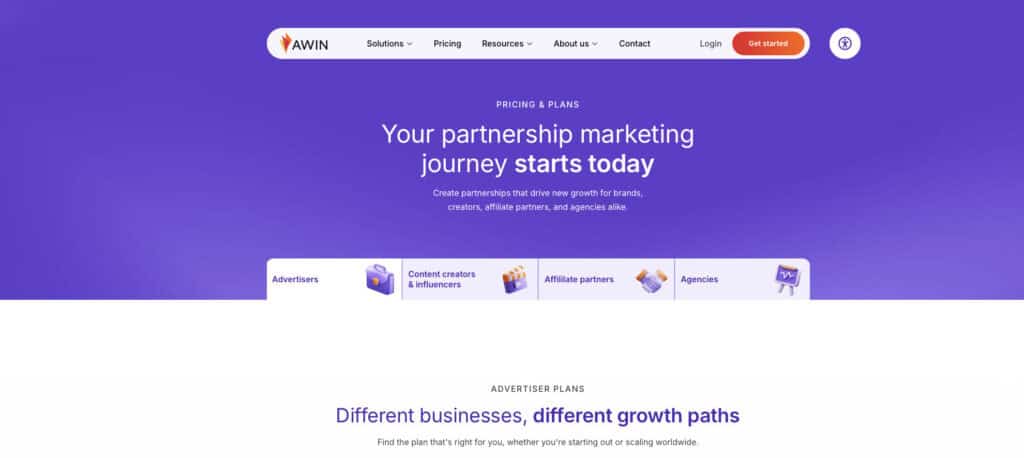
Awin is, at its core, a traditional affiliate network operating at global scale. It connects advertisers (brands) with publishers (cashback sites, coupon portals, content sites, media partners) within a structured network environment.
It was built to support:
- Enterprise advertisers
- Brands with structured affiliate departments
- Large publisher ecosystems (cashback, voucher, editorial, media)
- International expansion across multiple regions
Awin operates on a network-based infrastructure. That means brands plug into an established ecosystem of publishers, standardized commission structures, compliance systems, and reporting frameworks.
Historically, this model has worked exceptionally well for DTC and retail advertisers. If your affiliate strategy revolves around coupon sites, loyalty platforms, and large content publishers, Awin’s structure feels familiar and robust.
The key takeaway here is that Awin is built to manage affiliate programs at scale within a global network ecosystem.
It’s structured, mature, and it assumes you’re operating with dedicated resources to manage it.
Levanta’s Core Model
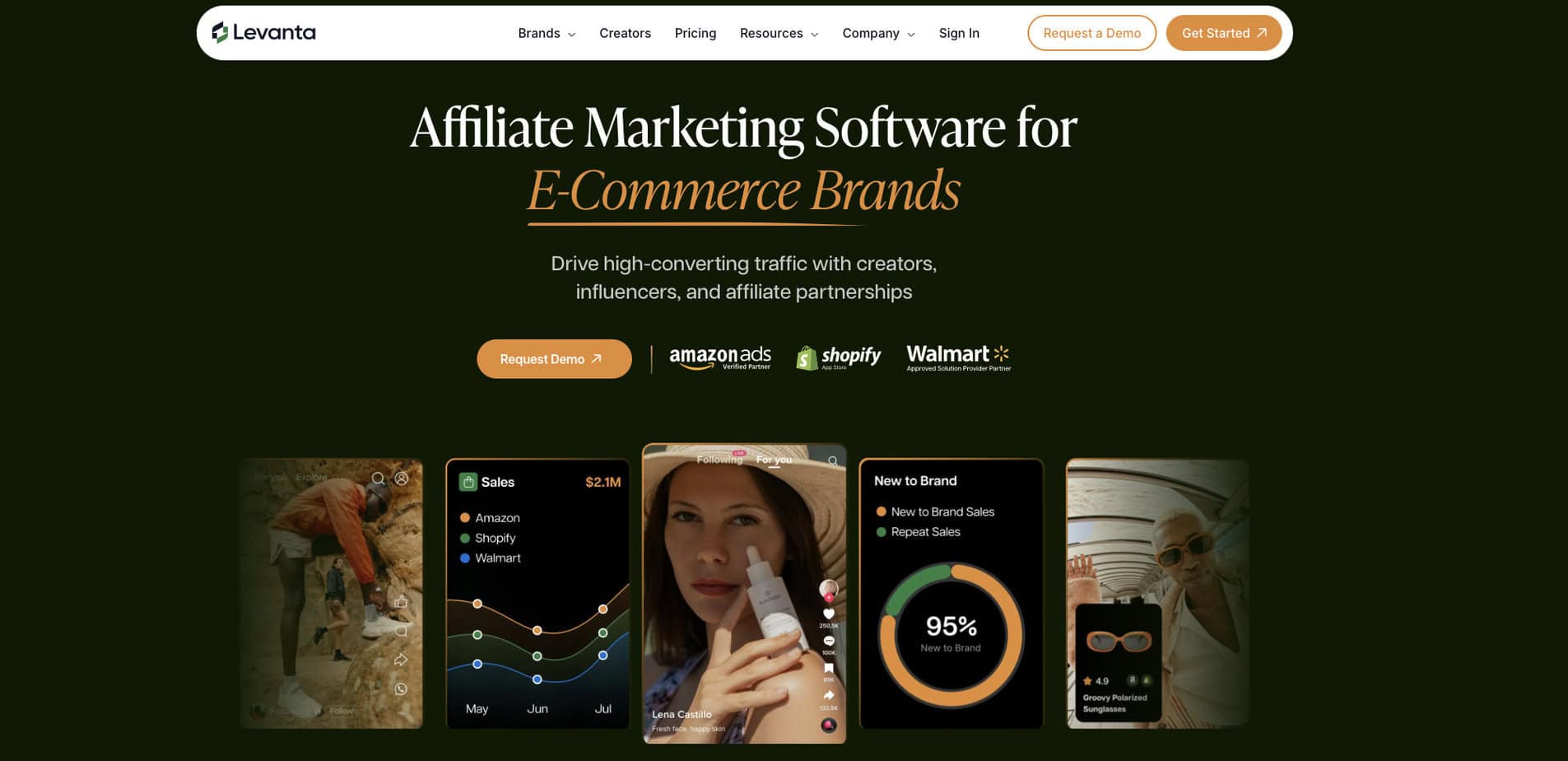
Levanta approaches the problem from a different angle.
It was built specifically for modern eCommerce brands selling across Amazon, Shopify, and Walmart, who want one unified system to manage creator and affiliate partnerships.
Instead of operating as a traditional affiliate network, Levanta functions as a centralized performance platform.
Key structural differences:
- Direct integration with the Amazon Attribution API
- Native one-click Shopify and Walmart integrations
- Unified dashboard across channels
- Built-in AI-powered creator marketplace
- Creator marketing tools like paid placements and product seeding
- Performance visibility at the ASIN level
Levanta isn’t architected around legacy publisher ecosystems. It’s architected around how brands actually sell today across marketplaces and owned storefronts simultaneously.
It assumes:
- Leaner marketing teams
- Heavy reliance on Amazon, Shopify, and Walmart revenue
- Performance-driven partnership models
- The need for granular attribution clarity
Basically, Levanta is built around modern marketplace realities, not legacy network structures. That philosophical difference shapes everything that follows, from onboarding to reporting to daily operations.
Onboarding & Setup: Operational Friction Matters
When evaluating affiliate infrastructure, don’t ask, “Does this have features?” Instead, ask, “How long until this is live and driving revenue?”
Because in eCommerce, complexity isn’t neutral; it costs momentum.
Awin Onboarding Process
Awin follows a traditional network-based onboarding structure. Implementation typically involves:
- Formal application and approval process
- Tracking setup (pixel-based or server-to-server)
- Compliance and documentation review
- Commission structure configuration
- Potential agency involvement for setup
Because Awin operates as a global affiliate network, onboarding often includes more structured checks and configurations.
From the operator’s perspective, this can mean:
- Longer onboarding cycles
- Greater coordination between marketing, tech, and finance teams
- Heavier documentation requirements
- More administrative setup
The process is structured and enterprise-ready. But it is not lightweight.
Strength: Extremely well-suited for brands with structured affiliate teams and established processes.
Challenge: Without experience, the setup phase can slow down momentum before your first meaningful partnership even activates.
Levanta Onboarding Process
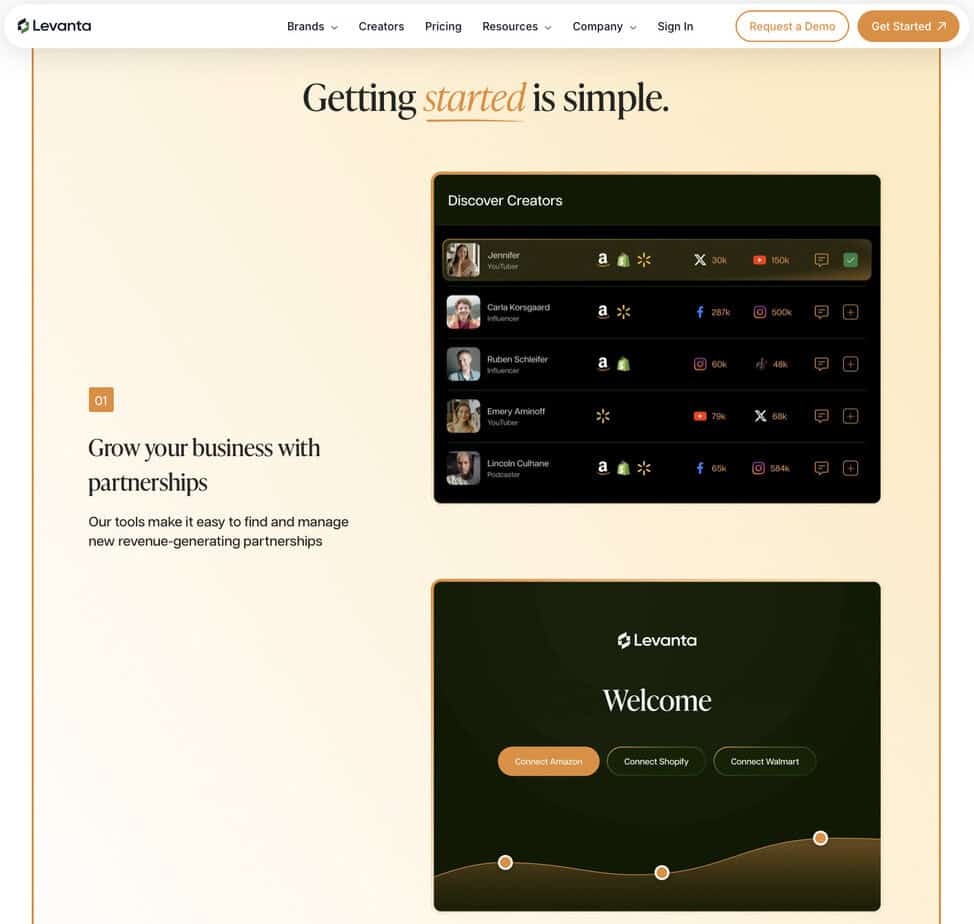
Levanta is structured for speed, particularly for marketplace-driven ecommerce brands.
Implementation typically includes:
- One-click integration for Amazon, Shopify, and Walmart
- Unified dashboard setup
- Branded partner signup pages
- A relatively fast go-live timeline
Instead of stitching together multiple tracking layers, Levanta connects directly to Amazon, Shopify, and Walmart natively rather than requiring extensive custom engineering.
From a team perspective, this means:
- Faster partner activation
- Less dependency on engineering resources
- Minimal custom tracking configuration
- Shorter time to revenue generation
Not every brand has a dedicated affiliate department. Many are operating with a small growth team managing paid media, lifecycle, marketplace optimization, and partnerships simultaneously.
Levanta’s onboarding flow is designed with that reality in mind. It reduces internal coordination overhead and accelerates program launch.
Strength: Faster time-to-first-partner activation.
Operational difference: Levanta requires less structural setup before you begin recruiting and testing partnerships.
Tracking & Attribution: The Biggest Strategic Divide
If onboarding determines speed, tracking determines intelligence. And this is the clearest philosophical difference between the two platforms.
Awin Tracking Model
Awin operates on a traditional affiliate tracking framework.
Standard Affiliate Tracking Includes:
- Pixel-based or server-to-server tracking
- Transaction-level reporting
- Cross-device tracking capabilities
For DTC ecommerce brands, this structure works well. It tracks checkout events and assigns commission based on completed transactions.
Awin Amazon Context
Amazon marketplace tracking is not native within Awin’s infrastructure.
Brands may need workarounds or indirect methods to connect marketplace performance to affiliate partners.
Product-level visibility inside Amazon is more limited on Awin compared to the marketplace-native integration offered by Levanta.
Brand-Level Implication
Awin performs strongly for:
- DTC checkout tracking
- Standard ecommerce funnels
- Multi-region affiliate programs
It is less optimized for:
- Deep Amazon ASIN-level or Walmart SKU-level attribution
- Marketplace-native product performance analysis
For brands where Amazon or Walmart represents a significant revenue share, this difference becomes structural rather than cosmetic.
Levanta Tracking Model
Levanta integrates directly with Amazon, Walmart, and Shopify. That single architectural decision shapes everything else.
Direct Amazon, Shopify and Walmart Integrations Enable:
- Revenue tracking tied to specific partners
- Performance measurement at the ASIN and SKU level
- Clear connection between campaign → product → revenue
- Access to Amazon’s Brand Referral Bonus and commission contribution from Walmart on eligible sales
Instead of relying on indirect tracking or workarounds, Levanta connects natively to Amazon, Walmart and Shopify’s reporting infrastructure.
Levanta Cross-Channel Capability
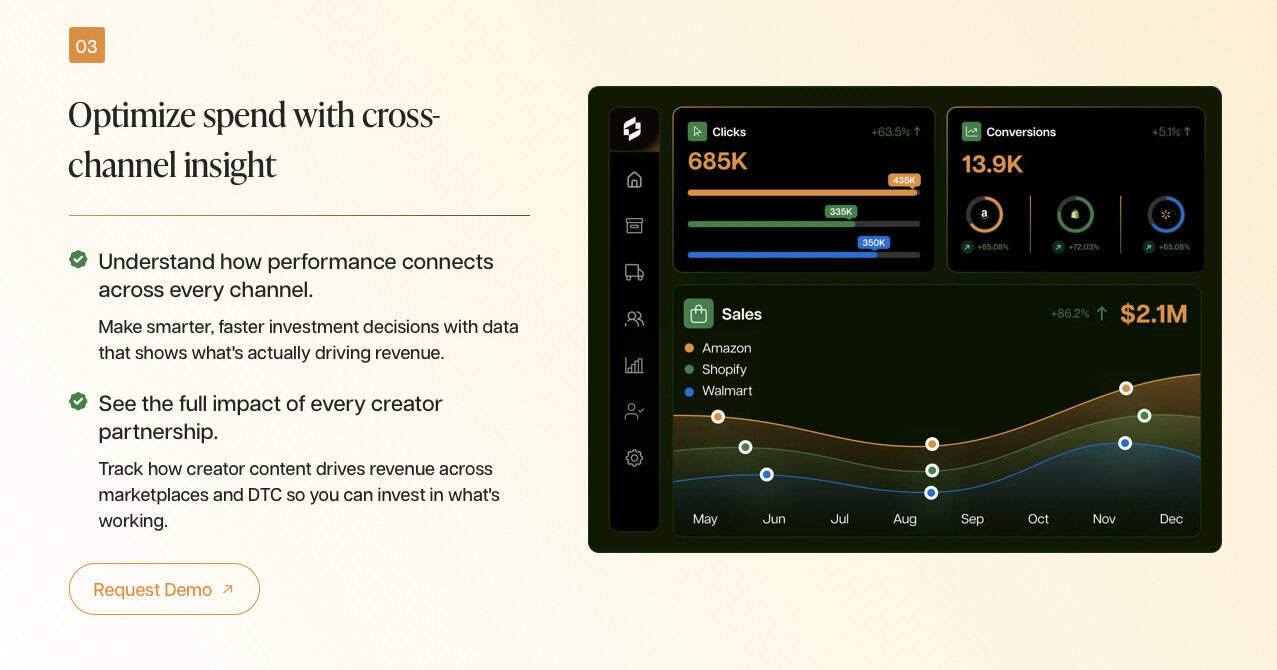
Levanta extends this model across:
- Amazon
- Shopify
- Walmart
The result is a unified dashboard showing performance across channels rather than fragmented program views.
What This Means for Brands
From a decision-making standpoint, brands gain:
- Clear ASIN- and SKU–level ROI
- Visibility into which products are driving growth
- Ability to allocate commission strategically
- Insight into incrementality and brand halo effects across channels
For example, if one product consistently outperforms through affiliate partnerships on Amazon, brands can adjust commission or promotional focus at the ASIN level.
That level of granularity is difficult to achieve in traditional affiliate structures. Levanta was built around marketplace attribution first. It did not retrofit it later.
Recruitment & Activation: How Brands Find and Manage Partners
Great affiliate software is often about who you can activate, and how efficiently.
Awin Recruitment
With Awin, you gain access to a global publisher database that includes:
- Coupon sites
- Cashback platforms
- Editorial content publishers
- Media partners
The structure is traditional: you review applicants, manually approve publishers, and outreach happens through the network’s communication system.
For brands prioritizing large publisher ecosystems, especially those relying on cashback and voucher models, this infrastructure is powerful. It’s systematic, controlled, and established.
But it’s also rooted in traditional affiliate relationships. The workflow assumes you’re managing publishers within a network hierarchy.
Levanta Recruitment
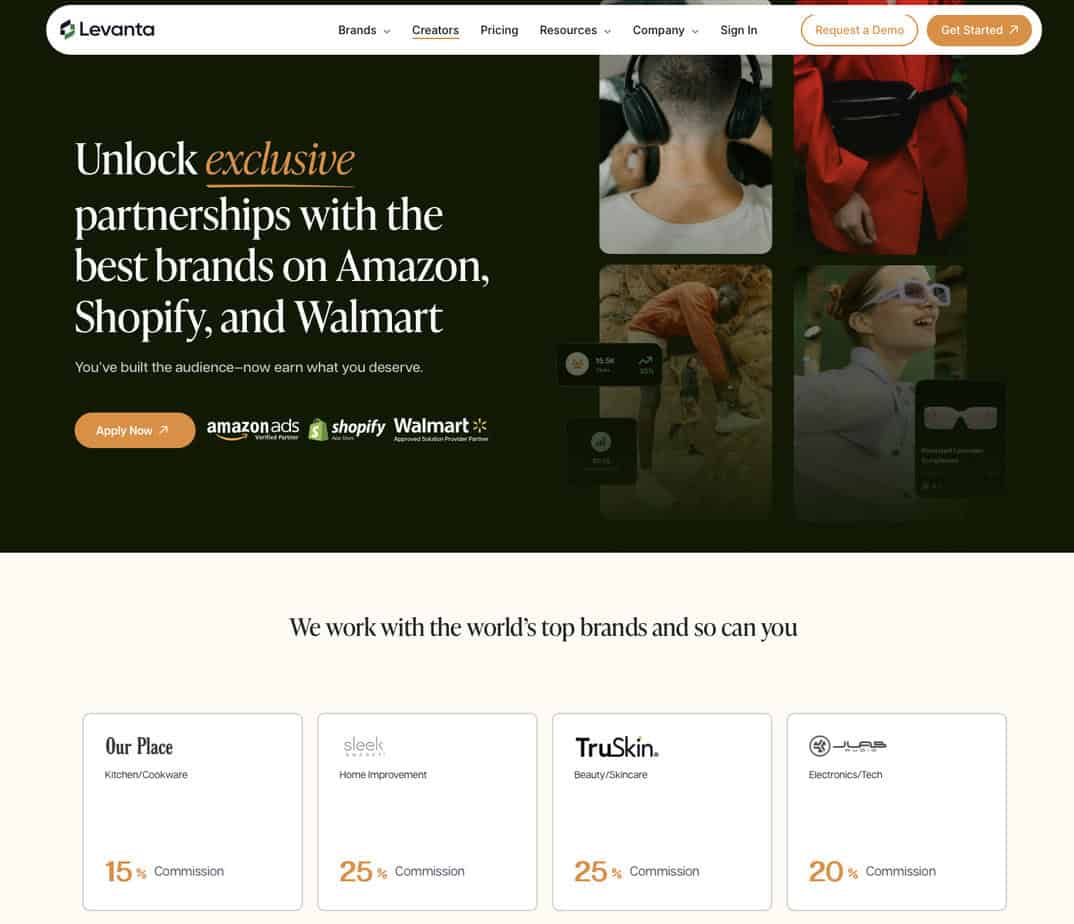
With Levanta, recruitment is pretty dynamic. Instead of navigating a classic publisher directory, you get access to:
- A vast creator and affiliate marketplace that’s powered by AI
- Amazon-, Shopify-, and Walmart-focused affiliates
- Social listening tools to identify existing brand mentions
- Direct invitation capabilities
- Built-in campaign tools
- Automated product gifting workflows
The operational difference here is that you don’t just approve publishers, you activate performance partnerships.
Strategically, this shifts recruitment away from exposure-based placement and toward performance-based partnerships. For brands thinking in terms of measurable ROI, that orientation changes how you scale.
Commission Structures & Payment Operations
If tracking tells what’s working, commission structure determines how aggressively you can scale it. This is where operational philosophy really shows.
Awin’s Structure
Inside Awin, the foundation is simple: percentage-based CPS (cost-per-sale).
It’s clean. Traditional. Predictable.
You define commission tiers. Publishers promote. The network tracks. Awin handles payouts. International payment infrastructure is already baked in, which is especially useful if you’re working with partners across regions.
From an enterprise standpoint, it feels stable.
You’re operating inside:
- Standardized commission structures
- Defined attribution windows
- Centralized payout handling
- Established financial processes
If you’ve built affiliate programs before, this structure feels familiar and almost institutional. It’s stable, standardized, and there’s comfort in that. However, there’s less flexibility for hybrid compensation models.
- If you want to combine CPS with CPC.
- If you want to test flat-fee creator placements tied to performance.
- If you want to experiment with layered incentives.
It’s possible, but not native to the philosophy. The model is built around classic performance payouts.
For pricing, Awin’s starter plan is at $49/month + 3.5% per transaction (tracking fee), then team pricing at $99/month + 2.5% per transaction (tracking fee), and finally a custom plan option for enterprises.
Levanta’s Structure

Levanta positions itself as growth infrastructure.
- Designed for serious Amazon, Shopify, and Walmart brands
- Unifying management within one platform
- Flexible commission models with the ability to negotiate paid placements with creators and partners directly
- Incrementality reporting that shows which partners are really influencing conversions
- Centralized payouts and financial reporting
- Focused on scalable performance systems
And critically, it supports optimization around Amazon’s Brand Referral Bonus, which directly impacts margin recovery for Amazon-heavy brands. They can make one monthly payment. Levanta distributes it. 1099s are automated. There’s flexibility in monetization without increasing back-office complexity.
Operational benefit: Brands can structure partnerships creatively without creating financial chaos internally. For those running performance-led creator strategies, that flexibility compounds over time.
For pricing, Levanta starts at its Gold tier ($750/month + performance fee).
Day-to-Day Program Management: Which Feels More Efficient?

This is the part most comparison articles ignore. Features matter. But how does it feel on a Tuesday afternoon when you’re buried in marketing decisions?
Managing Awin as a Brand
Running a program inside Awin feels like operating within an established institution. Day-to-day, brands are:
- Reviewing publisher applications
- Monitoring compliance
- Managing commission tiers
- Running manual performance evaluations
- Submitting or responding to support tickets
It’s structured. Organized. Procedural.
If you have a dedicated affiliate manager, this workflow makes sense. It’s designed for brands that treat affiliate as its own department.
Works well when: You have internal resources specifically allocated to affiliate program management.
But for leaner teams, the structure can feel heavy. Not inefficient, just layered.
Managing Levanta as a Brand
Inside Levanta, the experience is centralized. You get:
- A unified dashboard across Amazon, Shopify, and Walmart
- Easier partner discovery in the marketplace, which uses AI and social listening
- A system to communicate with creators/partners directly
- Clear ROI tracking and incrementality tied to partners
- Built-in gifting (product seeding) and campaign tools
- Paid placement negotiations and management
With Levanta, you don’t need multiple tools open to understand:
- Which product is moving?
- Which partner is driving it?
- Where should our budget shift?
Works well when: You want lean operations and faster execution cycles.
Strengths, Limitations & Ideal Fit
No platform is perfect. The question isn’t which is “better.” It’s which aligns with how your brand actually operates.
Awin Strengths
Awin brings:
- Global network scale
- Enterprise-level stability
- Strong DTC tracking infrastructure
- An established publisher ecosystem
If your strategy revolves around coupon sites, cashback programs, and international publisher relationships, Awin’s infrastructure is powerful.
Awin Limitations
What Amazon-heavy operators may find jarring:
- Less Amazon-native functionality
- Limited ASIN-level attribution
- More legacy-style workflows
- Support systems that can feel backlogged at scale
- Requires structured internal resources to operate efficiently
It’s not flawed, it’s just built for a different architecture.
Levanta Strengths
Levanta stands out in areas that matter for marketplace brands:
- Direct Amazon Attribution API integration
- ASIN and SKU-level reporting clarity
- Cross-channel unification (Amazon + Shopify + Walmart)
- Built-in creator marketplace
- Gifting + CPC + paid placement flexibility
- Much faster onboarding
- Designed specifically for omnichannel brands
It feels structured for how modern eCommerce revenue actually flows.
Levanta Limitations
- Not ideal for very small brands or startups
- Less focused on traditional cashback and coupon ecosystems compared to legacy networks
If your strategy is purely voucher-driven, a classic affiliate network may align more closely.
How Brands Should Choose between Levanta and Awin

When choosing between the two, take a step back from features and dashboards. Then, ask yourself these five simple questions:
- Where does most of our revenue come from?
- Are we Amazon-first or DTC-first?
- Do we need ASIN-level attribution?
- Do we have a full affiliate department?
- Are we running performance-based creator partnerships?
The answers usually make the decision clear.
Choose Awin If:
- You are DTC-heavy
- You operate internationally at enterprise scale
- You rely heavily on traditional affiliate publishers (cashback, coupon, editorial)
- You have a dedicated affiliate manager
Awin is built for structured, network-based affiliate programs.
Choose Levanta If:
- You sell across Amazon + Shopify + Walmart and need to unify program management
- You need native Amazon attribution
- You want leaner operations
- You want flexible commission models and paid placements
- You need insight into partner incrementality and performance
Levanta aligns more closely with performance-led, omnichannel brands.
Final Takeaway
Both platforms are credible.
For enterprise DTC brands operating traditional affiliate programs at scale, Awin remains a powerful network.
For modern ecommerce brands (especially Amazon-heavy or omnichannel) Levanta offers infrastructure aligned with marketplace attribution, cross-channel clarity, and operational efficiency.
The right choice depends on:
- Revenue mix
- Internal resources
- Growth strategy
- Reporting needs
But the structural differences between network-based affiliate systems and marketplace-native infrastructure are becoming increasingly important in 2026 and beyond.
How closely a platform matches the way that your brand actually sells, attributes, and scales today will ultimately determine if it’s the right choice for you.