


Last Updated on November 25, 2026 by The Digital Merchant Team
Most owners have the same worry when they decide to sell: what happens if employees, customers, or a competitor find out before the deal closes? As a CPA, I can tell you the worry is justified. A sale that leaks early can cost you key staff and push nervous customers toward another vendor. If the deal then falls apart, you still have to run the business with everyone knowing it was for sale and staff wondering if their jobs are safe.
Confidentiality in a sale is handled in stages. At each stage, the buyer gets a little more information in exchange for a little more commitment. Below, we’ll walk through what works in practice, from the first anonymous teaser to closing, and what a broker brings to the process.
Bottom Line Up Front

- Buyers should earn information in steps. Start with a blind teaser that describes the business without naming it, require a signed NDA, and verify the buyer has the funds to close before sharing detailed financials.
- A generic NDA template is a weak tool. Yours should cover non-solicitation of employees and customers, a no-contact clause, a defined term, and return or destruction of materials.
- Keep identifying details redacted until late in the process. This includes customer and supplier names, employee names and pay, domain names, and product-level data that points to you.
- Plan employee communication and a leak response before you list.
Stage 1: The Blind Teaser
The teaser (sometimes called a blind profile) is a one or two page summary that gives a buyer enough to decide whether to ask for more, and nothing that would let them find you with a quick search.
Here are some of the things you’d see in a typical blind teaser:
- Industry or business model, described broadly (B2B industrial services, ecommerce brand in home goods)
- General region instead of a city, or no location at all for online businesses
- Revenue and earnings (seller’s discretionary earnings or earnings before interest, taxes, depreciation, and amortization, known as EBITDA) in ranges or rounded figures
- Years in operation, and the reason for sale, kept general
- Asking price or a range, if you’re publishing one
The things that I think you shouldn’t include are obvious: the business name, domain, logos, facility photos, exact founding dates, the owner’s name, or any fact unique enough to search. That last category is where owners have regrets. “The only licensed provider in the parish” or “founded in 1987 by a former NASA engineer” tells a local competitor exactly who you are. Read your teaser as if you were your closest competitor, and cut anything that narrows the field to one.
Stage 2: The NDA
Once a buyer wants more, they sign a non-disclosure agreement. The NDA is the legal backbone of the process, yet plenty of sellers rely on a downloaded template that doesn’t address the risks specific to a sale. Have an attorney review it for sure, this is one of the largest transactions of your life. It’s important to get it right. At minimum it should include:
- Purpose limitation. The information can be used only to evaluate the acquisition.
- Definition of confidential information, including the fact that the business is for sale and that discussions are taking place. If word of the sale gets out, you could lose staff and customers even if your financials stay private.
- Permitted recipients. The buyer’s attorney, CPA, and lender can see materials, and the buyer is responsible for their compliance.
- Non-solicitation and no-hire. The buyer can’t recruit your employees or pursue your customers for a set period, commonly one to two years.
- No-contact clause. All communication goes through you or your broker. No calling employees, vendors, landlords, or customers.
- Return or destruction of materials if the deal doesn’t proceed.
- A defined term and the state law that governs the agreement.
An NDA won’t stop a determined bad actor, and enforcing one costs money. It does give you a remedy, and it works as a filter: a “buyer” who refuses a reasonable NDA has told you what you need to know.
Stage 3: Qualify the Buyer Before Sharing More
A signed NDA doesn’t make someone a buyer. The next step is sharing the confidential information memorandum (CIM), a detailed report on your business that includes your financials, operations, and customer info. Before it goes out, you or your broker should know who you’re dealing with:
- Identity, and whether they represent a company, a fund, or themselves
- Whether they operate in your industry (a competitor needs extra care)
- Proof of funds for the down payment and working capital, or a lender pre-qualification if they plan to use SBA financing
- Acquisition experience and a realistic timeline
Decide in advance what you’ll accept as proof of funds. A bank or brokerage statement with account numbers redacted, or a letter from a lender, is normal. A promise of “investor backing” with nothing behind it is not.
Competitors deserve their own track. They often pay the most, but they’re also best positioned to use your information against you. Consider releasing sensitive data only to their outside advisors or holding it until after a letter of intent. This is called a “clean team” arrangement. The advisors review the details and report back to the buyer in general terms, so the competitor’s own staff never see things like your customer list or pricing.
Stage 4: What Gets Redacted Before Real Numbers Show Up
The CIM includes real financials, an operations overview, and growth opportunities. Even at this stage, certain details should stay masked until a buyer has signed a letter of intent and is in due diligence. Common redactions:
- Customer names. Use “Customer A, Customer B” with revenue share and tenure. A buyer needs concentration data at this point, and the names can wait.
- Supplier and vendor names, especially sourcing or private-label relationships that took years to build.
- Employee names and individual pay. Show roles, tenure, and total payroll by function.
- Domain names, storefront names, and product listings for online businesses, since a single URL reveals everything.
- SKU-level or product-level sales that could identify the brand or expose margin by product.
- Pricing agreements and contract terms with specific customers.
- Proprietary processes, formulas, code, or supplier pricing.
The financial statements themselves belong in the CIM, but format is important. Annual summarized P&Ls and an add-back schedule with explanations give a buyer what they need to value the business. Bank statements, tax returns, and general ledger detail usually wait for diligence.
Stage 5: The Letter of Intent and the Data Room
Once a buyer submits a letter of intent, the deal changes character. The LOI sets price, structure, and an exclusivity period, often 60 to 90 days, during which you stop talking to other buyers. Exclusivity is the reason to hold the most sensitive material until here. You now have one counterparty, and they’ve committed to a framework.
Diligence documents should live in a virtual data room instead of email attachments. Useful controls include:
- Access by individual user instead of a shared login
- Folder-level permissions, so a buyer’s lender sees financials but not HR files
- View-only settings and watermarks on downloads
- Activity logs showing who opened what and when
Stage 6: Diligence, Site Visits, and Employees
Diligence is where confidentiality is most fragile, because the buyer needs to see the actual operation. A few steps include:
- Schedule site visits after hours or on weekends, or introduce visitors as consultants, insurance inspectors, or bankers. Agree on the cover story with the buyer beforehand.
- Keep sale meetings off-site and sale correspondence off company email and shared calendars.
- Delay customer and vendor calls until late in diligence, and limit them to the key accounts the buyer has to hear from.
Employees are the hardest piece. Most owners tell staff right before closing or just after. The exception is a small group of key people the buyer needs to meet, such as a general manager or lead technician. Bring them in late, have them sign a confidentiality agreement, and consider a stay bonus that pays out after closing and a transition period. People cooperate more readily when the sale works in their favor.
Have a Leak Plan Before You Need It

Leaks happen, so decide on your response before you list. Prepare a short, honest statement for employees and key customers (for example, “we talk with people regularly about the future of the business, and nothing changes for your job today”), and decide who delivers it. Then find out where the leak came from and remind any buyer under NDA of their obligations in writing. A calm, quick response usually keeps a rumor from turning into turnover.
Should You Use a Business Broker?
Running this process yourself means fielding every inquiry and judging whether each caller is real, and every contact is a chance to reveal more than you meant to. That’s why I usually tell my clients to work with a broker. A broker sits between you and the market, so buyers deal with the advisor instead of with you.
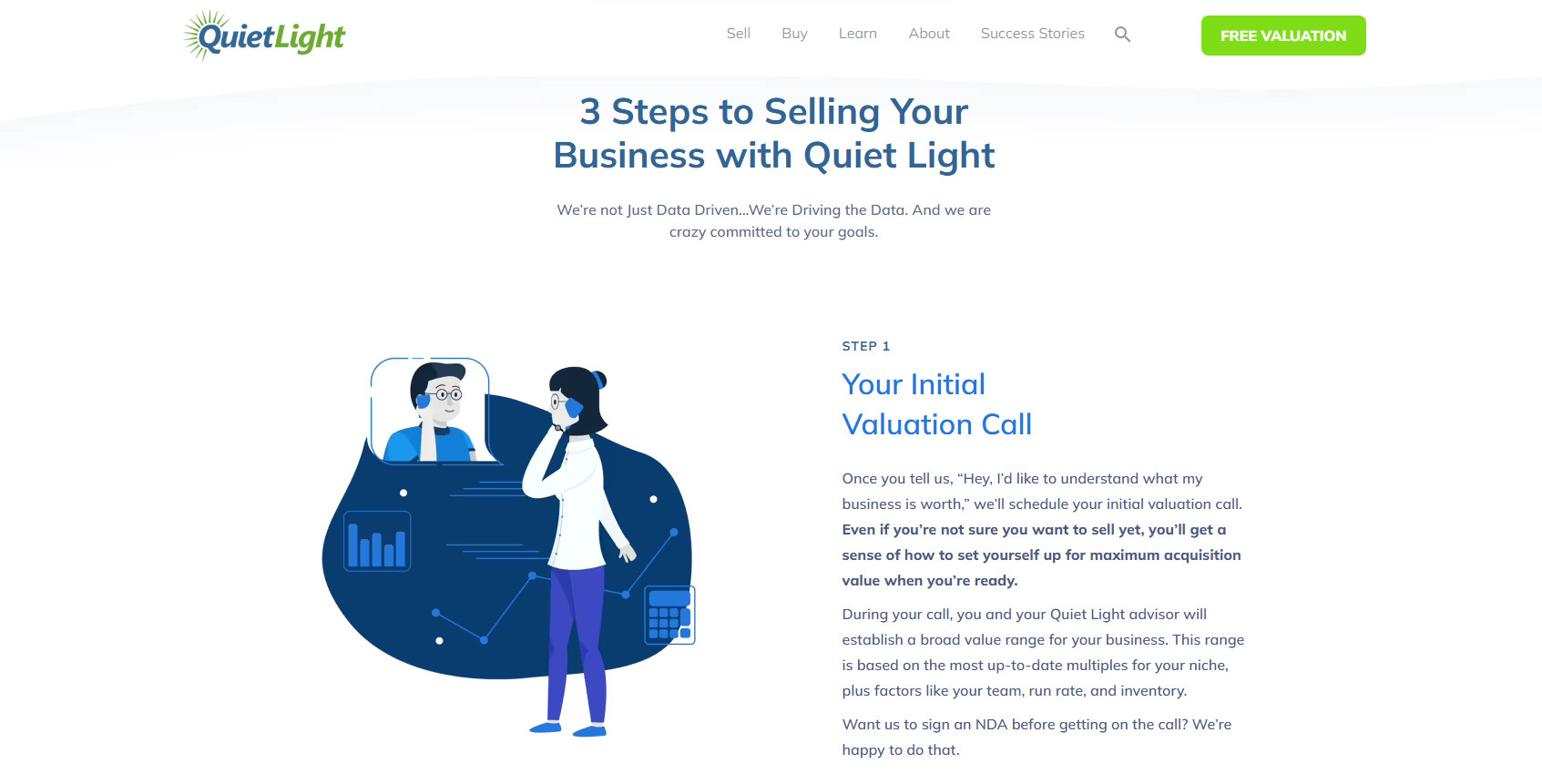
Quiet Light, a broker for online businesses, is a good example. They handle confidentiality through staged access:
- Confidentiality before information. Quiet Light requires every party who works on a deal to sign a confidentiality agreement before receiving any of the seller’s business information, and that well-known businesses get additional screening.
- NDA-gated listings. The public listing describes the business model and headline performance. Buyers create a buyer profile and sign an NDA for each listing before they can see the full listing package.
- The advisor as intermediary. Buyer questions go through the assigned advisor, who talks to buyers on the seller’s behalf and helps the seller weigh offers. Calls with the owner come after a buyer has reviewed the business summary and wants to pursue it.
- Proof of funds as the deal gets serious. Buyers are expected to show they can fund the purchase before serious financial discussions begin.
- Exclusivity before full disclosure. An accepted LOI, normally with a refundable earnest deposit, gives one buyer an exclusive period. That’s when the buyer verifies financials with third-party documents and, in most cases, receives the seller’s direct contact information.
However, there are trade-offs. The commission costs money, and Quiet Light is selective about what it lists, so smaller or early-stage sites may not qualify.
Self-serve marketplaces cost less and offer their own NDA gates, but you’ll do the buyer screening yourself. If a leak to a competitor or your staff would do real damage, having a professional filter every inquiry is often worth the fee.
Protect the Sale From Start to Finish

Whichever route you take, the principle holds: a buyer gets more information only after giving you more commitment. Write a teaser that can’t be traced, use an NDA built for a sale, qualify buyers before the CIM goes out, and keep identifying details back until someone has signed an LOI.